
Hear from Our Customers
You need cuts that hold tolerances down to 0.005 inches. Not close enough—exact. That’s what waterjet cutting in Babylon, NY delivers when you’re working with materials that can’t handle heat, can’t afford burrs, or require intricate shapes that traditional methods butcher.
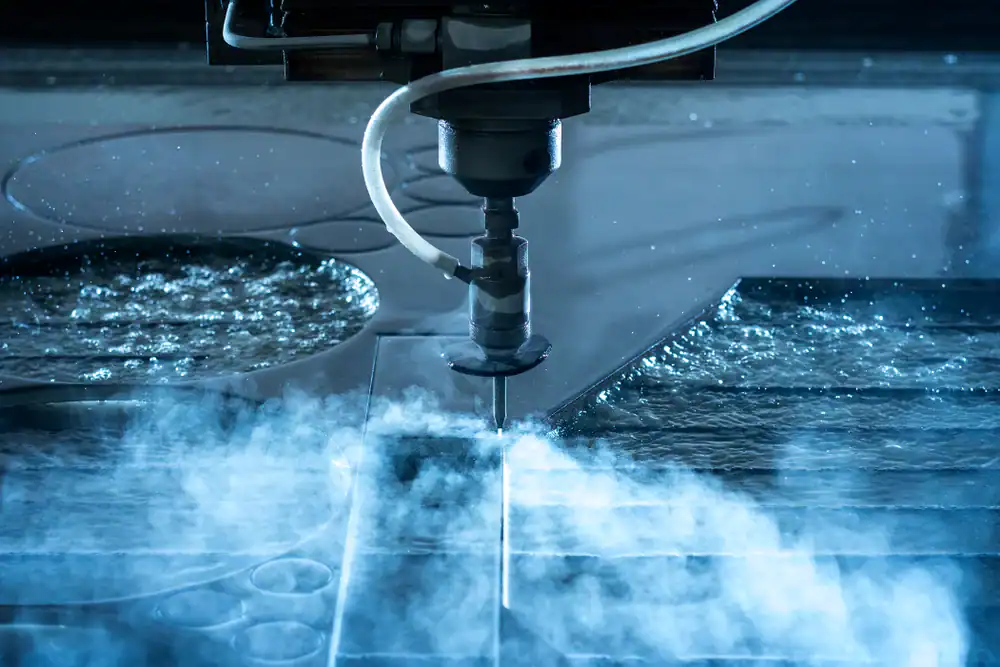
The process uses high pressure water cutting—up to 60,000 PSI—mixed with abrasive garnet when needed. No torches. No blades wearing down mid-job. No heat-affected zones that compromise your material’s integrity or dimensional stability.
What you get is a clean edge on the first pass. Parts that nest together without gaps. Components that go straight into assembly without additional grinding, deburring, or finishing. When your project timeline doesn’t have room for rework, that matters.
This isn’t about what we can cut. It’s about what you can build when the cutting process doesn’t limit your design, slow your production, or add cost through secondary operations.
We operate in Babylon, NY, serving the manufacturers, fabricators, architects, and builders across Long Island, NY’s industrial corridor. This region supports roughly 3,000 small and medium-sized manufacturers in Nassau and Suffolk counties—companies that need precision work done locally, quickly, and right.
Long Island, NY’s manufacturing landscape includes aerospace components, medical device parts, architectural metalwork, and custom fabrication. These industries don’t have margin for error, and they don’t have time to ship materials out of state and wait. Abrasive waterjet cutting gives them access to CNC-level precision without the lead times or costs of traditional machining.
We handle the materials Long Island, NY shops work with daily: stainless steel, aluminum, titanium, granite, marble, glass, acrylic, rubber, and composites. If you’re in Hauppauge’s industrial park or anywhere in the Babylon area, you’re within reach of cutting capacity that keeps your projects moving.
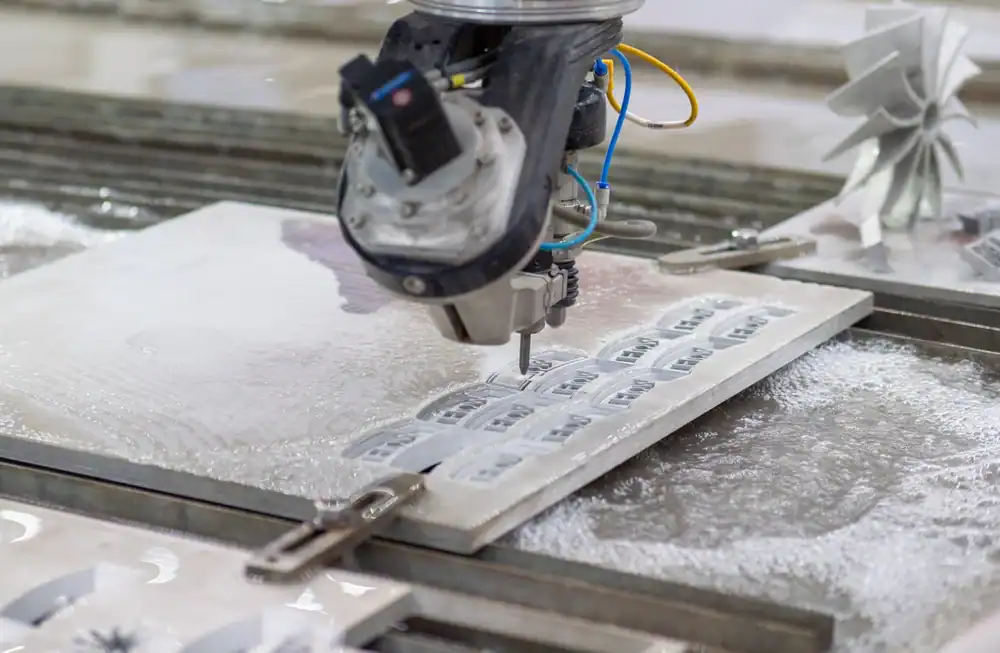
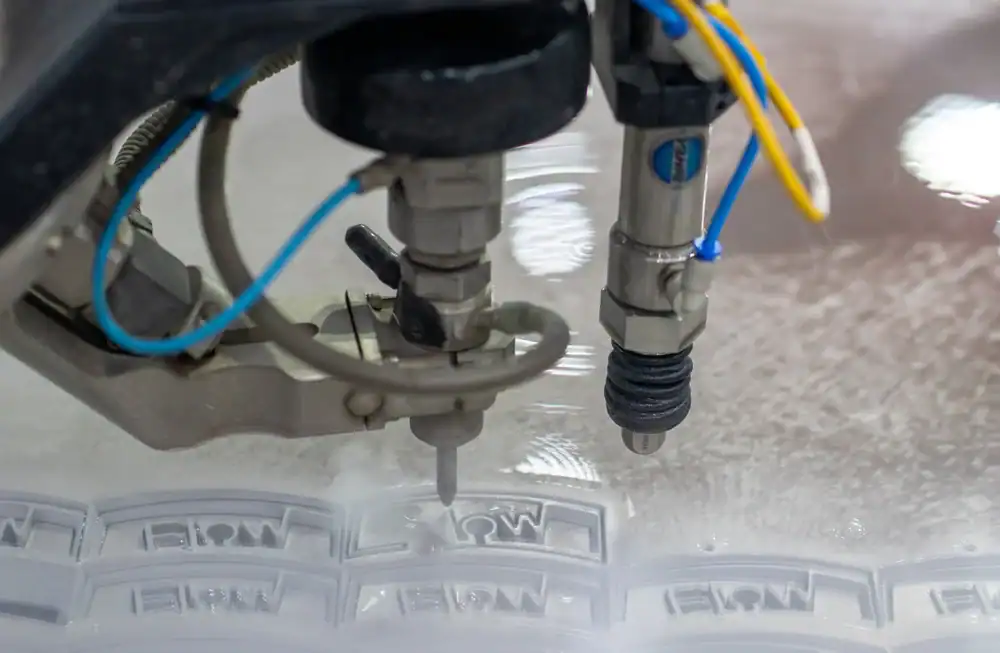
You send a CAD file or a drawing. We program the cutting path into the CNC system, accounting for material type, thickness, and the tolerances you need. The waterjet head moves along that path while the high-pressure pump delivers water through a nozzle the width of a human hair.
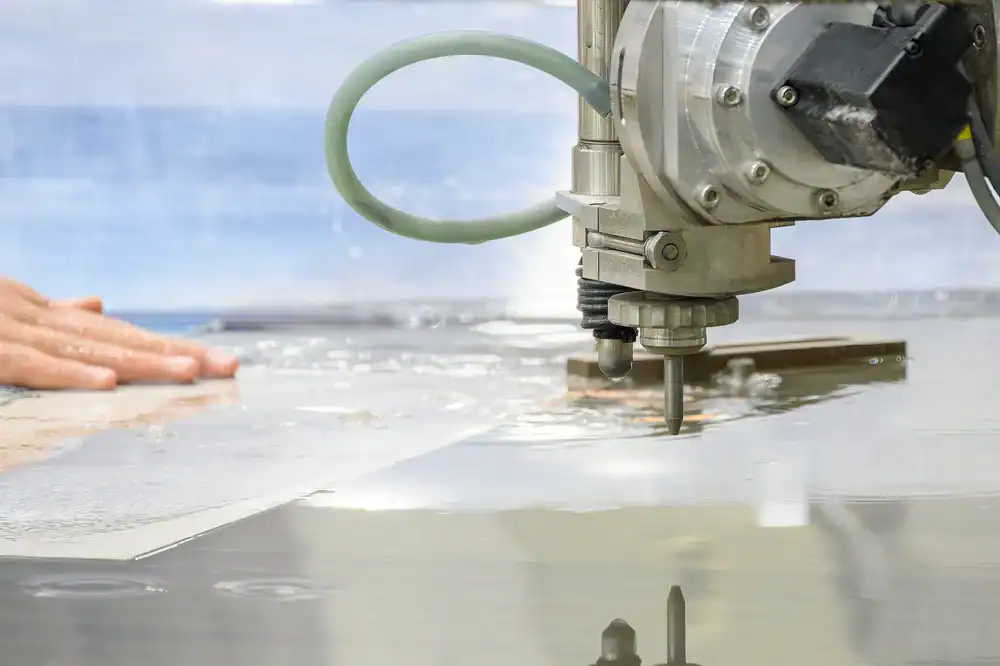
For softer materials—foam, rubber, gaskets—pure water does the job. For metals, stone, glass, or ceramics, we add abrasive garnet to the stream. The mixture cuts through up to six inches of steel or eight inches of aluminum, depending on the setup. The stream stays cold, so there’s no melting, no warping, no hardening of edges.
Once the cut finishes, parts come off the table ready to use. No slag. No burrs. No discoloration. You’re not paying for someone to grind down rough edges or straighten warped panels. The process is accurate enough that nested parts fit together without force, and complex enough to handle interior cutouts, tight radii, and intricate patterns that would take hours with a plasma torch or bandsaw.
If you’re prototyping, we can run one piece. If you’re in production, we can run hundreds with the same accuracy on the first part and the last.
Ready to get started?
Custom waterjet cutting in Babylon, NY means you’re not limited to standard shapes or materials. We cut architectural panels for building facades, custom inlays for countertops, precision gaskets for industrial equipment, and prototype parts for product development. The process handles nearly any material you bring—metals, stone, glass, plastics, composites, even laminates.
Long Island, NY’s pharmaceutical and chemical manufacturing sectors—which employ one out of every three chemical workers in New York State—rely on precision components that meet strict tolerances. Waterjet cutting delivers that without introducing contaminants, heat stress, or mechanical force that could compromise part integrity. It’s a cold process, so temperature-sensitive materials stay stable.
For architects and designers working on projects across Nassau and Suffolk counties, waterjet cutting opens up design possibilities that traditional fabrication methods can’t touch. Intricate patterns in metal screens. Custom stone inlays. Decorative glass panels. Radius cuts in thick acrylic. If you can draw it, we can cut it.
The process also keeps costs predictable. Waterjet cutting runs about $14 per hour in operating costs, and because there’s no tool wear or heat distortion, you’re not paying for scrapped parts or rework. Material waste stays minimal because parts nest tightly on the cutting bed.
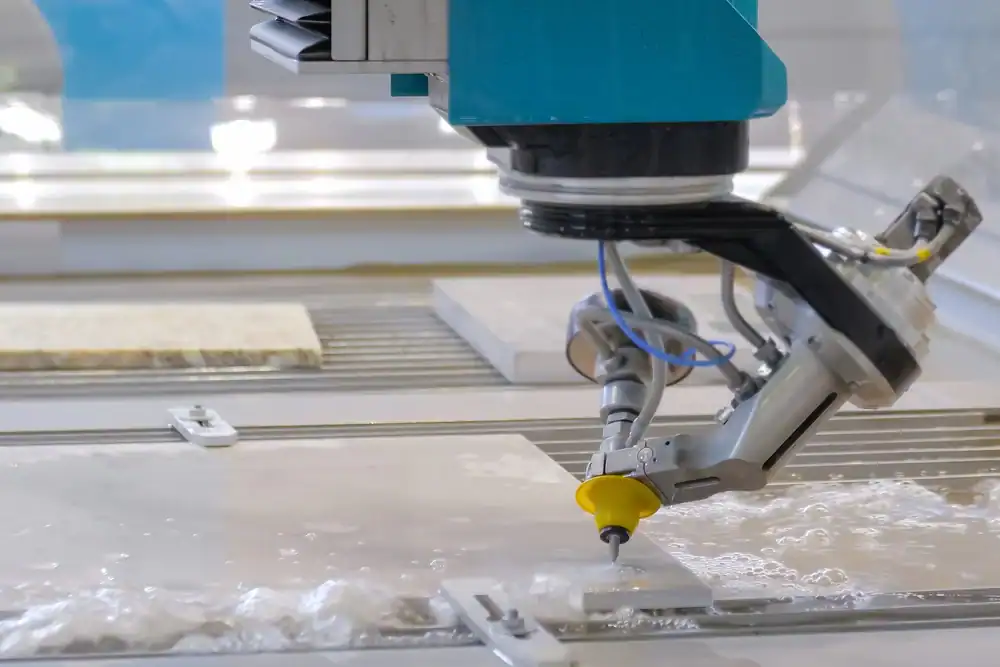
Waterjet cutting works on materials that are too brittle, too heat-sensitive, or too hard for saws, lasers, or plasma cutters. Glass doesn’t crack. Titanium doesn’t work-harden. Acrylic doesn’t melt. Stone doesn’t chip.
The process uses a cold cutting method, so there’s no heat-affected zone. That means no warping in thin metals, no thermal expansion in tight-tolerance parts, and no change to the material’s structural properties. For manufacturers working with exotic alloys, tempered materials, or composites, that’s critical.
You also avoid the limitations of mechanical cutting. Brittle materials like ceramic or hardened tool steel can shatter under blade pressure. Waterjet cutting applies no mechanical force—just erosion from the high-pressure stream. That’s why it’s the go-to method for cutting materials that would otherwise require slow, expensive processes or multiple setups.
Waterjet cutting holds tolerances down to ±0.005 inches on standard parts, with even tighter precision possible on smaller components. The CNC system controls the cutting head’s position, speed, and abrasive flow, so every part matches the programmed dimensions.
For production runs, that consistency matters. The first part off the table matches the hundredth part. There’s no tool wear to account for, no drift in cut quality, and no need to stop mid-run for adjustments. If you’re manufacturing components that need to fit together—brackets, panels, gaskets, or assemblies—waterjet cutting eliminates the gaps and misalignments that come from accumulated tolerances.
The process also handles complex geometries without losing accuracy. Interior cutouts, sharp corners, tight radii—all stay within spec. That’s harder to achieve with methods that rely on tool access or multiple setups.
Most parts come off the waterjet table ready to use. The edge quality is smooth, free of burrs, and doesn’t require grinding or deburring in typical applications. There’s no heat discoloration to remove, no slag to chip off, and no rough edges that need attention.
That saves time and cost. You’re not paying for secondary operations or tying up equipment to finish parts. For high-volume jobs, that difference adds up quickly. It also reduces handling, which lowers the risk of damage or contamination between cutting and assembly.
In some cases—like when you need a polished edge on glass or a specific surface finish on metal—you might add a finishing step. But that’s a design choice, not a requirement to fix rough cutting. The waterjet process itself delivers a clean result that’s often acceptable as-is for functional parts, and it gives you a head start on cosmetic finishing when that’s part of the spec.
Pure waterjet cutting uses only high-pressure water. It works well for softer materials like foam, rubber, gaskets, textiles, and thin plastics. The stream is narrow and precise, but it doesn’t have the cutting power needed for harder materials.
Abrasive waterjet cutting adds garnet—a hard, angular mineral—to the water stream. That mixture cuts through metals, stone, glass, ceramics, and composites. The abrasive particles do the actual cutting by eroding the material, while the water carries them through and cools the cut zone. This is what most people mean when they talk about waterjet cutting for industrial or architectural applications.
The choice between pure and abrasive depends on what you’re cutting. Softer materials don’t need abrasive, and skipping it keeps operating costs lower. Harder materials require it. The setup adjusts based on thickness, material hardness, and the edge quality you need. Both methods avoid heat, so your material properties stay intact regardless of which approach the job requires.
Waterjet cutting doesn’t generate heat, so it won’t warp thin materials, create a heat-affected zone, or change the material’s properties. Laser and plasma both use high temperatures to melt through material, which works fast on metals but limits what you can cut and how the edges turn out.
Lasers struggle with reflective materials like aluminum or copper, and they can’t cut stone, glass, or thick composites. Plasma handles thicker metals better than lasers but leaves a rough edge and a wide heat-affected zone. Both methods also produce fumes and require ventilation systems to handle the byproducts.
Waterjet cutting handles a wider range of materials and thicknesses without those limitations. The edge quality is cleaner, there’s no secondary cleanup from slag or oxidation, and you’re not restricted by reflectivity or thermal sensitivity. For jobs that involve multiple material types or require tight tolerances without heat distortion, waterjet cutting avoids the compromises that come with thermal cutting methods.
Waterjet cutting works for one-off prototypes and high-volume production runs. The setup time is minimal because there are no custom tooling or dies to fabricate. You send a file, we program the cut, and the machine runs. That makes it practical for testing designs before committing to full production.
For prototyping, you get real parts in the actual material—not a stand-in or a rough approximation. That means you can test fit, function, and finish before scaling up. Changes are easy because adjusting the cut path is just a matter of updating the file, not reworking physical tooling.
When you move into production, the process scales without losing accuracy. The CNC system repeats the same cut path with the same precision across hundreds or thousands of parts. There’s no tool wear to account for, so quality stays consistent from the first part to the last. That repeatability is what makes waterjet cutting viable for both prototyping and ongoing manufacturing work.
Useful Links
Other Services we provide in Babylon