Hear from Our Customers
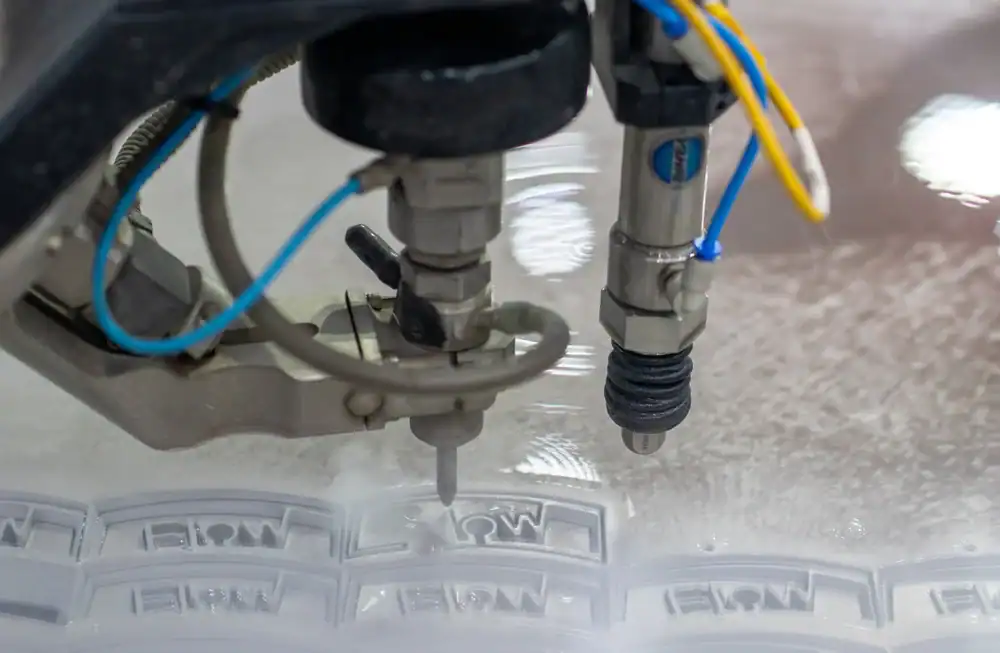
You’re not looking for close enough. You need parts that fit, edges that don’t need rework, and materials that aren’t warped from heat.
Custom waterjet cutting in Brookhaven, NY handles that. High pressure water cutting slices through steel, aluminum, titanium, glass, stone, rubber, and composites without changing their properties. No melting. No hardening. No burrs that need grinding down later.
The process is cold, so there’s no heat-affected zone to worry about. That means your tolerances stay tight—often within 0.005 inches—and your material stays true. Whether you’re running one prototype or a hundred production parts, what comes off the table is what you specified. No secondary cleanup. No surprises when you go to assemble.
We’ve been operating in the tri-state area since the early 1990s. We’re a family-owned shop, now in our third generation, and we’ve built our reputation on delivering repeatable, on-spec cuts for manufacturers, fabricators, and builders across Long Island, NY.
We’re not the biggest operation out there. But that’s exactly why shops in Brookhaven, NY and surrounding areas keep coming back. You’re not a ticket number here. You get direct access to people who’ve been running waterjet cutting services for decades—people who understand what happens when a part is off by even a few thousandths.
Our equipment is powered by Mitsubishi Electric controls, which means precision you can count on, job after job. And because we’re local, your turnaround is faster than waiting on a shop across state lines.
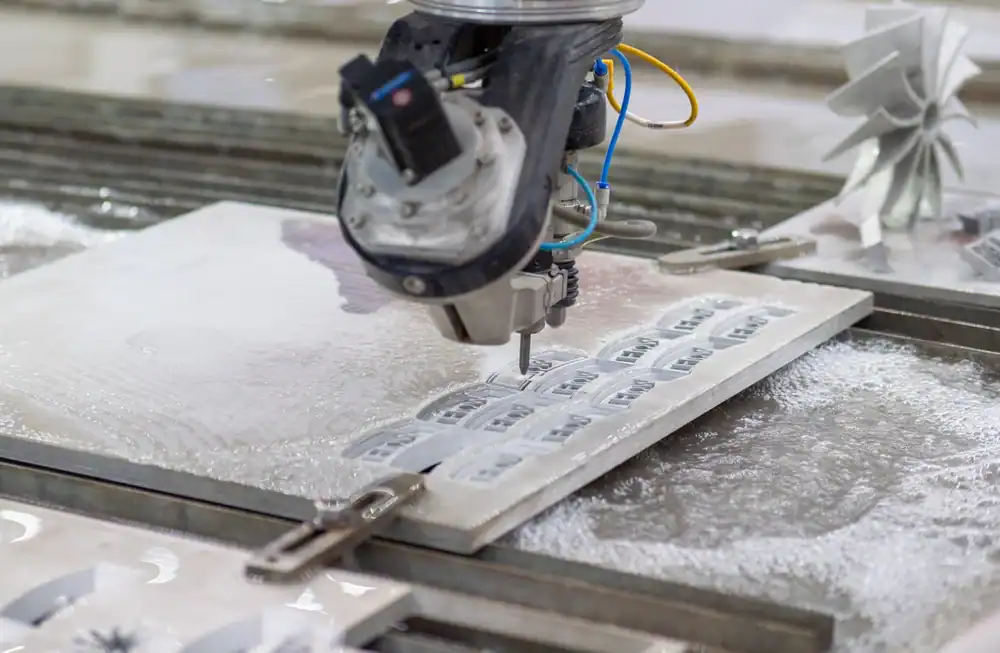
You send us your CAD file or a drawing. If you don’t have one, we can create it. Once we’ve got your specs, we program the cut directly from your file. That’s how we maintain consistency across multiple parts.
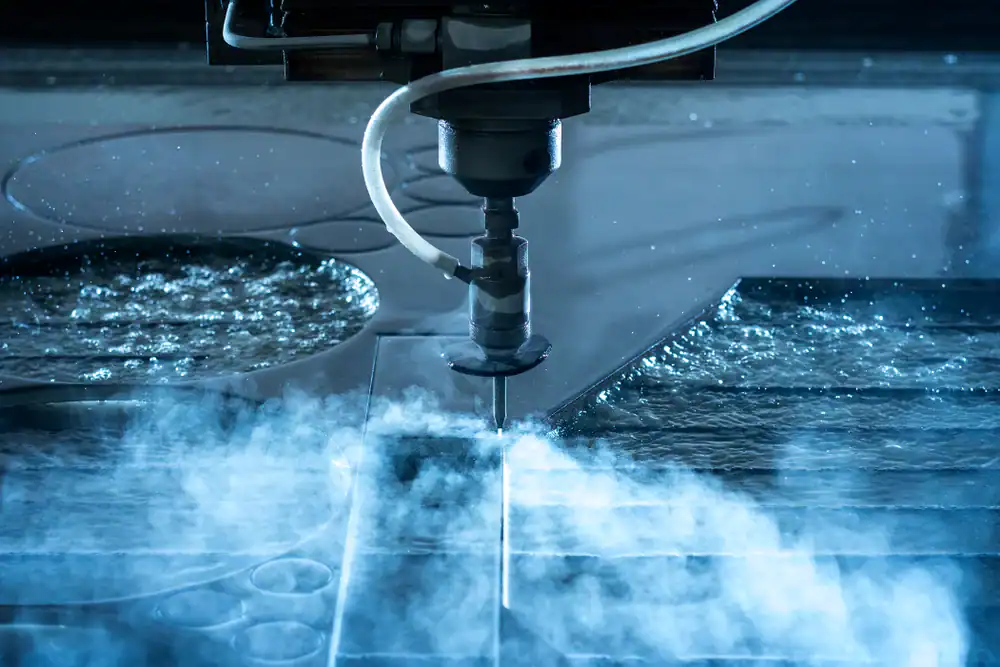
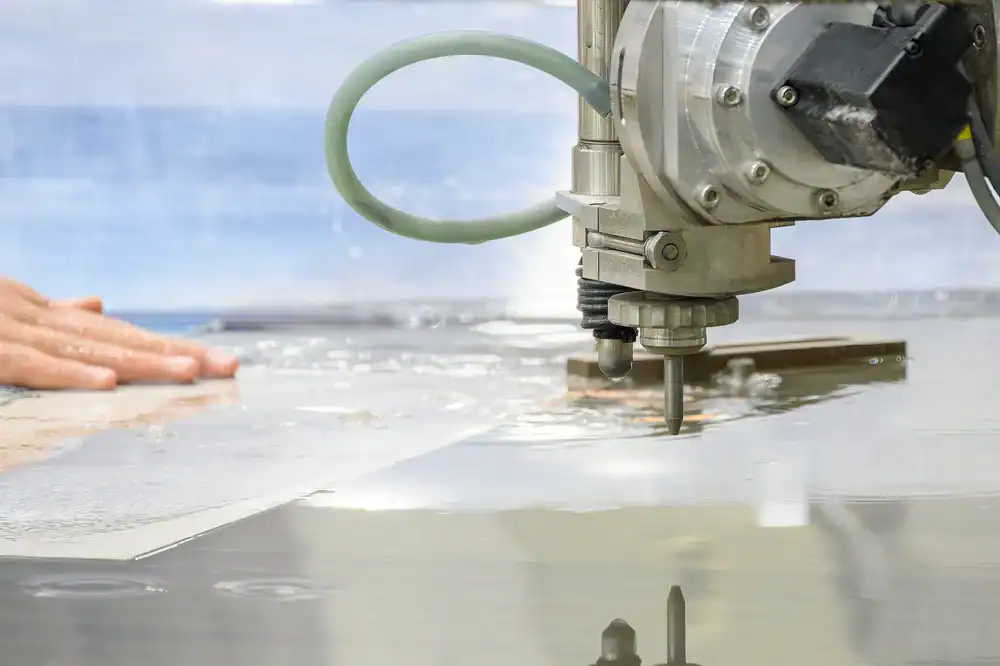
The actual cutting happens with a stream of water pressurized up to 60,000 PSI, mixed with fine abrasive garnet. The stream is thinner than a pencil lead but cuts through materials up to six inches thick in steel—thicker in softer materials. Because it’s abrasive waterjet cutting in Brookhaven, NY, we’re not limited by hardness. Titanium, tool steel, composites—it all cuts the same way.
There’s no tool wear to throw off dimensions mid-run. No heat means no warping, even on thin stock. The edge quality is clean enough that most parts go straight to assembly or finish work without additional machining. You get exactly what the file says, every time.
Ready to get started?
Waterjet cutting works for brackets, plates, gaskets, panels, mounting hardware, decorative elements, and complex profiles. If it’s flat stock and needs tight tolerances, this is the right tool.
In Brookhaven, NY, we see a lot of work from marine fabricators who need corrosion-resistant stainless and aluminum parts. The saltwater environment here demands clean cuts with no compromised edges—waterjet delivers that. We also handle aerospace components, automotive prototypes, architectural metalwork, and custom machine parts for local manufacturers.
Material thickness isn’t usually the issue. We’ve cut foam as thick as twelve inches and steel up to six. The real advantage is versatility. One setup handles stainless, acrylic, rubber, and granite without swapping tooling or worrying about melting points. That saves you time and keeps costs predictable, especially on mixed-material jobs.
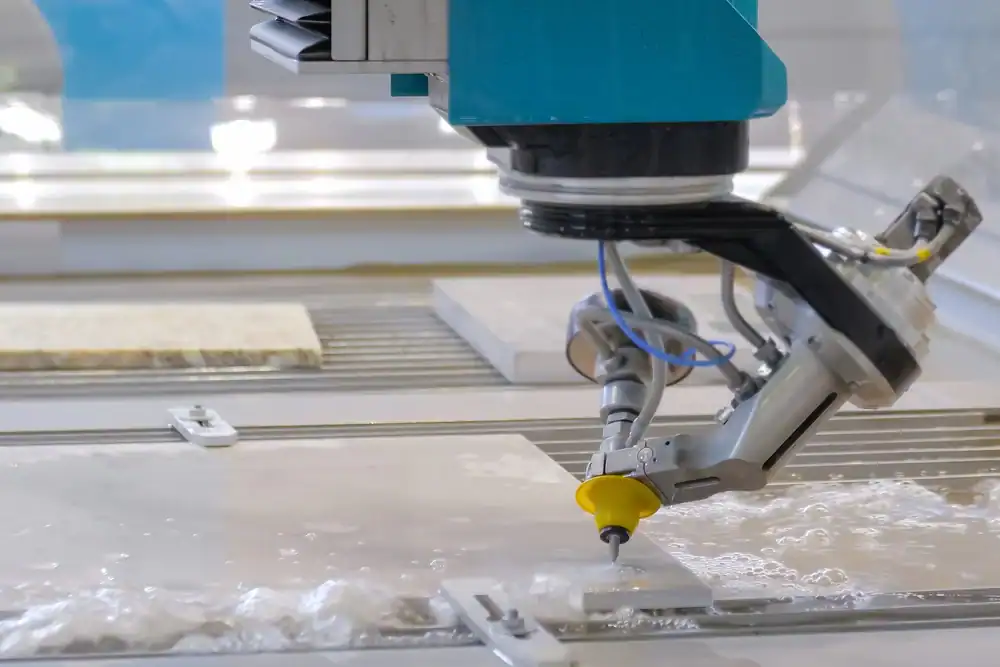
Waterjet cuts anything that won’t dissolve in water. That includes hardened tool steel, titanium, tempered glass, stone, ceramics, thick rubber, and layered composites—materials that would crack, melt, or delaminate under a torch or laser.
The reason it works across such a wide range is simple: there’s no heat. A laser burns through material, which limits you to metals and some plastics. A plasma torch melts, which rules out anything heat-sensitive. Waterjet is a mechanical process. The abrasive stream physically erodes the material, so hardness doesn’t matter.
For manufacturers in Brookhaven, NY working with mixed materials—like a bracket that combines aluminum and rubber, or a panel that’s part metal and part acrylic—this means one process handles the whole part. You’re not bouncing between shops or methods. Everything gets cut in one pass, with the same level of precision.
Waterjet typically holds tolerances around ±0.005 inches, sometimes tighter depending on material thickness and edge finish requirements. That’s on par with or better than most laser systems, and significantly tighter than plasma, which usually runs closer to ±0.020 inches.
The accuracy comes from CNC control and the fact that there’s no heat distortion. When you cut with a torch or laser, the material heats up and can warp—especially thin stock. Even if the cut path is perfect, the part might not be flat when it cools. Waterjet stays cold, so what you program is what you get.
There’s also no kerf variation from tool wear. A plasma tip degrades. A laser lens can drift. The waterjet stream stays consistent because the orifice and nozzle are replaced on a schedule, and the abrasive flow is controlled digitally. For repeat jobs or high-volume runs in Brookhaven, NY, that consistency means every part matches the first.
Not usually. The edge quality depends on cutting speed and abrasive flow, but most parts come off the table with a finish smooth enough for direct use. You’ll see some texture—it’s not polished—but it’s clean, with no burrs, slag, or heat discoloration.
If you need a specific edge finish, we can adjust the cut speed. Slower passes produce smoother edges, often comparable to a milled surface. Faster cuts leave a slightly rougher texture but still cleaner than plasma or oxy-fuel. For parts that need cosmetic perfection, a quick pass with a file or sander is usually enough.
The bigger advantage is what you don’t have to do. There’s no grinding down sharp edges, no removing slag, no dealing with hardened zones that dull your tools. That saves time in your shop and keeps your costs down, especially on jobs with dozens or hundreds of parts.
In steel, most industrial waterjet systems handle up to six inches. In softer materials like aluminum, plastic, or foam, you can go thicker—sometimes twelve inches or more. The limitation isn’t the pressure; it’s how long it takes and whether the stream stays coherent through the material.
Thicker cuts take longer because the abrasive stream has to travel farther and remove more material. A quarter-inch steel plate might cut in a minute or two. A four-inch plate could take twenty minutes for the same length of cut. But it’s still faster and cleaner than drilling, sawing, or torching your way through.
For most projects in Brookhaven, NY, we’re working with materials under two inches thick. That’s where waterjet really shines—fast cuts, tight tolerances, and no heat damage. If you’ve got something thicker and need to know if it’s feasible, send us the specs. We’ll tell you what’s realistic.
Waterjet isn’t the cheapest option per hour, but it’s often the most cost-effective when you factor in accuracy, material waste, and secondary operations. Operating costs run between $12 and $30 per hour depending on the job, which is higher than plasma but competitive with laser.
Where you save is in what you don’t have to do afterward. There’s no deburring, no heat straightening, no scrapping parts that warped during cutting. The kerf is narrow, so you get more parts per sheet. And because we program directly from CAD files, setup time is minimal—even for complex shapes.
For low-volume or prototype work, waterjet often beats other methods because there’s no expensive tooling to build. You send a file, we cut it, and you’ve got parts in hand. For production runs in Brookhaven, NY, the repeatability means less scrap and fewer rejects, which adds up fast when you’re running hundreds of pieces.
Yes. The stream diameter is typically between 0.020 and 0.040 inches, which lets you cut fine details, sharp internal corners, and complex geometries that would be difficult or impossible with a torch or saw. If you can draw it in CAD, we can cut it.
The process also handles piercing without pre-drilling. The waterjet starts the cut by boring straight through the material, then follows the programmed path. That means you can create fully enclosed shapes, slots, and pockets without secondary operations.
For parts with angled edges or beveled cuts, five-axis waterjet systems can tilt the cutting head to match the geometry. We use that for aerospace components, custom brackets, and architectural pieces where the edge angle matters. It’s all controlled through the same CAD file, so there’s no manual setup or guesswork.
Useful Links
Other Services we provide in Brookhaven