Hear from Our Customers
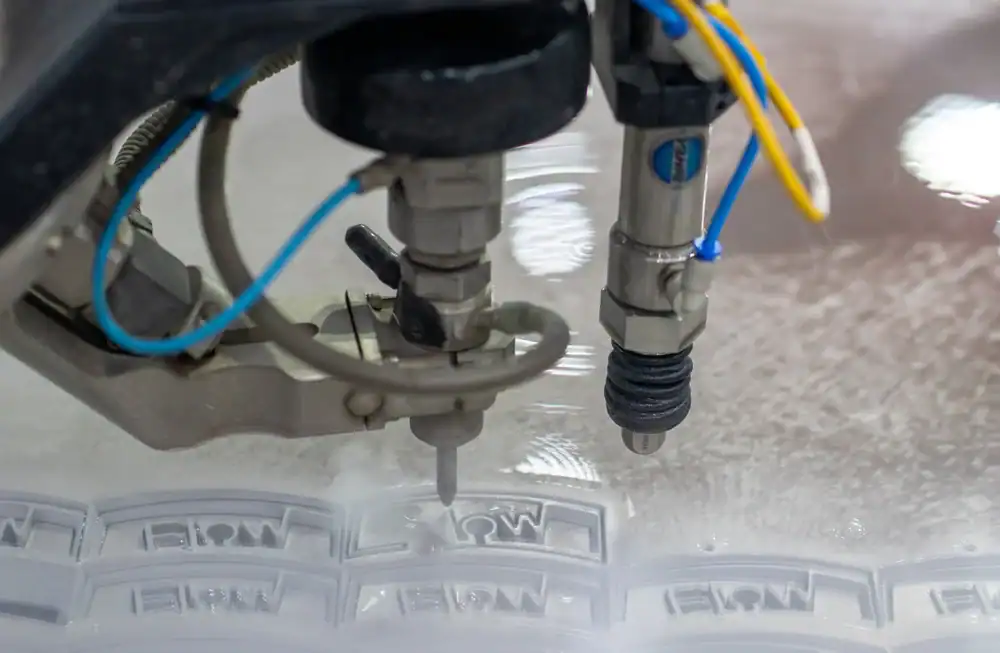
You need parts that fit your specs exactly. Not close enough. Not “we’ll make it work.” Exact.
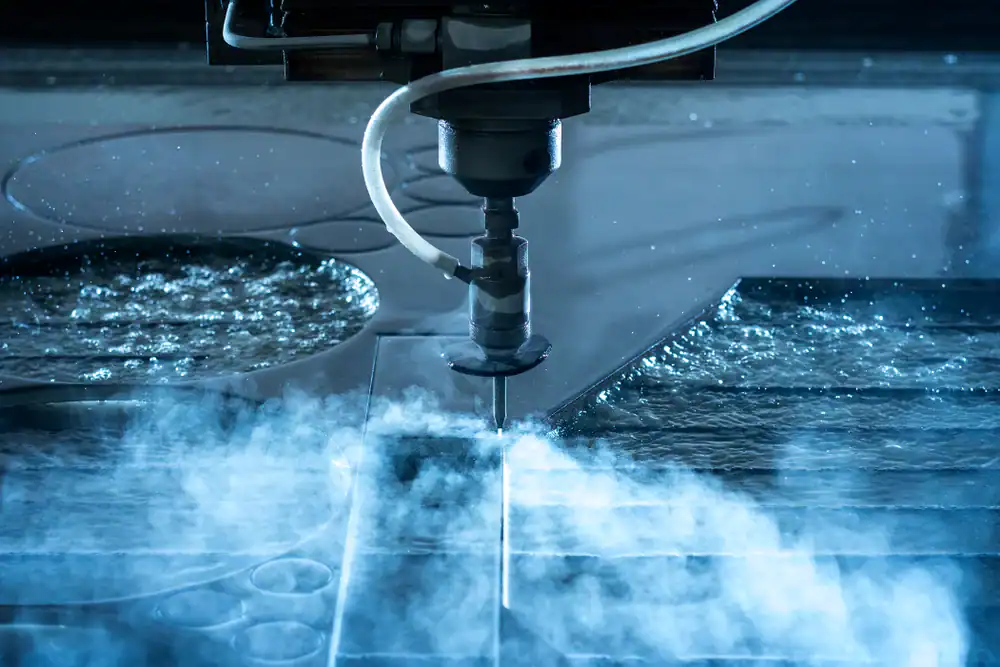
That’s what abrasive waterjet cutting in Franklin Square, NY delivers. High-pressure water mixed with fine abrasive cuts through up to 10 inches of material without generating heat. No heat-affected zone means no warping, no distortion, no compromised edges that need rework.
You get clean cuts with a Q5 finish quality. Sharp corners. Small inner radii. Complex shapes that would take hours on traditional equipment. And because there’s no thermal stress on the material, you’re not dealing with hardened edges or weakened structures.
This matters when you’re prototyping a new design and can’t afford delays. It matters when you’re running production and need consistency across hundreds of parts. It matters when your tolerances are tight and your timeline is tighter.
We’ve been operating in the Franklin Square area for over 20 years. We’ve cut parts for Ralph Lauren, Coach, Port Authority, and American Aluminum Company—clients who don’t accept excuses or second-rate work.
Franklin Square sits in Nassau County, where over 60% of workers are employed by private companies in manufacturing, aerospace, automotive, and medical device sectors. These industries demand precision. You’re likely in one of them, or you supply someone who is.
We run high-performance CNC waterjet equipment. We’ve cut nearly every material you can name—ferrous and non-ferrous metals, granite, marble, composite plastics, foam. If you’re not sure whether your material can be cut with waterjet, the answer is probably yes.
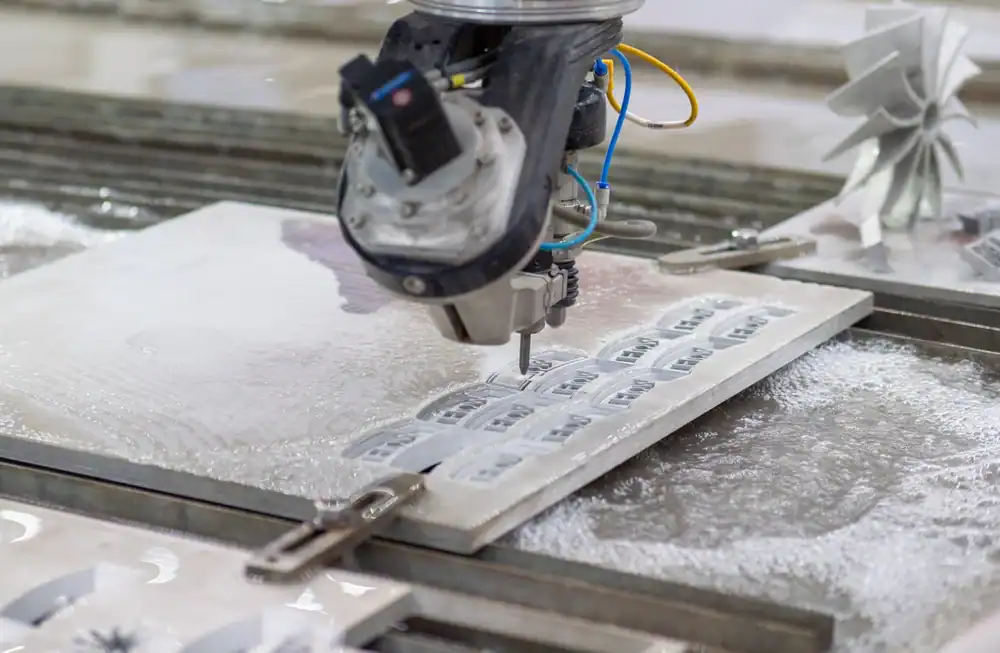
You send us your CAD file or specs. If you don’t have a CAD file, we’ll create one for you. We review your material type, thickness, and tolerance requirements to determine the right cutting parameters.
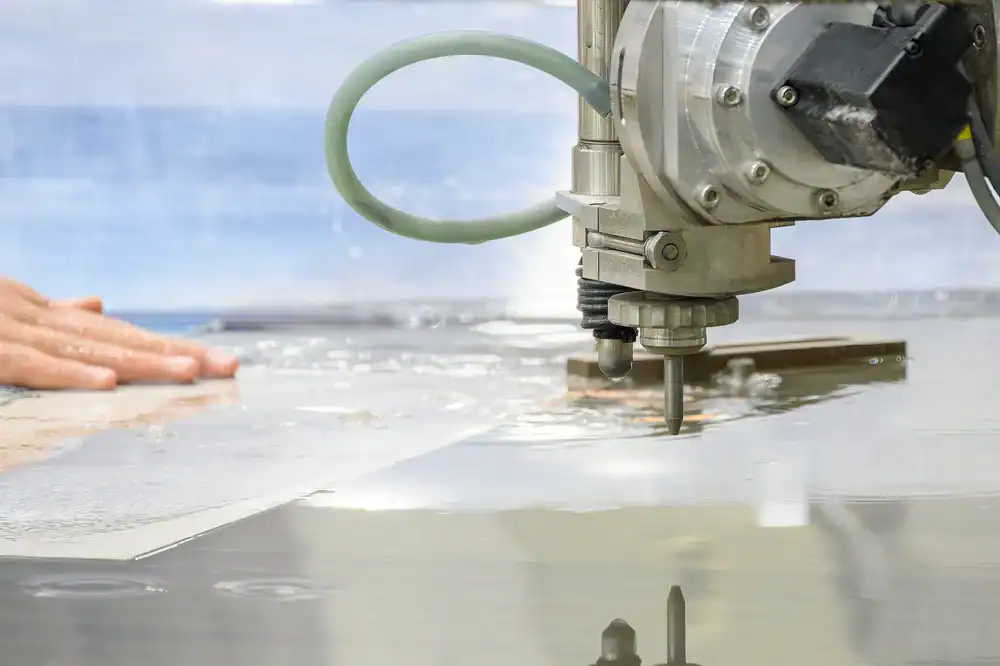
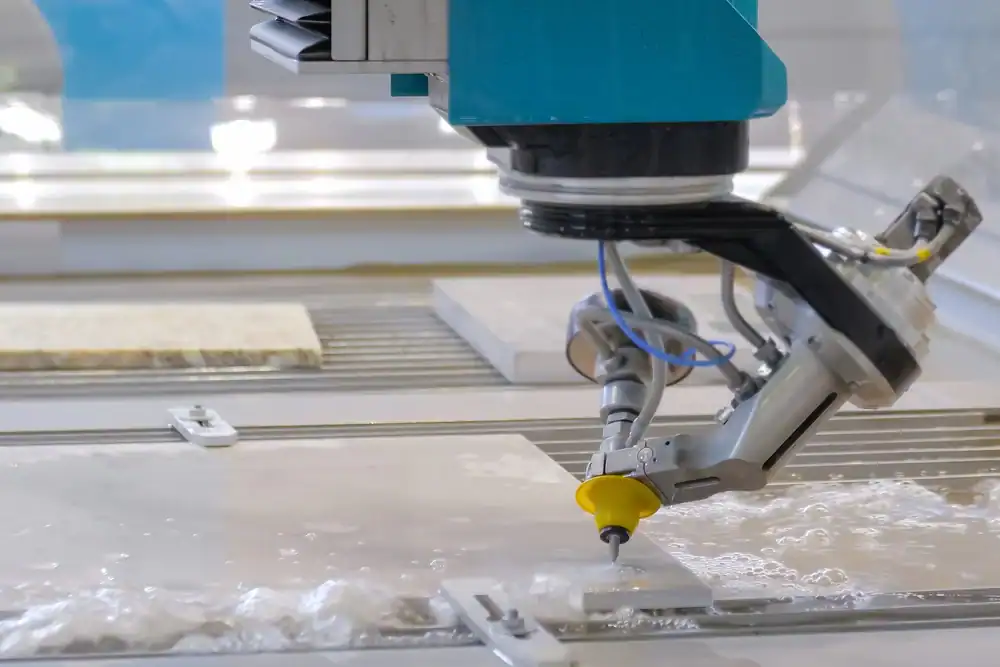
Then we load your material onto our CNC waterjet table. The cutting head moves along your programmed path, mixing water pressurized up to 60,000 PSI with garnet abrasive. This stream cuts through your material at speeds up to four times faster than conventional waterjet methods.
Because the process is CNC-controlled, every cut follows your exact specifications. You’re not relying on operator skill to freehand a complex shape. The machine executes your design with repeatability across one part or a thousand.
After cutting, most parts don’t need secondary finishing. The edges are clean. Burrs are minimal or nonexistent. If you do need additional services—milling, welding, polishing, plating—we handle that too. You get finished parts ready to install or assemble.
Ready to get started?
You get precision cuts on materials up to 10 inches thick. Metals, stone, glass, composites, rubber, foam—if it’s a solid material, we can cut it.
You get tolerances tighter than +/- 0.005 inches. That’s not marketing language. That’s what our equipment holds, consistently, because there’s no tool wear affecting accuracy mid-job.
Franklin Square’s location gives you access to fast turnaround. We’re positioned to serve the broader New York metro area, but local clients get priority scheduling. If you’re prototyping and need parts this week, not next month, that matters.
You also get material efficiency. Waterjet cutting allows for tight nesting—arranging parts on your material sheet to minimize waste. Less waste means lower material costs. When you’re cutting expensive metals or specialty composites, that adds up quickly.
And you get an environmentally sound process. The water is recyclable. The abrasive is recyclable. There are no harmful fumes, no toxic chemicals, no hazardous waste disposal. If your company tracks environmental impact, waterjet cutting helps you stay clean.
We cut nearly any material you need. Metals—aluminum, steel, stainless steel, titanium, copper, brass. Stone—granite, marble, slate. Composites—carbon fiber, fiberglass, Kevlar. Plastics—acrylic, polycarbonate, PVC. Rubber, foam, glass, ceramics.
The limitation isn’t the material itself. It’s thickness. We can cut up to 10 inches thick on most materials. Softer materials like foam can go thicker. Harder materials like tool steel may max out around 6-8 inches depending on your tolerance requirements.
If you’re working with something unusual—exotic alloys, layered composites, or materials with varying densities—call us. We’ve likely cut it before. If we haven’t, we’ll run tests to dial in the right pressure, abrasive flow, and cutting speed before we touch your actual material.
We consistently hold tolerances tighter than +/- 0.005 inches. On some materials and geometries, we can get even tighter—down to +/- 0.003 inches.
Here’s why that matters. Traditional cutting methods—plasma, laser, even some CNC machining—introduce heat. Heat causes expansion during cutting and contraction during cooling. That movement affects your final dimensions. You might measure a part hot and think it’s perfect, then find it’s out of spec once it cools.
Waterjet cutting eliminates that variable. No heat means no thermal expansion. What you program is what you get. If your design calls for a 2.000-inch hole, you’ll get a 2.000-inch hole, not 2.003 or 1.997.
This is critical in aerospace, medical devices, and precision manufacturing. If your parts need to mate with other components, even a few thousandths of variance creates assembly problems. Waterjet cutting removes that risk.
Laser and plasma both use heat to cut. That heat creates a heat-affected zone around your cut edge. The material in that zone changes properties—it can harden, weaken, or warp depending on the material type.
Waterjet cutting uses high-pressure water and abrasive. No heat. No HAZ. Your material properties stay consistent from edge to center. This is especially important with metals that harden when heated, or with composites that delaminate under thermal stress.
Laser cutting is fast on thin materials—under a quarter inch. But as thickness increases, laser cutting slows down significantly and edge quality degrades. Waterjet maintains consistent speed and quality through thick materials.
Plasma is cost-effective for rough cuts on thick steel. But if you need tight tolerances or clean edges, plasma doesn’t deliver. You’ll spend time and money on secondary finishing. Waterjet gives you finished edges right off the table.
Turnaround depends on material availability, complexity, and our current queue. For straightforward cuts on common materials, you’re looking at 3-5 business days from file approval to finished parts.
Rush jobs can often be accommodated. If you’re in Franklin Square or the surrounding Nassau County area and you need prototype parts for an urgent design review, call us directly. We’ve turned around simple cuts in 24-48 hours when the situation required it.
Complex projects—large quantities, intricate geometries, or materials we need to source—take longer. A week to ten days is typical. We’ll give you a realistic timeline upfront, not an optimistic guess that we can’t meet.
Keep in mind that waterjet cutting itself is fast. The bottleneck is usually material procurement or scheduling around other jobs. If you provide your own material, that eliminates one variable and speeds things up.
A CAD file makes the process faster and more accurate. If you have one, send it. We work with most common formats—DXF, DWG, STEP, IGES.
If you don’t have a CAD file, we can create one. Send us a technical drawing with dimensions, or even a sketch if that’s all you have. We’ll convert it to a CAD file and send it back for your approval before we cut.
Creating a CAD file from a drawing adds a day or two to the timeline. But it ensures we’re cutting exactly what you need. We’ve seen too many jobs go wrong because someone eyeballed dimensions or made assumptions about what the customer wanted.
Once we have an approved CAD file, our CNC waterjet equipment reads it directly. There’s no manual programming or interpretation. The machine follows your design precisely, which is why repeatability is so high across multiple parts.
Yes. Waterjet cutting doesn’t require expensive tooling or dies. You’re not amortizing a $10,000 die cost across hundreds of parts to make the math work.
For one-off prototypes or small runs—say, 10 to 50 parts—waterjet is often the most economical option. You pay for machine time, material, and abrasive. That’s it. No setup fees for custom tooling.
This is especially true when you’re still refining a design. If you need to make changes after the first prototype, we just update the CAD file and cut the revised version. With traditional methods, design changes mean new tooling and new costs.
Even for larger production runs, waterjet remains competitive. Our operating costs run around $14 per hour, and abrasive waterjet cuts up to four times faster than conventional methods. That efficiency keeps per-part costs reasonable even as quantities scale up.
Useful Links
Other Services we provide in Franklin Square