Hear from Our Customers
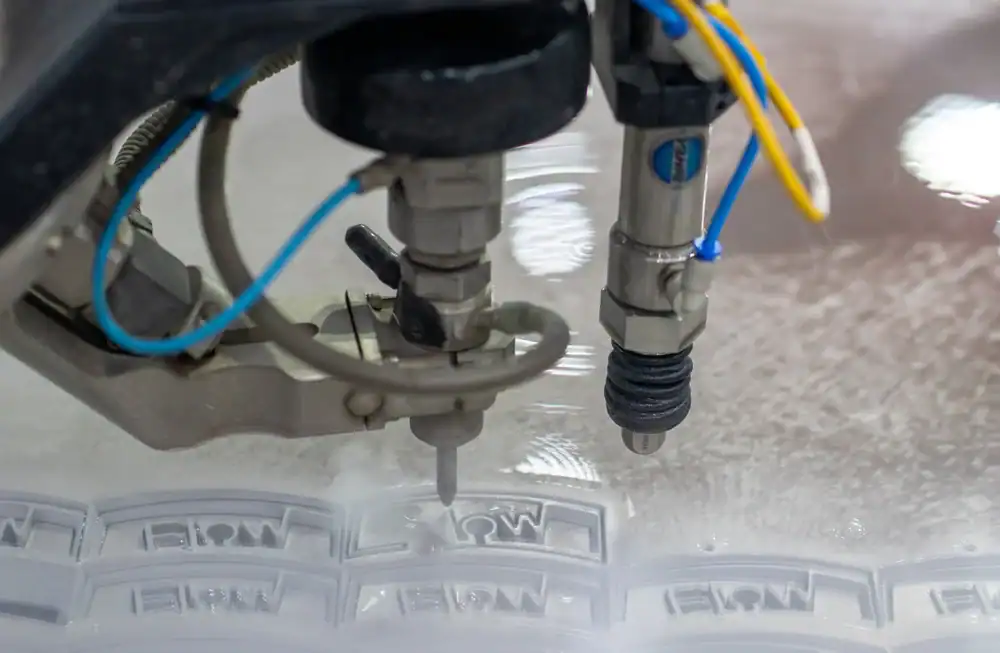
You need parts that fit. Not parts that almost fit, or parts that need rework because the cutting process warped the material or left rough edges that require finishing.
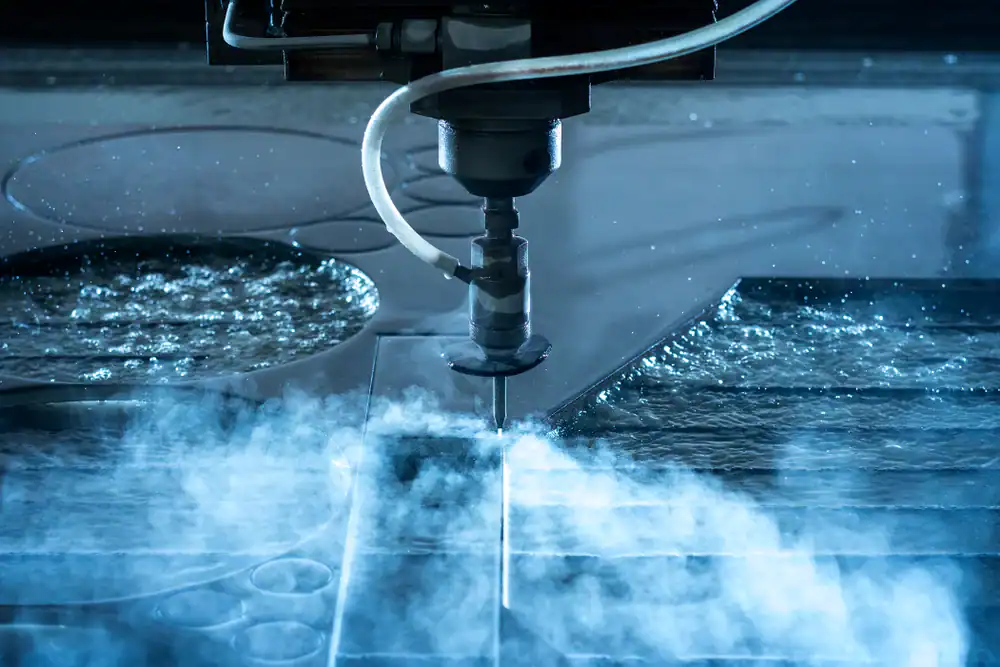
Waterjet cutting in Mineola, NY uses high-pressure water and abrasive to cut through nearly any material without adding heat. That means no warping, no hardening, no micro-fissures, and no heat-affected zones that compromise your material’s integrity. You get clean edges, tight tolerances, and parts that go straight into assembly or installation.
Whether you’re prototyping a single piece or running production volumes, the process stays consistent. Same tolerances, same edge quality, same dimensional accuracy. You’re not gambling on whether the tenth part will match the first.
Tri-State Waterjet serves manufacturers, fabricators, and designers across Mineola, NY and the broader Long Island, NY area. We work with aerospace shops in nearby Farmingdale, metal fabricators throughout Nassau County, and contractors who need custom architectural elements cut to exact specifications.
Our equipment handles the materials Long Island, NY industries rely on: aluminum, stainless steel, titanium, Inconel, granite, glass, composites, and plastics. We’ve cut parts for aerospace assemblies, medical devices, marine applications, and custom architectural projects.
You’re working with a shop that understands the local manufacturing landscape and the precision requirements that come with it.
You send us your design files or specifications. We review them for feasibility, material requirements, and any potential issues that might affect the cut quality or your timeline. If something won’t work as drawn, we tell you before we start cutting.
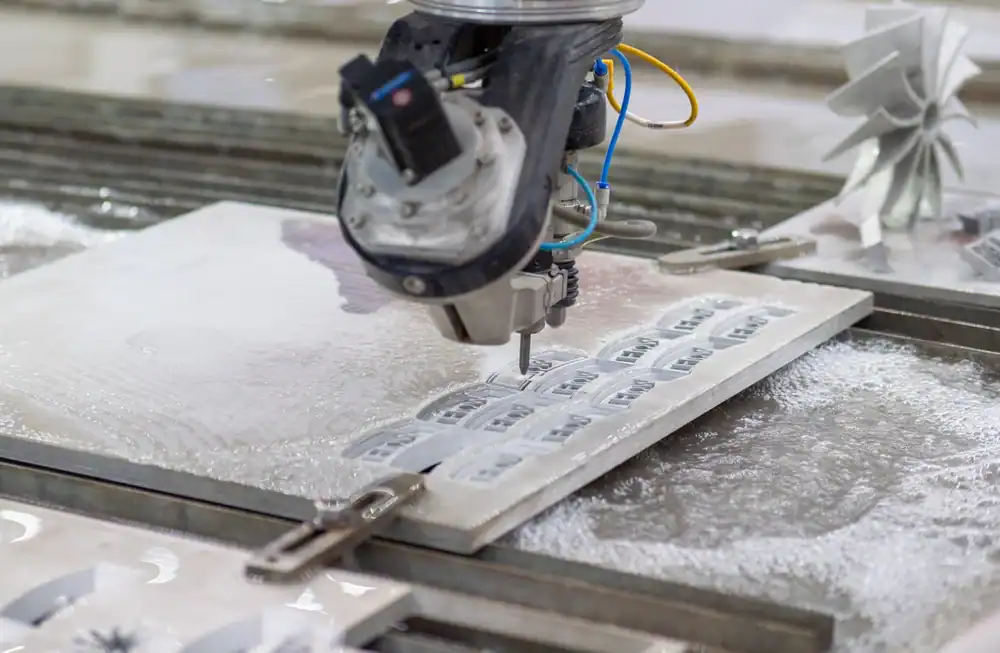
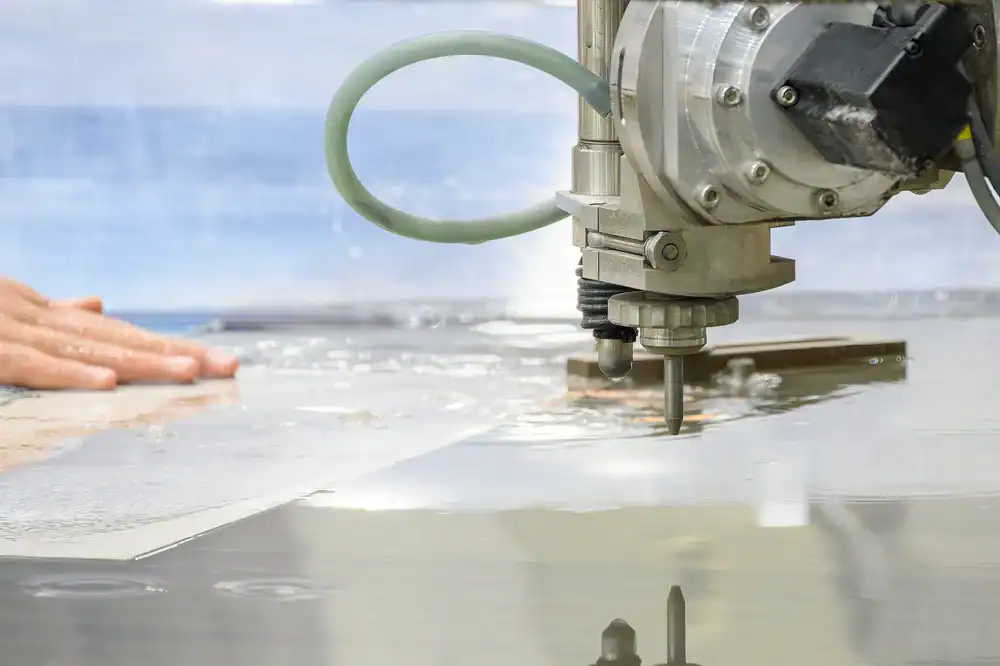
Once the file is programmed into our CNC waterjet system, we secure your material on the cutting bed. The waterjet nozzle mixes high-pressure water (up to 60,000 PSI) with garnet abrasive and cuts through your material following the programmed path. The process is cold—no heat input means no thermal distortion or changes to your material’s properties.
After cutting, we inspect dimensions and edge quality. If you need secondary operations like deburring or finishing, we handle that too. Then your parts ship, ready for whatever comes next in your process.
Ready to get started?
Waterjet cutting services in Mineola, NY give you access to precision cutting across materials that other processes can’t handle—or can’t handle well. You can cut hardened tool steel and delicate glass with the same equipment. You can create intricate shapes, tight inside corners, and complex geometries without multiple setups or specialized tooling.
The Long Island, NY manufacturing sector—particularly aerospace and medical device manufacturers in Nassau County—requires parts that meet strict dimensional tolerances and material certifications. Our waterjet process maintains material traceability and delivers parts with tolerances as tight as ±0.002″ when your application demands it. For most work, we hold ±0.005″ consistently, even in thicker materials.
Because there’s no heat-affected zone, materials that work-harden easily (like titanium and Inconel common in aerospace applications) stay stable. You’re not introducing stresses or structural changes that could cause problems downstream. The cut edge comes out similar to a sandblasted finish—smoothest at the top, slightly rougher at the bottom—but clean enough for many applications without secondary finishing.
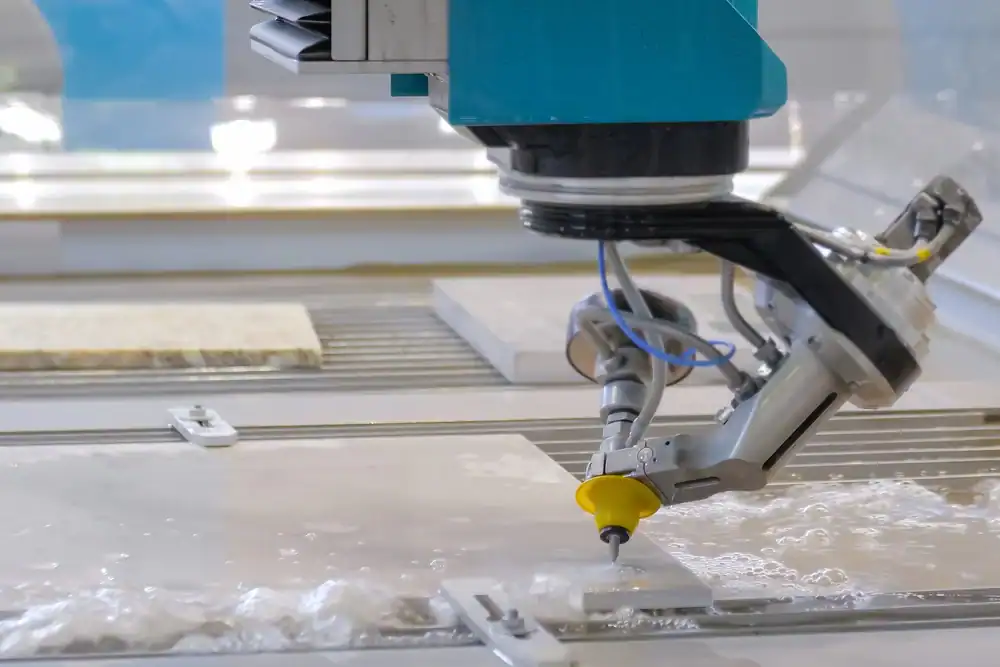
We cut metals (aluminum, stainless steel, titanium, Inconel, tool steel, copper, brass), stone (granite, marble, limestone), glass, ceramics, plastics, composites, rubber, and foam. Basically, if it’s not tempered glass or certain ceramics prone to shattering, we can cut it.
The versatility matters because you might need multiple materials cut for a single project. Instead of coordinating with different shops for different materials, you get everything cut in one place with consistent quality and turnaround. That’s particularly useful for architectural projects or custom fabrication work where you’re combining metal with stone or glass.
Material thickness capacity depends on the specific material, but we regularly cut metals up to 6 inches thick and softer materials even thicker. If you’re unsure whether your material or thickness will work, send us the specs and we’ll tell you what’s possible.
Waterjet cutting in Mineola, NY delivers tolerances down to ±0.002″ for precision work, with ±0.005″ being standard for most applications. That’s tighter than plasma cutting and comparable to laser cutting, but without the heat issues that lasers create in thicker materials.
Laser cutting works great for thin metals but struggles with thicker stock and can’t touch non-metals. Plasma is fast but rough—you’re looking at wider kerfs and heat-affected zones. Waterjet gives you the precision of laser with the material versatility plasma can’t match, and no thermal distortion regardless of thickness.
For parts going into aerospace assemblies or medical devices where dimensional accuracy isn’t negotiable, waterjet is often the only process that hits the required tolerances without introducing heat stress. You get repeatable accuracy across your entire production run, not just the first few parts before tool wear becomes a factor.
Cutting time depends on material type, thickness, complexity, and the level of edge quality you need. Simple shapes in thin material might take minutes per part. Complex patterns in thick stainless steel or stone could take hours.
Here’s what actually affects your timeline: programming time for complex geometries, material procurement if we’re sourcing it, our current queue, and whether you need secondary operations after cutting. For straightforward jobs with materials in stock, you’re typically looking at a few days from file to finished parts.
Rush work is possible when our schedule allows. If you’ve got a deadline driving the project, tell us upfront. We’ll let you know if it’s realistic and what it takes to hit it. We’d rather tell you no than promise a date we can’t meet.
Depends on your application. Waterjet cutting produces an edge finish similar to sandblasting—smoothest at the top of the cut, progressively rougher toward the bottom. For many applications, especially structural parts or components that get welded or fastened, the as-cut edge works fine.
If you need smoother edges for aesthetic reasons, tight sealing surfaces, or parts that people will handle, we can adjust cutting parameters to improve edge quality or add deburring and finishing as secondary operations. Slowing down the cutting speed produces smoother edges but increases cutting time and cost.
The top edge of a waterjet cut is typically very clean with minimal burr. The bottom edge may have slight burr or roughness depending on material and thickness. We’ll talk through your edge quality requirements when we review your project and recommend the most cost-effective approach to get you what you need.
Pure waterjet uses only high-pressure water and works for soft materials like foam, rubber, gaskets, food products, and thin plastics. Abrasive waterjet cutting in Mineola, NY mixes garnet abrasive into the water stream, which is what lets us cut hard materials like metal, stone, glass, and composites.
For the work most manufacturers and fabricators need—cutting metals, stone, or thick plastics—you need abrasive waterjet. The garnet particles do the actual cutting while the water stream carries them and cools the cut zone. This is why there’s no heat buildup even when cutting materials that would normally generate significant heat with other cutting methods.
The abrasive does add to operating costs since garnet is consumable, but it’s what makes the process viable for industrial applications. You’re trading slightly higher per-part costs for the ability to cut materials and thicknesses that other processes can’t handle, with better edge quality and no thermal distortion.
Yes to both. Waterjet cutting services in Mineola, NY work for one-off prototypes, small custom batches, and production runs. There’s no hard tooling required, so you’re not investing thousands in dies or molds just to cut a few test pieces.
For prototypes, that means you can iterate designs quickly. Cut a part, test fit, revise the file, cut another. You’re only paying for machine time and material, not tooling changes. For production work, CNC programming ensures every part matches the first one, with the same tolerances and edge quality throughout the run.
The economic sweet spot for waterjet is typically low to medium volume production where the per-part cost makes sense and the design complexity or material requirements rule out cheaper processes. If you’re running hundreds of thousands of parts, stamping or laser might be more cost-effective. But for everything from single prototypes to several hundred production parts, waterjet gives you precision and flexibility without the tooling investment.
Useful Links
Other Services we provide in Mineola