
Hear from Our Customers
You’re not looking for someone who can “probably” hit your tolerances or “usually” avoids heat distortion. You need parts that fit, edges that don’t need grinding down, and materials that aren’t warped from thermal stress.
High pressure water cutting in Roosevelt, NY handles what traditional methods can’t. Metal, composites, glass, stone, plastics—materials up to several inches thick get cut with the same precision whether it’s your first piece or your five hundredth. No heat-affected zones. No mechanical stress. No burrs that require extra labor to clean up.
The edge quality you get from abrasive waterjet cutting eliminates most secondary processing. That’s time you’re not paying for and delays you’re not dealing with. When your production schedule is tight and your tolerances are tighter, that difference matters.
We serve manufacturers, contractors, architects, and fabricators throughout Roosevelt, NY and the broader Long Island, NY region. We’re not running consumer-grade equipment or guessing at your specifications.
Roosevelt’s industrial and manufacturing sector demands reliable cutting services that understand tight deadlines and tighter tolerances. Whether you’re fabricating automotive components, architectural elements, or custom parts for aerospace applications, you’re working with a shop that knows what +/- 0.001 inch actually looks like in practice.
We handle custom waterjet cutting in Roosevelt, NY with CNC-controlled systems and material consultation when you need it. You get straight answers about what’s possible, realistic turnaround times, and cuts that match your drawings.
You send us your design file or specifications. We review it for any potential issues with kerf width, corner geometry, or material thickness that might affect the outcome. If something won’t work the way you’ve drawn it, you hear about it before we start cutting, not after.
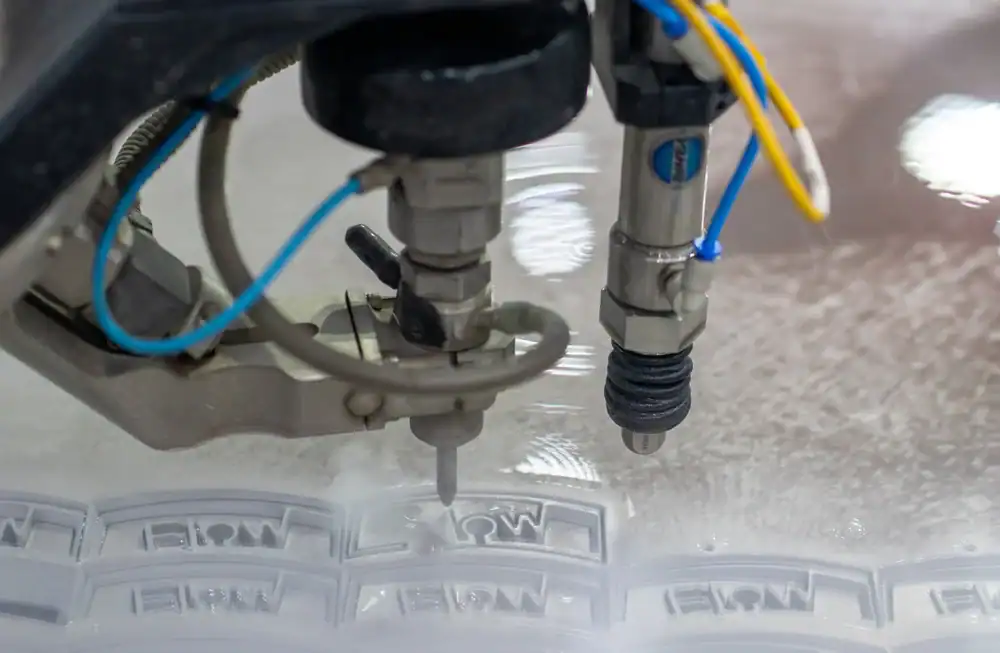
Once the file is programmed into our CNC waterjet system, we set up your material and dial in the cutting parameters—pressure, abrasive flow rate, and traverse speed all get adjusted based on what you’re cutting and how thick it is. The waterjet stream reaches up to 60,000 PSI, mixed with garnet abrasive for harder materials.
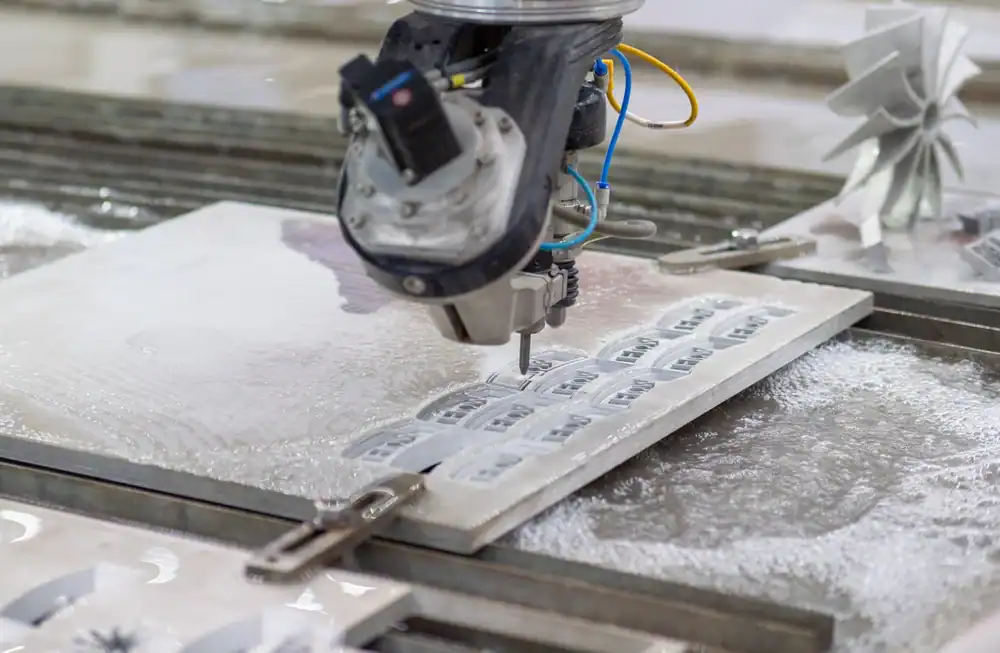
During the cut, the stream stays focused and consistent. There’s no heat buildup, no hardened edges, no warping. Complex shapes and tight inside corners get cut in a single pass. When your parts come off the table, they’re ready to use or move directly into assembly without additional finishing in most cases.
Ready to get started?
Waterjet cutting services in Roosevelt, NY give you material versatility that other methods can’t match. Laser cutting burns through certain plastics and creates heat-affected zones in metal. Plasma leaves rough edges and can’t handle non-conductive materials. Traditional machining is slow and limited by tool access.
Waterjet handles all of it—stainless steel, aluminum, titanium, copper, brass, composites, rubber, foam, glass, granite, marble, ceramic. You’re not restricted by thermal sensitivity or hardness. Thick materials that would take multiple passes with other methods get cut in one go, and you’re not dealing with tool wear or replacement costs.
Roosevelt’s manufacturing and construction sectors benefit from the cold cutting process, especially when working with materials that can’t tolerate heat or when edge quality directly affects the final product. Architectural metalwork, custom automotive parts, industrial gaskets, and precision components all come out cleaner and more accurate. The kerf width stays narrow, which means less material waste and better nesting efficiency when you’re cutting multiple parts from a single sheet.
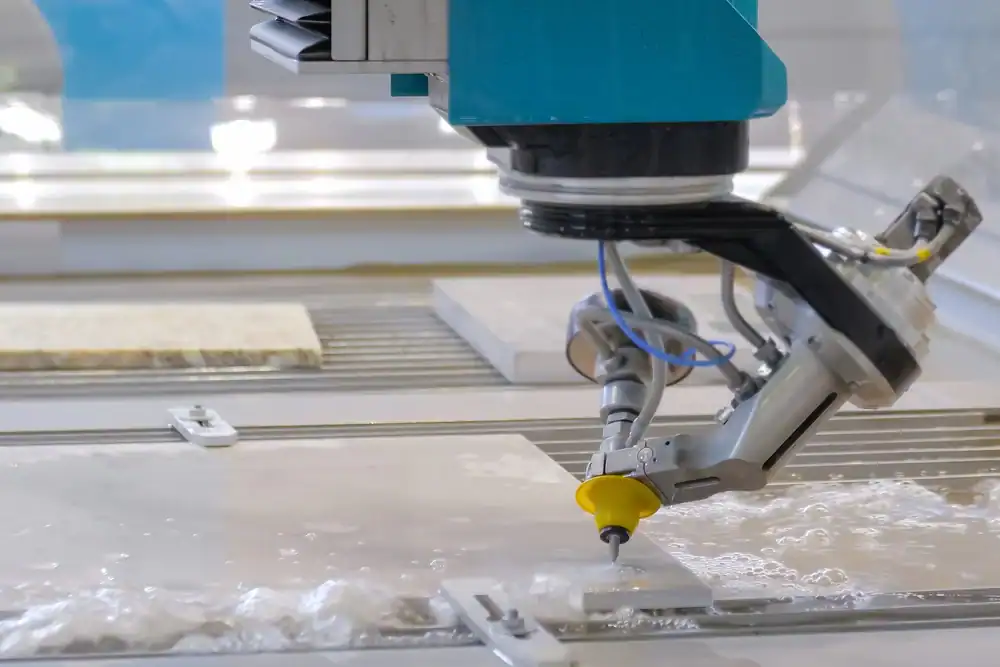
Waterjet cuts materials that would burn, melt, warp, or crack under heat-based cutting methods. That includes heat-sensitive plastics like acrylic and polycarbonate, composite materials with mixed properties, tempered glass, and reflective metals like copper and brass that deflect laser energy.
It also handles material combinations in a single setup. If you’ve got a part with metal inserts in a plastic housing, or layered composites with different hardness levels, waterjet cuts through the entire assembly without delamination or thermal damage. You’re not switching between tools or methods.
Thickness isn’t the limiting factor it is with laser or plasma. We cut materials from thin gauge sheet up to six inches or more, maintaining the same edge quality and precision throughout the entire depth. Stone, ceramic, rubber, foam, fiberglass—if it’s a solid material, waterjet handles it.
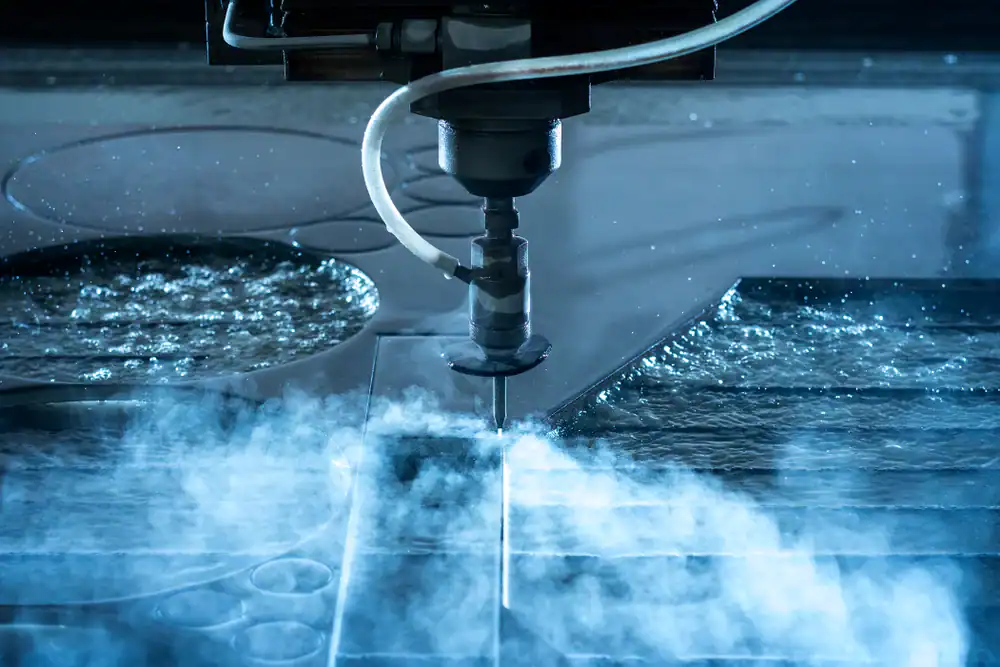
The cutting happens through erosion, not thermal energy. High pressure water mixed with garnet abrasive hits the material at speeds over twice the speed of sound, wearing away material in a controlled stream. There’s no flame, no arc, no laser beam generating heat.
Because there’s no heat, there’s no heat-affected zone where the material’s properties change. Metals don’t harden at the cut edge. Plastics don’t melt or create rough, burred edges. Tempered glass doesn’t crack from thermal shock. The material stays at room temperature throughout the entire cutting process.
CNC control keeps the stream positioned exactly where it needs to be, following your programmed path with repeatable accuracy. The narrow kerf width—typically 0.030 to 0.040 inches—means less material gets removed, which translates to tighter tolerances and less deviation from your design. You get dimensional accuracy that holds across production runs without drift or variation from heat buildup.
Standard waterjet cutting in Roosevelt, NY holds tolerances of +/- 0.005 inches on most materials and part geometries. When you need tighter precision, CNC waterjet systems can achieve +/- 0.001 inches on smaller parts with proper fixturing and material preparation.
Tolerance depends on several factors: material thickness, hardness, and how the material is supported during cutting. Thinner materials and harder materials generally hold tighter tolerances. Parts with long, intricate cuts may see slight variation at the end of the cut path compared to the beginning, but proper programming and traverse speed control minimize this.
Inside corner radii are limited by the kerf width—you’ll typically see a 0.015 to 0.020 inch radius in corners, which is significantly tighter than plasma or laser can achieve in thicker materials. If your design requires truly sharp inside corners, that’s something to discuss during the quoting phase so we can adjust the design or use alternative methods for those specific features.
Most parts come off the waterjet table ready to use. The edge quality is smooth and uniform, without the rough striations you get from plasma cutting or the hardened edges from laser cutting. There’s no slag to chip off, no oxide layer to remove, and minimal burring.
Thicker materials or parts cut at higher traverse speeds may show slight texture variation between the top and bottom edge—the top edge is typically smoother because that’s where the stream enters with full force. For most applications, this texture is acceptable and doesn’t affect fit or function. If you need a polished edge for aesthetic reasons, light sanding or tumbling is usually sufficient.
The lack of heat-affected zones means the material properties remain consistent right up to the cut edge. You’re not dealing with hardened edges that are difficult to drill, tap, or weld. Parts can move directly into assembly, welding, or finishing processes without additional prep work. That’s where the real time and cost savings show up—you’re not paying for secondary operations that other cutting methods require.
Waterjet cutting speed depends on material type, thickness, and the level of edge quality you need. For thinner materials under half an inch, laser cutting is typically faster. But once you factor in setup time, material limitations, and secondary finishing requirements, waterjet often comes out ahead on total production time.
Thicker materials are where waterjet really outpaces other methods. Cutting two-inch stainless steel with a laser requires multiple passes and still leaves heat damage. Plasma cuts it faster but with rough edges that need grinding. Waterjet cuts it in a single pass with a finished edge, and you’re moving directly to the next operation.
The other time advantage is flexibility. When you’re cutting multiple materials or switching between different thicknesses, waterjet doesn’t require tool changes, different gas mixtures, or equipment swaps. One setup handles everything. For custom fabrication work and short production runs common in Roosevelt, NY manufacturing, that flexibility translates to faster turnaround times and fewer delays waiting for the right equipment to become available.
Waterjet cutting costs more per linear inch than laser or plasma in many cases, but that’s not the full picture. You’re comparing the cutting cost without accounting for what happens after the cut. Waterjet eliminates or reduces secondary finishing, which is where labor costs add up quickly.
Material waste is lower with waterjet because of the narrow kerf width. When you’re nesting parts on expensive materials like titanium or thick stainless steel, that tighter kerf means you fit more parts per sheet. Less scrap, lower material costs. For production runs, those savings compound.
The real cost advantage shows up when you factor in the versatility. You’re not paying for multiple processes or outsourcing certain materials because your primary cutting method can’t handle them. One shop, one process, all your materials. For manufacturers and fabricators in Roosevelt, NY working with diverse materials and tight budgets, that consolidation cuts both costs and complexity out of your supply chain.
Useful Links
Other Services we provide in Roosevelt