Hear from Our Customers
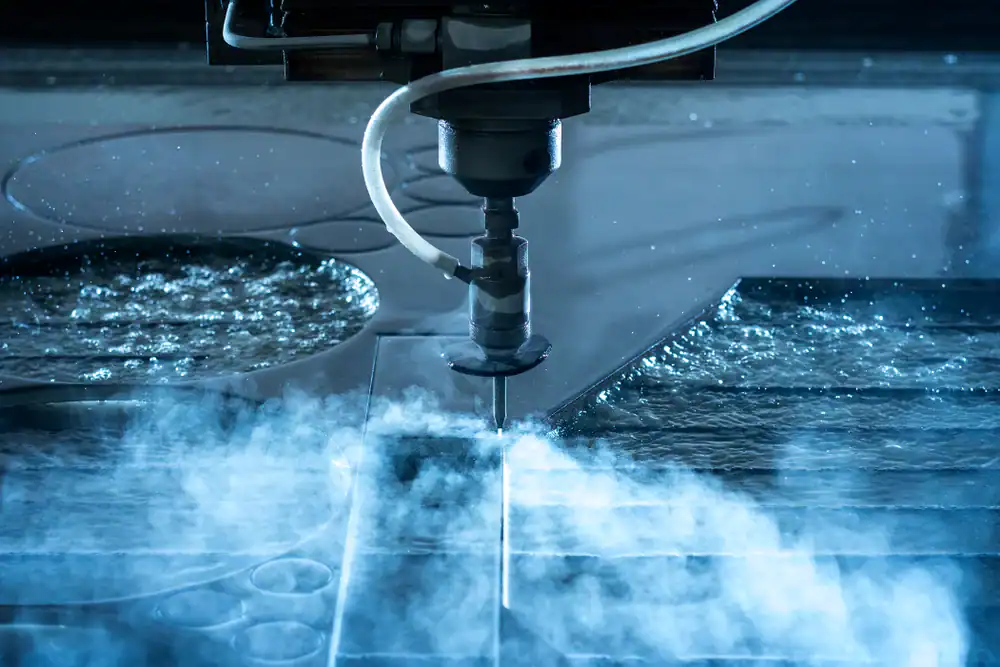
You need parts that fit. Dimensions that hold. Edges that don’t need hours of secondary finishing.
That’s what waterjet cutting delivers. No heat means no warping, no hardened edges, no metallurgical changes that throw off your tolerances. The material stays true because we’re cutting with high-pressure water and abrasive—not torches or blades that introduce stress.
Whether you’re prototyping a new design or running production parts, you get the same result: clean cuts that meet your specs without the guesswork. Architects working on decorative panels get intricate patterns without burn marks. Contractors get structural components that bolt up without grinding or rework. Engineers get test pieces that reflect actual material properties.
You send us a file or a sketch. We turn it into a finished part. And because there’s no heat-affected zone, you’re not dealing with brittleness, discoloration, or dimensional drift that shows up later during assembly.
We serve architects, contractors, fabricators, and engineers across Stony Brook, NY and the surrounding Long Island area. We’re not a national chain running automated quotes—we’re a local shop that understands the pace and precision Long Island projects demand.
Stony Brook has a strong manufacturing presence, supported by organizations like the Manufacturing and Technology Resource Consortium at Stony Brook University. That means you’re working in an area where precision matters and timelines are tight. We’ve built our process around that reality.
You get direct access to people who know waterjet cutting, not a call center. You get realistic lead times based on actual shop capacity. And you get parts cut locally, so you’re not waiting on cross-country shipping when your project is already moving.
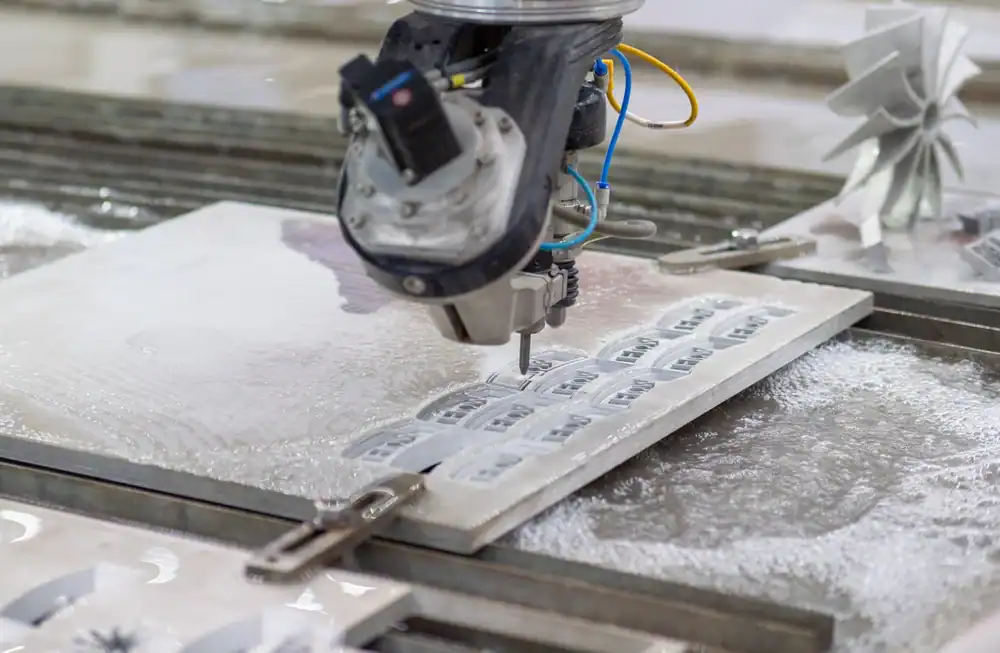
First, you send us your design. CAD files work best, but we can also work from drawings, templates, or even a sample piece you need replicated. If your design needs adjustments for cutting efficiency or material optimization, we’ll walk you through it before we start.
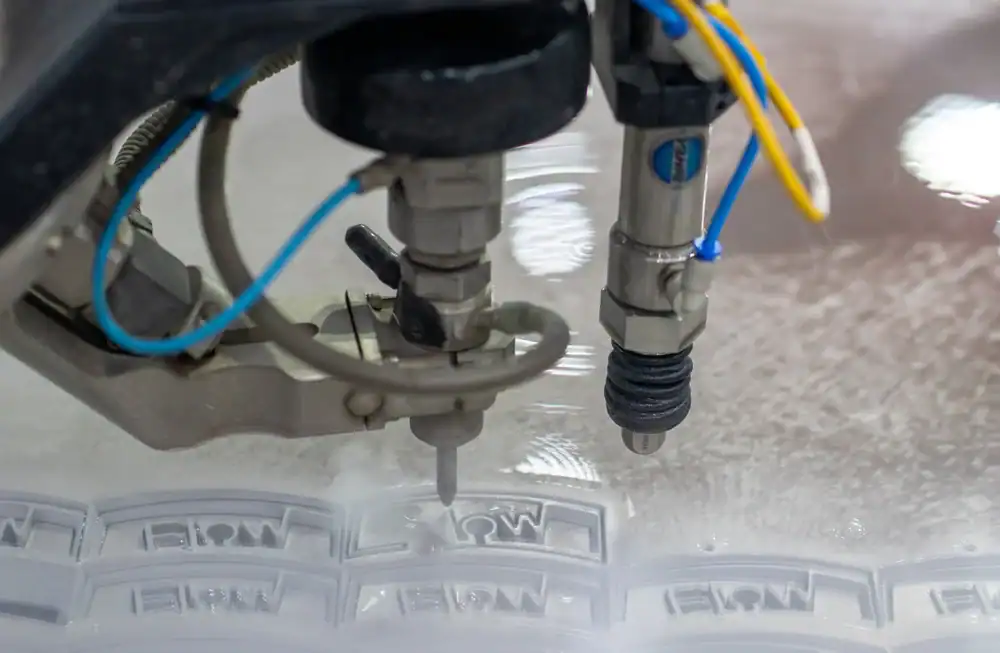
Next, we program the cut and select the right abrasive and pressure settings for your material. Thin aluminum cuts differently than thick stainless steel or granite. We adjust feed rates, abrasive flow, and nozzle distance to match what you’re cutting so you get a clean edge without excessive taper or roughness.
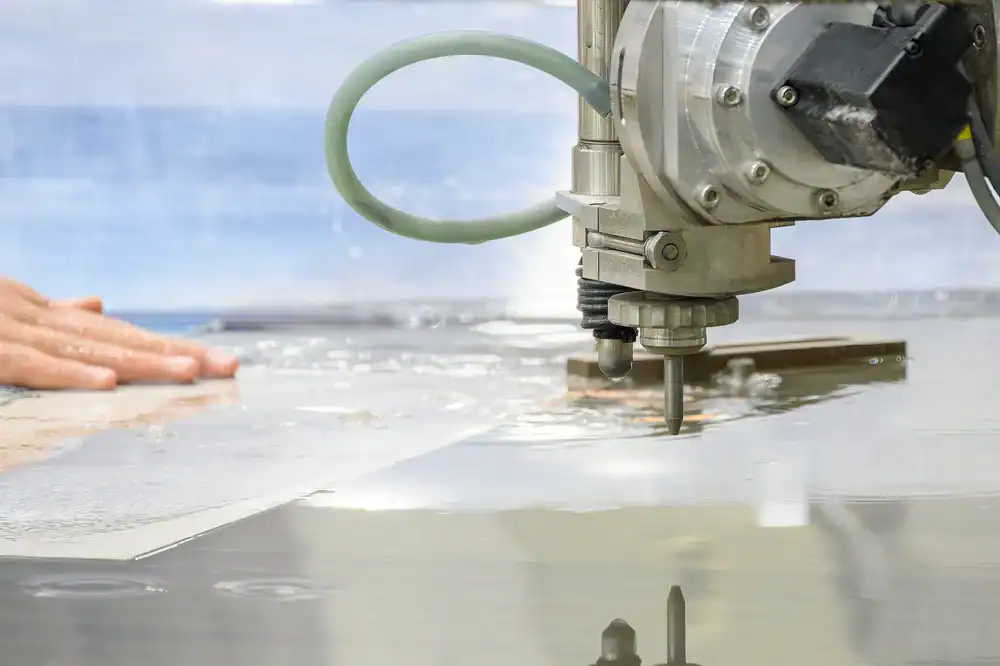
Then we cut your parts. The waterjet follows the programmed path with extreme accuracy—tolerances within +/- 0.005″ are achievable on most materials and thicknesses. There’s no heat, so there’s no warping or hardening. No secondary deburring on most jobs. Just precise parts ready for your next step, whether that’s welding, assembly, or installation.
You pick up or we ship. If it’s a prototype and you need changes, we adjust the file and recut. If it’s a production run, we save the program for easy reordering.
Ready to get started?
You get material versatility that other cutting methods can’t match. Metals like steel, stainless, aluminum, titanium, and copper. Stone including granite, marble, and quartz. Glass, plastics, composites, rubber, foam—if it’s a solid material, we can cut it. All without changing equipment or introducing heat that limits what’s possible.
You get edge quality that reduces your finishing time. Most waterjet cuts come off the machine ready to use. No grinding down slag. No sanding off burn marks. The edge is smooth enough for many applications as-is, and when you do need secondary work, you’re talking minutes instead of hours.
You get complex shapes without expensive tooling. Curves, angles, interior cutouts, tight radii—waterjet handles them all from the same setup. You’re not paying for custom dies or waiting weeks for tooling to arrive. Changes to the design happen in the software, not the shop floor.
For Long Island projects, this matters. Architectural work often involves one-off decorative elements that need to look identical across multiple materials. Contractors need custom brackets or structural pieces that fit specific dimensions. Waterjet gives you that flexibility without the lead time or cost of traditional fabrication methods.
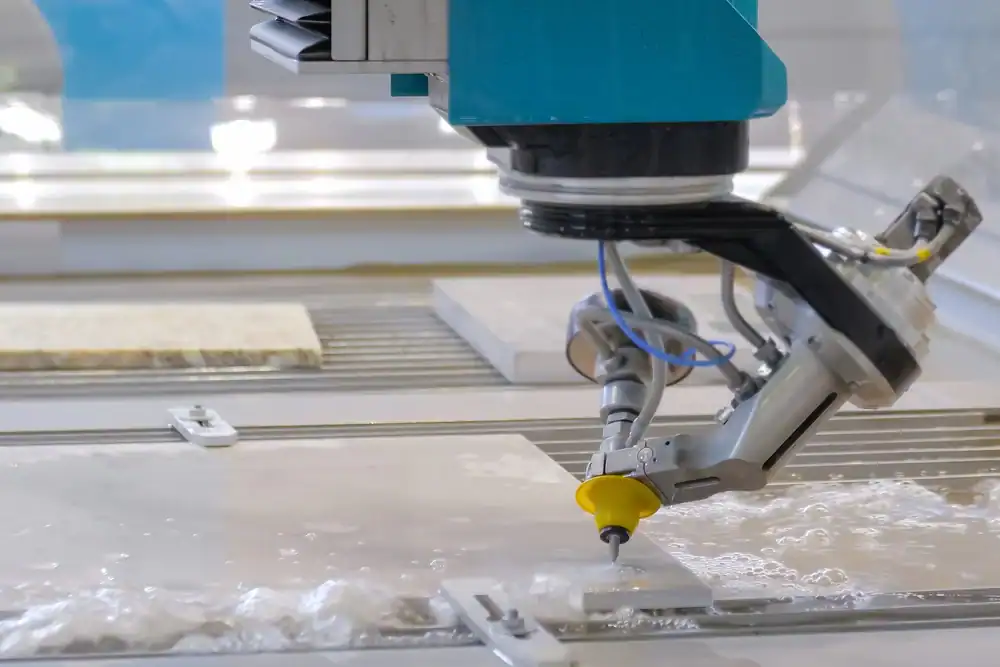
We cut nearly any solid material you’d use in fabrication, construction, or manufacturing. Metals are the most common—steel, stainless steel, aluminum, brass, copper, titanium, tool steel. Thickness ranges from thin sheet up to several inches depending on the material.
Stone and glass are also standard. Granite, marble, quartz countertops, ceramic tile, tempered or laminated glass. Waterjet doesn’t crack or chip brittle materials the way saws or routers can.
Plastics and composites cut cleanly without melting. Acrylic, polycarbonate, HDPE, nylon, fiberglass, carbon fiber, rubber, gasket materials, foam. If you’re prototyping or need custom parts in non-metal materials, waterjet handles it without the heat damage you’d get from laser or plasma cutting.
Waterjet cutting holds tolerances within +/- 0.005″ on most materials when we’re using a quality finish setting. Thinner materials and shorter cuts give you the tightest accuracy because there’s less room for the cutting stream to deflect.
Thicker materials—anything over a couple inches—will have slightly more taper as the stream travels through the material, but we compensate for that in the programming. For production parts that need to fit together, we run test cuts and measure before committing to the full run.
The key advantage is consistency. Because there’s no heat distortion or tool wear between parts, the first piece and the last piece in a run come out dimensionally identical. You’re not dealing with drift that happens with mechanical cutting tools that dull over time or thermal processes that change based on ambient temperature.
Simple cuts on thin material can happen same-day or next-day if we have the material in stock and the shop schedule allows. A few custom brackets or decorative panels in quarter-inch aluminum might take a couple hours of machine time once programmed.
Complex parts in thick material take longer. Cutting through two-inch stainless steel with intricate interior cutouts could mean several hours per piece because the cutting speed slows down as thickness increases. We’re talking precision, not speed.
Production runs depend on quantity and complexity. Twenty identical parts will have faster per-piece time than twenty different designs because we’re not reprogramming between cuts. Lead time also factors in current shop workload—during busy periods you might wait a few days for scheduling, while slower times might get you in faster.
Best approach: send us your file or specs and we’ll give you a realistic timeline based on what’s actually happening in the shop, not a generic estimate.
Waterjet doesn’t introduce heat. That’s the fundamental difference. Laser and plasma both melt material to cut it, which creates a heat-affected zone that changes the material properties right at the edge. You get hardening, discoloration, micro-cracking, and warping on thin materials.
For thick materials, waterjet wins on versatility. Laser struggles with anything over half an inch in most metals. Plasma can cut thicker, but the edge quality drops significantly and you’re left with heavy slag and dross that needs grinding. Waterjet cuts several inches deep with a clean edge.
Material range is another factor. Waterjet cuts reflective metals like aluminum, copper, and brass without issue. Laser can have problems with reflection. Waterjet cuts stone, glass, and composites that would be impossible with thermal processes.
The tradeoff is speed. On thin metals, laser cuts faster. But when you factor in the time spent deburring, grinding, and dealing with warped parts, waterjet often comes out ahead on total job time. And for anything that needs to maintain exact material properties—like hardened tool steel or aerospace alloys—waterjet is the only option that doesn’t compromise the metallurgy.
Yes. A significant portion of our work comes from architects specifying custom decorative elements and contractors needing one-off structural components that don’t exist in standard catalogs.
For architectural work, waterjet excels at intricate patterns in metal panels, stone inlays, glass partitions, and signage. You can create designs that would be impossible or prohibitively expensive with traditional fabrication. We work from your CAD files or help translate design sketches into cuttable formats.
Contractors use us for custom brackets, mounting plates, structural reinforcements, and specialty hardware. When you’re renovating a building and need parts that match existing dimensions, or you’re installing equipment that requires non-standard mounting solutions, waterjet gives you exact pieces without minimum order quantities or tooling costs.
We handle the material consultation too. Not sure if your design should be cut from aluminum or stainless? Need to know if quarter-inch will hold up or if you need half-inch? We’ll walk through the options based on structural requirements, budget, and how the part will be used. You’re not guessing—you’re getting input from people who cut these materials every day.
Waterjet typically costs more per hour of cutting time than saws or shears, but less than you’d pay for custom tooling or multiple setups with conventional methods. Operating costs run between $14 and $30 per hour depending on material and complexity.
For one-off parts or small runs, waterjet is almost always cheaper overall. You’re not paying for dies, punches, or custom tooling that might cost thousands before the first part gets made. Design changes happen in software, not by scrapping expensive fixtures.
For high-volume production of simple shapes, traditional stamping or punching might be more economical once you’ve amortized the tooling cost. But if your parts have any complexity—curves, interior cutouts, tight tolerances—waterjet stays competitive even at higher volumes because you’re eliminating secondary operations.
The real cost advantage shows up in material waste and rework. Waterjet nesting software arranges parts to maximize material usage, so you’re not throwing away large sections of expensive sheet stock. And because parts come out dimensionally accurate without heat distortion, you’re not scrapping pieces that don’t fit or spending labor hours on corrective grinding and fitting.
Useful Links
Other Services we provide in Stony Brook