Hear from Our Customers
You’re not looking for close enough. You need dimensions that hold, edges that don’t need finishing, and materials that won’t warp under heat. That’s what precision waterjet cutting for tight tolerances in Bay Shore gives you.
The process uses high-pressure water mixed with fine abrasive to cut through virtually anything—hardened steel, titanium, Inconel, copper, plastics, composites. Because there’s no heat involved, there’s no thermal expansion, no warping, no discoloration, and no hardened edges that need secondary machining.
You get tolerances down to ±0.0001″ on complex geometries that would be nearly impossible with traditional methods. The edge quality comes out with a fine finish that often eliminates deburring or additional processing. That means faster turnaround, fewer rejected parts, and less money spent fixing what didn’t work the first time.
We operate right here in Bay Shore, serving manufacturers across Long Island, NY who need precision water jet cutting services without the guesswork. We work with aerospace companies, metal fabricators, pharmaceutical manufacturers, and precision shops that can’t afford dimensional drift or material damage.
Our team uses advanced computer-aided design tools and CNC-controlled 3-axis and 5-axis waterjet systems. We’re AS9100D, ISO 9001:2015, and ISO 13485:2016 certified, which means the quality controls you need are already in place. We’ve completed projects for companies like Metfab Metals and other industry names that require documentation, repeatability, and accountability.
Bay Shore has a strong manufacturing base—nearly 200 companies in the area alone—and many of them face the same challenge: finding a shop that can handle tight tolerances on difficult materials without the lead times or limitations of traditional machining.
You send us your CAD file or concept. Our designers review it, confirm dimensions, and program the cut using advanced CNC software that accounts for kerf, taper, and material thickness. If something won’t work as drawn, we’ll tell you before we start.
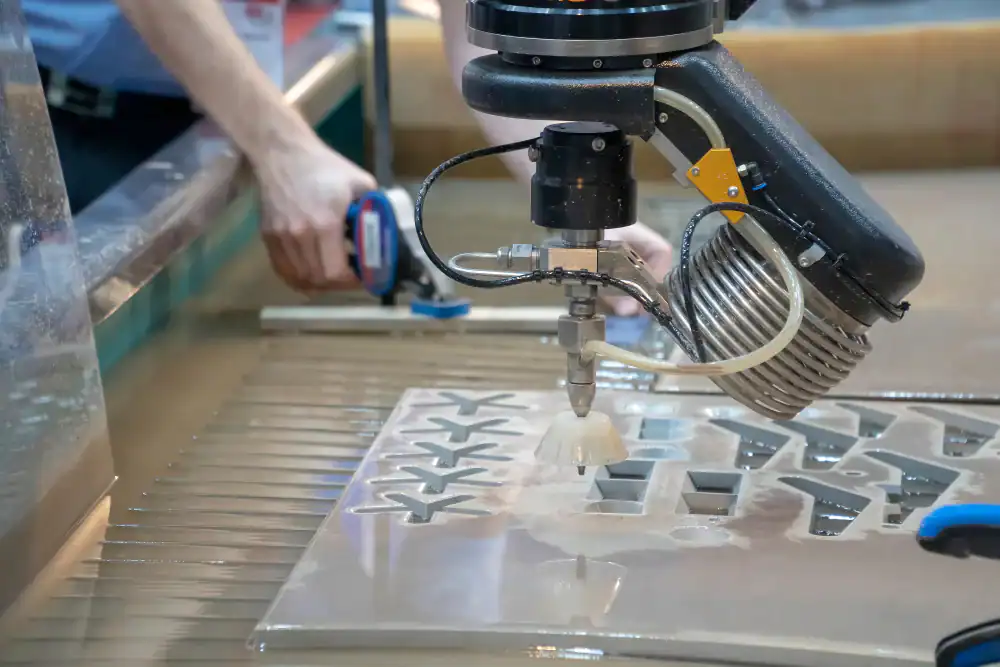
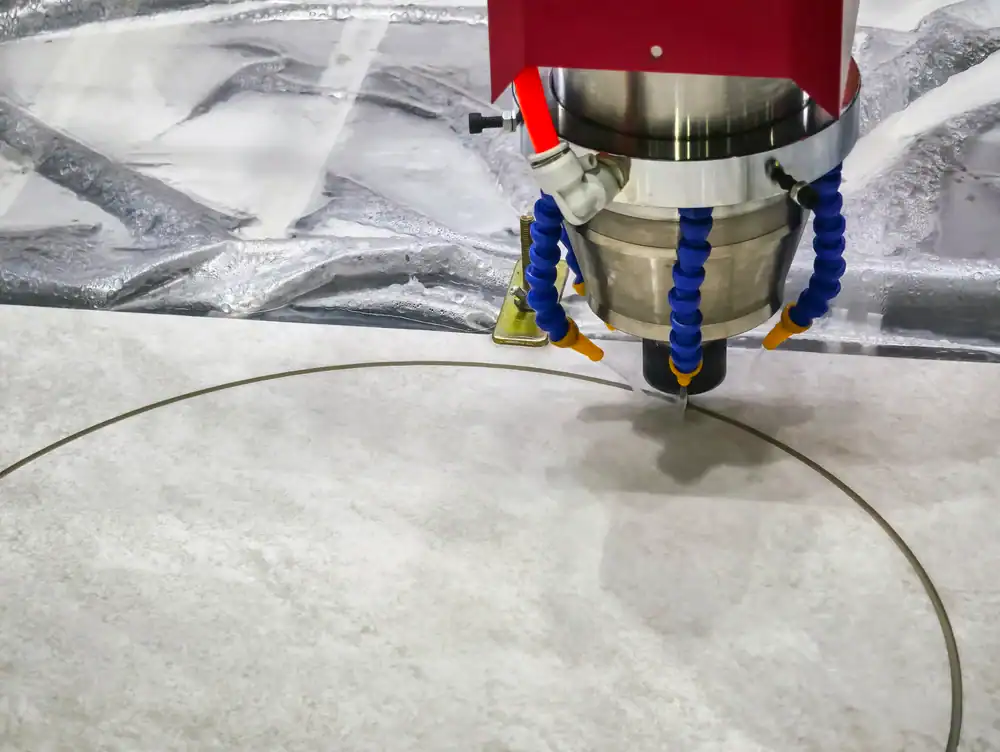
Once programming is locked in, the waterjet system runs the job. Water pressurized up to 90,000 PSI mixes with garnet abrasive and cuts through your material with a stream thinner than a human hair. The CNC controls the path, speed, and pressure to maintain tight tolerances across the entire part—even on intricate shapes, tight radii, or small holes.
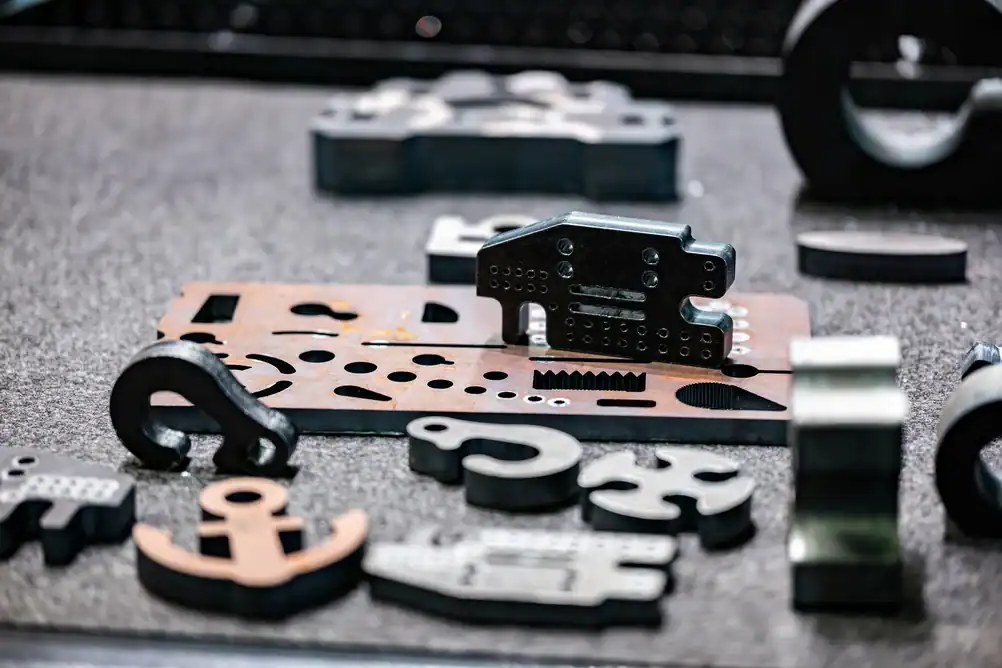
There’s no tool wear to account for, no heat-affected zones to manage, and no need for pre-drilled starting holes. The system can cut materials up to six inches thick, and with 5-axis capability, we can handle angled cuts and complex 3D geometries. After the cut, parts come off the table with clean edges and accurate dimensions, ready for assembly or minimal finishing.
Ready to get started?
Every job includes full CNC programming, material handling, and quality checks to confirm dimensions match your specs. You’re not paying for trial runs or tooling changes—waterjet cutting doesn’t need them. The abrasive stream adjusts to the material, whether you’re cutting soft rubber or hardened Inconel.
In Bay Shore and across Long Island, NY, manufacturers are dealing with tighter tolerances and more complex designs than ever. Aerospace and defense companies need parts that meet strict standards. Metal fabricators need clean cuts on thick plate without edge hardening. Pharmaceutical equipment manufacturers need non-contaminating processes that won’t introduce heat or metal particles.
Precision waterjet cutting handles all of that. You get burr-free edges, no material distortion, and the ability to nest multiple parts on a single sheet to reduce waste. The process is also cleaner than plasma or laser cutting—no hazardous fumes, minimal dust, and the abrasive and scrap metal are both recyclable. If you’re running a shop in Bay Shore where quality and efficiency matter, this is how you keep production moving without the bottlenecks that come from rework or secondary operations.
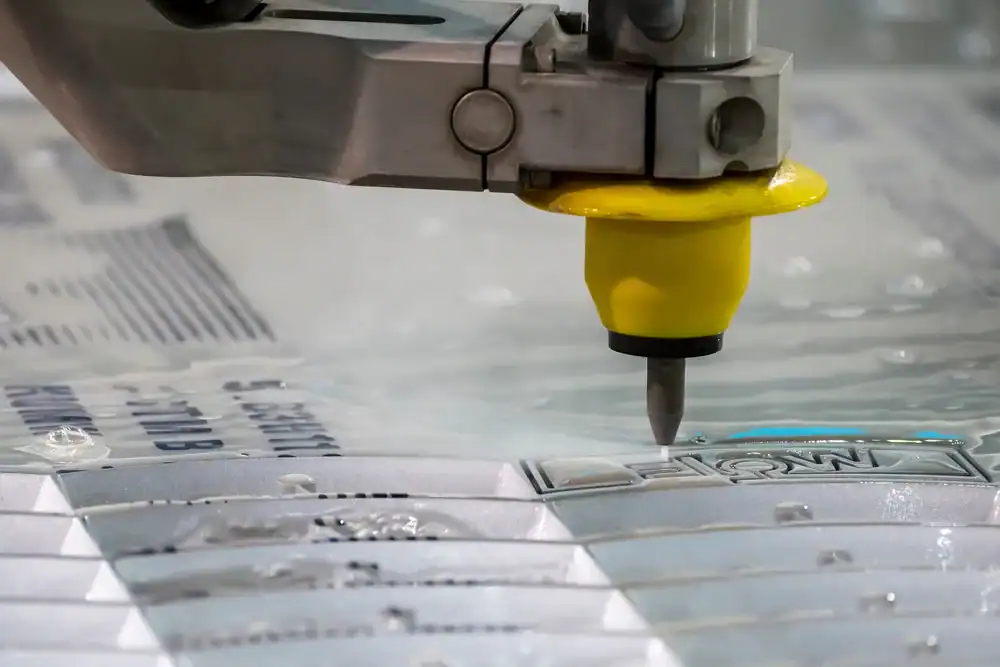
Precision waterjet cutting in Bay Shore can hold tolerances down to ±0.0001″ depending on material thickness, part geometry, and machine calibration. For most production work, you’re looking at ±0.005″ to ±0.001″ consistently, which is tight enough for aerospace, medical, and high-precision manufacturing applications.
The key difference is that waterjet doesn’t generate heat, so there’s no thermal expansion during the cut. That means the dimensions you program are the dimensions you get, even on materials like titanium or Inconel that are notorious for moving under heat. The CNC system compensates for variables like abrasive flow, water pressure, and cutting speed to maintain accuracy across the entire part.
Complex shapes with tight radii, narrow slots, or small holes don’t require special tooling or multiple setups. The waterjet stream is thin enough to navigate intricate paths without deflection, and because there’s no mechanical force on the material, you won’t see the kind of distortion that happens with stamping or punching. If your part has features that need to align perfectly or fit into tight assemblies, waterjet gives you the control to make that happen.
Yes. Precision CNC waterjet cutting in Bay Shore can cut materials up to six inches thick while maintaining clean edges and dimensional accuracy. The process works by adjusting pressure, abrasive flow, and cutting speed based on material type and thickness, so you’re not sacrificing quality for capacity.
Thicker materials do require slower cutting speeds to maintain edge finish, but the tradeoff is worth it. You get a smooth, burr-free edge without the heat-affected zone that comes with plasma or laser cutting. That’s especially important on thick steel plate or hardened alloys where heat can change the material properties and create brittleness or cracking along the cut line.
For parts that need angled cuts or beveled edges on thick material, 5-axis waterjet systems can tilt the cutting head to machine complex geometries in a single pass. This eliminates the need for secondary machining or hand-finishing, which saves time and reduces the risk of dimensional errors. If you’re working with heavy plate or structural components that need precise fitment, waterjet handles it without the limitations you’d run into with traditional cutting methods.
Precision water jet cutting services in Bay Shore can cut virtually any material—metals, plastics, composites, rubber, glass, stone, and ceramics. The abrasive stream is adjustable, so whether you’re cutting soft foam or hardened tool steel, the process adapts without changing tooling or setup.
For metals, that includes stainless steel, aluminum, titanium, Inconel, copper, brass, and hardened alloys that would wear down cutting tools or generate excessive heat with other methods. Waterjet doesn’t care about material hardness because it’s not relying on mechanical force—it’s eroding the material with high-velocity abrasive particles suspended in water.
For non-metals, you can cut plastics like acrylic, polycarbonate, and PTFE without melting or chipping. Composites like carbon fiber and fiberglass cut cleanly without delamination. Rubber and gasket materials cut without tearing or distortion. If you’re working with mixed-material assemblies or need to cut dissimilar materials in the same production run, waterjet handles it all on the same machine without reconfiguration. That flexibility is hard to match with any other cutting process.
Precision waterjet cutting for tight tolerances in Bay Shore offers advantages over CNC machining in specific situations—particularly when you’re dealing with thin materials, complex 2D shapes, or parts that can’t handle the heat and mechanical stress of traditional machining.
Waterjet doesn’t generate heat, so there’s no thermal distortion or material hardening. It doesn’t apply mechanical force, so thin-walled parts won’t deflect or vibrate during the cut. And there’s no tool wear to account for, which means the first part and the last part in a production run come out identical. For flat parts with intricate profiles, waterjet is often faster and more cost-effective than machining because there’s no need for multiple tool changes or complex fixturing.
That said, CNC machining still has the edge on 3D geometries, threaded features, and parts that require extremely fine surface finishes or tolerances tighter than ±0.0001″. The two processes complement each other. Many shops use waterjet to rough-cut blanks or create near-net shapes, then finish critical features on a CNC mill. If your part is primarily 2D with tight tolerances and you want to avoid heat and tool marks, waterjet is the smarter choice.
Most parts cut with high precision waterjet cutting in Bay Shore come off the table with a fine, sand-blasted edge finish that doesn’t require deburring or secondary processing. The edge quality depends on cutting speed and abrasive flow—slower cuts produce smoother finishes, while faster cuts may leave a slightly rougher texture.
For parts that need to go straight into assembly or welding, the as-cut finish is usually acceptable. There’s no burr, no sharp edge, and no heat-affected zone that would need grinding or machining. If you do need a polished or mirror finish, waterjet gives you a clean starting point that’s easier to finish than a thermally cut edge with slag, dross, or hardened material.
The other advantage is that waterjet doesn’t leave residual stress in the material. Laser and plasma cutting introduce heat that can warp thin parts or create internal stresses that show up later during forming or welding. Waterjet eliminates that risk, so the part you cut is the part you use—no surprises after the fact. If you’re running a high-volume production shop in Bay Shore where finishing time adds up, waterjet cuts down on labor and keeps parts moving through your workflow without extra steps.
Turnaround depends on material type, thickness, part complexity, and current shop capacity, but precision waterjet cutting shop Bay Shore jobs typically move faster than you’d expect because there’s no tooling to build, no setup changes between materials, and no heat cooldown time between cuts.
Simple parts on thin material can often be programmed and cut the same day. More complex jobs with thick material or tight tolerances might take a few days, but that’s still faster than waiting for custom tooling or dealing with the trial-and-error that comes with thermal cutting methods. The CNC system runs unattended once it’s programmed, so jobs can continue overnight or during off-hours without operator intervention.
If you’re dealing with a rush job or need prototype parts quickly to test fit and function, waterjet is one of the fastest ways to go from CAD file to finished part. There’s no lead time for tooling, no minimum order quantities, and no penalty for cutting one-off custom shapes. For Bay Shore manufacturers who need fast turnaround without sacrificing accuracy, that flexibility makes a real difference in keeping projects on schedule.
Useful Links
Other Services we provide in Bay Shore