Hear from Our Customers
You’re dealing with specs that don’t have room for error. A few thousandths off means rework, delays, and explaining to your customer why the job’s late. That’s not a position you want to be in.
Precision water jet cutting services handle the materials traditional methods can’t touch without compromising them. No heat-affected zones means no warping, no hardening, no metallurgical changes that throw your tolerances out the window. The cut you specify is the cut you get.
Your production schedule doesn’t have buffer time built in for someone else’s learning curve. You need a precision waterjet cutting shop in Bohemia, NY that understands tight timelines and tighter tolerances. When you’re working with aerospace components, architectural metalwork, or custom fabrication that has to fit exactly right, the difference between ±0.005″ and ±0.001″ isn’t academic—it’s the difference between a part that works and one that doesn’t.
We serve manufacturers, contractors, and designers across Bohemia and the broader Long Island, NY market. We’re based in West Islip, which means you’re working with a local shop that understands the pace and demands of the regional manufacturing environment.
Long Island, NY has roughly 3,000 small and medium manufacturers between Nassau and Suffolk counties. That’s a lot of production happening, and a lot of shops competing for the same customers you are. Your edge comes from delivering quality consistently, and that starts with the precision of your components.
We work with the same supply chain challenges you do. When you need precision CNC waterjet cutting done fast, you’re not dealing with a distant facility that doesn’t understand the urgency. You’re working with a team that knows what it means when a contractor’s waiting on parts or a designer’s timeline just got compressed.
You send us your design file—DXF, DWG, or whatever format you’re working in. We review it for any potential issues with kerf width, corner radii, or nesting efficiency that might affect your material costs or tolerances.
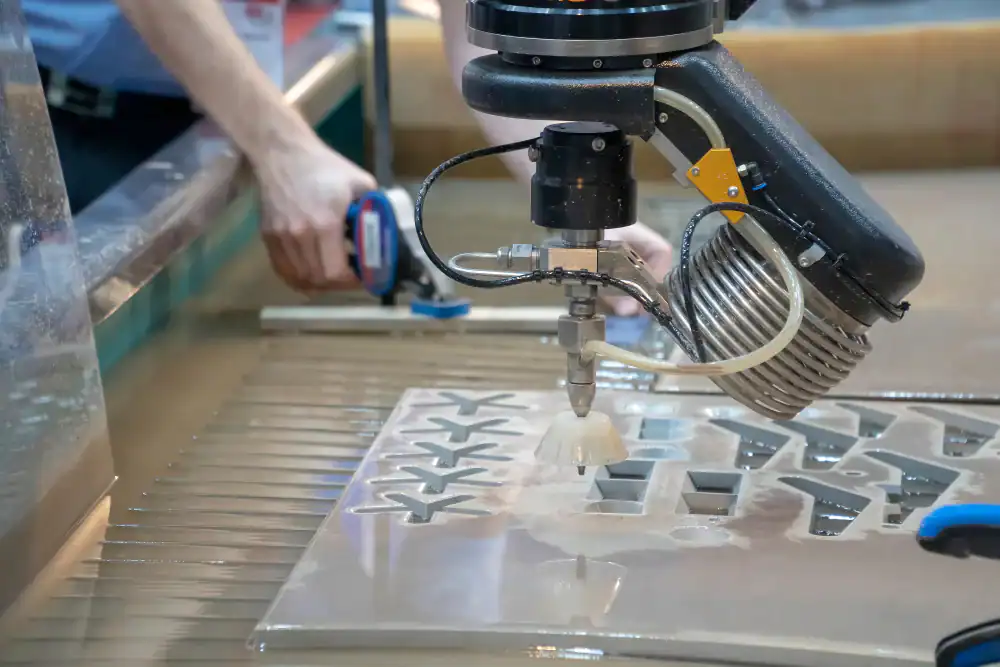
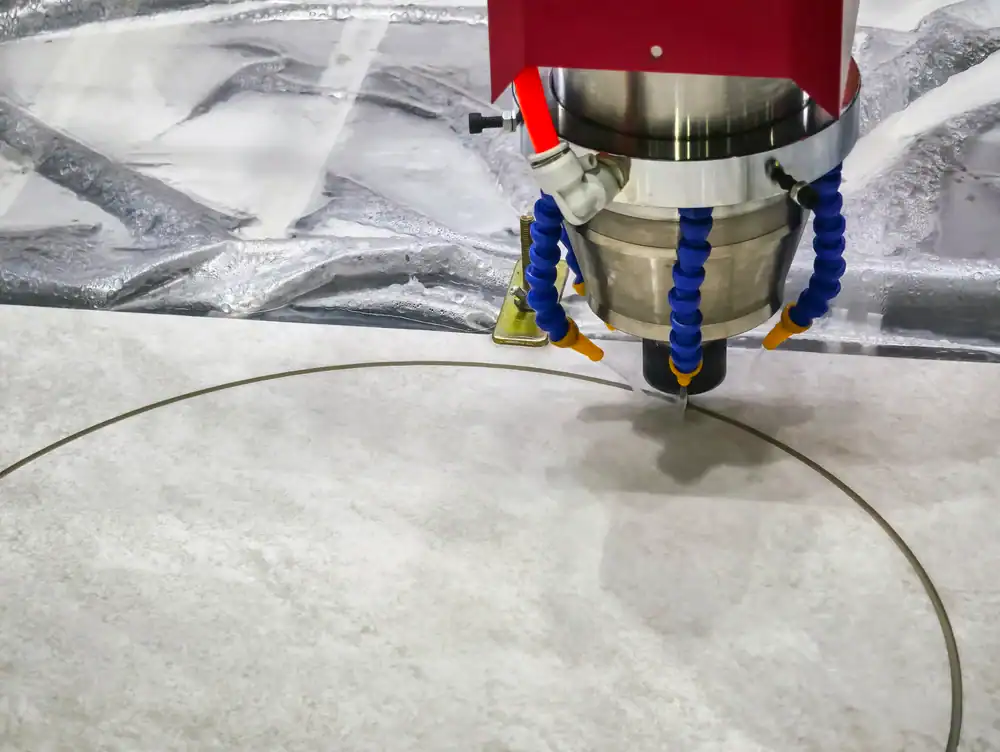
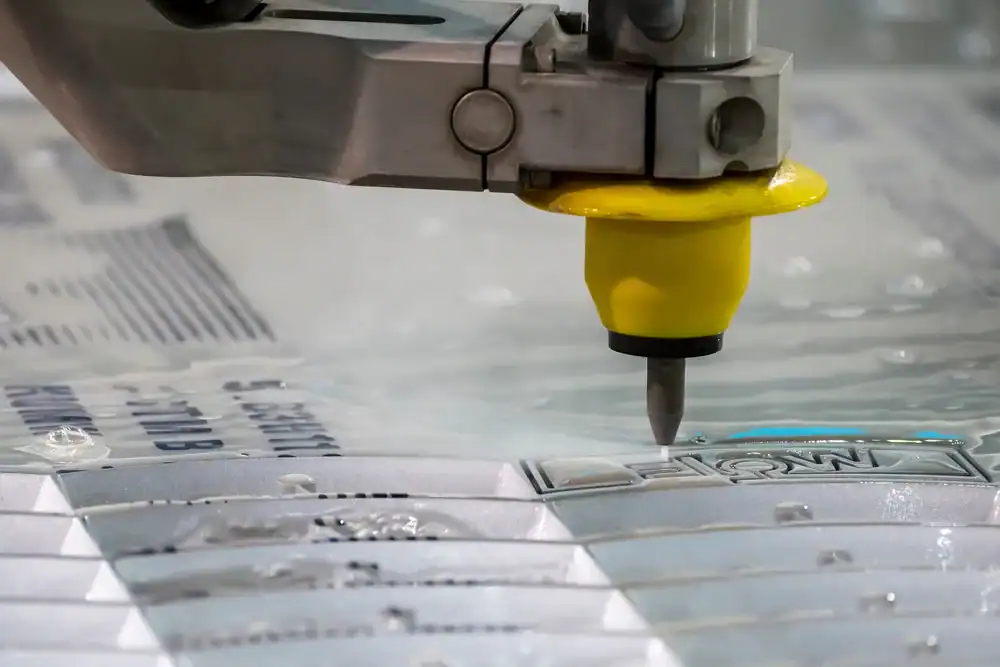
Once the file’s dialed in, we program the cut path into our CNC system. The waterjet uses a high-pressure stream mixed with abrasive garnet to cut through your material. No blades wearing down and changing dimensions mid-job. No heat building up and changing the material properties. Just water and abrasive doing exactly what the program tells them to do.
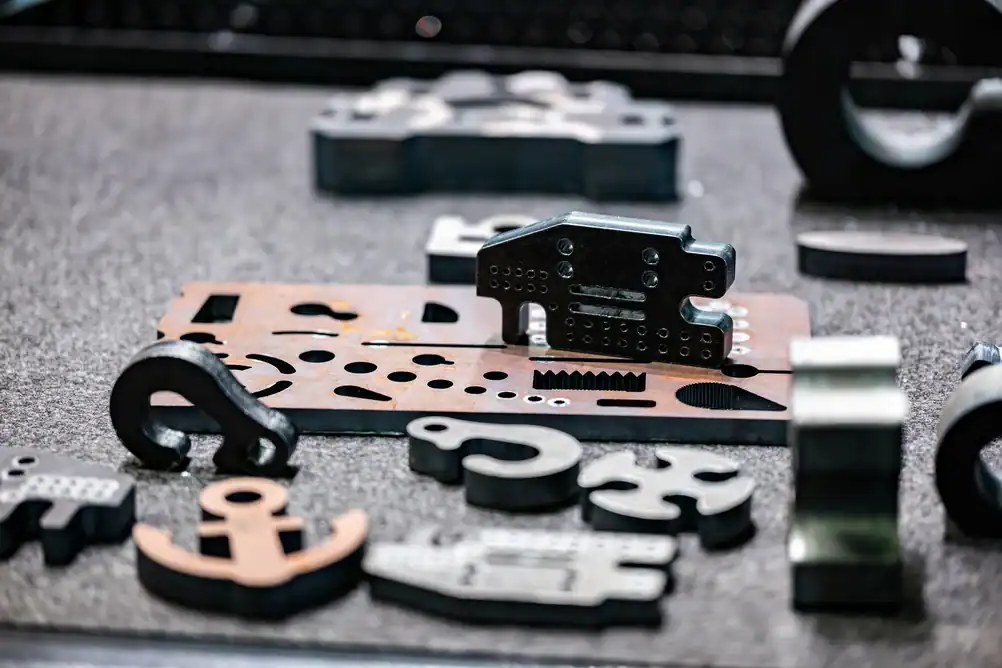
The process is cold, which matters more than most people realize until they’ve dealt with heat warping on a critical part. You can cut hardened tool steel right next to aluminum without worrying about different thermal expansion rates throwing your tolerances off. The material comes off the table ready to use in most cases—no secondary deburring, no grinding to remove heat scale, no stress relieving.
Turnaround depends on complexity and material thickness, but you’re typically looking at days, not weeks. We handle materials up to 8 inches thick, which gives you options when you’re spec’ing parts that other cutting methods can’t manage in a single operation.
Ready to get started?
Tolerances down to ±0.001″ on most materials. That’s not marketing language—that’s what the process delivers when it’s set up correctly. You’re getting dimensional accuracy that holds up across the entire cut, not just on the first few parts before tooling starts to wear.
Material versatility matters when you’re not always working with the same stock. Metals, composites, stone, glass, rubber—the process handles all of it without changing tooling or setup. If you’re a shop doing custom architectural work in Bohemia, that means you can cut stainless steel brackets and glass panels in the same day without retooling.
Kerf width runs about 0.030″ to 0.040″, which is thin enough to nest parts closely and minimize scrap. When you’re working with expensive materials like titanium or Inconel, that material savings adds up fast. You’re not leaving money on the floor in the form of chips and offcuts.
Edge quality comes off clean. You’re typically looking at a surface finish between 125 and 250 Ra depending on material and cutting speed. For most applications, that’s ready to go as-is. When you do need secondary finishing, you’re removing a few thousandths, not trying to clean up a rough plasma edge or a burned laser cut.
Pretty much anything that’s not tempered glass or certain ceramics. Metals are the most common—aluminum, stainless steel, tool steel, titanium, Inconel, brass, copper. Thickness up to 8 inches depending on material density.
Composites and plastics work well because there’s no heat to melt or deform the material. Carbon fiber, G10, acrylic, polycarbonate, nylon—all cut clean without the edge melting or the material delaminating. Stone, tile, and glass are also options if you’re doing architectural or decorative work.
The cold cutting process means you’re not limited by melting points or heat sensitivity. If you’ve got a material that warps or hardens when you try to cut it with traditional methods, waterjet usually solves that problem. The only real limitation is material friability—if it crumbles or shatters under pressure, waterjet won’t work.
Standard tolerance is ±0.005″, which handles most commercial and industrial applications without issue. When you need tighter, we can hold ±0.001″ on critical dimensions with proper setup and slower cutting speeds.
The accuracy stays consistent because there’s no tool wear changing your dimensions mid-cut. A plasma torch degrades, a laser lens gets dirty, a mill bit dulls—waterjet doesn’t have those variables. The stream diameter stays constant, which means part 100 matches part 1.
Corner radii are typically 0.015″ to 0.030″ depending on material thickness and cutting speed. If you need sharper internal corners, we can make relief cuts or approach it from multiple angles. The kerf width is narrow enough that you can nest parts with minimal spacing, which matters when you’re trying to maximize material usage on expensive stock.
Heat. That’s the main reason. Laser and plasma both create heat-affected zones that change the material properties right at the edge of your cut. You get hardening, warping, oxidation, and sometimes micro-cracking depending on the material. For precision work, those changes matter.
Waterjet is a cold process. The material temperature barely rises during cutting, which means no thermal stress, no warped parts, no hardened edges that are difficult to machine in secondary operations. If you’re cutting parts that need to fit together with tight tolerances, thermal expansion during cutting throws those dimensions off.
Material versatility is the other factor. Laser works great on thin metals but struggles with reflective materials like copper or brass. Plasma is fast but rough. Waterjet handles thick materials, reflective materials, and composites without changing setup or worrying about material properties affecting cut quality. When you’re running a shop that handles diverse jobs, that flexibility keeps you from turning work away.
Most jobs run 2-5 business days from approved file to finished parts. Simple cuts in common materials move faster. Complex geometries, thick materials, or large production runs take longer. Rush service is available when your timeline doesn’t allow for standard turnaround.
The actual cutting time varies based on material thickness and complexity. Thin aluminum with simple shapes might run 1-2 minutes per part. Thick stainless with intricate details could be 20-30 minutes per part. We can give you a solid estimate once we see your file and know your material specs.
Programming and setup time is usually a few hours unless you’ve got an extremely complex part. The advantage of CNC waterjet is that once it’s programmed, it runs unattended. We can often run jobs overnight or over weekends to meet tight deadlines without adding labor costs that get passed to you.
Most parts come off the table ready to use. The edge quality is clean enough for assembly in the majority of applications. You’ll see some abrasive residue that rinses off, and there might be a slight burr on the bottom edge depending on material, but it’s minimal compared to plasma or laser.
When you do need secondary finishing, you’re typically removing 0.002″ to 0.005″ to get to your final dimension or surface finish. That’s a light touch compared to cleaning up a rough cut from other methods. For parts that need to be deburred for safety or aesthetic reasons, a quick pass with a file or tumbling usually handles it.
If your application requires a specific surface finish or edge treatment, let us know up front. We can adjust cutting speed and abrasive flow to optimize edge quality, or we can work with your finishing vendor to make sure the parts come off our table in the right condition for their process.
The kerf width is narrow—about 0.030″ to 0.040″—which means you can nest parts closer together than with most other cutting methods. When you’re working with expensive materials, that tighter nesting directly reduces your material cost per part. Less scrap means you’re getting more finished parts from each sheet or plate.
There’s no heat-affected zone to trim off, no burned edges to grind away, and no warped parts to scrap because they don’t meet tolerance. Every part that comes off the table is usable, which improves your yield rate. When you’re quoting jobs, that predictability matters for your margins.
Setup costs are lower because there’s no hard tooling to build or replace. You’re not buying custom dies, punches, or specialized cutting tools that wear out and need replacement. The abrasive is cheap, and the water is recycled. For short runs and custom work, that cost structure makes waterjet competitive even on parts where other methods might seem faster.
Useful Links
Other Services we provide in Bohemia