Hear from Our Customers
You’re not cutting parts for fun. You need them to fit, function, and meet tolerance requirements without eating up your timeline or budget on rework.
That’s where precision waterjet cutting makes sense. The process uses a high-pressure stream of water mixed with abrasive garnet to cut through metal, stone, glass, composites, and more—without introducing heat. No warping. No hardening. No melted edges that need grinding down later.
You get parts with tolerances as tight as ±0.001″, burr-free edges, and cuts that handle complex geometries most other methods can’t touch. Whether you’re prototyping a single piece or running production volumes, the setup is fast and the results are repeatable. That means fewer delays, less waste, and components that actually work the way you designed them.
If you’re in aerospace, automotive, architecture, or manufacturing and you’ve dealt with inconsistent quality or lead times that drag—this is the alternative. Precision CNC waterjet cutting in East Patchogue, NY gives you control over outcomes, not just promises.
We operate out of East Patchogue, NY, serving manufacturers, architects, contractors, and designers across Long Island, NY and the surrounding region. We’re not the biggest shop, and we’re not trying to be. What we are is focused—on precision, material knowledge, and turnaround times that don’t leave you waiting weeks for a test cut.
Our equipment handles everything from 1/16″ up to 10″ thick material. We work with metals like titanium, aluminum, stainless steel, and tool steel, plus stone, tile, acrylic, rubber, and composites. If you’re not sure whether your material will work, we’ll tell you straight.
East Patchogue sits in a manufacturing corridor that’s seen steady growth in aerospace subcontracting, custom architectural fabrication, and precision component production. We’re here because the work is here—and because the industries operating in this area need a precision water jet cutting services provider in East Patchogue, NY that understands what’s at stake when parts don’t meet spec.
You send us a CAD file, a drawing, or even a sketch if that’s what you’re working from. We review it, confirm material type and thickness, and flag anything that might affect the cut—like interior corners, small holes, or edge finish expectations.
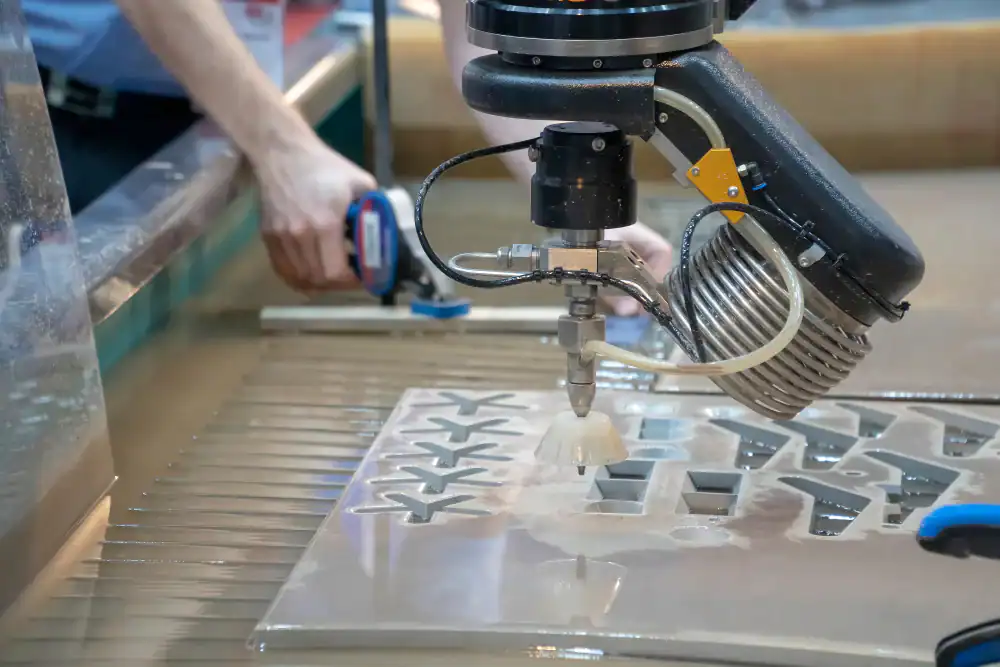
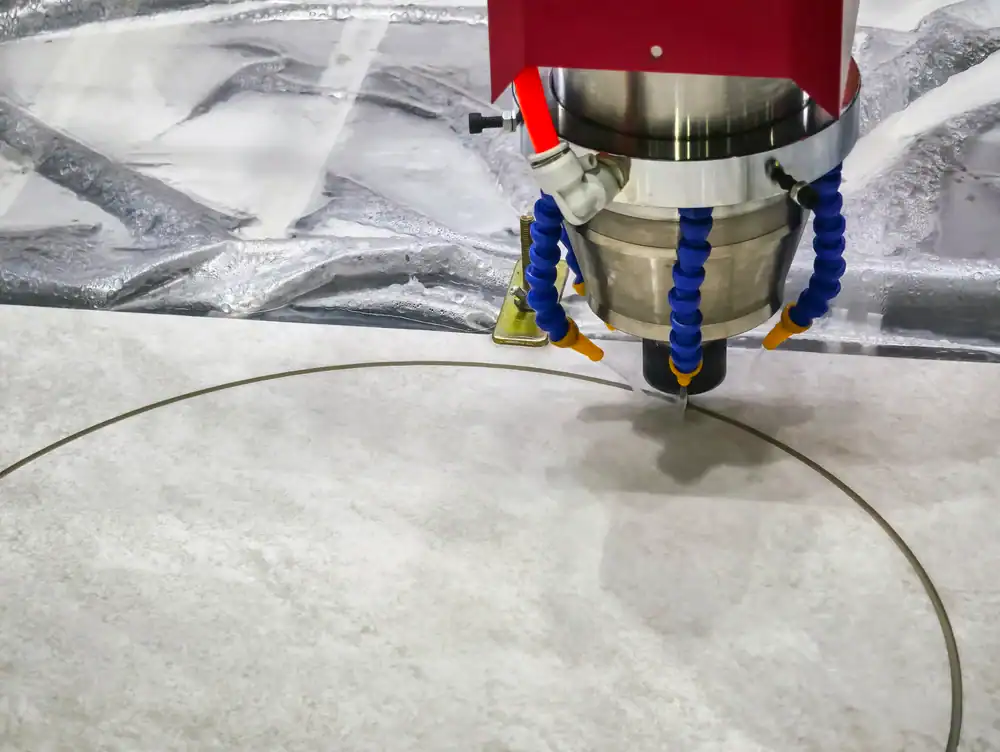
From there, we program the cut using CNC-controlled waterjet systems. The machine follows your design with a stream of water pressurized up to 60,000 PSI, mixed with fine abrasive garnet. The cutting head moves in multiple axes to handle angles, bevels, and complex shapes without repositioning the material. There’s no heat, so there’s no thermal distortion or hardened edges to deal with later.
Once the cut is complete, we inspect dimensions and edge quality. If you’re running a prototype, we measure the first piece and send you results before moving to production. If it’s a repeat order, we follow the same parameters we used last time—no guesswork, no drift in quality.
Most projects move through in days, not weeks. Setup is fast because we’re not swapping tooling or waiting for custom dies. You get what you ordered, when you need it, without the back-and-forth that comes from working with a shop that’s guessing.
Ready to get started?
When you bring a project to us, you’re getting more than just a cut. You’re getting material consultation, file review, and tolerance verification before we ever turn the machine on.
We’ll tell you if your design has features that won’t hold up in your chosen material. We’ll recommend thickness adjustments if it improves structural integrity or cost. And if you’re working with a material we haven’t cut before, we’ll run a test piece and measure it before committing to a full run. That’s standard, not an upsell.
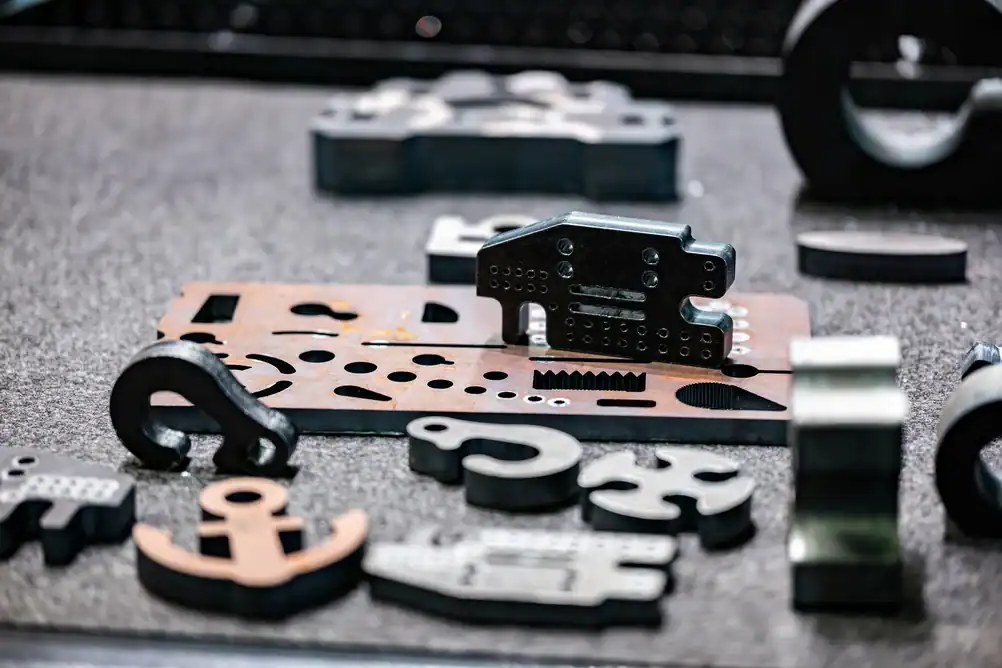
East Patchogue’s proximity to major aerospace and architectural firms means we see a lot of demanding applications—aircraft components, custom metal inlays, structural brackets, and decorative panels that need to fit perfectly the first time. The tolerance expectations here are high, and the timelines are tight. We built our process around that reality.
You also get access to 5-axis cutting capability, which matters when you need angled edges, beveled cuts, or complex 3D shapes. And because waterjet is a cold-cutting process, you’re not dealing with heat-affected zones that compromise material properties. That’s critical in aerospace and automotive work, where metallurgical integrity isn’t optional.
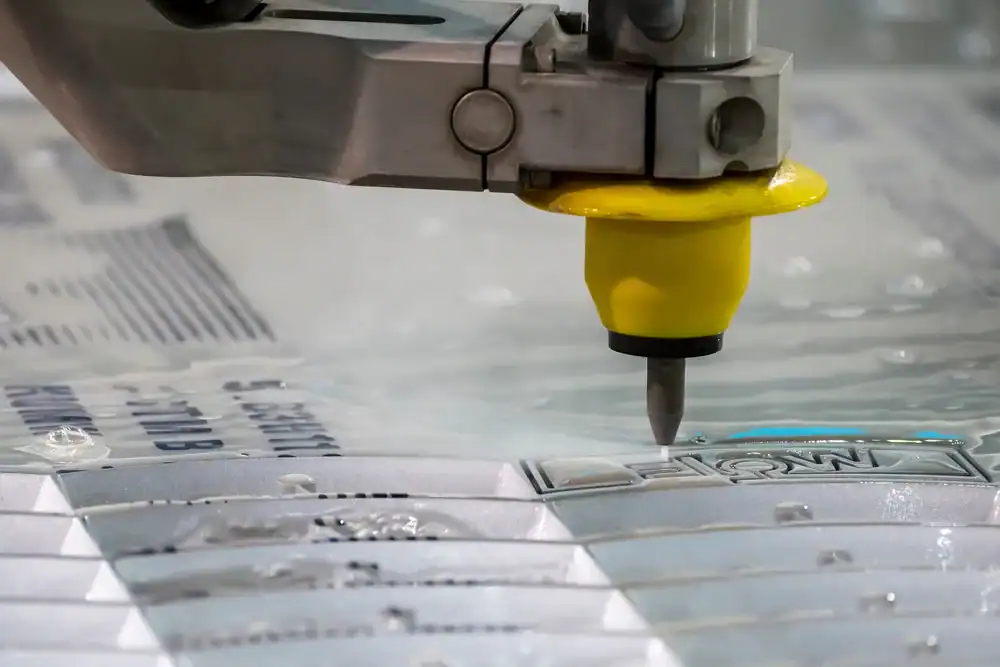
Waterjet cuts just about anything—metals, composites, stone, glass, rubber, foam, tile, and more. On the metal side, that includes aluminum, stainless steel, titanium, tool steel, brass, copper, and carbon steel. Thickness ranges from 1/16″ up to over 10″ depending on material hardness and your tolerance requirements.
The process works because it’s abrasive, not thermal. There’s no melting, so you’re not limited by a material’s melting point or thermal sensitivity. That opens up options for heat-sensitive alloys, laminated materials, and composites that would degrade or delaminate under laser or plasma cutting.
If you’re not sure whether your material will work, send us the specs. We’ll tell you what’s possible and what tolerances we can hold before you commit to anything.
Standard waterjet tolerances sit around ±0.002″. With proper setup, calibration, and the right equipment, you can push that to ±0.001″ on certain materials and geometries. That’s tighter than most plasma or oxy-fuel processes, and it’s achievable without secondary machining in many cases.
Tolerance depends on a few factors: material type, thickness, edge quality requirements, and part geometry. Thicker materials and harder alloys can shift the tolerance slightly. Interior corners and small holes also affect precision—there’s a physical limit to how tight a radius the waterjet stream can navigate.
If your project requires tolerances tighter than ±0.001″, we’ll tell you up front and discuss whether additional finishing makes sense. But for the majority of precision work—aerospace brackets, custom panels, prototype parts—waterjet hits the mark without extra steps.
Most waterjet cuts come off the machine with clean, burr-free edges that don’t need grinding or deburring. The abrasive stream exits the material cleanly, so you’re not dealing with the slag, dross, or heat-affected zones that come with thermal cutting methods.
Edge finish quality depends on cutting speed and abrasive flow rate. A slower cut with higher abrasive concentration produces a smoother edge. A faster cut prioritizes speed over finish but still avoids the rough, burnt edges you’d see from plasma or torch cutting.
In some cases—especially with thicker materials or when you need a polished edge for aesthetic reasons—light finishing might make sense. But that’s the exception, not the rule. For functional parts, brackets, and components that get assembled or welded, waterjet edges are ready to go as-cut.
Turnaround depends on complexity, material, and current shop schedule—but most projects move through in days, not weeks. Simple cuts on thinner materials can often be completed same-day or next-day if the schedule allows. More complex parts with tight tolerances, thicker materials, or high quantities take longer but rarely stretch past a week.
Setup time is one of the biggest advantages of waterjet. There’s no custom tooling to fabricate, no dies to machine, and no tool changes between cuts. We program the machine from your CAD file, load the material, and start cutting. That’s it.
If you’re running a prototype or first article, we’ll cut one piece, measure it, and send you results before moving forward. That adds a day or two but saves you from discovering fit issues after a full production run. For repeat orders, we use the same program and parameters, so there’s no re-setup—just load and cut.
Yes. Waterjet excels at intricate geometries, tight inside corners, small holes, and irregular shapes that would be difficult or impossible with punch presses, saws, or routers. The cutting stream is narrow—typically around 0.020″ to 0.040″—so it can navigate detailed paths without requiring multiple setups or tool changes.
Interior corners will have a small radius based on the kerf width of the stream. You won’t get a perfectly sharp 90-degree corner, but the radius is minimal and usually well within design tolerances for functional parts. If your design requires truly sharp corners, we can approach from two directions or discuss secondary machining options.
5-axis waterjet systems add another layer of capability. The cutting head can tilt and rotate, which allows for beveled edges, angled cuts, and 3D shapes that a standard 2-axis system can’t handle. That’s useful for aerospace components, architectural details, and any application where the part needs to fit or mate at an angle.
Waterjet doesn’t introduce heat, so there’s no warping, no hardened edges, and no change to the material’s metallurgical properties. That matters in aerospace, automotive, and any application where material integrity is critical. Laser and plasma both create a heat-affected zone that can compromise strength, hardness, and dimensional accuracy.
Waterjet also handles a wider range of materials and thicknesses. Lasers struggle with reflective metals like aluminum and copper. Plasma works well on conductive metals but can’t cut stone, glass, rubber, or composites. Waterjet cuts all of it, up to 10″ thick or more, without switching processes.
Edge quality is another factor. Waterjet produces clean, burr-free cuts that typically don’t need secondary finishing. Laser and plasma both leave some degree of dross, slag, or oxidation that requires cleanup. If you’re trying to minimize labor and keep parts moving through production, waterjet saves time on the back end.
Useful Links
Other Services we provide in East Patchogue