Hear from Our Customers
You’re not chasing down rework because a laser warped your part. You’re not explaining to your customer why the tolerance drifted or why there’s a heat-affected zone where there shouldn’t be one.
With our precision water jet cutting services in Jericho, NY, you get dimensional accuracy within +/- 0.005 inches on complex geometries. No thermal distortion. No hardened edges. No secondary deburring eating into your timeline.
That means your parts fit the first time. Your assembly doesn’t stall. Your production schedule holds. Whether you’re cutting aerospace-grade aluminum, hardened tool steel, or layered composites, the cut quality stays consistent because the process stays cold.
We serve manufacturers, fabricators, and engineers across Jericho, NY and the surrounding Long Island, NY region. This area has deep roots in aerospace and precision manufacturing—companies here understand what tight tolerances actually mean.
We work with shops that can’t afford rework and engineers who need parts that match CAD files without excuses. Our precision waterjet cutting shop in Jericho, NY handles everything from one-off prototypes to production runs, and we don’t treat those jobs differently when it comes to accuracy.
You’re working with a team that knows the difference between “close enough” and “within spec.”
You send us your CAD file or technical drawing. We review it for cuttability—things like kerf width, inside corners, and material thickness. If something won’t cut the way you need it to, we’ll tell you before we start.
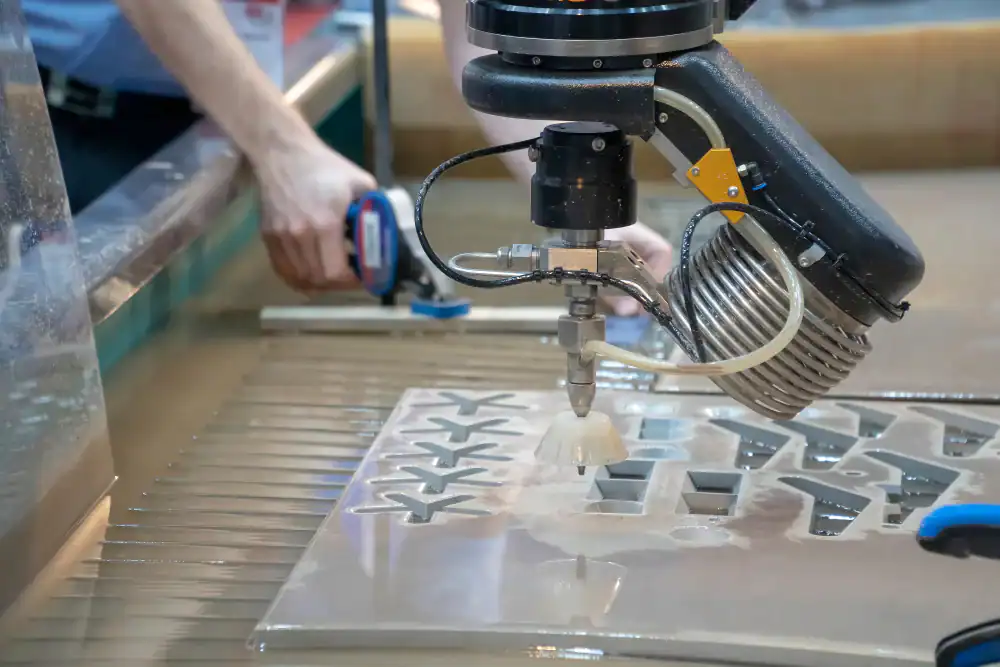
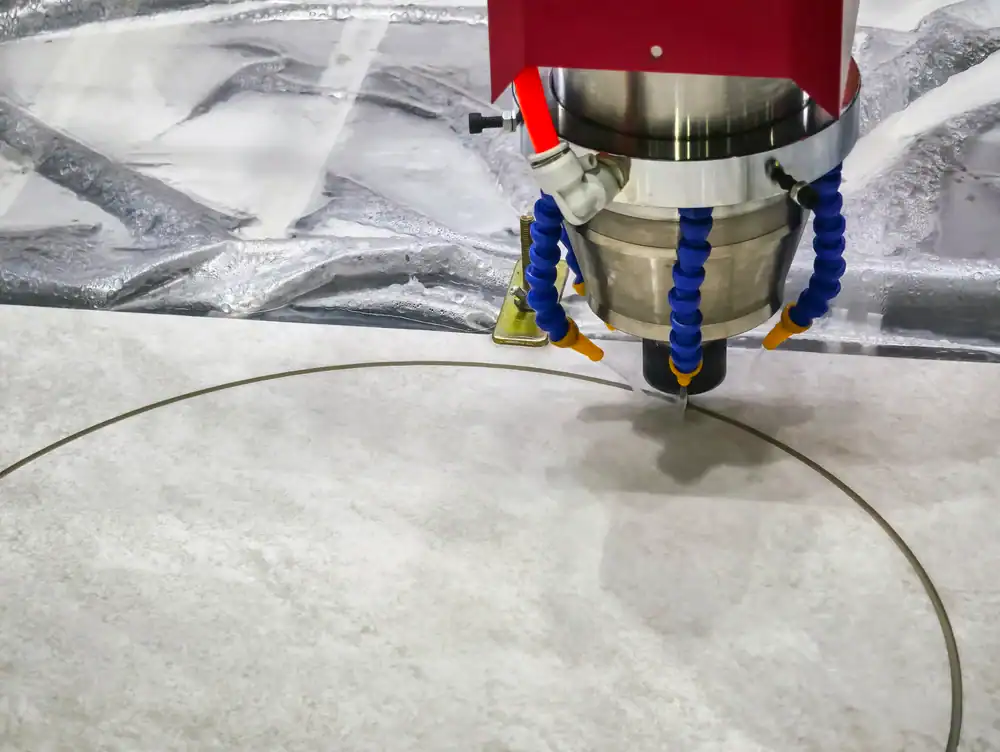
Once the file is programmed into our precision CNC waterjet cutting system in Jericho, NY, the machine follows the toolpath with repeatable accuracy. The abrasive waterjet stream cuts through your material without generating heat, so there’s no warping, no HAZ, and no change to the material’s properties.
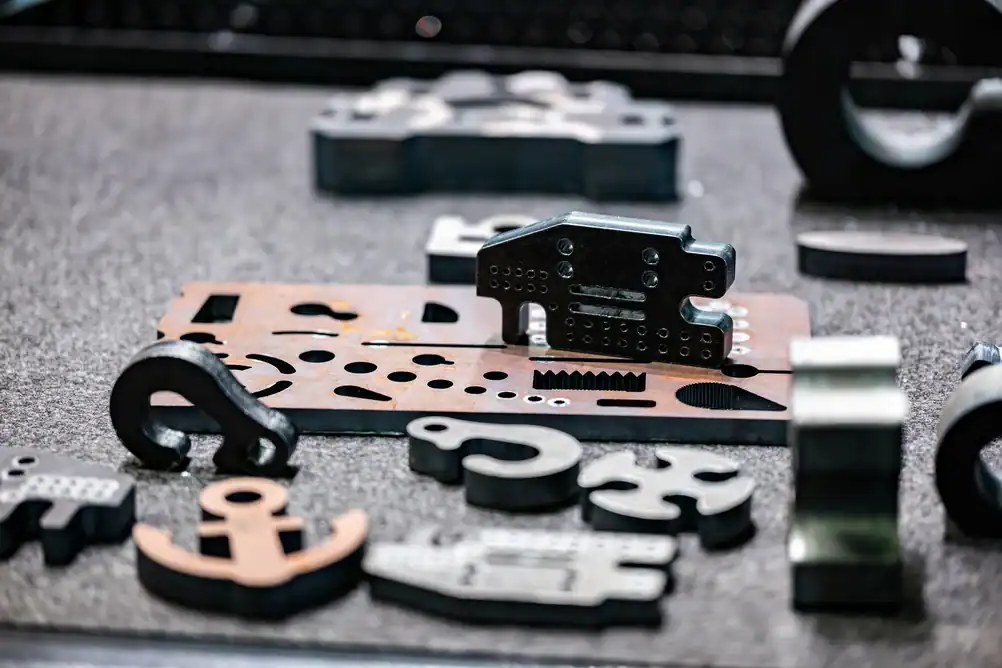
After cutting, parts come off the table with clean edges. Most jobs don’t need additional finishing unless you’re chasing a specific surface requirement. You get what you specified, and you get it faster than methods that require multiple setups or secondary operations.
Ready to get started?
Our precision waterjet cutting for tight tolerances in Jericho, NY handles materials up to 8 inches thick. That includes stainless steel, titanium, Inconel, copper, aluminum, tool steel, glass, stone, composites, and plastics. If it’s too hard for a blade or too sensitive for a laser, waterjet handles it.
You also get complex shapes without limitations. Tight inside radii, narrow slots, small holes, intricate contours—the five-axis capability means we can cut bevels and angles without repositioning your part. That cuts down on setup time and keeps tolerances tighter across multi-sided geometry.
Jericho’s manufacturing sector—especially the aerospace and defense supply chain that’s been here since the Grumman days—demands this level of precision. When you’re producing components that go into aircraft, medical devices, or high-performance machinery, you’re not looking for “good enough.” You need cuts that won’t fail inspection, won’t require rework, and won’t slow down your production line.
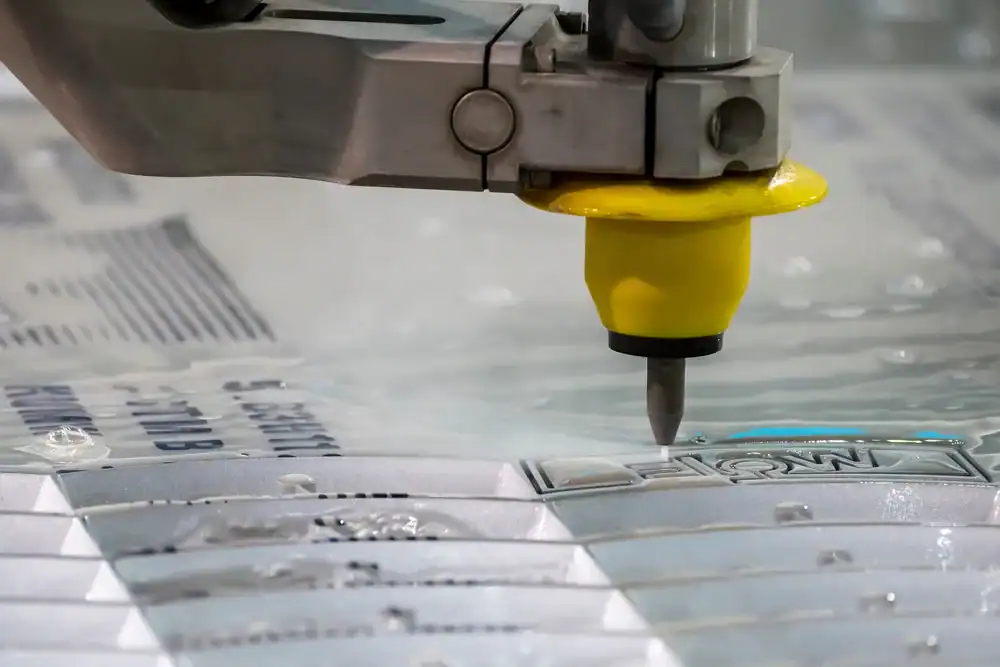
Waterjet cutting holds tolerances around +/- 0.005 inches on most materials, which is tighter than plasma and comparable to laser—but without the heat. Laser cutting introduces a heat-affected zone that can warp thin materials or change hardness near the cut edge. Plasma is faster on thick steel but leaves a wider kerf and rougher edge.
Waterjet stays cold. The stream is around 60°F, so there’s no thermal expansion, no melting, no oxidation. That matters when you’re cutting materials that are heat-sensitive or when your part needs to maintain specific material properties after cutting.
If your job requires tight tolerances and you’re working with exotic alloys, composites, or anything that can’t handle heat, waterjet is the more reliable process. You’re not fighting distortion or dealing with secondary operations to fix heat damage.
We cut metals, composites, glass, stone, rubber, foam, and plastics. On the metal side, that includes stainless steel, tool steel, aluminum, titanium, Inconel, copper, brass, and hardened alloys. Thickness ranges from thin foil up to 8 inches depending on material hardness.
For composites, we handle carbon fiber, fiberglass, Kevlar, and layered materials without delamination. Waterjet doesn’t create the heat or vibration that causes layers to separate, so your composite parts stay intact.
The process works on materials that are too brittle for mechanical cutting, too thick for laser, or too hard for conventional methods. If you’re not sure whether your material is a good fit, send us the specs. We’ll tell you what’s possible and what tolerances we can hold.
Most parts come off the table ready to use. The edge quality is clean, and there’s no burr or slag like you’d see with plasma or oxy-fuel cutting. If your application requires a specific surface finish or you’re chasing a tighter edge tolerance, secondary finishing is an option—but it’s not a requirement for most jobs.
The abrasive waterjet stream leaves a slightly textured edge. For structural parts, brackets, or components that don’t require a polished finish, that edge is fine as-is. If you need a smoother finish for aesthetic reasons or to meet a specific Ra value, we can discuss post-processing.
The advantage here is that you’re not dealing with heat scale, hardened edges, or thermal stress that needs to be machined away. You’re starting with a clean cut, so any finishing you do add is minimal. That saves time and keeps costs down compared to processes that require heavy secondary work.
Cutting speed depends on material type, thickness, and complexity. Thicker or harder materials take longer because the abrasive stream needs more time to penetrate. Intricate shapes with tight curves or small details also slow the process compared to straight cuts.
For context, cutting 1-inch stainless steel might take a few minutes per linear foot, while cutting ¼-inch aluminum is faster. A simple bracket might take 10 minutes total. A complex part with dozens of features could take an hour or more.
What speeds things up is that waterjet doesn’t require tool changes, multiple setups, or repositioning for different features. Once your part is programmed and fixtured, the machine runs the entire cut in one pass. That’s faster than methods that need different tools for different features or multiple operations to complete the part. If you have a deadline, let us know upfront—we’ll tell you whether it’s realistic based on your part’s specs.
Yes, but there are limits based on the kerf width. The waterjet stream diameter is typically around 0.030 to 0.040 inches, so the smallest hole we can cut is slightly larger than that—usually around 0.050 inches minimum. Inside corner radii will also have a small radius rather than a sharp 90-degree corner because the stream has width.
If your design requires sharp internal corners or holes smaller than the kerf allows, we’ll flag that during file review. In some cases, a design tweak—like increasing a hole diameter slightly or adding a small radius to a corner—makes the part cuttable without affecting its function.
Dynamic waterjet technology can tighten corner geometry further by adjusting stream angle and pressure during the cut, but even that has physical limits. The key is communication upfront. Send us your file, and we’ll tell you what’s achievable and where adjustments might be needed.
Aerospace parts can’t have heat-affected zones, material property changes, or dimensional drift. Waterjet cutting eliminates all three. There’s no thermal input, so the material’s hardness, grain structure, and mechanical properties stay unchanged. There’s no warping or expansion during the cut, so dimensions stay true to your CAD file.
Waterjet also handles the exotic alloys common in aerospace—Inconel, titanium, hardened stainless—without tool wear or speed limitations. A laser might struggle with reflective materials like aluminum or copper. A mill might wear through tooling on hardened steel. Waterjet cuts them all at the same quality level.
The other advantage is flexibility. If you need a prototype today and a production run next month, the setup doesn’t change. The same process that cuts one part cuts a hundred with the same accuracy. For engineers and fabricators in Jericho, NY working in aerospace, medical, or defense, that consistency matters. You’re not adjusting processes or requalifying methods between jobs.
Useful Links
Other Services we provide in Jericho