Hear from Our Customers
You’re not looking for “close enough.” You need parts that meet spec without the back-and-forth, the rework, or the excuses about why the tolerance slipped.
Precision waterjet cutting in Malverne, NY gives you that. We’re talking tolerances as tight as ±0.001 inch. No heat-affected zones that warp your material. No slag or dross to clean up afterward.
The cutting happens cold. Water and garnet abrasive do the work, which means your metal, plastic, glass, or composite stays dimensionally stable. You get a satin-smooth edge that doesn’t need grinding, deburring, or finishing before it goes into assembly.
That’s time back in your schedule. That’s fewer rejected parts. That’s what happens when the process doesn’t fight the material.
We operate out of West Islip, serving manufacturers, fabricators, and design teams across Malverne, NY and the broader Long Island, NY area. We’ve built our reputation on accuracy, not speed-talking.
Our shop runs Mach 4 systems from Flow. That’s not marketing talk—it’s the equipment that holds the tolerances you’re actually asking for when you say “precision.” We handle materials from 1/16 inch up past 10 inches thick, in prototype quantities or production runs.
Malverne’s manufacturing landscape includes aerospace components, architectural metalwork, and custom fabrication shops that can’t afford to guess on tolerances. We work with those teams because our process delivers consistency they can build around.
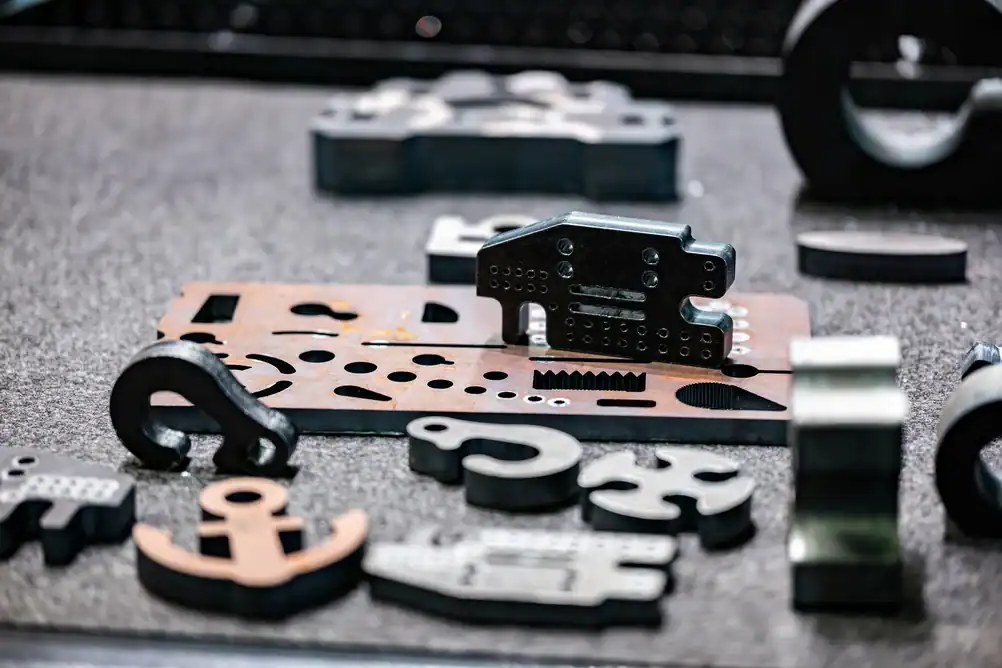
You send over your CAD file or drawing with the specs. We review it for material type, thickness, and tolerance requirements. If something won’t work the way it’s drawn, we’ll tell you before we start cutting.
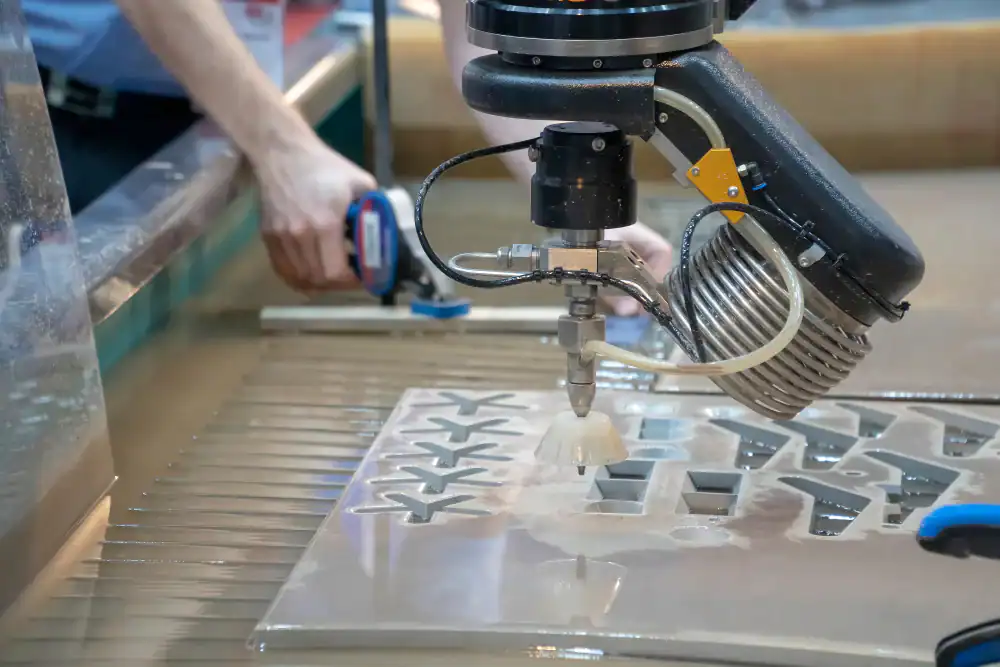
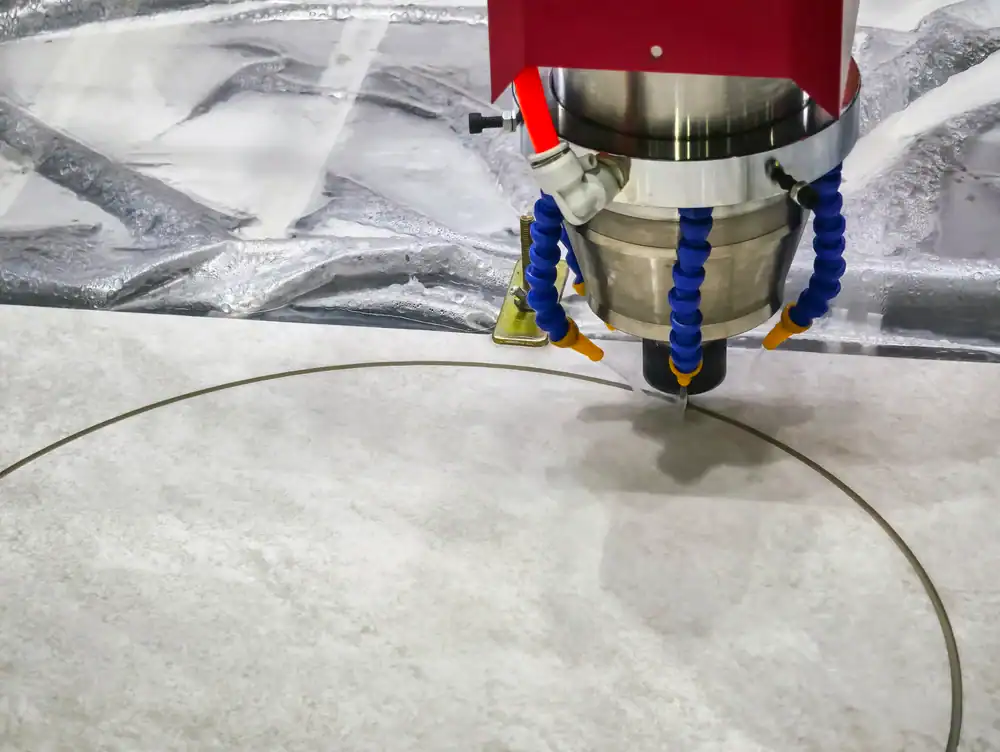
Once the file is programmed, the waterjet head follows the toolpath using a stream of water mixed with garnet abrasive. The stream cuts through your material without heating it. No torches, no lasers, no thermal distortion. The process is cold from start to finish.
Because there’s no heat, there’s no hardening along the cut edge. No micro-cracks. No warping that throws your part out of tolerance after it cools. What comes off the table is what you specified.
Setup is fast. We can switch from cutting half-inch aluminum to two-inch glass in minutes. That’s why precision CNC waterjet cutting in Malverne, NY works for both one-off prototypes and repeat production orders. You’re not waiting on tooling changes or new fixtures.
Ready to get started?
You get parts cut to your exact geometry without heat distortion. The waterjet handles inside corners, complex curves, and tight radii that would require multiple setups on traditional equipment.
Edge quality comes out smooth—typically 125 RMS or better depending on material and thickness. That means you can skip secondary finishing in most cases. The part goes straight from our table into your assembly or coating process.
Material waste stays low. The kerf width on a waterjet is narrow, so you’re not losing significant material between parts. For expensive alloys or composites common in Malverne, NY manufacturing, that adds up over a production run.
Malverne sits in a region where 63% of fabrication facilities rely on precision cutting equipment to maintain production accuracy. Aerospace manufacturers in the area especially depend on waterjet technology because it doesn’t alter material properties. When you’re cutting titanium or Inconel for a component that’ll see high stress, you can’t introduce heat that changes the metallurgy.
We also handle materials that other processes won’t touch. Stone, glass, rubber, composites—if you can spec it, we can cut it. That flexibility matters when you’re working on architectural projects or custom applications where the material isn’t negotiable.
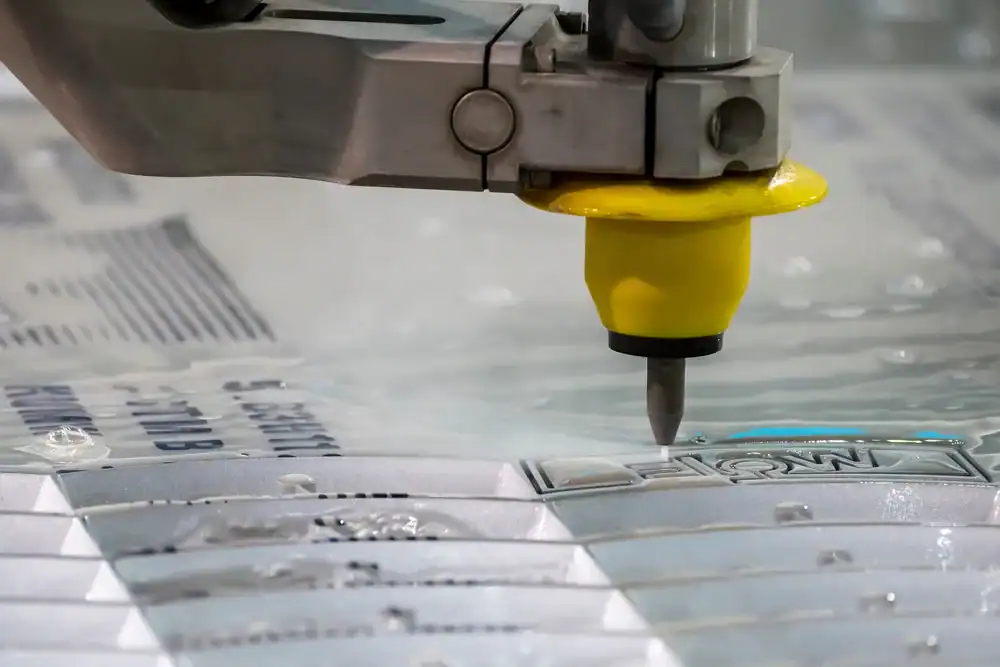
Standard precision waterjet cutting in Malverne, NY holds ±0.005 inch on most materials and thicknesses. That’s the realistic working tolerance for production environments.
If your application requires tighter control, micro abrasive waterjet systems can achieve ±0.001 inch or better. But that level of precision depends on material type, thickness, and edge quality requirements. Thicker materials and harder alloys will be on the looser end of that range.
The key difference between waterjet and thermal cutting is consistency. Because there’s no heat, the part doesn’t warp as it cools. The dimension you cut is the dimension you keep. That repeatability matters more than chasing a number that won’t hold once the part comes off the table.
Waterjet gives you a smooth edge without heat-affected zones. Laser and plasma both use thermal energy, which melts the material as it cuts. That creates a heat-affected zone along the edge where the material’s properties change.
You’ll see hardening, micro-cracking, and oxidation on laser or plasma cut edges. Those edges need grinding or machining before they’re usable in most applications. Waterjet cuts cold, so the edge comes out clean without secondary operations.
Edge finish on waterjet typically runs between 125 and 250 RMS depending on cutting speed and abrasive flow. If you need a smoother finish, you slow the cut down. If you’re okay with a slightly rougher edge to save time, you speed it up. Either way, you’re not dealing with slag, dross, or a hardened layer that’ll dull your tools during finishing.
Waterjet cuts materials over 10 inches thick. The process doesn’t lose cutting power as it goes deeper the way a laser does. Water and abrasive maintain their energy through the entire thickness.
Accuracy does shift slightly on thicker materials because of a taper effect. The stream enters the material narrower than it exits. On a six-inch thick plate, you might see 0.010 to 0.015 inch of taper depending on the material. That’s predictable and can be compensated for in the toolpath programming.
For precision waterjet cutting for tight tolerances in Malverne, NY, we adjust cutting parameters based on thickness. Slower traverse speeds and optimized abrasive flow keep the taper minimal. If your application can’t tolerate any taper, we program a multi-pass cut that squares up the edge.
Prototype and small-batch orders typically turn around in two to five business days. That includes programming time, material staging, cutting, and quality checks.
Production runs depend on part complexity and quantity. Simple geometries in standard materials move faster. Complex parts with tight tolerances or difficult materials take longer because we’re optimizing cut quality over speed.
The advantage of precision CNC waterjet cutting in Malverne, NY is setup speed. We don’t need custom tooling or fixtures for each job. Your CAD file becomes the program, and we’re cutting within minutes of loading the material. That’s why waterjet works well for rapid prototyping—you’re not waiting days for tooling before the first part gets made.
Waterjet cuts virtually any material. Metal, plastic, glass, stone, ceramic, rubber, composites, foam—if it’s a solid material, waterjet will cut it.
The process doesn’t rely on melting or burning, so materials that would deform under heat stay stable. That’s why precision water jet cutting services in Malverne, NY handle applications from gasket cutting in rubber to intricate patterns in marble for architectural work.
Different materials need different cutting parameters. Softer materials like foam or rubber get cut with water only—no abrasive. Harder materials like metal, glass, or stone require garnet abrasive mixed into the stream. We adjust pressure, traverse speed, and abrasive flow based on what you’re cutting and what edge quality you need.
DXF and DWG files work best because they contain the vector geometry our CAM software reads directly. If you’re working in SolidWorks, AutoCAD, or similar programs, export your part outline as a DXF and that’s usually all we need.
We can also work from PDF drawings if they’re dimensioned clearly. STEP and IGES files work for 3D parts where we’re cutting a specific profile from a model. The key is having clean geometry without overlapping lines or gaps in the toolpath.
If your file isn’t quite right, we’ll catch it during programming and reach out before we start cutting. Most issues come from layers that shouldn’t be cut or dimensions that don’t match the material thickness you’re using. A quick conversation usually clears it up, and we move forward without delays.
Useful Links
Other Services we provide in Malverne