
Hear from Our Customers
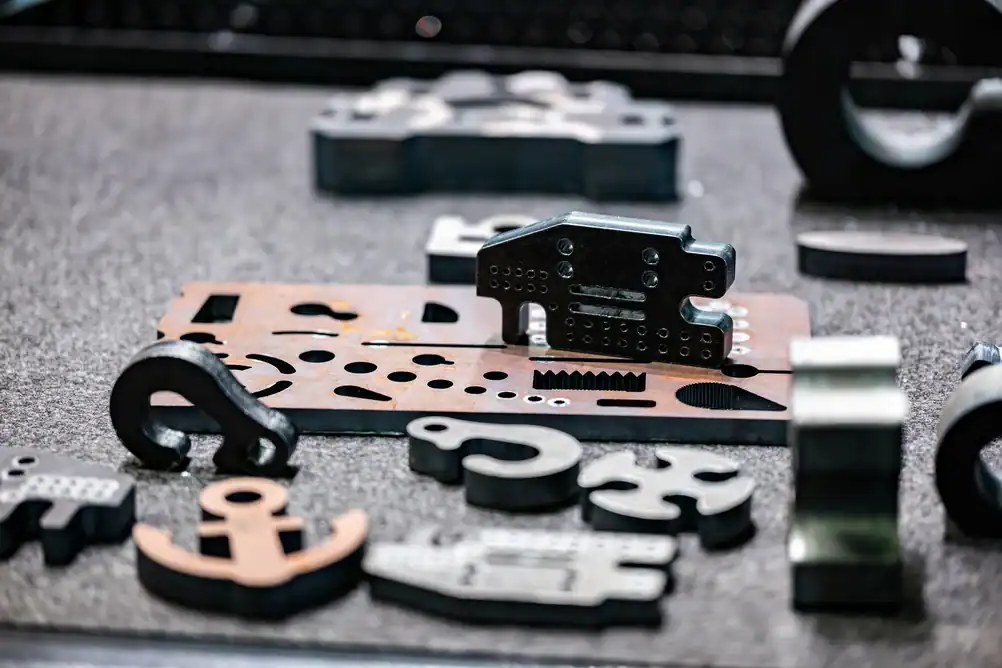
Your parts come off the table ready to use. No deburring. No heat-affected zones that compromise material integrity. No rework because someone missed a tolerance.
Precision water jet cutting services handle materials from aerospace-grade aluminum to 10-inch steel plate with tolerances as tight as 0.001″. That’s the difference between a part that fits and a part that costs you time, money, and credibility with your customer.
The edge quality matters too. You get a satin-smooth finish that typically eliminates secondary operations. For shops running tight margins in Massapequa Park and across Long Island, NY, that’s not a luxury—it’s how you stay competitive when every hour and every dollar counts.
Cold cutting means no thermal distortion. No slag. No dross waste like you’d see with plasma or laser. The material stays true to spec because there’s no heat stress changing its properties. That matters when you’re fabricating for industries where precision isn’t negotiable.
We operate in a region where manufacturing still means something. Long Island, NY’s industrial base—anchored by facilities in Hauppauge, metal fabricators across Nassau County, and aerospace suppliers throughout the Tri-State area—demands precision that holds up under scrutiny.
We cut parts for shops that can’t afford to fail inspections or miss delivery windows. That means understanding what tolerances actually matter in your application, what materials behave differently under abrasive waterjet cutting, and how to program multi-axis cuts that save you setup time.
Massapequa Park sits in the middle of a manufacturing corridor that’s been producing quality work for decades. We’re here because the demand for precision waterjet cutting for tight tolerances keeps growing as shops retire outdated equipment and look for partners who can handle complex geometries without the limitations of thermal cutting methods.
You send us your specifications—CAD files, drawings, or even a sample part. We review the tolerances, material type, thickness, and quantity to determine the optimal cutting parameters. This isn’t automatic. Different materials and different thicknesses require different abrasive flow rates, cutting speeds, and nozzle standoff distances.
Programming happens fast. CNC waterjet systems allow for rapid setup compared to traditional machining, but the operator still needs to know how to nest parts efficiently, account for kerf width, and set lead-ins that won’t leave witness marks where they matter.
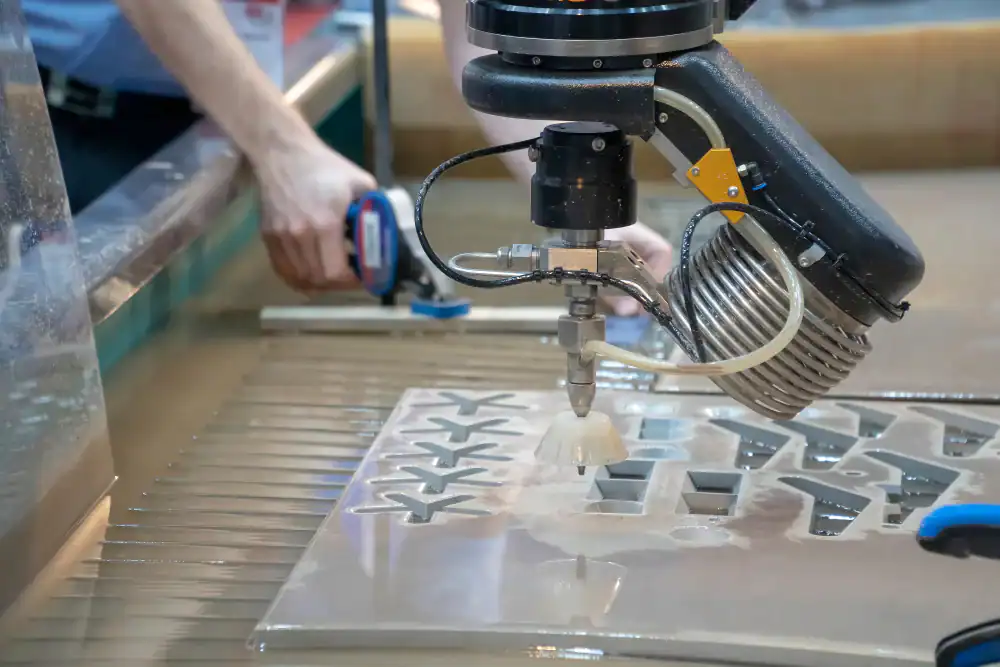
The actual cutting is where precision water jet cutting services separate from other methods. A high-pressure stream—typically 50,000 to 60,000 PSI—mixed with garnet abrasive cuts through your material without generating heat. The CNC system follows the programmed path with repeatability that keeps parts consistent whether you’re ordering one prototype or a hundred production pieces.
You get parts that are ready for assembly or final inspection. Most customers in the Massapequa Park area are looking at the edge and checking dimensions right off the table. That’s the point. Less handling, less secondary work, faster turnaround.
Ready to get started?
Material consultation matters more than most shops realize. Not every material cuts the same way, and not every application needs the tightest tolerance the machine can hold. We help you figure out what’s realistic and what’s overkill so you’re not paying for precision you don’t need—or worse, speccing something that won’t hold up in your application.
Custom design support means we can work from your prints or help you optimize a design for waterjet cutting. Sometimes a small change in geometry makes a big difference in cost or lead time. Sometimes the material you specified isn’t the best choice for what you’re trying to accomplish. Those conversations happen before we start cutting.
Long Island, NY’s manufacturing sector—especially around Massapequa Park, Hauppauge, and the broader Nassau County industrial base—runs on tight deadlines. Shops here are supplying aerospace, automotive, marine, and heavy industry customers who don’t accept late deliveries. Our turnaround times reflect that reality. Fast programming and machine setup mean you’re not waiting days for a simple part.
Multi-axis capability gives you access to 3D cutting when your part requires it. Most work is 2D, but when you need beveled edges, complex angles, or intricate three-dimensional forms, the equipment and the programming experience have to be there. That’s not every shop.
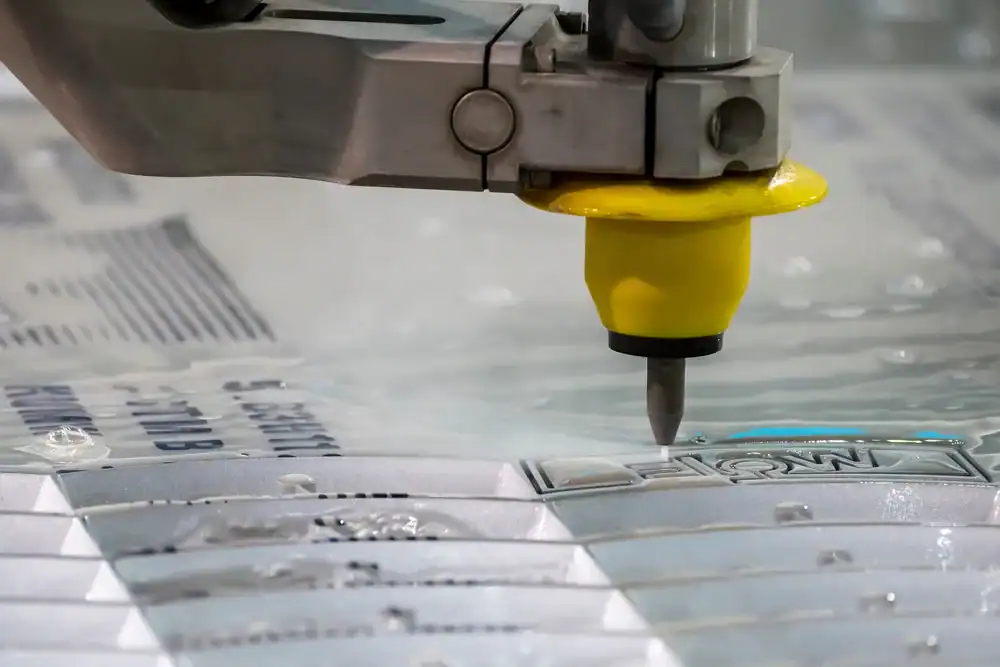
Standard waterjet cutting typically holds tolerances between 0.003″ and 0.005″. With proper equipment, experienced programming, and the right cutting parameters, you can achieve tolerances as tight as 0.001″ on certain materials and part geometries.
That tolerance range works for the majority of aerospace, automotive, and metal fabrication applications in the Tri-State area. If you’re coming from plasma or oxy-fuel cutting, this is a significant improvement. If you’re comparing to laser, waterjet gives you similar or better accuracy without the heat-affected zone.
Tolerance also depends on material thickness, type, and part complexity. Thicker materials and harder alloys may require slightly looser tolerances. Thinner materials and simpler geometries can hit the tighter end of the range. The conversation about what’s achievable happens when we review your prints and understand what dimensions are critical versus what has more room for variation.
The biggest difference is heat. Waterjet is a cold cutting process, so there’s no thermal distortion, no hardened edges, and no heat-affected zone that changes the material properties. Laser and plasma both generate significant heat, which can warp thin materials, create slag, and require secondary grinding or finishing.
Edge quality is another factor. Precision water jet cutting services produce a smooth, burr-free edge that often goes straight to assembly. Plasma leaves dross on the bottom edge that needs removal. Laser can leave a heat-discolored edge depending on the material.
Material versatility matters too. Waterjet cuts virtually anything—metals, composites, glass, stone, rubber, plastics—without changing tooling or setup. Laser works well on thinner metals but struggles with reflective materials like copper or brass. Plasma is fast on steel but limited on non-conductive materials. For shops in Massapequa Park handling diverse projects, that versatility eliminates the need for multiple cutting methods.
Abrasive waterjet handles metals, composites, ceramics, glass, stone, plastics, rubber, and foam. Thickness ranges from 1/16″ up to 10 inches or more depending on the material. There’s no material hardness limitation like you’d encounter with mechanical cutting tools.
For metal fabrication shops around Massapequa Park and Long Island, NY, the most common materials are aluminum, stainless steel, carbon steel, titanium, brass, and copper. Aerospace applications often involve titanium and aluminum alloys. Automotive and heavy industry work leans toward steel plate in various thicknesses and grades.
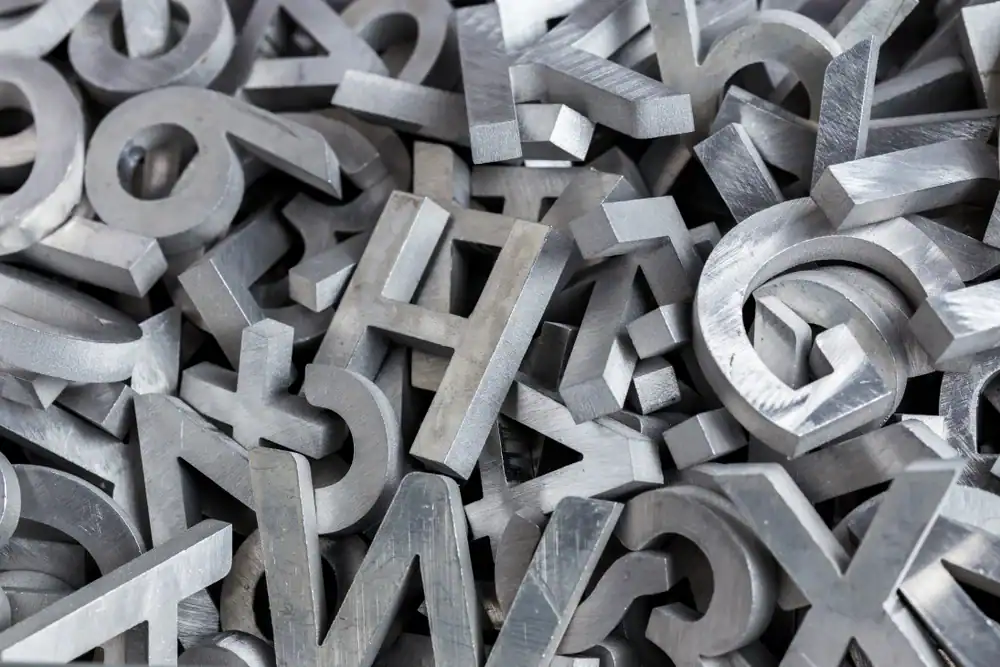
The abrasive—usually garnet—is what allows the waterjet to cut hard materials. Pure waterjet without abrasive works for softer materials like rubber, foam, and certain plastics, but any metal cutting requires the abrasive stream. The type of garnet, the mesh size, and the flow rate all get adjusted based on what you’re cutting and how fast you need it done.
Programming and setup are fast compared to traditional machining. Simple 2D parts can often be programmed and cut the same day if the material is in stock. Complex parts or large production runs take longer, but you’re still looking at days, not weeks.
Lead time depends on current shop load, material availability, and part complexity. A single prototype with standard material might turn around in 24 to 48 hours. A production run of 100 parts in a specialty alloy could take a week or more if we need to source the material.
Massapequa Park’s proximity to material suppliers across Long Island, NY and the Tri-State area helps. We’re not waiting on shipments from across the country for common materials. That geographic advantage matters when you’re trying to hit a tight deadline for a customer who’s already behind schedule.
Most parts don’t. The edge quality from precision waterjet cutting for tight tolerances is smooth enough for direct assembly in the majority of applications. You’re looking at a satin finish that’s free of burrs, slag, and heat discoloration.
There are exceptions. If your application requires a polished edge or a specific surface finish for aesthetic reasons, you’ll need secondary work. If you’re welding and need a specific edge prep, that might require additional machining. But for functional parts where the edge just needs to be clean and dimensionally accurate, waterjet delivers that right off the table.
Compare that to plasma cutting, which almost always requires grinding to remove dross and smooth the bottom edge. Or laser cutting, which can leave a heat-affected zone that needs addressing depending on the application. The time and labor you save on secondary operations is where waterjet often pays for itself, especially on higher-volume runs where every minute of handling adds up.
Location matters when you’re managing tight project timelines. Massapequa Park sits in the center of Long Island, NY’s manufacturing corridor, close to metal fabricators, machine shops, and industrial suppliers throughout Nassau County and the broader Tri-State region. Shorter distances mean faster deliveries and easier communication when specs need clarification or changes happen mid-project.
Local shops understand the industries they’re serving. Aerospace suppliers in the area have specific requirements around material traceability and edge quality. Automotive fabricators need parts that fit the first time because rework kills their margins. Marine applications require corrosion-resistant materials cut without introducing stress or contamination.
Working with a high precision waterjet cutting provider who knows the local market means fewer surprises. You’re not explaining why a 0.002″ tolerance matters or why heat distortion is unacceptable in your application. That knowledge is already built into how we program, cut, and inspect parts before they leave the shop.
Useful Links
Other Services we provide in Massapequa Park