Hear from Our Customers
You’re not looking for close enough. You need parts that meet spec without the headaches that come from traditional cutting methods—no burn marks to clean up, no warped edges that throw off your assembly, no material hardening that creates problems down the line.
High precision waterjet cutting in Melville, NY gives you tolerances within 0.005 inches on materials that other methods can’t touch without damaging them. The cold cutting process means your metals, composites, and specialty alloys come off the table exactly as they should be—dimensionally accurate with edge quality that often eliminates secondary operations entirely.
That’s time back in your schedule and cost out of your budget. Whether you’re producing aerospace components that demand exacting standards or custom architectural elements with complex geometries, you get parts that work the way you designed them. No thermal distortion changing your dimensions. No heat-affected zones compromising material properties. Just clean cuts that let you move to the next step in your process.
We understand what’s at stake when you’re working on critical components. We’ve built our precision waterjet cutting shop in Melville, NY to serve the exacting standards that Long Island, NY’s aerospace and advanced manufacturing sectors have demanded for decades.
This area didn’t become the Cradle of Aviation by accepting mediocre work. The same precision that built that legacy is what drives our approach to every job—from single prototypes to full production runs.
We’re not the cheapest option, and that’s intentional. You’re getting CNC-controlled accuracy, material expertise across metals and composites, and turnaround times that keep your projects moving. When you need precision water jet cutting services in Melville, NY that understand the difference between “good enough” and “exactly right,” that’s what we deliver.
The process starts with your design specifications. You send us your CAD files or drawings, and we review them for any potential issues before cutting begins. If there’s a more efficient way to nest your parts or a material consideration you should know about, we’ll tell you upfront.
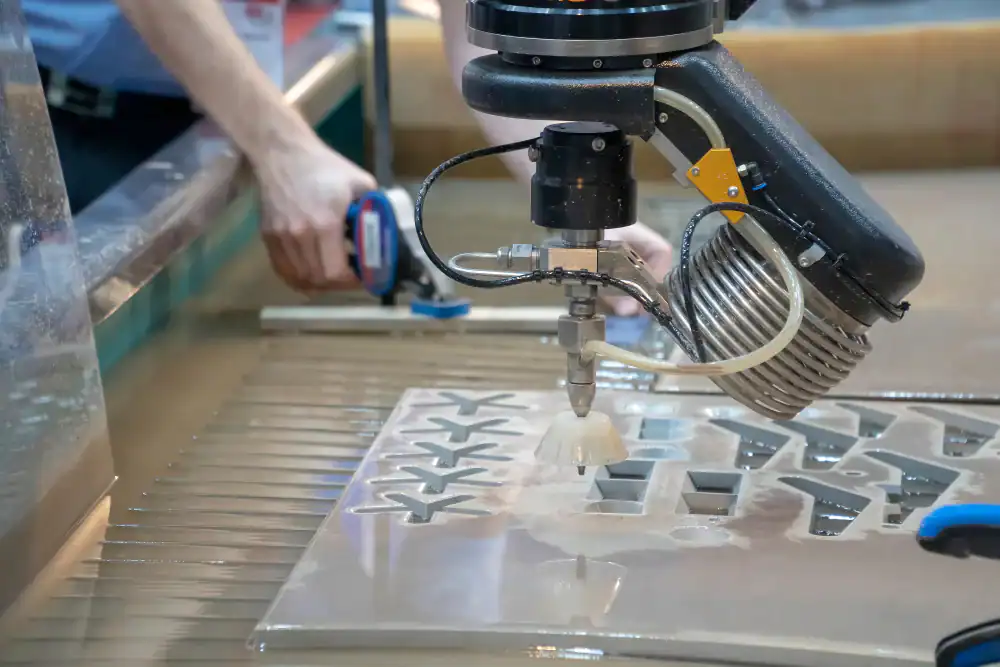
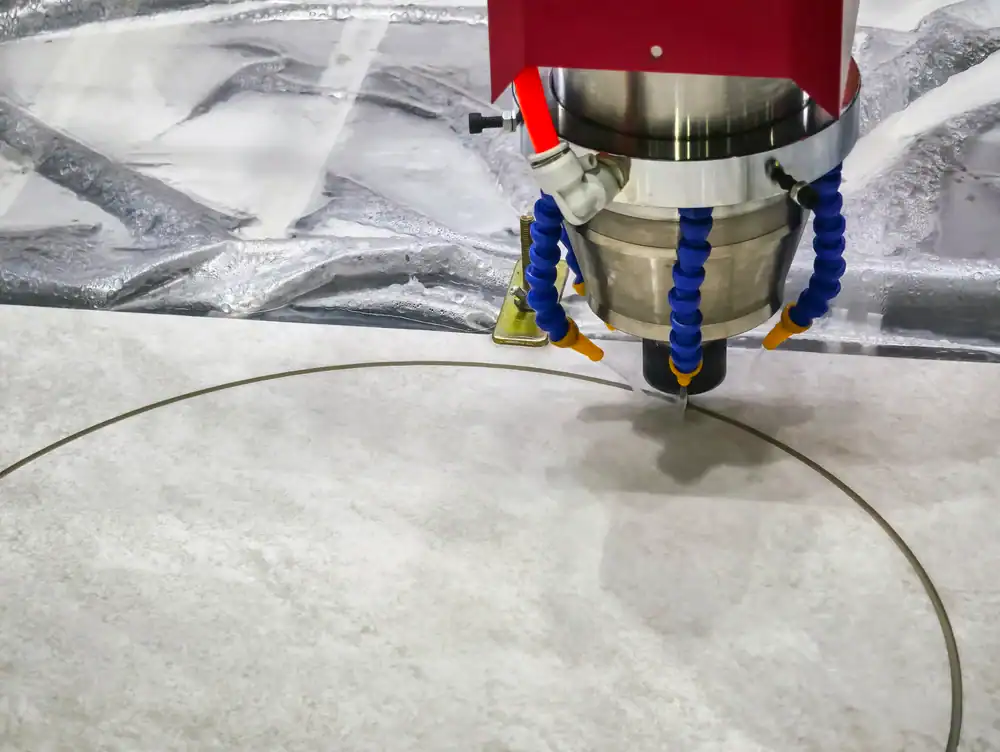
Once the programming is set, our CNC waterjet system cuts using a high-pressure stream of water mixed with abrasive garnet. The cutting head follows your exact geometry at pressures up to 60,000 PSI, slicing through materials up to several inches thick without generating heat. Because there’s no thermal input, your material properties stay intact—no hardening, no warping, no metallurgical changes.
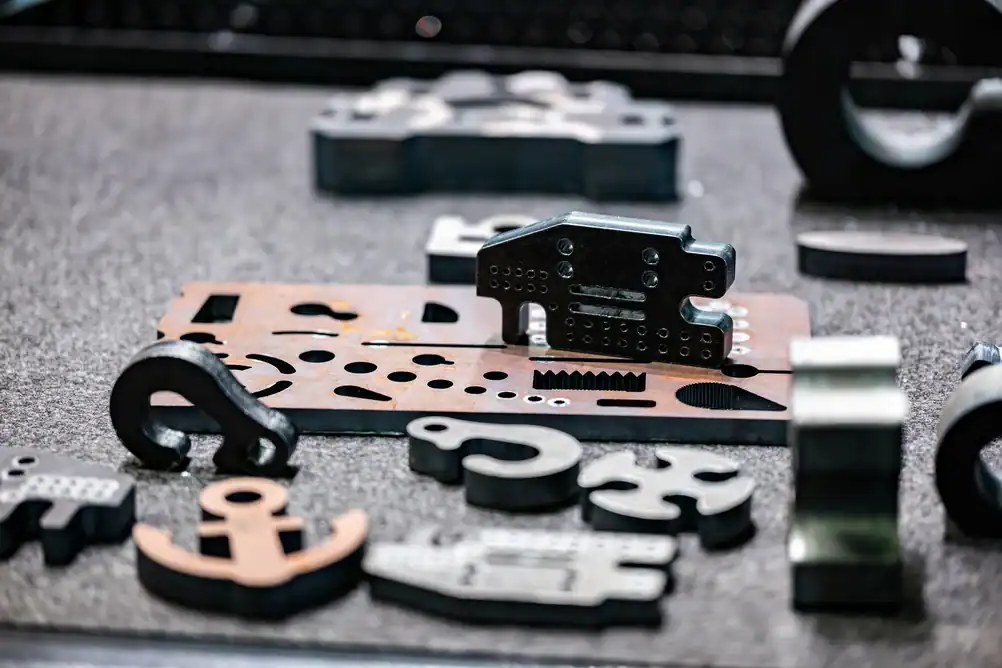
For most jobs, you’re looking at 2-3 business days from file submission to finished parts. Rush work can often be accommodated when your timeline demands it. Parts come off the table with a smooth, sandblasted-type finish that’s often ready for immediate use or assembly. If you need additional operations like deburring or finishing, we can discuss that during the quoting process, but many customers find the as-cut edge quality sufficient for their applications.
Ready to get started?
Precision waterjet cutting for tight tolerances in Melville, NY means you’re working with a process that holds ±0.005″ on most materials and geometries. That’s repeatable accuracy across single parts or production quantities, with the ability to cut intricate shapes that would be difficult or impossible with traditional methods.
The material range covers what Long Island, NY manufacturers actually use: aluminum and stainless steel for aerospace components, titanium and exotic alloys for defense applications, tool steels and hardened materials for tooling and fixtures, composites and laminates without delamination, glass, stone, and ceramics for architectural work. If you’re not sure whether your material is suitable, that’s a quick conversation.
Melville’s position in the Long Island, NY manufacturing corridor means you’re not dealing with long shipping delays or minimum order quantities that don’t match your needs. Local proximity matters when you’re trying to hit a deadline or need to inspect parts before committing to a full run. You can work directly with people who understand the local aerospace and defense standards, the architectural requirements for high-end projects, and the reality of production schedules that don’t have room for do-overs.
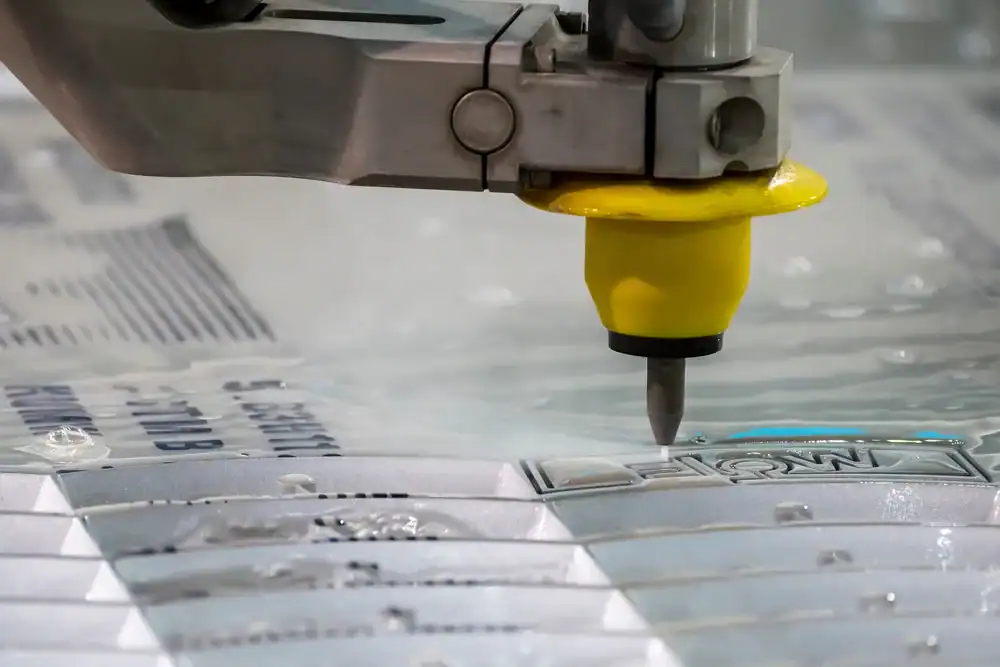
For most materials and geometries, you’re looking at ±0.005 inches as a standard working tolerance. That’s achievable on both straight cuts and complex curves, assuming your material is properly supported and the part geometry doesn’t create unusual challenges.
Tighter tolerances are possible in specific situations—some shops are hitting ±0.002″ on smaller parts with optimal conditions. But that requires careful setup, material consistency, and sometimes multiple passes. If your prints call for tolerances tighter than ±0.005″, that’s a conversation worth having upfront so we can tell you honestly whether waterjet is the right process or if you’d be better served by a different method.
The tolerance consistency across a production run is often more important than the absolute number. Waterjet cutting doesn’t wear like traditional tooling, so part 100 comes out the same as part 1. That repeatability is why aerospace and medical device manufacturers use the process for components where dimensional consistency directly impacts function and safety.
The biggest difference is heat. Laser cutting melts material, which means you’re dealing with a heat-affected zone that can change material properties, create hardness variations, and sometimes cause warping on thinner materials. Waterjet cutting is a cold process—no heat input at all.
That matters most when you’re cutting materials that don’t respond well to heat: hardened tool steels, titanium, composites, or anything where you can’t afford metallurgical changes. It also matters on thicker materials—laser cutting loses efficiency and edge quality as thickness increases, while waterjet handles thick sections without issue.
Laser is typically faster on thin sheet metal with simple geometries, and it can produce a slightly finer edge on mild steel in the right thickness range. But if you’re cutting stainless over half an inch thick, working with exotic alloys, or need to avoid any heat distortion, waterjet is the better call. The edge quality on waterjet-cut parts often eliminates secondary deburring, which can offset any speed advantage laser might have on simpler jobs.
Standard turnaround runs 2-3 business days from the time we receive your files and confirm the quote. That covers most jobs—prototypes, small production runs, and custom one-offs. If your project is straightforward and we have the material in stock, we can often turn it faster.
Rush service is available when your timeline doesn’t allow for standard lead times. That might mean same-day or next-day completion depending on machine availability and job complexity. There’s usually an upcharge for rush work, but when you’re facing a deadline that can’t move, it’s there.
The local advantage matters here. You’re not waiting for parts to ship cross-country or dealing with a shop three states away that can’t accommodate a quick change. If you need to stop by and check first articles before we run the full quantity, or if something needs adjustment after you’ve seen the initial parts, that’s a conversation and a short drive instead of a multi-day delay. Long Island, NY manufacturing moves fast—our turnaround times reflect that reality.
Yes, and that’s actually one of the primary applications. Aerospace components often use materials specifically chosen for properties that make them difficult to cut with traditional methods—titanium alloys, Inconel, hardened stainless, aluminum-lithium composites, and carbon fiber laminates.
Waterjet cutting doesn’t create the heat-affected zones that can compromise the metallurgical properties aerospace engineers designed into these materials. When you’re cutting a titanium bracket that needs to maintain specific strength characteristics, or a composite panel that can’t delaminate, the cold cutting process preserves what you need.
Long Island, NY has deep aerospace roots—this area understands the documentation requirements, the material traceability expectations, and the zero-tolerance attitude toward dimensional errors on flight-critical components. Around 51% of aerospace component manufacturers now rely on waterjet technology for processing the specialized materials that go into aircraft production. That’s not a coincidence—it’s because the process delivers what the industry requires. If you’re producing parts that need to meet aerospace standards, waterjet cutting gives you a process that can actually hold up to the scrutiny.
Standard CAD formats work fine—DXF and DWG files are the most common and easiest to program directly into the CNC system. If you’re working in SolidWorks, AutoCAD, or similar programs, just export your part geometry as a DXF and you’re set.
We can also work with PDF drawings if that’s what you have, though CAD files are preferred because they eliminate any potential interpretation issues. If your files are in a different format—STEP, IGES, or something less common—reach out and we’ll let you know if we can use them directly or if a quick conversion is needed.
The important part is that your geometry is clear and dimensioned. If there are tolerance callouts that matter, specific edge finish requirements, or particular areas where accuracy is critical, note that in the file or the accompanying documentation. We’ll review everything before cutting starts, and if something looks unclear or seems like it might cause an issue, we’ll ask rather than guess. Getting the programming right on the front end means your parts come out right the first time.
Yes, particularly when you factor in the full cost picture. Waterjet cutting doesn’t require custom tooling or dies, which means there’s no large upfront investment to amortize across parts. Whether you need one prototype or a hundred production pieces, the per-part programming cost is minimal.
The bigger cost advantage often shows up in what you don’t have to do after cutting. Parts come off the waterjet with edge quality that frequently eliminates deburring, grinding, or other secondary operations. When you’re comparing quotes, make sure you’re accounting for those additional steps that other cutting methods might require. A process that looks cheaper per cut can end up costing more once you add the finishing work.
For prototypes specifically, waterjet gives you the ability to test designs in your actual production material without committing to expensive tooling. If the design needs adjustment after you see the first part, you’re changing a CAD file and running another piece—not scrapping a custom die. That flexibility matters when you’re still refining geometry or testing fit and function before committing to larger quantities.
Useful Links
Other Services we provide in Melville