Hear from Our Customers
You’re not dealing with parts that almost fit. You’re getting components cut to ±0.003″ to ±0.005″ tolerances using Flow Dynamic Waterjet technology. That level of accuracy means your assemblies align without forcing, your project timelines hold, and you’re not burning budget on rework.
The edge quality matters too. You get clean, satin-smooth finishes with no burrs, no discoloration, and no heat-affected zones that compromise material integrity. For architectural work, that’s Q3-Q4 quality. For mechanical or ballistic applications, Q4-Q5.
Because waterjet is a cold cutting process, your materials keep their original properties. Stainless steel doesn’t harden. Aluminum doesn’t warp. Titanium and composites cut clean without thermal stress. That’s especially critical for aerospace, defense, and precision manufacturing work where material performance can’t be compromised.
Every part gets inspected for dimension, edge finish, and squareness before it leaves our shop. You’re getting components that meet spec, not parts that need secondary finishing to become usable.
We operate out of Sayville, NY, serving manufacturers, fabricators, architects, and contractors throughout Suffolk County and the broader tri-state area. Our shop runs a Flow Mach 500 CNC waterjet system controlled directly from CAD files, which means your designs translate to cut parts without interpretation errors.
Long Island, NY’s manufacturing sector—from aerospace suppliers to architectural metalwork shops—needs precision that holds up under inspection. That’s what our equipment is built for. Our system handles materials from 0.005 inches up to 12 inches thick, cutting everything from thin gauge stainless to thick titanium plate.
You’re working with a shop that understands the local market. Whether you’re a machine shop in Bohemia handling defense contracts or a fabricator in Ronkonkoma producing custom architectural elements, our turnaround times and quality standards are designed around what Long Island, NY businesses actually need to stay competitive.
You send over your CAD file or design specs. We load the file into our CNC system, which controls the waterjet head with precision motion servos. There’s no manual setup interpretation—your design drives the cut path directly.
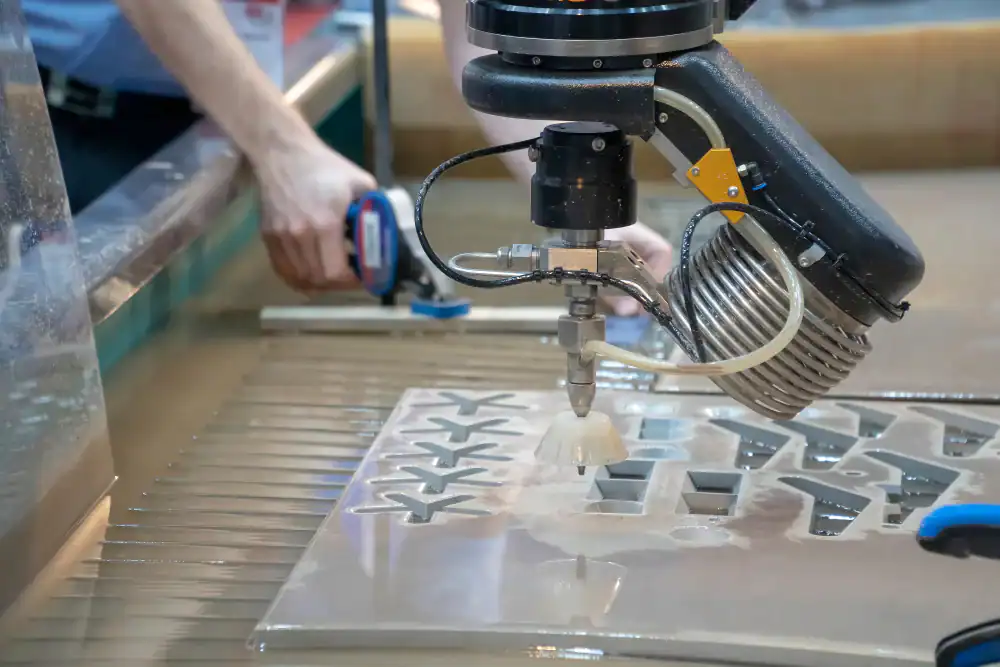
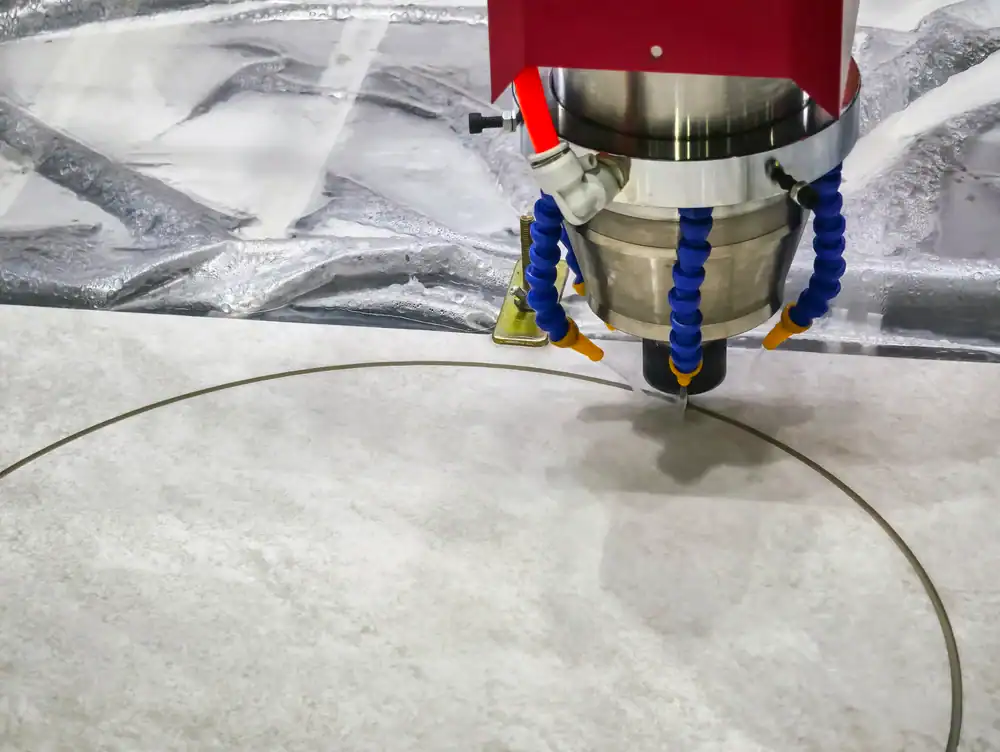
The waterjet stream combines ultra-high-pressure water (up to 60,000 PSI) with fine abrasive garnet particles. That stream cuts through your material without generating heat. No flames, no plasma arc, no laser burn. Just focused erosion that removes material along your cut line while leaving everything else untouched.
For complex geometries or parts that need to nest efficiently on a sheet, our CAM software optimizes the layout to reduce waste. Dynamic taper compensation adjusts the cut angle in real time, so even thick materials come out square and true. Vibration-dampened tables keep everything stable during the cut.
Once cutting finishes, we pull each part and inspect it against your dimensional tolerances and flatness standards. If it doesn’t meet spec, it doesn’t ship. You get parts ready to install, assemble, or integrate—not blanks that still need work.
Ready to get started?
Our precision water jet cutting services handle metals like aluminum, stainless steel, titanium, Inconel, and tool steel. We also cut stone, glass, ceramics, composites, plastics, and rubber. If it’s a material that doesn’t respond well to heat or needs a clean edge, waterjet handles it.
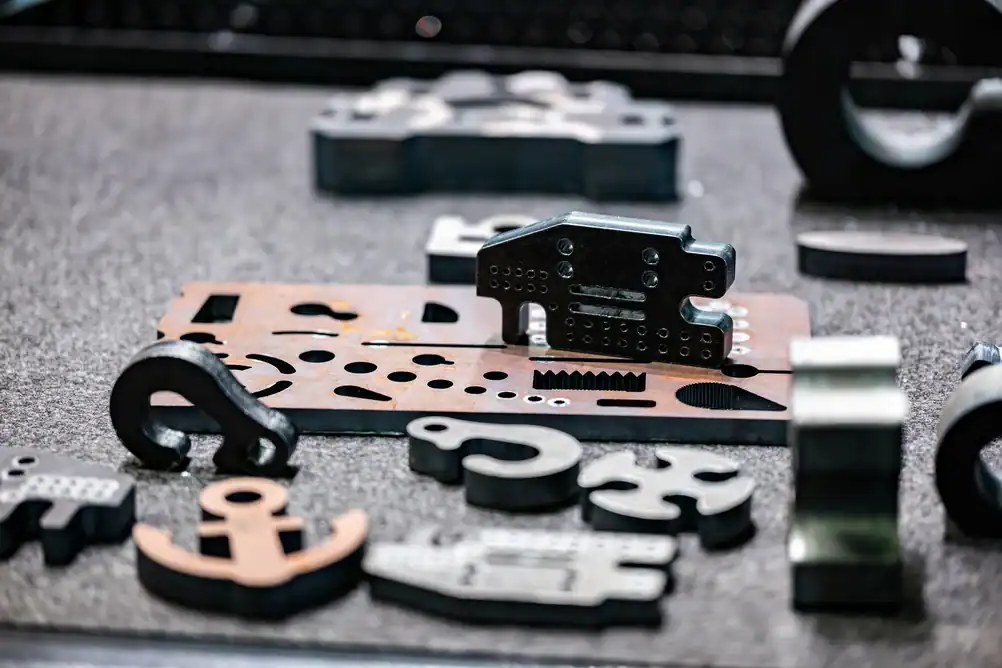
Architectural projects get decorative panels, custom inlays, signage, and structural components cut to exact dimensions. Industrial and manufacturing clients get gaskets, brackets, machine parts, and prototype components. Aerospace and defense work gets the tight-tolerance, high-performance material cutting that passes inspection.
Our Sayville location puts us within easy reach of Long Island, NY’s dense manufacturing corridor. Suffolk County has a strong presence of aerospace suppliers, precision machine shops, and custom fabricators—all industries where a few thousandths of an inch determines whether a part works or gets scrapped. That’s the standard we’re built around.
The waterjet process also keeps things environmentally cleaner than thermal cutting. No hazardous fumes, no toxic gases, no metal dust in the air. We recycle water through closed-loop systems, and garnet abrasive is inert and disposable. For shops managing environmental compliance or working in sensitive facilities, that’s a real operational advantage.
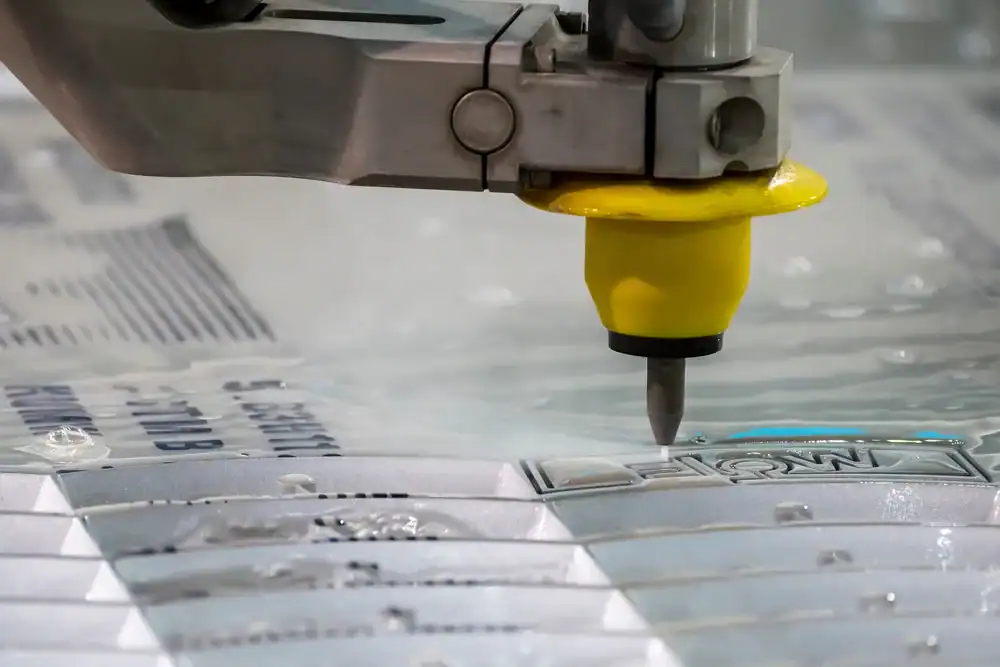
Modern CNC waterjet systems like our Flow Mach 500 hold linear cutting accuracy between ±0.003″ and ±0.005″ (0.08 to 0.13 mm). That’s tight enough for most precision machining applications and often tighter than what plasma or laser cutting can achieve on thicker materials.
The key is that waterjet maintains that tolerance through the full depth of the cut. You’re not getting accuracy on the top surface that degrades halfway through a thick plate. Dynamic taper compensation adjusts the stream angle in real time to keep edges square and dimensions consistent from entry to exit.
For parts that need even tighter tolerances—say ±0.001″ or better—waterjet can get you close enough that minimal secondary machining finishes the job. You’re removing most of the material with waterjet, then doing a light cleanup pass instead of machining the whole part from solid stock. That saves time and tool wear.
We cut materials up to 12 inches thick with full-depth precision. That includes metals like stainless steel, aluminum, titanium, and tool steel, as well as stone, glass, and composites. Thicker materials take longer to cut, but the process doesn’t change—you still get clean edges and no heat distortion.
For most manufacturing and fabrication work, you’re looking at materials between 0.25″ and 3″ thick. Waterjet handles that range efficiently and delivers edge quality that often eliminates secondary finishing. Thinner materials—down to 0.005″—also cut cleanly without deformation, which is hard to achieve with mechanical shearing or punching.
The thickness capability matters because it opens up options. You can cut structural components, thick wear plates, or layered assemblies in a single setup. You’re not limited by what a laser can penetrate or what a plasma cutter can handle without excessive dross and angulation.
No. Waterjet is a cold cutting process, so there’s no heat-affected zone (HAZ). Your material doesn’t experience thermal stress, hardening, warping, or changes to its metallurgical properties. That’s a major advantage over plasma, laser, or oxy-fuel cutting, all of which introduce significant heat into the cut zone.
For materials like stainless steel, titanium, or hardened tool steel, avoiding heat distortion means the part stays flat and dimensionally stable. You’re not dealing with warped edges that need straightening or hardened zones that are difficult to machine or weld later.
Composites and plastics benefit even more. These materials can melt, delaminate, or release toxic fumes when cut with heat. Waterjet cuts them cleanly without any of those issues. You get smooth edges, no fraying, and no need for ventilation systems to handle hazardous smoke.
Edge quality depends on cut speed and abrasive flow rate, but you’re typically looking at Q3 to Q5 finishes. For architectural and decorative work, Q3-Q4 gives you a clean, satin-smooth edge with minimal striations. For mechanical parts or ballistic applications, Q4-Q5 delivers near-machined surface quality.
In most cases, the edge comes off our waterjet table ready to use. No grinding, no deburring, no secondary finishing unless your application has unusually tight cosmetic or surface roughness requirements. That saves time and keeps costs down compared to processes that need cleanup work after every cut.
The lack of burrs is another benefit. Laser and plasma cutting often leave sharp edges or dross that need removal. Waterjet edges are smooth and safe to handle right away. For parts going into assemblies or installations where fit and finish matter, that edge quality makes a difference.
Waterjet handles complex geometries well, but there are some limitations to understand. The cutting stream has a finite width (kerf), typically around 0.03″ to 0.04″, which determines the tightest inside radius you can cut. You’re not getting sharp 90-degree internal corners—there will be a small radius where the stream turns.
For intricate parts with lots of curves, holes, or cutouts, waterjet excels. Our CNC system follows your CAD path exactly, and there’s no tooling to change or fixtures to reposition. You can nest multiple complex parts on a single sheet and cut them all in one run.
Piercing (starting the cut) does leave a slightly rougher entry point than the rest of the cut line, so part orientation and pierce location get planned into the programming. For parts where cosmetics matter on all edges, we place the pierce points in areas that will be hidden or trimmed off.
Waterjet, laser, and plasma each have strengths depending on what you’re cutting. Waterjet’s advantage is versatility and edge quality. It cuts virtually any material without heat distortion, holds tight tolerances on thick stock, and delivers clean edges that often don’t need secondary work.
Laser cutting is faster on thin materials (under 0.5″) and gives excellent edge quality on metals, but it struggles with reflective materials like aluminum or copper, and it can’t cut stone, glass, or certain composites. Plasma is fast and cost-effective for thick steel, but edge quality is rougher, heat distortion is significant, and tight tolerances are harder to maintain.
For precision work in Sayville, NY—especially for manufacturers and fabricators handling mixed materials, tight tolerances, or parts where heat distortion isn’t acceptable—waterjet is the more reliable process. You’re getting consistent results across a wider range of materials and thicknesses without the trade-offs that come with thermal cutting methods.
Useful Links
Other Services we provide in Sayville