Hear from Our Customers
You’re not cutting parts for fun. You need them to fit an assembly, meet a spec sheet, or pass inspection without someone calling you back about dimensional issues.
Precision waterjet cutting in Stony Brook, NY means accuracies of ±0.001 inch on complex geometries. Sharp corners, tight radii, holes that line up exactly where your CAD file says they should. No heat-affected zones that warp your material or create welding problems down the line.
The kerf width runs 0.030″ to 0.040″, so you can nest parts tight and stop throwing away expensive material. Whether you’re prototyping one piece or running a thousand, the cuts stay consistent. No grinding to clean up edges. No secondary operations to hit tolerance. Just clean parts ready for the next step in your process.
We serve manufacturers across Stony Brook, NY and the surrounding region who can’t afford to waste time on parts that don’t fit. Our in-house design team has actual fabrication experience, not just software training.
Before your job hits the table, we review the file. We catch tolerance stackups, material thickness issues, and geometry problems that would cost you time and material. It’s not about being nice—it’s about getting it right so you’re not calling us (or your customer) with problems later.
We’ve handled projects for aerospace, medical device manufacturing, metal fabrication shops, and architectural firms throughout Long Island, NY. The work ranges from titanium components with tight tolerances to custom architectural panels in composite materials.
You send us your CAD file—DXF, DWG, or most vector formats work. Our team reviews it for manufacturability. If there’s an issue with corner radii, kerf compensation, or material selection, we’ll tell you before we start cutting.
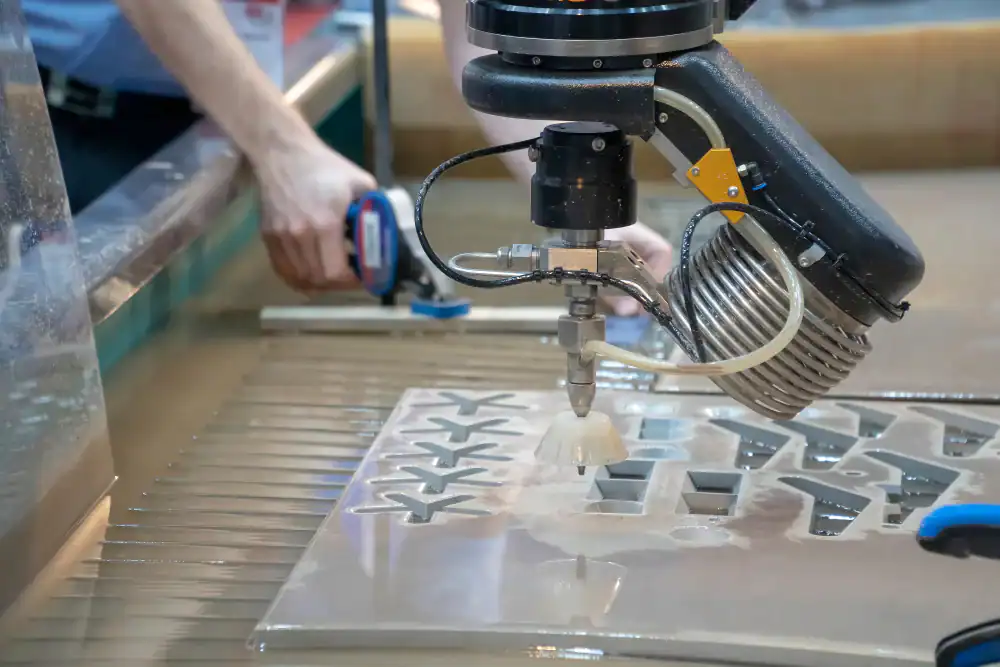
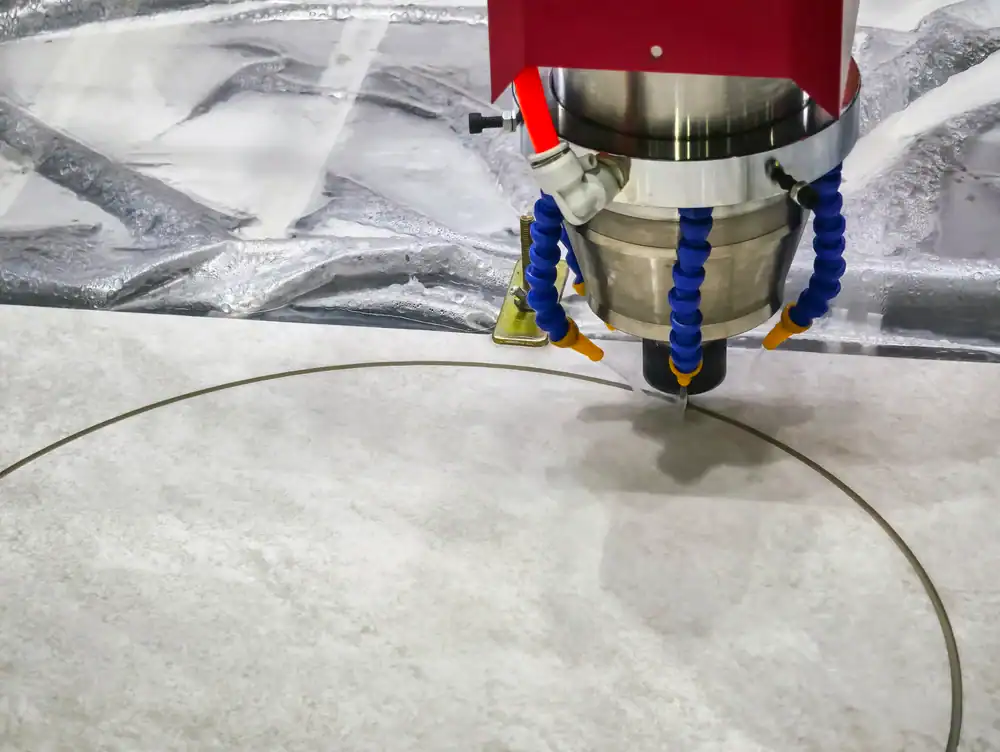
Once the file is approved, it goes to our CNC waterjet system. We program the toolpath, set up your material, and dial in the abrasive flow and pressure based on what you’re cutting and how tight the tolerances need to be. The cutting head follows the programmed path using a high-pressure stream of water mixed with garnet abrasive.
There’s no heat, so no warping or hardening of cut edges. No mechanical stress that changes your material properties. The process works on virtually anything—metals, glass, stone, plastics, composites up to 8 inches thick. When the cut is done, parts come off the table ready to use. You get exactly what your file specified.
Ready to get started?
Every precision water jet cutting service we provide in Stony Brook, NY starts with file review and ends with parts that meet your specifications. You’re not paying for extra operations to fix what should have been right the first time.
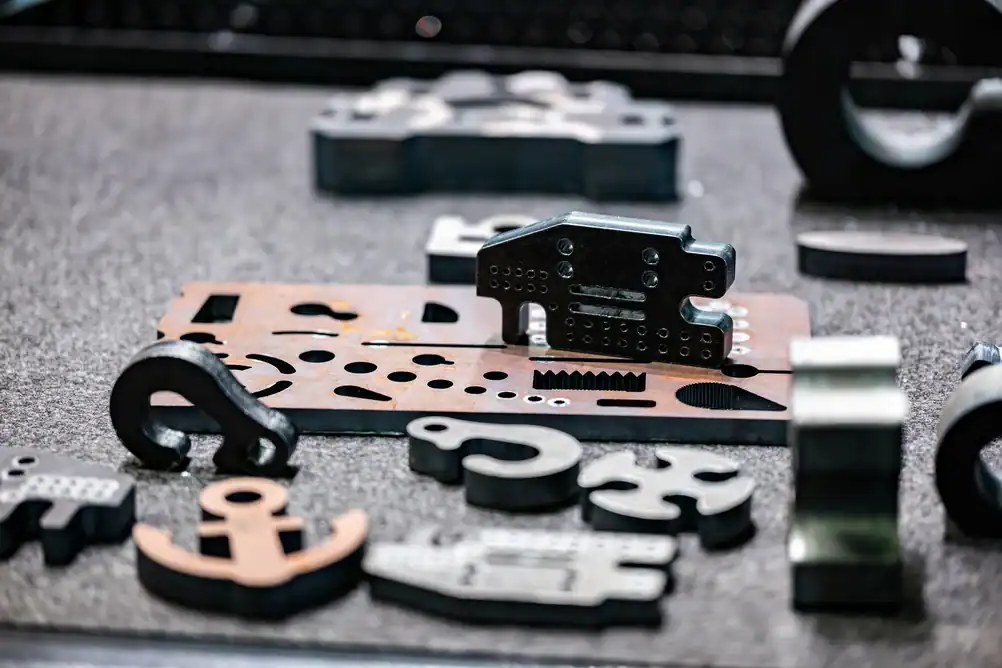
The process handles complex shapes that would be difficult or impossible with plasma, laser, or mechanical cutting. Small inner radii, sharp corners, intricate patterns—all without tool wear changing your dimensions halfway through the run. Materials that are heat-sensitive, brittle, or prone to work hardening cut cleanly without those issues.
Stony Brook’s manufacturing sector includes a mix of precision component suppliers, research and development facilities, and custom fabricators serving aerospace and medical industries. These applications demand repeatability and accuracy. A heat-affected zone isn’t just an inconvenience—it’s a rejected part. Our precision waterjet cutting shop in Stony Brook, NY delivers the tolerances these industries require, whether you’re in prototyping or production.
You also get minimal burring, which means less deburring labor on your end. The narrow kerf means you’re not losing material width to the cutting process itself. And because there’s no thermal distortion, parts stay flat and true to dimension.
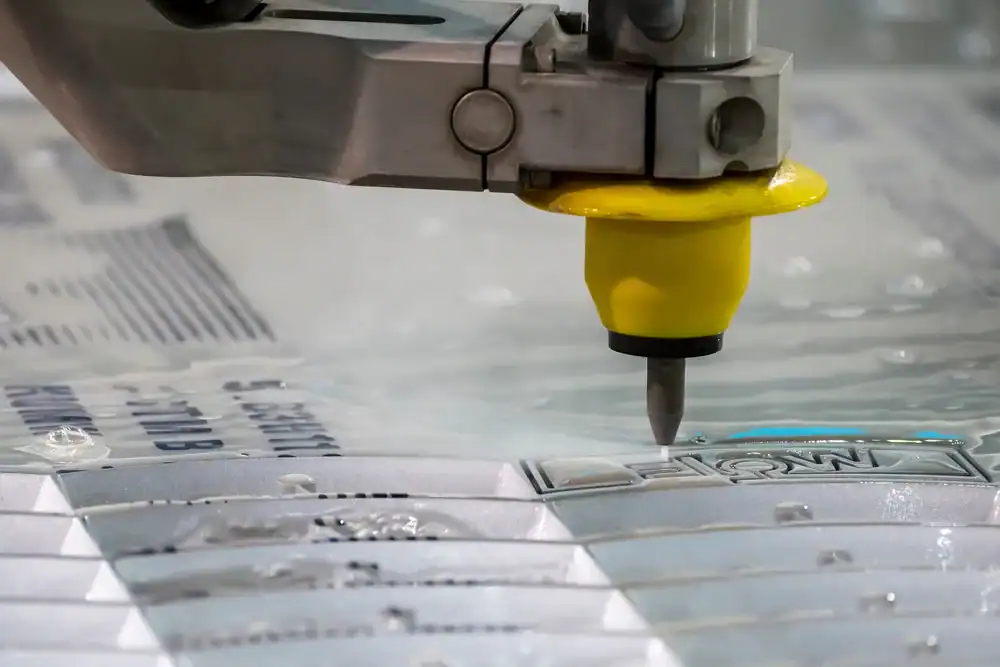
High precision waterjet cutting holds ±0.001 inch on most materials and geometries. That’s the realistic number, not a marketing claim.
The actual tolerance you’ll see depends on material thickness, hardness, and part geometry. Thinner materials and simpler shapes hold tighter tolerances more easily. Thicker materials or complex curves might land closer to ±0.003 inch, which is still tighter than most plasma or oxy-fuel processes.
If your print calls for tolerances tighter than ±0.001 inch, we’ll tell you up front whether waterjet is the right process or if you need grinding or EDM for those features. We’re not going to promise something we can’t deliver consistently.
Yes. Precision waterjet cutting in Stony Brook, NY handles titanium, Inconel, aluminum alloys, stainless steel, composites, and other specialty materials common in aerospace and medical applications.
The cold-cutting process matters here. There’s no heat-affected zone that changes material properties or creates micro-cracks. That’s critical when you’re working with materials specified for strength, corrosion resistance, or biocompatibility. Heat from plasma or laser cutting can alter those properties and cause part rejection.
Waterjet also cuts carbon fiber and composite laminates without delamination. The abrasive stream cuts through the layers cleanly instead of heating and separating them. If you’re working with materials that can’t tolerate thermal stress, waterjet is often the only process that works.
Waterjet doesn’t create a heat-affected zone. Laser and plasma both use thermal energy, which means edge hardening, warping, and discoloration on many materials.
Laser works well for thinner materials and offers fast cutting speeds on mild steel. But it struggles with reflective materials like aluminum or copper, and thicker sections require multiple passes or aren’t practical at all. Plasma is faster on thick steel but leaves a rougher edge and wider kerf.
Precision CNC waterjet cutting in Stony Brook, NY handles any material without changing the process. You’re not switching methods based on whether it’s metal, glass, or plastic. The edge quality is consistent, and there’s no HAZ to grind off or work around during welding. If your parts need to fit tight assemblies or you’re cutting materials sensitive to heat, waterjet is the process that won’t create new problems.
Turnaround depends on material availability, complexity, and current queue. Simple cuts on common materials can turn around in a few days. More complex jobs or specialty materials take longer.
The file review happens quickly—usually within a day of receiving your CAD file. If there are no issues, we move into programming and setup. Cutting time varies based on material thickness and part complexity. Thicker materials and intricate geometries take longer because the cutting head moves slower to maintain accuracy.
If you have a tight deadline, let us know up front. We’ll tell you whether it’s realistic and what it takes to meet it. Rush jobs are possible, but they require coordination. The worst thing we can do is promise a date we can’t hit, so we’re direct about timing from the start.
DXF and DWG files work best because they’re vector-based and contain the geometry information our CNC system needs. Most CAD programs export to these formats easily.
If you’re working in SolidWorks, AutoCAD, Inventor, or similar software, export your part outline as a DXF. Make sure it’s a 2D profile of what you want cut—the waterjet follows that path. If you have multiple parts to nest, you can send them as separate files or arranged in one file.
We can also work with PDF or AI files in some cases, but vector formats are cleaner and reduce the chance of conversion errors. If you’re not sure what format to send, reach out before you export. We’d rather spend two minutes on a call than have you send something that needs to be redone.
Our equipment cuts materials up to 8 inches thick. That covers most applications in metal fabrication, architectural work, and industrial manufacturing.
Cutting speed slows down as thickness increases because the abrasive stream needs more time to penetrate and maintain kerf quality through the entire depth. An 8-inch cut takes significantly longer than a half-inch cut, which affects both turnaround and cost.
For very thick materials, we adjust pressure, abrasive flow, and cutting speed to maintain edge quality and dimensional accuracy. If you’re cutting something at the upper end of the thickness range, expect the kerf to widen slightly and tolerances to open up compared to thinner materials. We’ll walk you through what’s realistic for your specific job.
Useful Links
Other Services we provide in Stony Brook