
Hear from Our Customers
You’re not looking for another supplier who promises precision but delivers parts that need rework. You need metal cut exactly to spec, with edges clean enough to skip secondary finishing, and material properties that haven’t been compromised by heat.
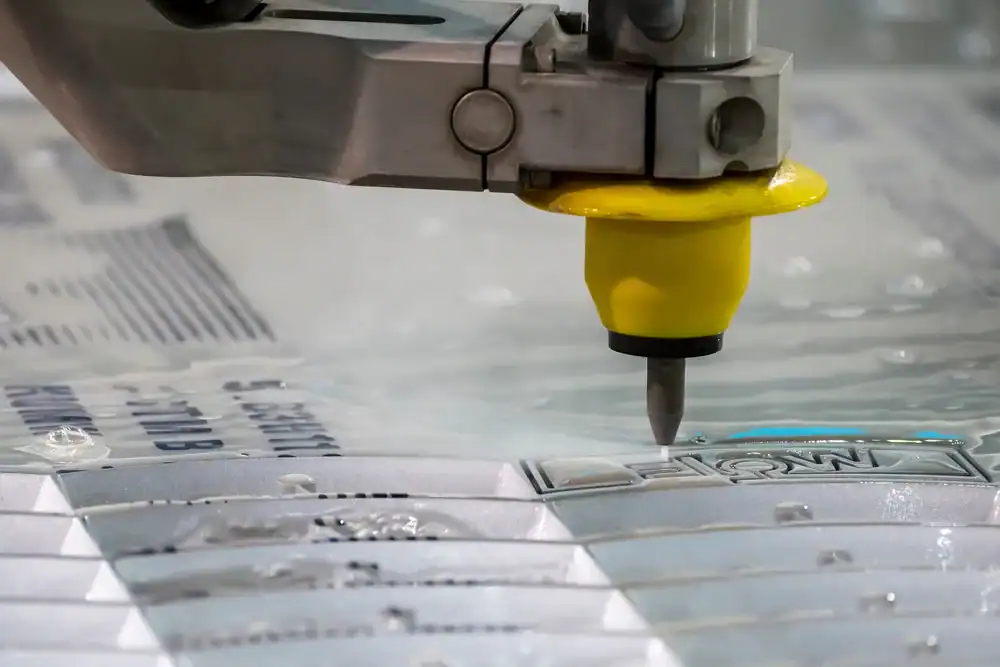
Waterjet cutting metal in Baldwin, NY means no heat-affected zones that warp your tolerances or change material strength. The process uses high-pressure water mixed with abrasive to slice through aluminum, stainless steel, titanium, Inconel, and hardened tool steel without altering the metal’s integrity. You get smooth edges, burr-free cuts, and dimensional accuracy that holds to ±0.001 inches.
When you’re working with expensive materials or tight deadlines, you can’t afford to gamble on a process that might distort your parts. Cold cutting preserves what you paid for—the exact material properties your application demands. No burning, no melting, no warping. Just clean cuts that meet your drawings the first time.
We serve manufacturers, fabricators, and job shops throughout Baldwin, NY and the surrounding Long Island, NY area. Our shop runs ISO 9001:2015 certified quality programs, which means every custom metal waterjet cutting project follows documented procedures with full traceability.
We’ve handled projects for aerospace contractors, medical device manufacturers, automotive shops, and architectural firms in the Baldwin area. The equipment we run operates at pressures exceeding 4,200 bar, giving us the capability to cut through materials up to 24 inches thick while maintaining tight tolerances.
You’re working with a team that reviews your CAD files before cutting starts. We catch potential issues early—nesting problems, tolerance conflicts, or design elements that won’t translate well to waterjet. That’s the difference between a vendor who just runs your file and a shop that actually understands fabrication.
You send us your CAD file or drawing. Our engineering team reviews it for manufacturability—checking tolerances, material thickness, and any features that might need adjustment for optimal waterjet cutting. If something won’t work as drawn, we tell you before we start cutting.
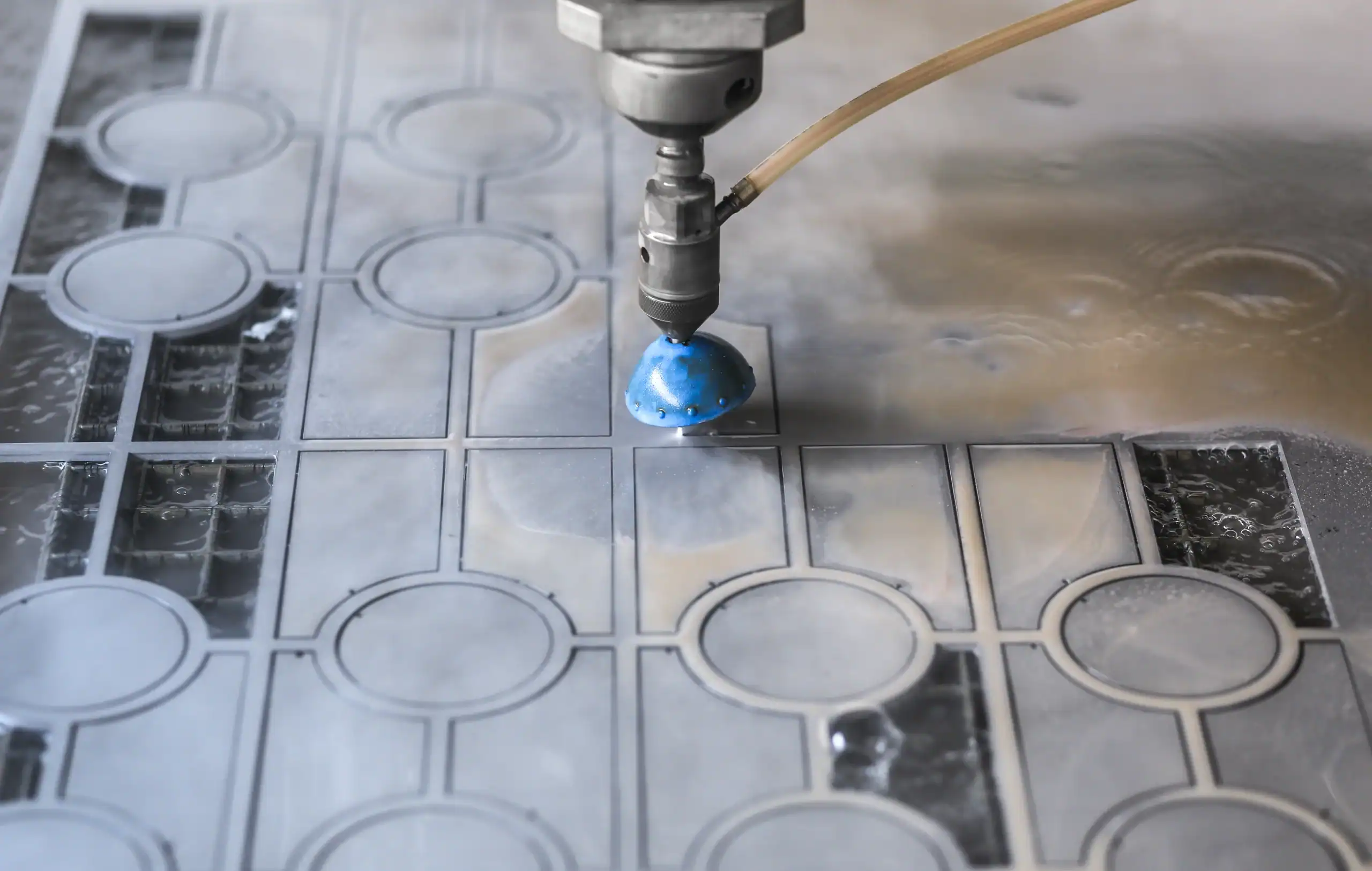
Once the file is approved, we program the CNC waterjet system and nest your parts to maximize material usage. The cutting head moves along your programmed path while ultra-high-pressure water mixed with garnet abrasive slices through the metal. There’s no heat, so there’s no distortion or hardening of cut edges.
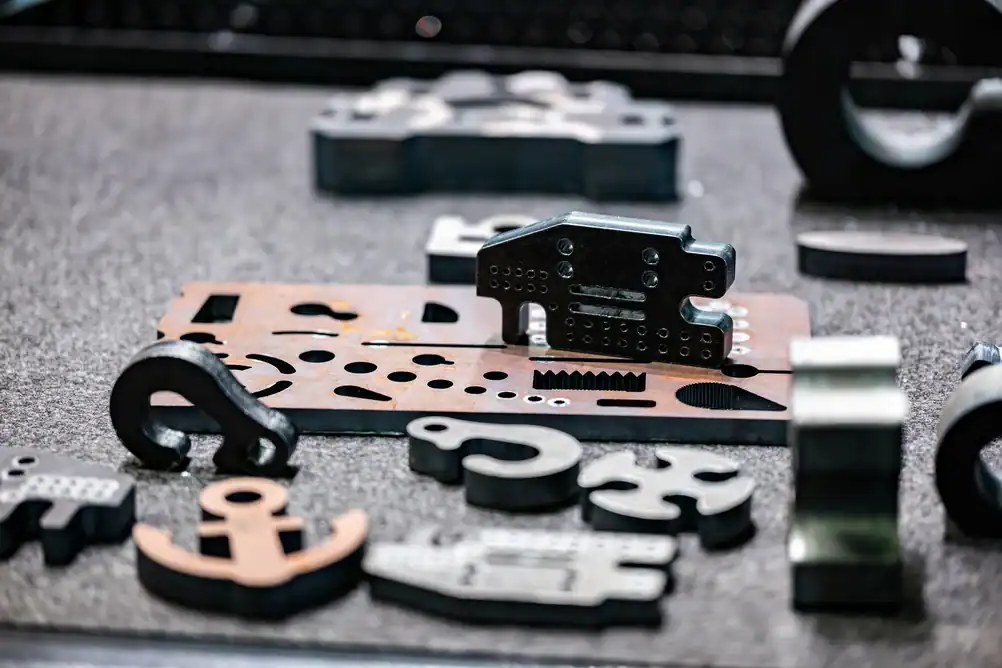
After cutting, we inspect dimensions and edges. Most waterjet-cut parts come off the table ready to use, with smooth edges that don’t require deburring. If your project needs additional services like bending, welding, or finishing, we handle that in-house. You get parts that are ready to install or assemble, not half-finished pieces that need more work.
Ready to get started?
You get the ability to cut virtually any metal without tooling costs or setup delays. Aluminum, stainless steel, titanium, Inconel, copper, brass, hardened steel—the waterjet doesn’t care how hard or thick the material is. We can stack thinner materials to cut multiple parts in one pass, which speeds up production for higher quantities.
Baldwin’s manufacturing sector includes aerospace suppliers and medical device companies that can’t tolerate material property changes from heat. Waterjet cutting metal in Baldwin, NY addresses that requirement directly. The cold-cutting process means your stainless steel stays non-magnetic, your aluminum doesn’t get work-hardened edges, and your titanium maintains its corrosion resistance.
Complex geometries that would require multiple setups on traditional equipment get cut in one operation. Small inside radii, sharp corners, intricate patterns—the waterjet handles details that punch presses and plasma cutters struggle with. You’re not limited by tool access or heat input. If you can draw it, we can cut it, and the kerf width stays narrow enough that you’re not wasting expensive material on wide cut paths.
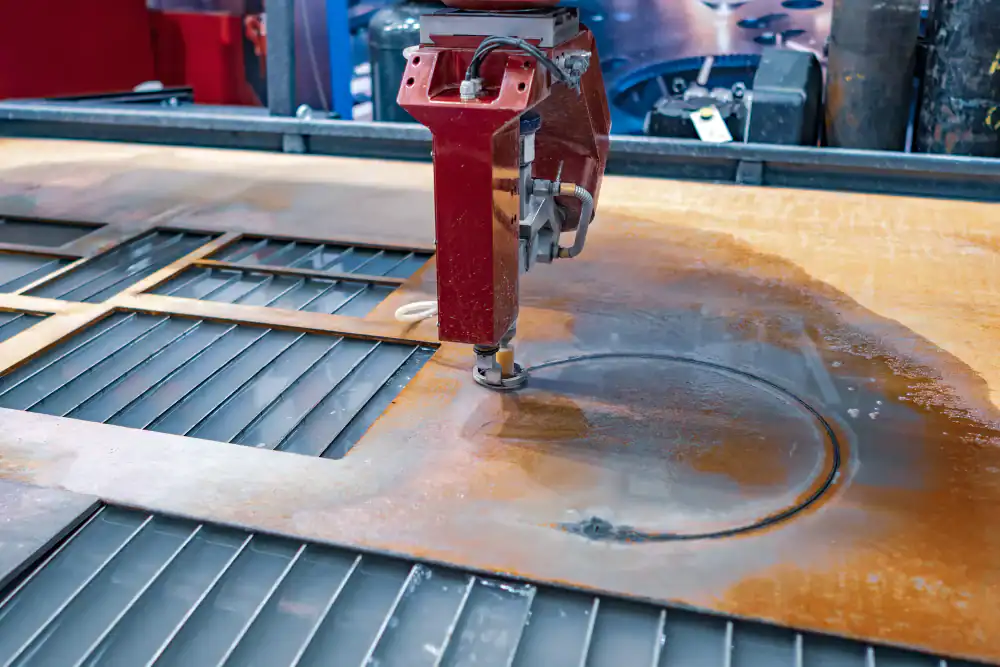
We cut all common metals and most exotic alloys. That includes aluminum in all grades, stainless steel (including 304, 316, and 17-4 PH), carbon steel, tool steel (even after hardening), titanium, Inconel, Hastelloy, copper, brass, and bronze.
The waterjet process doesn’t generate heat, so it won’t change the material’s properties. If you’re working with pre-hardened tool steel or heat-treated aluminum, the cut edges won’t lose their hardness or temper. Medical-grade stainless stays non-magnetic. Aerospace titanium keeps its corrosion resistance.
Thickness capacity goes up to 24 inches on most materials, though cutting speed slows down significantly on thicker stock. For production work, we typically see materials ranging from thin gauge sheet up to about 6 inches thick. If you’re not sure whether your material or thickness will work, send us the specs and we’ll give you a straight answer.
We hold tolerances to ±0.001 inches on most metals, depending on material thickness and part geometry. Thinner materials and smaller parts generally achieve tighter tolerances than thick plate or large parts, but that’s true of any cutting process.
The CNC control system guides the cutting head along your programmed path with repeatable precision. Because there’s no mechanical force pushing against the material (just water pressure cutting through it), you don’t get the deflection or vibration issues that come with sawing or milling. The kerf width stays consistent, which means your dimensions stay consistent from the first part to the last.
Edge quality is smooth enough that most parts don’t need secondary finishing. You’ll see some striations on the cut edge—that’s normal for waterjet—but they’re fine enough that they rarely affect fit or function. If your application requires a completely smooth edge, we can adjust cutting parameters or add a finishing operation, but most customers use the parts as-cut.
Cutting time depends on material type, thickness, and part complexity. Thinner materials cut faster than thick plate. Softer metals like aluminum cut faster than hardened steel. Simple shapes cut faster than intricate patterns with lots of detail.
As a rough reference, cutting 1/4-inch aluminum might take 8-12 inches per minute, while 1-inch stainless steel might cut at 2-3 inches per minute. Those are ballpark numbers—actual speeds vary based on the specific grade, required edge quality, and tolerance requirements.
Setup time is minimal compared to traditional machining. We don’t need custom tooling, fixtures, or dies. That makes waterjet extremely cost-effective for prototypes, short runs, or one-off custom parts. If you need five parts or five hundred, the setup cost stays low. For Baldwin-area manufacturers working on tight deadlines, we offer emergency service when you need parts fast. Most standard projects turn around within a few days, depending on our current queue.
Waterjet-cut edges come off the table smooth and relatively burr-free. You’ll get a cleaner edge than plasma or flame cutting, and in most cases, cleaner than laser cutting on thicker materials. The edge isn’t polished, but it’s finished enough for most applications without additional work.
The top edge where the waterjet enters the material is slightly sharper than the bottom edge where it exits. On thicker materials, you might see a small amount of taper (the kerf gets slightly wider as the stream passes through the material), but we’re talking about a few thousandths of an inch. For most parts, that taper is negligible and doesn’t affect fit or function.
If your application requires deburred edges or a specific edge finish, we can add that as a secondary operation. But the majority of waterjet-cut metal parts in Baldwin, NY go straight from our table to assembly or installation. The edges are safe to handle and ready to use. That’s one of the reasons manufacturers prefer waterjet for parts that need to move through production quickly without extra finishing steps.
Laser cutting uses focused heat to melt through metal. Waterjet uses high-pressure water and abrasive to erode through metal. That fundamental difference changes what each process can and can’t do well.
Laser generates a heat-affected zone around the cut edge. For thin materials and applications where a small amount of edge hardening or discoloration doesn’t matter, laser works fine and cuts faster than waterjet. But if you’re cutting thick material, working with metals that are sensitive to heat, or holding tight tolerances on large parts, the heat becomes a problem. Warping, hardened edges, and oxidation are common issues with laser-cut metal.
Waterjet doesn’t generate heat, so there’s no distortion, no hardened edges, and no discoloration. You can cut materials that would reflect or absorb laser energy—like copper, brass, or highly reflective aluminum. You can cut thicker materials without the edge quality degradation that happens when laser struggles through heavy plate. And you can cut hardened metals without worrying about cracking from thermal stress. For Baldwin manufacturers working with aerospace alloys, medical-grade stainless, or pre-hardened tool steel, waterjet is often the only process that delivers the required edge quality and material integrity.
Yes. Waterjet works equally well for one-off prototypes and production runs. The low setup cost makes it economical for small quantities, and the speed and consistency make it viable for larger production orders.
For prototype work, you get real parts cut from your actual production material without investing in tooling or dies. That means you can test fit, function, and assembly before committing to a full production run. Changes are easy—we just update the CAD file and cut the revised part. No scrapping expensive tooling or waiting for new dies.
For production runs, we can stack thinner materials to cut multiple parts simultaneously, which increases throughput. The CNC system ensures every part matches your specifications exactly, with the same edge quality and dimensional accuracy from the first piece to the last. We’ve handled production orders for Baldwin-area manufacturers ranging from a few dozen parts to several thousand. If your volumes grow beyond what makes sense for waterjet, we’ll tell you. But for many applications—especially parts with complex geometry or expensive materials—waterjet remains the most cost-effective option even at higher quantities.
Useful Links
Other Services we provide in Baldwin