Hear from Our Customers
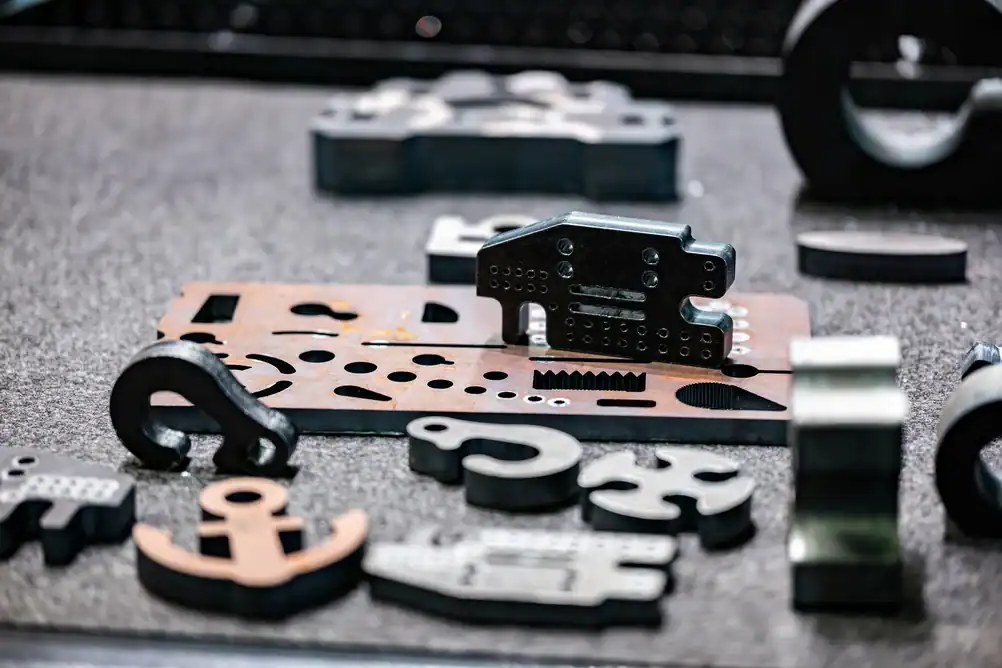
Your parts come off the machine ready to use. No heat-affected zones means no metallurgical changes, no hardened edges, no thermal distortion that throws your tolerances off. The material properties you started with are the same properties you end with.
This matters when you’re working with hardened tool steel, titanium, or aluminum that can’t afford to lose its temper. It matters when you’re cutting aerospace components where material integrity isn’t negotiable. And it matters when you need to tap a hole or weld a seam directly off the cut without grinding, deburring, or worrying about stress cracks down the line.
Waterjet cutting metal in Bethpage means you’re not paying for secondary operations you shouldn’t need in the first place. The kerf is narrow, the edge is clean, and the part is dimensionally accurate. Stack that against laser or plasma cutting, and you’ll see why manufacturers who need it done right the first time end up here.
We operate out of West Islip and serve the broader Long Island, NY manufacturing community, including Bethpage’s aerospace and metal fabrication sectors. This area has a long history of precision manufacturing, and the standards here reflect that.
We work with architects, designers, contractors, and fabricators who need custom cuts that meet spec without the back-and-forth. Our equipment handles complex geometries, thick materials, and tight tolerances—the kind of work that requires both the right technology and the experience to use it correctly.
If you’re in Bethpage and you need a waterjet metal cutting shop that understands what you’re actually trying to accomplish, we’re set up for that conversation.
You send us your design file—DXF, DWG, or whatever format your CAD software spits out. We review it for manufacturability and flag anything that might cause issues before we start cutting. If your tolerances are tight or your material is tricky, we talk through it upfront.
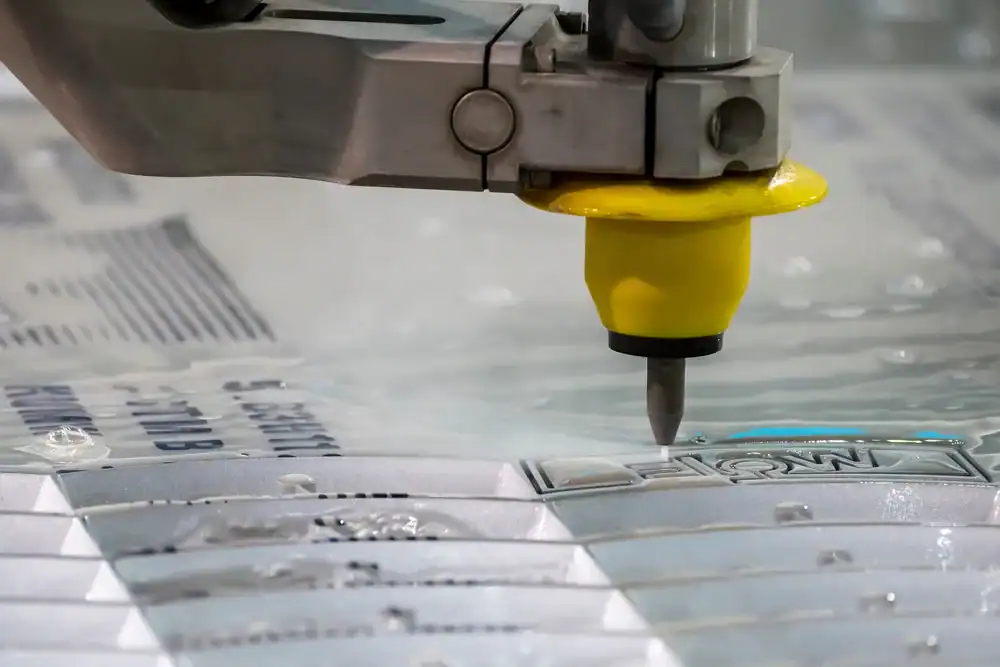
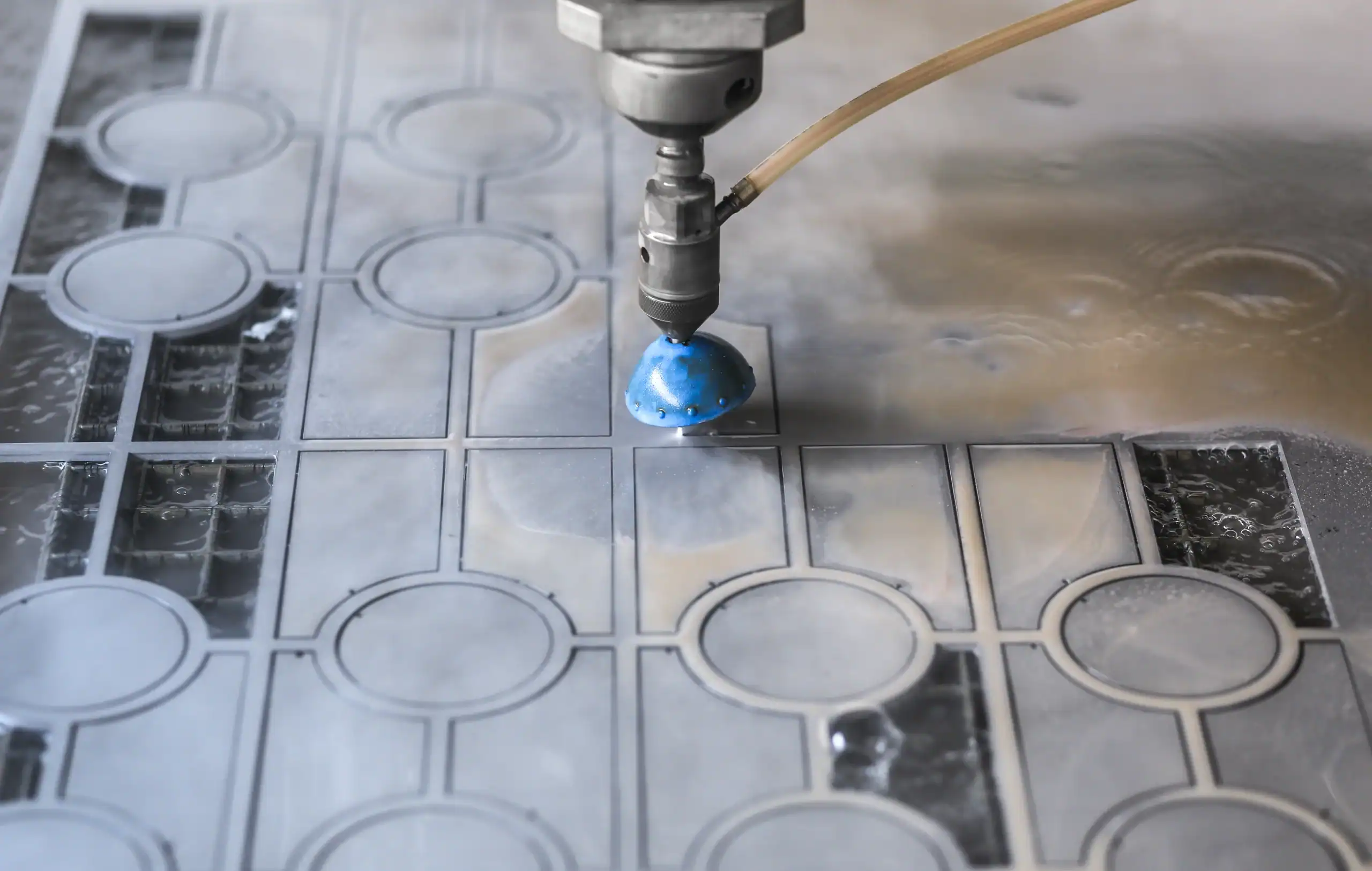
Once the file is dialed in, it goes into our CNC system. The waterjet nozzle follows the programmed path with a stream of water and abrasive garnet moving at speeds up to three times the speed of sound. That stream cuts through your metal without generating heat, which means no warping and no changes to the material’s microstructure.
For custom metal waterjet cutting in Bethpage, setup time is fast because there’s no hard tooling involved. We can nest multiple parts on a single sheet to minimize waste, and we can handle one-off prototypes or production runs without retooling between jobs. Thick plate, thin sheet, exotic alloys—it all runs through the same process. You get parts that are ready for the next step in your workflow, whether that’s welding, assembly, or final inspection.
Ready to get started?
CNC metal waterjet cutting in Bethpage means you’re getting programmable precision on every cut. We handle materials from aluminum and stainless steel to titanium, brass, copper, and hardened tool steel. Thickness capacity goes beyond 10 inches on some materials, and we can cut shapes with radii as tight as 0.020″.
Bethpage’s manufacturing landscape includes aerospace suppliers, automotive fabricators, and architectural metalwork shops. These industries demand accuracy, and they can’t afford to work with processes that introduce variables like heat distortion or material stress. Waterjet cutting eliminates those variables.
You also get material consultation if you’re not sure which alloy or thickness makes sense for your application. We’ve cut enough different metals to know what works and what doesn’t, and we’d rather have that conversation early than waste your time and material on something that won’t perform. The goal is to deliver parts that meet your quality standards without the usual headaches that come with thermal cutting methods.
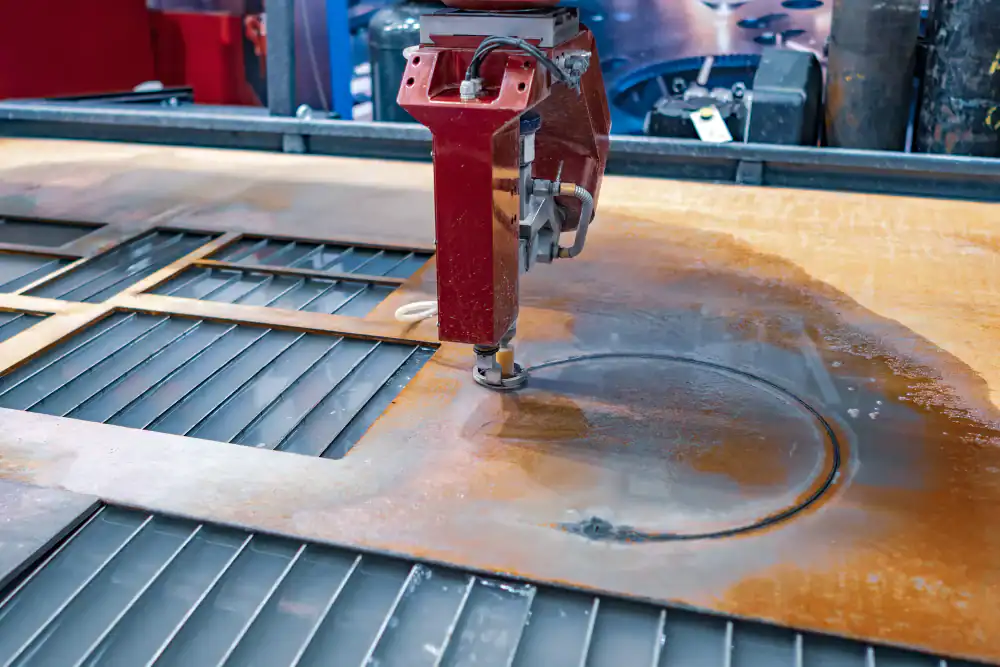
Yes. Waterjet systems cut through metal exceeding 10 inches thick while maintaining dimensional accuracy. The process doesn’t rely on heat, so there’s no thermal distortion as you go deeper into the material.
Thicker cuts do slow down the cutting speed, but the tradeoff is that you’re not introducing stress or warping into the part. For heavy plate work, this is often the only cutting method that keeps tolerances in check without requiring extensive post-processing. If you’re working with structural steel, thick aluminum, or titanium plate, waterjet gives you a clean edge all the way through.
The abrasive stream stays focused and consistent, even on deep cuts. You’re not dealing with taper issues or rough edges that need grinding. The part comes off the table ready for the next operation.
All of them. We cut aluminum, stainless steel, carbon steel, titanium, brass, copper, Inconel, hardened tool steel, and any other metal you’re likely to work with. The process doesn’t care about hardness or thermal conductivity because it’s not a thermal process.
This is particularly useful when you’re dealing with exotic alloys or materials that are difficult to machine. Titanium, for example, is notoriously hard on cutting tools and generates heat quickly with traditional methods. Waterjet handles it without issue. Same goes for hardened steel that would destroy a saw blade or burn up under a laser.
If you’re switching between different materials on the same job, waterjet doesn’t require retooling. You’re using the same nozzle and the same abrasive regardless of whether you’re cutting soft aluminum or hardened steel. That flexibility speeds up production and reduces setup costs.
The cutting stream is water mixed with abrasive garnet. It’s not a thermal process, so it doesn’t generate the kind of heat that alters the material’s microstructure. Your metal stays at room temperature throughout the cut.
Heat-affected zones are a problem with laser, plasma, and oxy-fuel cutting because those processes melt the material to cut through it. That heat changes the metallurgy along the cut edge—hardening it, softening it, or creating internal stresses that lead to cracking or distortion. Waterjet eliminates that entirely.
This matters when you’re working with materials that have been heat-treated or tempered to specific properties. If you cut them with a thermal process, you’re undoing that work along the edge. Waterjet preserves the material’s original properties, which means you can weld it, tap it, or machine it without worrying about brittleness or stress fractures. For aerospace, medical, and automotive applications where material integrity is critical, that’s not a nice-to-have—it’s a requirement.
Standard waterjet cutting holds tolerances around ±0.005″ to ±0.010″, depending on material thickness and part geometry. For high-precision work, smaller machines with advanced motion control can hit ±0.0005″, though that’s not necessary for most applications.
Tolerances tighten up when you’re cutting thinner material and loosen slightly as you go thicker. Complex shapes with tight inside radii are more challenging than straight cuts, but the CNC system compensates for that. If your print calls for specific tolerances, we program the tool path to account for kerf width and abrasive flow.
The consistency is what matters most. You’re not dealing with tool wear or heat buildup that throws dimensions off as the job progresses. Part one and part one hundred come out the same, which is critical for production runs where you need interchangeable components. If you’re used to fighting tolerance drift with other cutting methods, waterjet is going to feel like a different game.
Usually not. The edge quality off a waterjet is clean enough for most applications without additional grinding, deburring, or machining. You’re looking at a smooth, square edge that’s ready for welding, powder coating, or assembly.
Because there’s no heat-affected zone, you’re also not dealing with oxidation, scale, or hardened edges that need to be removed before the next operation. Parts that would normally require secondary cleanup to meet quality standards often don’t need it after waterjet cutting. That saves time and labor costs.
There are cases where you might want additional finishing—if you need a polished edge for aesthetic reasons, or if you’re working to extremely tight tolerances that require post-cut machining. But for the majority of metal fabrication work, the part is done when it comes off the waterjet table. That’s one of the reasons this process has become standard in industries where efficiency and accuracy both matter.
Laser cutting is fast and works well for thinner materials, but it’s a thermal process. That means you’re introducing heat into the material, which creates a heat-affected zone along the cut edge. For some applications, that’s not a problem. For others, it disqualifies the process entirely.
Waterjet doesn’t have that limitation. It cuts thicker materials more effectively than laser, handles reflective metals like aluminum and copper without issue, and doesn’t create any thermal distortion. The tradeoff is speed—laser is faster on thin sheet metal. But if you’re cutting anything over half an inch thick, or if you’re working with materials that can’t tolerate heat, waterjet is the better option.
Cost per part also tends to favor waterjet when you factor in the elimination of secondary operations. Laser-cut parts often need deburring, grinding, or stress-relieving. Waterjet parts typically don’t. If you’re comparing quotes, make sure you’re accounting for the total cost to get a finished part, not just the cost of the cut itself.
Useful Links
Other Services we provide in Bethpage