Hear from Our Customers
You’re looking at tolerances between ±0.001″ and ±0.008″ depending on your material and thickness. That’s the kind of precision that eliminates secondary machining on most jobs.
The process uses high-pressure water mixed with abrasive garnet to cut through stainless steel, aluminum, titanium, and other metals without generating heat. No heat means no hardened edges, no warping, and no burned material that needs rework.
You can cut intricate geometries that would be difficult or impossible with plasma, laser, or mechanical methods. Complex curves, tight inside corners, and detailed patterns come out clean the first time. The kerf is minimal—often under 1mm—so you can nest parts tightly and reduce material waste by 15-30% compared to other cutting methods.
If you’re running architectural metalwork, custom signage, machine components, or prototype parts in Franklin Square, this matters. You’re not paying for material you throw away, and you’re not waiting on secondary finishing to clean up rough edges.
We’ve been serving manufacturers, fabricators, and designers across Long Island, NY and the greater New York area for years. We’re not new to this, and we’re not learning on your project.
Franklin Square sits in the heart of Nassau County’s manufacturing corridor. You’ve got machine shops, metal fabricators, architectural firms, and custom manufacturers all within a few miles. That means fast turnaround matters here, and so does getting the cut right the first time.
We run CNC-controlled waterjet systems that handle everything from 0.010″ acrylic to 10″ stainless steel plate. Our equipment is maintained for consistent performance, and our operators know how to program complex cuts that hold tolerance across the entire sheet.
You send us your CAD file or drawing with material specs and quantity. We review it for manufacturability and flag anything that might cause issues—like inside corners that are too tight or features that won’t hold tolerance at your specified thickness.
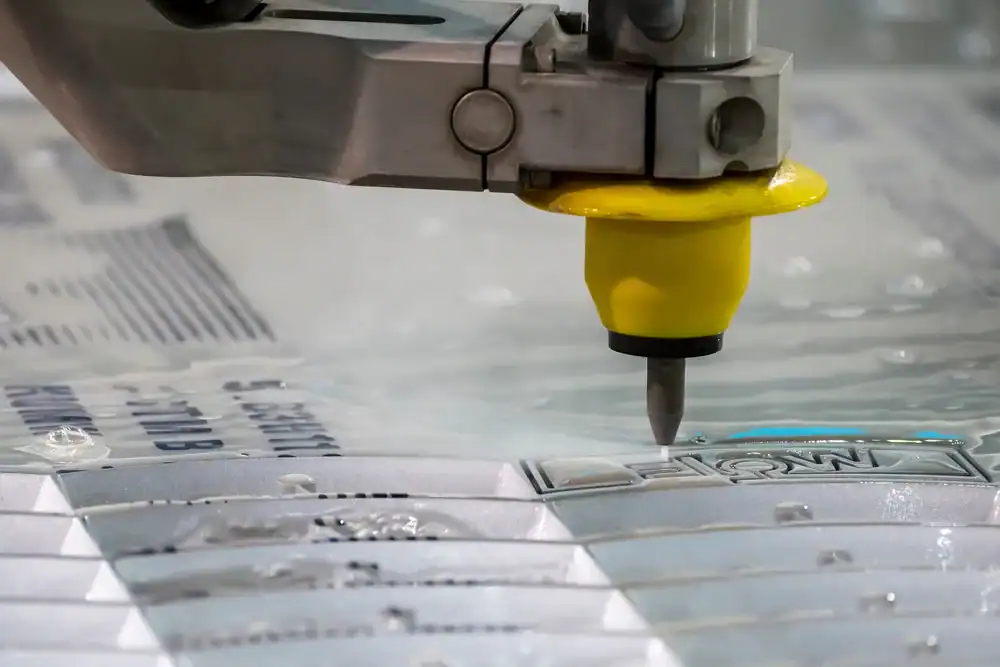
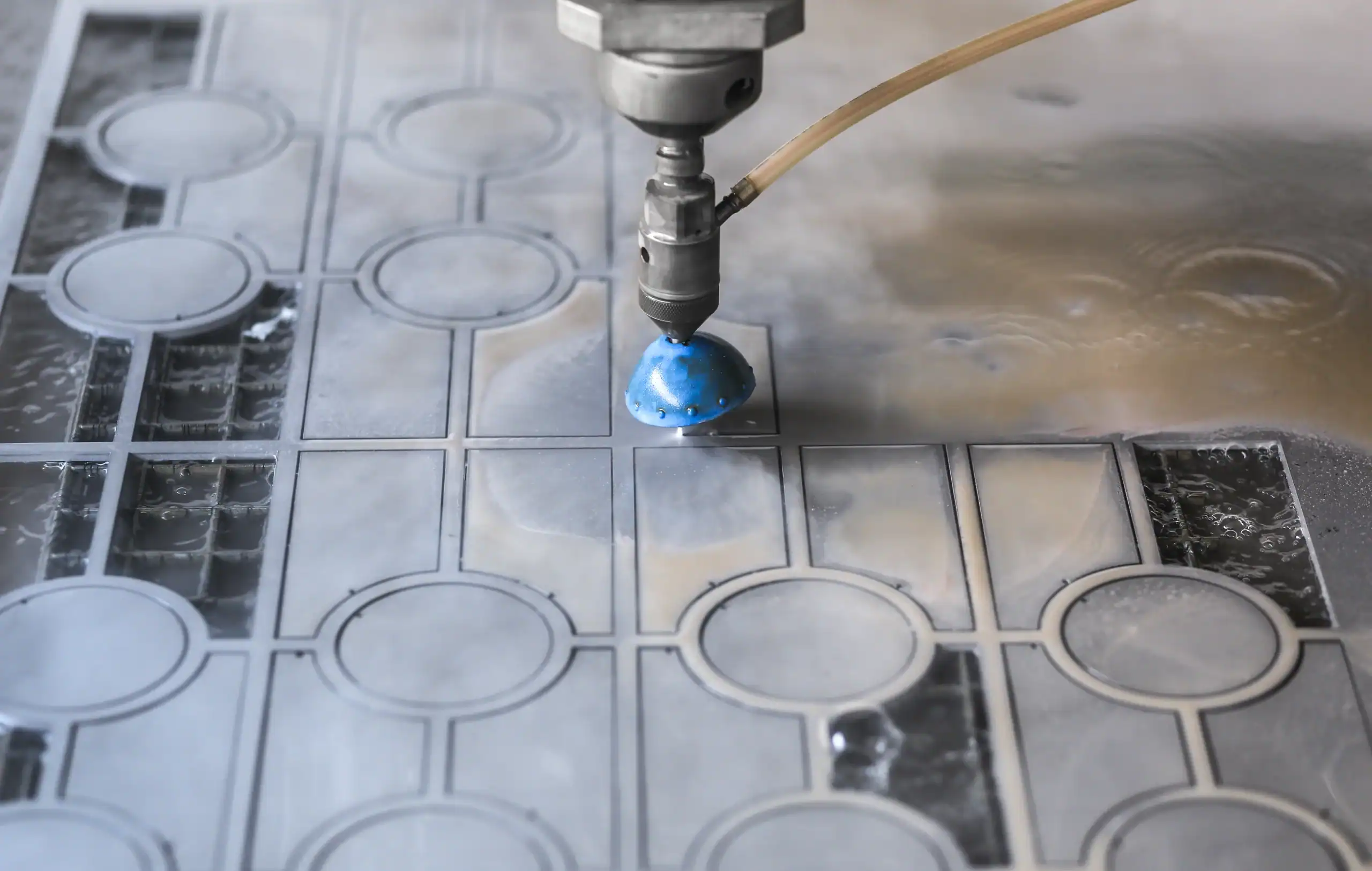
Once the file is approved, we program the CNC waterjet with your cut paths, nesting your parts to minimize material waste. The machine uses a high-pressure pump (typically 50,000-60,000 PSI) to force water through a tiny orifice, mixing it with abrasive garnet just before it exits the cutting head.
That abrasive waterjet stream cuts through your metal with a kerf around 0.030″ to 0.040″, depending on the nozzle size. The CNC system follows your programmed path with repeatability, so part one and part one hundred come out identical.
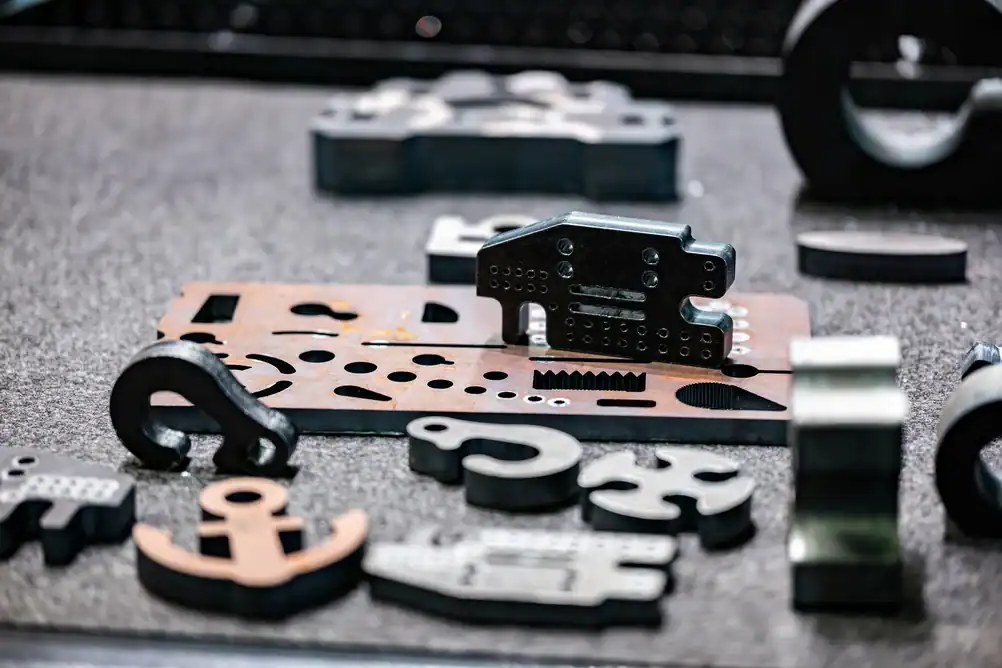
After cutting, most parts come off the table ready to use. There’s no slag, minimal burr, and no heat-affected zone to grind down. If your application requires it, we can add secondary deburring, but most customers skip it because the edge quality is already there.
Ready to get started?
You get material consultation upfront. If you’re not sure whether 304 or 316 stainless is right for your application, or if aluminum 6061 will hold up better than 5052 in your environment, we’ll walk through it. Franklin Square’s proximity to coastal areas means corrosion resistance comes up often—especially for architectural and outdoor applications.
We handle material sourcing if you need it, or we’ll cut from your supplied stock. Our CNC waterjet systems cut ferrous and non-ferrous metals, composites, plastics, stone, and glass. If you’re prototyping or running mixed-material assemblies, you can get everything cut in one place.
Programming includes optimized nesting to reduce your material cost. We don’t just drop your parts randomly on a sheet—we arrange them to maximize yield. On a typical job, that saves 20-30% in material compared to less efficient layouts.
Turnaround depends on complexity and queue, but standard jobs usually ship within 3-5 business days. Rush service is available when you’re up against a deadline. We’ve cut parts for manufacturers in Franklin Square who needed components the next day, and we’ve handled production runs with thousands of pieces that required consistent quality across every sheet.
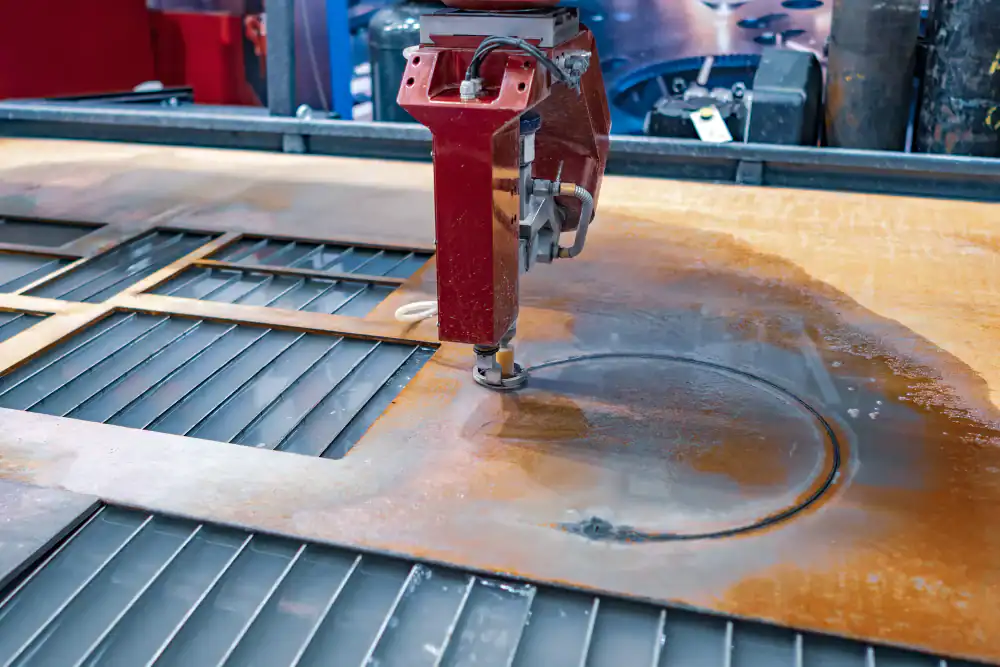
We cut stainless steel (304, 316, 17-4 PH), aluminum (5052, 6061, 7075), mild steel, tool steel, titanium, copper, brass, and bronze. Thickness ranges from thin gauge sheet up to 10″ plate, though cutting speed drops significantly on thicker material.
Waterjet works on hardened metals without issue since there’s no heat generation. If you’re cutting tool steel or hardened stainless that would destroy a saw blade or burn under a laser, waterjet handles it the same as annealed material.
Exotic alloys like Inconel, Hastelloy, and other high-nickel superalloys cut fine, though the abrasive consumption is higher. We’ve cut all of these for aerospace and industrial customers in the Franklin Square area who need materials that resist extreme temperatures or corrosive environments.
Tolerance depends on material type, thickness, and edge quality requirements. For most metals under 1″ thick, you’re looking at ±0.005″ on dimensions. Thinner materials (under 0.25″) can hit ±0.001″ to ±0.003″ if the setup is dialed in.
Thicker materials—anything over 2″—will have slightly wider tolerance bands, typically ±0.008″, because the waterjet stream deflects slightly as it cuts deeper. We account for this in programming by adjusting lead-ins, cutting speed, and abrasive flow.
Edge perpendicularity (taper) is usually within 0.005″ per inch of thickness on standard cuts. If you need tighter taper control, we can slow the cut speed and use dynamic head tilting to compensate for stream lag. That adds time but delivers near-zero taper on critical edges.
If your parts require tighter tolerances than waterjet can deliver, we’ll tell you upfront. Some features need post-machining or a different process entirely, and there’s no point pretending otherwise.
Most waterjet-cut metal parts come off the table with minimal burr—usually just a slight roughness you can knock off with a hand file in seconds. The exit side of the cut (where the waterjet stream leaves the material) will have a slightly rougher edge than the entry side, but it’s not the sharp, jagged burr you get from plasma or laser cutting.
Edge finish depends on cutting speed. Faster cuts leave more pronounced striation marks (vertical lines along the cut edge). Slower cuts produce smoother edges with finer striations. For parts that need a smooth edge finish, we program a slower final pass that cleans up the surface.
If your parts are going into an assembly where edge finish doesn’t matter—like brackets, mounting plates, or internal components—you can skip secondary finishing entirely. If you’re cutting parts for architectural applications or anywhere the edge is visible, we can add deburring or tumbling to smooth everything out.
Franklin Square has a lot of custom metal fabricators who send us parts specifically because the edge quality eliminates extra finishing steps in their shop. That’s time and labor they don’t have to spend cleaning up cuts.
Our waterjet systems cut up to 10″ thick stainless steel, though cutting speed drops to around 0.5-1.5 inches per minute at that thickness. Most jobs in Franklin Square fall between 0.25″ and 2″ thick, which is where waterjet runs efficiently.
Thicker material takes longer because the abrasive stream has to remove more material and maintain focus through the entire depth. At 6″ thick stainless, you’re looking at roughly 1-2 inches per minute cutting speed, depending on edge quality requirements.
Aluminum cuts faster than steel at the same thickness because it’s softer. A 4″ aluminum plate might cut at 3-5 inches per minute, while 4″ stainless would be closer to 1-2 inches per minute.
If you’re cutting thick plate and need multiple parts, we’ll give you an honest time estimate upfront. Waterjet is often still faster and cheaper than bandsawing or machining thick material, especially when you factor in setup time and the cost of tooling wear on other methods.
Cost depends on material type, thickness, cutting time, and complexity. Thicker materials and harder metals take longer to cut, which increases cost. Intricate patterns with lots of pierces (starting points) also add time since each pierce takes 5-30 seconds depending on thickness.
Operating cost for waterjet runs around $14-20 per hour when you factor in abrasive, water, power, and equipment wear. That’s significantly lower than laser cutting for thick materials, and it’s competitive with plasma on mild steel while delivering better edge quality.
We typically quote jobs based on cutting time plus material (if we’re supplying it). A simple bracket in 0.25″ aluminum might take 2-3 minutes to cut, while a complex architectural panel in 0.5″ stainless could take 30-45 minutes depending on detail level.
For production runs, per-piece cost drops because setup time gets distributed across more parts. If you’re running 500 pieces instead of 5, the programming and nesting work is the same, so your per-piece price comes down.
We’ll quote your job with a detailed breakdown so you know exactly what you’re paying for. No surprises, no hidden fees for “setup” or “handling” that double the price.
Yes. Waterjet excels at complex geometries because the cutting head follows a programmed CNC path—it doesn’t care if you’re cutting a straight line or a compound curve. We’ve cut everything from simple rectangles to intricate logos, gears with internal teeth, and architectural panels with hundreds of detailed cutouts.
Inside corners will have a small radius equal to the kerf width (typically 0.030″-0.040″), since the waterjet stream is round. If your design requires sharp inside corners, we can program a corner-cutting technique that gets closer, but true zero-radius corners aren’t possible without secondary machining.
We work from DXF, DWG, or other CAD formats. If you only have a sketch or PDF, we can redraw it into a cuttable file, though that adds engineering time to the quote. Franklin Square has a lot of designers and architects who send us concept drawings, and we turn those into manufacturable parts with proper dimensions and tolerances.
If your design has features that won’t work with waterjet—like threads, countersinks, or features smaller than the kerf width—we’ll flag those during file review and suggest alternatives. Sometimes that means combining waterjet cutting with drilling or milling. Other times it means redesigning a feature slightly so it can be cut in one operation.
Useful Links
Other Services we provide in Franklin Square