Hear from Our Customers
You’re looking at tight tolerances on complex shapes without the headaches that come with traditional cutting methods. Waterjet cutting metal means no heat-affected zones that compromise material integrity, no hardened edges that need grinding down, and no distortion that throws your measurements off.
Your parts come off the table ready to use. The kerf width sits at just 0.04 inches, so you’re not wasting material on wide cuts. That matters when you’re working with expensive metals or trying to nest multiple parts efficiently.
Whether you’re cutting aluminum for architectural work, stainless for food processing equipment, or hardened tool steel for industrial components, the process stays consistent. Same clean edges. Same dimensional accuracy. Same reliability across different materials and thicknesses.
We operate out of Selden with Flow Mach 500 CNC equipment—the kind that cuts directly from your CAD files without interpretation errors or manual adjustments. You send the design, we program the machine, and the cuts match your specifications.
The Long Island, NY manufacturing corridor has been home to metal fabricators for decades, and that’s not by accident. You’ve got aerospace suppliers, custom machine shops, and construction contractors all within a short drive, all needing precision cutting that doesn’t compromise the material. We’ve built our operation around serving that market with the speed and accuracy it requires.
Our team includes designers who work with computer-aided design tools daily. They can review your files before cutting, catch potential issues, and optimize the process to save you time and material costs.
You start by sending us your CAD file—DXF, DWG, or most standard formats work fine. Our designers review it to confirm the design translates properly to the cutting process and flag anything that might cause issues with material selection or tolerances.
Once the file is approved, it goes directly into the CNC system. The Flow Mach 500 reads the design and calculates the cutting path, accounting for material thickness and the type of edge finish you need. There’s no tooling to create, no dies to build—just direct translation from design to cut.
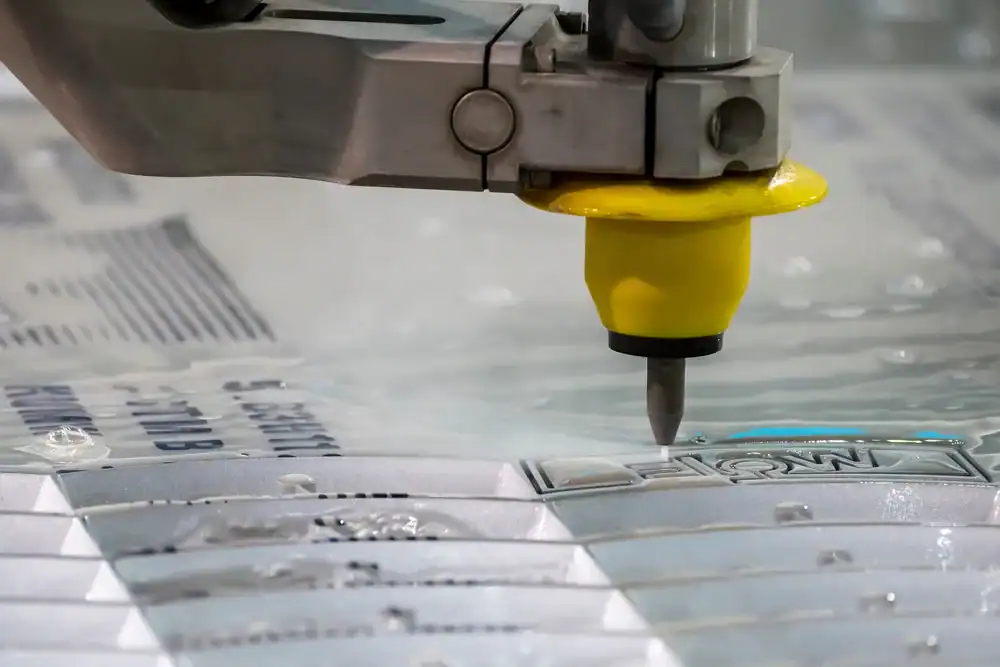
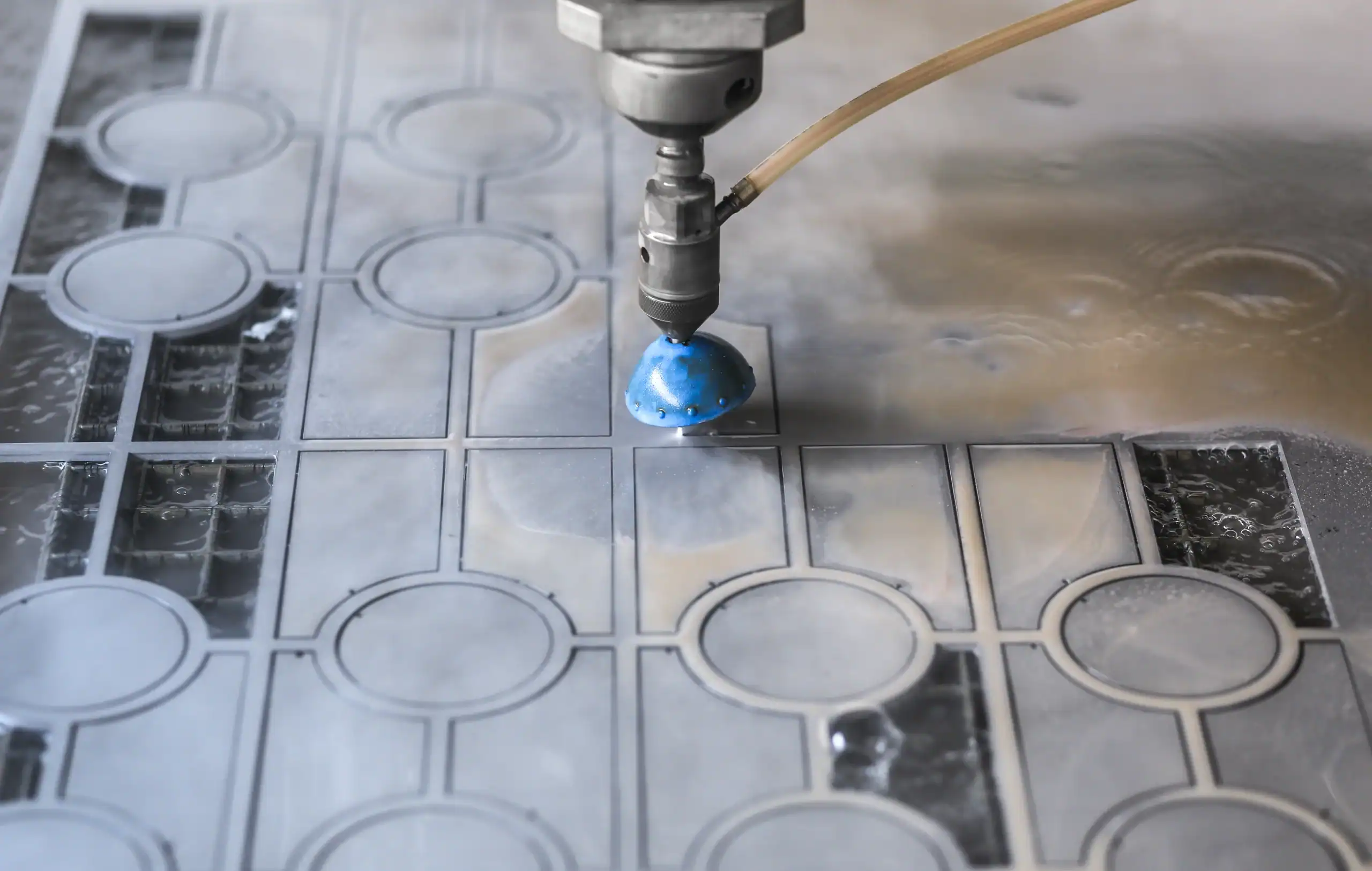
The actual cutting uses a high-pressure water stream mixed with abrasive garnet. It cuts through the metal without generating heat, which means the material properties stay intact from edge to edge. No warping. No hardening. No thermal stress that shows up later when you’re trying to weld or form the part.
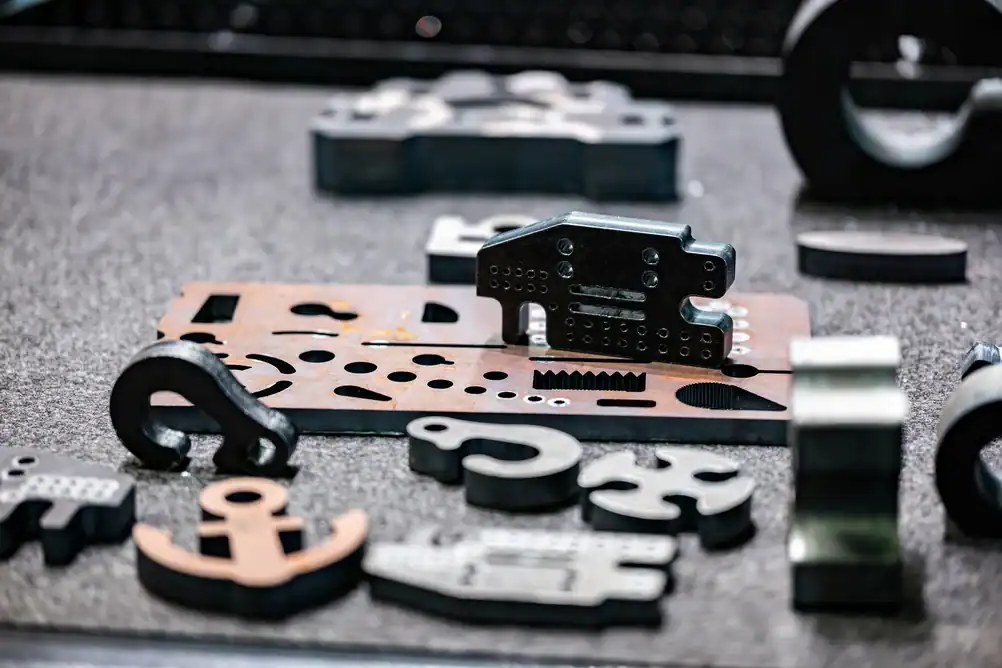
After cutting, most parts are ready to go. The edge quality is clean enough for many applications without secondary finishing. If you need specific deburring or surface prep, that’s straightforward to add, but the waterjet process itself delivers a usable edge right off the table.
Ready to get started?
Every metal waterjet cutting project includes CNC precision controlled directly from your CAD design. You’re not dealing with manual operation or eyeballed measurements—the machine follows the programmed path with repeatable accuracy across single prototypes or production runs.
Material versatility is built into the process. Aluminum, stainless steel, titanium, brass, copper, hardened tool steel—the waterjet handles them all without changing tooling or adjusting for hardness. That matters in the Selden area where manufacturers often work with mixed materials across different projects or need quick turnarounds without setup delays.
Thickness capacity goes up to 300mm for materials where you need that kind of depth. Most projects sit well below that range, but knowing you can handle thick plate or structural components without farming out to another shop keeps your timeline predictable.
The cutting process itself is environmentally sound compared to plasma or laser cutting. No hazardous fumes, no toxic byproducts, minimal waste beyond the used garnet abrasive. For facilities with environmental compliance requirements or shops operating in mixed-use areas, that’s not just a nice feature—it’s often a necessity.
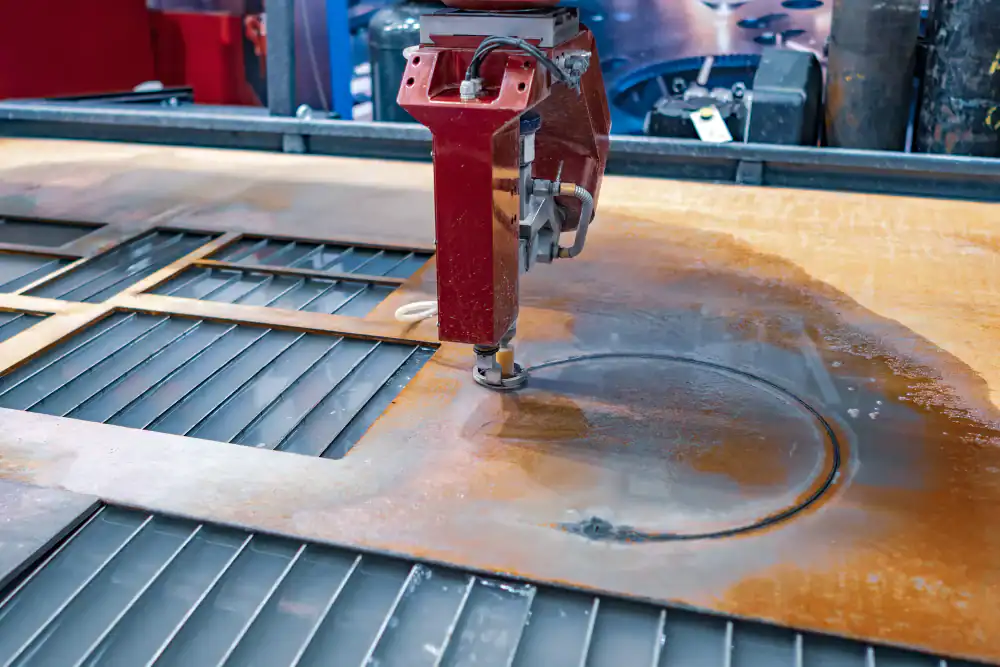
Waterjet cutting metal eliminates heat from the equation entirely. Laser and plasma both use thermal energy to melt through material, which creates a heat-affected zone along the cut edge. That zone changes the material properties—hardening the edge, creating internal stress, sometimes warping thin materials.
With waterjet cutting, the material stays cold throughout the process. You maintain the original properties edge to edge, which matters when you’re working with metals that have been heat-treated or tempered to specific specifications. There’s no secondary annealing needed to restore material characteristics.
The other practical difference is material versatility. Laser cutting works great on certain metals but struggles with reflective materials like copper or brass. Plasma handles thicker materials but leaves a rougher edge. Waterjet cuts everything with the same process and delivers consistent edge quality regardless of material type or reflectivity.
Turnaround depends on material availability and queue position, but the actual cutting process is faster than most people expect. Because there’s no tooling to create or dies to build, we go straight from approved CAD file to cutting. Simple parts can be done same-day if the material is in stock and the schedule allows.
More complex projects with intricate designs or multiple parts typically run within a few days. The CNC system operates efficiently once it’s programmed—there’s no manual adjustment between cuts, so production runs move quickly even for detailed work.
Material procurement is usually the variable that extends timelines. If you’re working with standard aluminum or stainless steel in common thicknesses, we often have that on hand. Exotic metals or unusual dimensions might require ordering, which adds lead time. Sending your specs early helps us confirm material availability and give you an accurate completion date.
CNC control means the cutting head follows your CAD design exactly as programmed. Tolerances typically hold to ±0.005 inches on most projects, which covers the requirements for precision components in aerospace, medical devices, and custom machinery.
Intricate designs are where waterjet cutting really shows its capability. The narrow kerf width allows for detailed interior cuts, sharp corners, and complex geometries that would be difficult or impossible with traditional machining. You can cut artistic patterns, architectural details, or functional components with multiple features all in a single operation.
The process doesn’t create tool pressure against the material, so there’s no deflection or vibration that throws off accuracy. Thin materials cut just as precisely as thick plate because the cutting force is distributed through the water stream rather than concentrated at a tool edge. That makes it ideal for delicate work where mechanical cutting methods would bend or damage the material.
The material list is essentially unlimited for metals. Aluminum, stainless steel, carbon steel, titanium, brass, copper, bronze, tool steel, Inconel—if it’s a metal, waterjet will cut it. Hardness doesn’t matter because the abrasive stream erodes material rather than trying to shear through it mechanically.
Thickness capacity on our Flow Mach 500 system goes up to 300mm, though most projects fall in the range of 0.25 to 2 inches. Thicker materials take longer to cut as the stream needs more time to penetrate, but the edge quality remains consistent regardless of thickness. You don’t see the taper or roughness that shows up with other cutting methods on thick plate.
Material condition doesn’t restrict the process either. Pre-hardened metals, heat-treated alloys, work-hardened materials—they all cut the same way. That’s useful when you’re working with metals that have already been processed to specific properties and you can’t risk changing those characteristics with heat-based cutting.
Most waterjet cutting metal applications use the parts straight off the table. The edge quality is clean, with minimal burr formation and a surface finish that works for welding, forming, or assembly without additional prep. You’re looking at a slightly frosted appearance rather than a polished edge, but it’s smooth and consistent.
The level of finish depends partly on cutting speed. Slower cutting produces a smoother edge with fewer striations. Faster cutting gets the job done quicker but may show more texture on the cut face. We adjust speed based on your application—if the edge will be visible or needs to meet specific surface requirements, we slow it down. If it’s getting welded or hidden in assembly, we optimize for speed.
Some applications do benefit from light deburring, particularly if you’re handling the parts frequently or they need to meet strict cosmetic standards. But compared to plasma cutting, which leaves heavy slag and dross, or saw cutting, which creates significant burrs, waterjet edges are remarkably clean right from the cut. Any finishing needed is minimal and quick.
Pricing depends on material type, thickness, cutting time, and design complexity. Waterjet cutting typically costs more per hour than plasma or oxy-fuel cutting but less than laser cutting for thicker materials. The real cost comparison needs to factor in the total job, not just the cutting rate.
You save money by eliminating secondary operations. No grinding to clean up rough edges. No annealing to fix heat-affected zones. No scrapped parts from warping or thermal distortion. The parts come out ready to use, which cuts labor time and reduces your total cost even if the per-hour cutting rate is higher.
Material waste is lower with waterjet cutting because the kerf width is narrow and you can nest parts tightly. On expensive metals or large production runs, that material savings adds up quickly. There’s also no tooling cost—you don’t need to build dies or create custom fixtures, which makes waterjet economical even for short runs or one-off prototypes.
Useful Links
Other Services we provide in Selden