Hear from Our Customers
You’re not just cutting glass. You’re executing a design that can’t afford mistakes. One crack means reordering material, missing your deadline, and explaining to your client why the project’s delayed.
Waterjet cutting removes heat from the equation entirely. No thermal stress means no microfractures forming along your cut line. The abrasive stream cuts through glass up to 4 inches thick while maintaining tolerances within 0.1mm, which matters when you’re fitting panels into architectural frameworks or creating decorative installations where gaps show.
The edges come off the table smooth. For applications where the edge will be hidden or fitted, you’re often looking at zero additional finishing work. That’s time back in your schedule and cost out of your budget. When you need architectural glass waterjet cutting in Holtsville, NY that holds up under inspection, this is how it’s done.
We’ve spent over twenty years serving Holtsville and the surrounding Long Island, NY area with CNC waterjet cutting. We’re not a general fabrication shop that happens to cut glass sometimes. This is what we do, day in and day out, for architects, contractors, designers, and manufacturers who need it done right.
Our Flow Mach 500 system runs directly from your CAD files. You send the design, we program the machine, and the glass gets cut exactly as drawn. No interpretation errors, no manual measuring, no “close enough.” Holtsville’s mix of residential renovation projects and commercial construction means we’ve cut everything from custom shower enclosures to storefront panels to decorative art installations.
You’re working with people who understand what’s riding on the cut. We’ve seen what happens when glass breaks mid-project, and we’ve built our process around making sure that doesn’t happen to you.
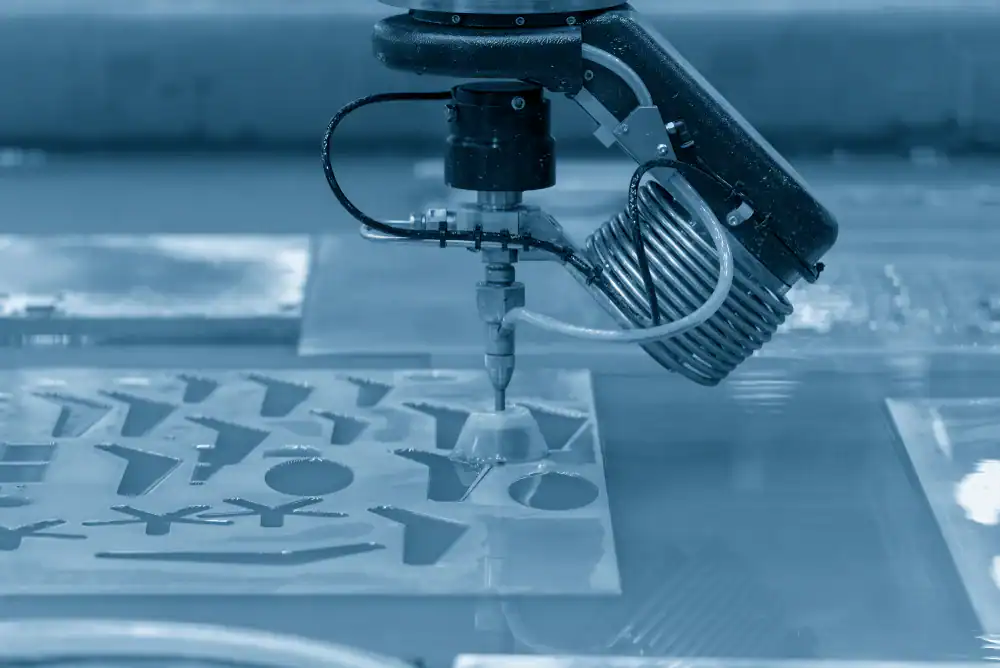
You start by sending us your design file and specifications. We review the file for any potential issues, confirm the glass type and thickness you need, and program the cut path into our CNC system. If something in the design could cause problems during cutting or installation, we’ll flag it before we start.
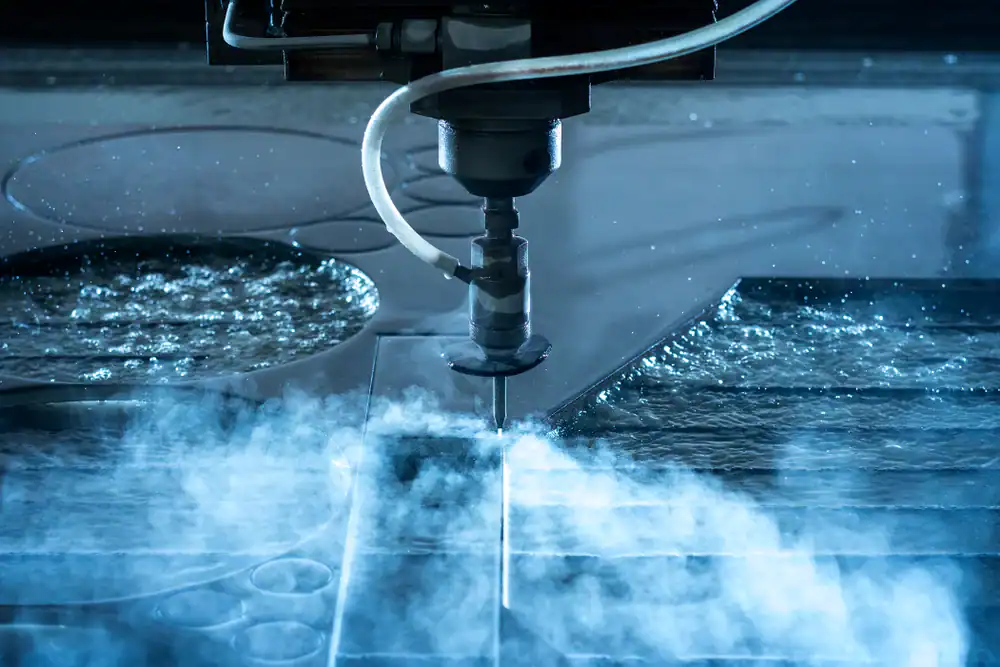
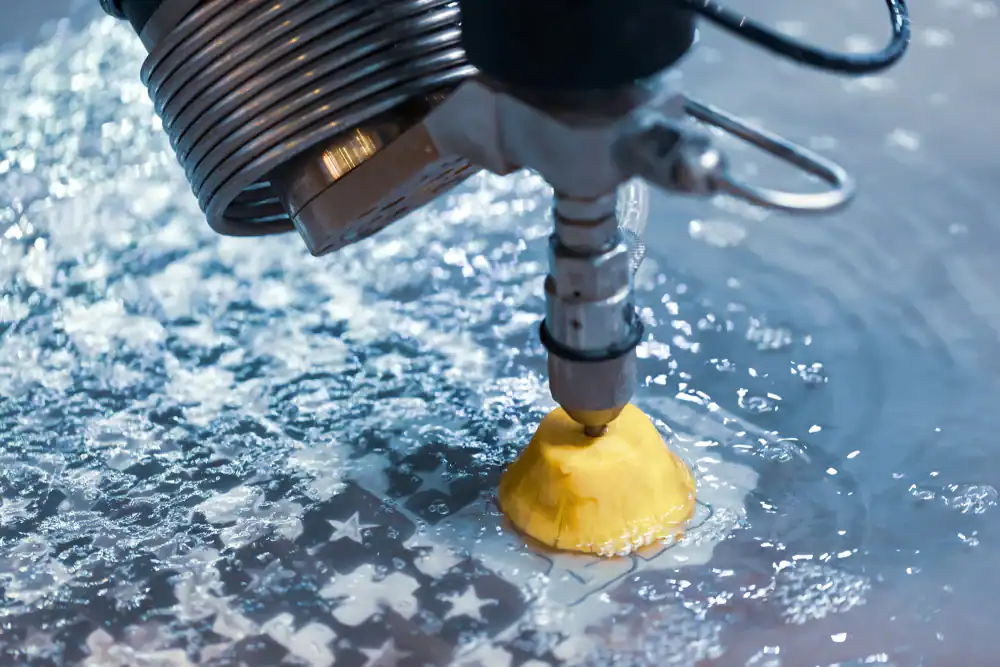
The glass gets secured to the cutting table. The waterjet nozzle, loaded with abrasive garnet, begins cutting at pressures up to 60,000 PSI. The stream is thinner than a credit card but powerful enough to slice through thick glass without generating any heat. Because there’s no thermal expansion or contraction happening in the material, you don’t get the stress fractures that cause glass to crack hours or days after a traditional cut.
Once the cut is complete, we inspect the edges and dimensions. For most applications, especially residential glass cutting services in Holtsville, NY, the edges are ready to go as-is. If your project requires polished edges or specific finishing, we handle that too. You receive glass that’s been cut to your exact specifications, ready for installation, with no surprises when you go to fit it.
Ready to get started?
Every project includes design file review and consultation before we cut. If you’re working on a renovation in one of Holtsville’s older residential neighborhoods, where measurements might not be perfectly square, we’ll talk through how to account for that in your template. If you’re a contractor working on new commercial construction along the Route 112 corridor, we’ll confirm that your glass specs match your structural requirements.
You get CNC-controlled cutting with tolerances tight enough for precision fitting. The process works for standard float glass, tempered glass, laminated glass, and specialty materials. Thickness capacity runs from thin decorative glass up to 100mm for industrial applications, though most residential and architectural projects in Holtsville fall between 3mm and 50mm.
Material consultation is part of the service. If you’re not sure whether your application needs tempered glass or if laminated would be better, or if you’re questioning whether the thickness you’ve spec’d will hold up to the installation environment, we’ll walk through it with you. Long Island, NY’s coastal proximity means moisture and salt air are factors for exterior applications. We’ve cut glass for enough local projects to know what holds up and what doesn’t. You’re not just getting custom glass waterjet cutting in Holtsville, NY. You’re getting the experience that keeps your project on track.
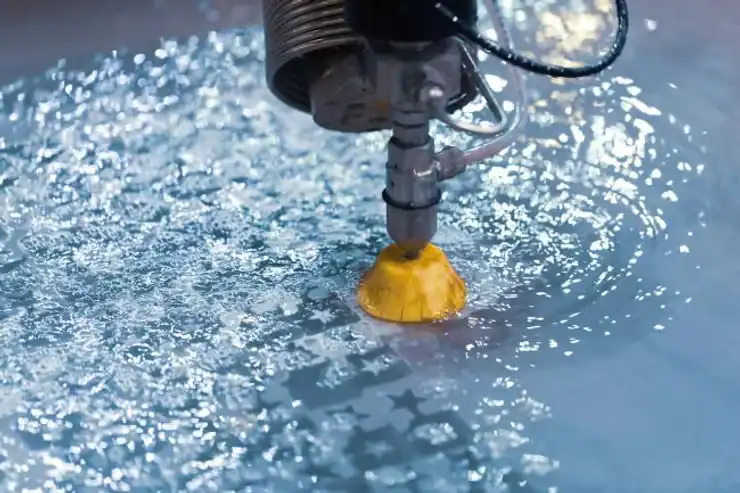
Yes, and that’s one of the main reasons people choose waterjet over traditional glass cutting methods. The cutting stream is cold, which means there’s no thermal expansion happening in the glass as you cut. Heat is what causes stress fractures, and stress fractures are what turn into cracks.
The CNC system can execute curves, angles, interior cutouts, and notches that would be extremely difficult or impossible with a scoring wheel. If you’re creating a decorative glass panel with flowing organic shapes, or if you need precise rectangular cutouts for hardware mounting, the waterjet handles it without putting stress on the material.
The abrasive stream is also narrow enough to cut fine details. You’re not limited to simple geometric shapes. Architectural projects often require complex patterns, and artistic installations can involve intricate designs that need to be replicated exactly across multiple panels. The waterjet cuts them all the same way, with the same precision, because it’s following the CAD file every time.
The edges come off smooth enough for many applications to use directly, especially if the edge will be hidden in a frame, set into a gasket, or butted against another surface. You’re not dealing with the rough, scratchy edge that comes off a scoring break or a saw cut.
For applications where the edge will be visible and handled regularly, like a glass tabletop or a shower door, you’ll typically want to add edge polishing. But that’s a choice based on your specific use case, not a requirement to fix a rough cut. The waterjet produces a consistent edge quality that gives you a clean starting point.
The lack of chipping is the bigger advantage. Traditional cutting methods can cause small chips along the cut line, especially near corners or at the end of a cut. Those chips compromise the strength of the glass and create weak points where cracks can start. Waterjet cutting doesn’t create those chips because the cutting force is distributed evenly and there’s no mechanical stress being applied to the edge. You get a clean cut that maintains the structural integrity of the glass.
The system can cut glass up to 100mm thick, which is about 4 inches. Most projects don’t require anything close to that. Residential applications typically run between 3mm and 12mm. Commercial architectural glass usually falls between 6mm and 25mm. Industrial applications occasionally push into the 50mm range.
Thickness does affect cutting speed, but it doesn’t significantly affect accuracy. The waterjet stream cuts straight through the material regardless of thickness, and the CNC system maintains the same path. You’re still looking at tolerances within 0.1mm whether you’re cutting 6mm glass or 50mm glass.
Thicker glass does require slower cutting speeds to ensure the abrasive stream fully penetrates the material and maintains a clean cut through the entire depth. But slower doesn’t mean less accurate. It just means the job takes longer. If you’re working with thick glass for a structural application or a heavy-duty industrial component, the waterjet handles it without the risk of thermal cracking that you’d get from other cutting methods that generate heat.
Laser cutting uses focused heat to melt or vaporize material, which creates a problem when you’re working with glass. Glass doesn’t respond well to localized heating. You end up with thermal stress, microfractures, and a high risk of the piece cracking either during the cut or shortly after when it cools.
Waterjet cutting uses a cold process. The abrasive stream mechanically erodes the glass without changing its temperature. That’s why you don’t get thermal stress and why the material stays stable after cutting. For glass, waterjet is the more reliable choice.
Laser cutting can work for very thin glass in controlled conditions, but it’s limited in thickness and it requires careful management of heat buildup. Waterjet doesn’t have those limitations. You can cut thick glass, thin glass, laminated glass, and tempered glass without worrying about heat-related failures. The edge quality is also more consistent with waterjet because you’re not dealing with melted material that can create rough or uneven surfaces. If you need industrial glass waterjet cutting in Holtsville, NY that won’t crack your material, waterjet is the answer.
Glass needs to be cut before it’s tempered. The tempering process puts the glass under internal stress, which is what makes it stronger. But that also means any attempt to cut it after tempering will cause it to shatter immediately. The internal stress has nowhere to go once you break the surface, so the whole piece fractures.
The correct sequence is to cut the glass to your final dimensions and shape first, then send it out for tempering if your application requires it. That’s standard procedure for any glass cutting method, not just waterjet. If you’re working on a project that requires tempered glass, we’ll cut it to your exact specifications, including any holes, notches, or cutouts, so it’s ready to go straight to tempering.
Once the glass comes back tempered, it can’t be modified. That’s why getting the cut right the first time matters. CNC waterjet cutting gives you the accuracy to ensure your dimensions are correct before tempering, which eliminates the risk of having to scrap an expensive piece of tempered glass because the holes don’t line up or the shape is slightly off. You cut it once, cut it right, and then temper it.
Waterjet cutting works for any project where precision matters and you can’t afford to have the glass crack. Architectural applications like custom windows, glass facades, decorative panels, and interior partitions are common. The ability to cut complex shapes means architects and designers can specify intricate patterns that wouldn’t be feasible with traditional cutting.
Residential projects include custom shower enclosures, glass tabletops, backsplashes, shelving, and decorative elements. If you’re renovating a home in Holtsville and need glass cut to fit an irregular space, waterjet gives you the accuracy to match those dimensions exactly. Contractors use it for storefronts, door panels, and any application where the glass needs to fit precisely into a frame or opening.
Industrial and manufacturing applications include glass components for machinery, equipment housings, and protective barriers. Artists and designers use waterjet cutting for sculptures, installations, and custom artwork that involves intricate glass shapes. Marine and automotive projects sometimes require specialized glass cutting for windows, windshields, or protective panels. If your project involves glass and you need it cut accurately without risking cracks or chips, waterjet cutting handles it. That’s what makes it the go-to method for architectural glass waterjet cutting in Holtsville, NY across multiple industries.
Useful Links
Other Services we provide in Holtsville