Hear from Our Customers
You’re dealing with tight tolerances, complex designs, or thick glass that traditional methods can’t handle without cracking. Laser cutting overheats the material. Saws chip the edges. Both leave you with secondary finishing work, wasted material, and installation headaches.
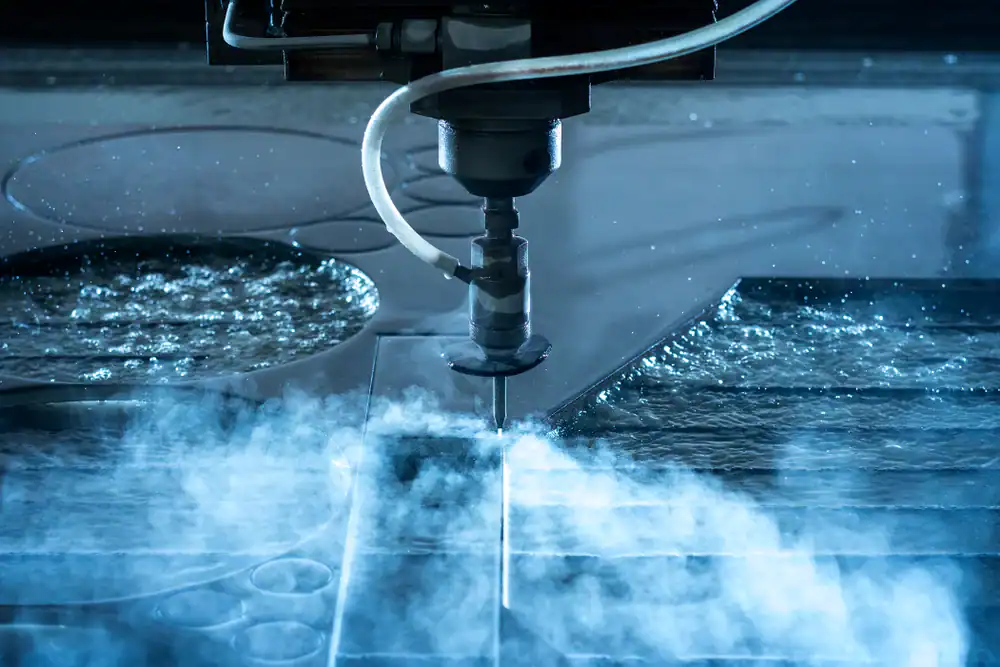
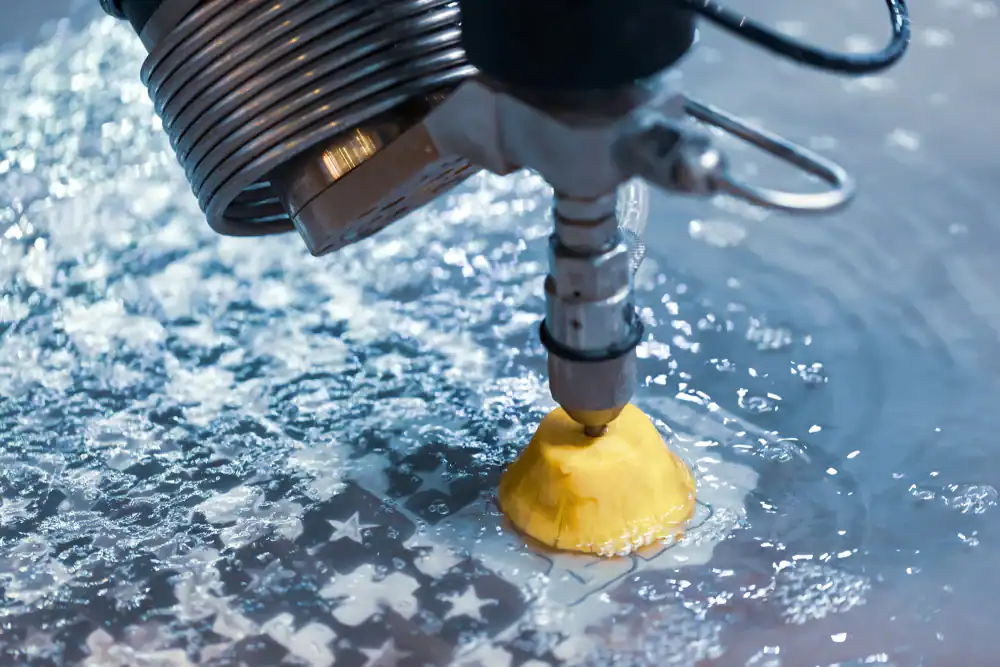
Waterjet cutting uses high-pressure water and abrasive to cut through glass without generating heat. No thermal stress means no microcracks, no warping, no burnt edges. The process maintains precision within ±0.1mm across any thickness, whether you’re cutting 3mm architectural panels or 50mm industrial components.
You get clean edges that don’t need grinding or polishing. Complex curves, tight radii, interior cutouts—all done in one pass. The glass goes straight from our CNC glass waterjet cutting system in Massapequa, NY to your installation or assembly. Less handling, less risk, less time between order and completion.
For architectural firms working on commercial builds across Nassau County, that means custom glass that fits the first time. For industrial manufacturers, it means components that meet spec without the reject pile. For contractors, it means fewer callbacks and faster project turnover.
We serve the Massapequa area and the broader Long Island, NY manufacturing community with CNC waterjet technology built for precision work. We’re part of a region supporting over 3,000 small and medium manufacturers across Nassau and Suffolk counties—shops that need reliable fabrication without the overhead of owning specialized equipment.
Our facility handles custom glass waterjet cutting in Massapequa, NY for commercial construction, industrial production, marine applications, and residential specialty projects. We’ve worked with local contractors navigating the unique demands of coastal builds, architects specifying non-standard glass dimensions, and manufacturers who can’t afford to scrap expensive materials.
You’re not getting a sales pitch here. You’re getting access to equipment that cuts what you need, when you need it, without the learning curve or capital investment of bringing it in-house.
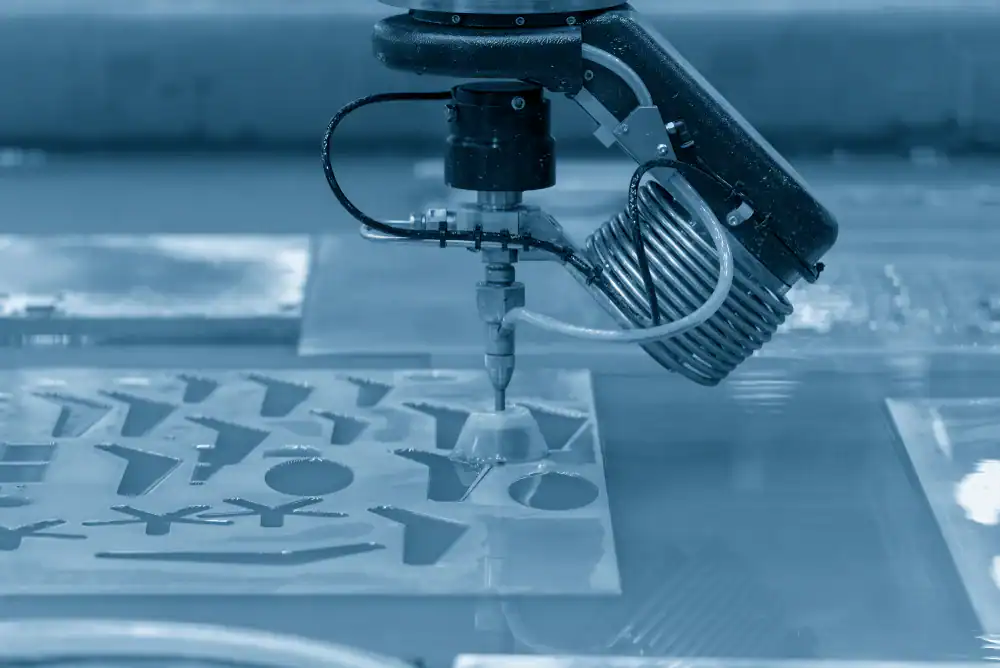
You provide the design file—CAD drawings, DXF, PDF with dimensions, whatever format works for your workflow. We program the CNC system to follow your exact specifications. If there’s a tolerance issue or a cut that might compromise structural integrity, we’ll flag it before we start.
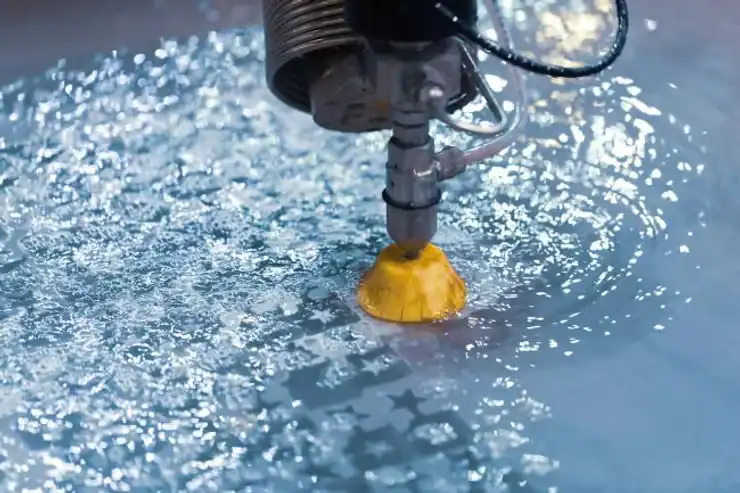
The glass gets positioned on the cutting bed. Our waterjet system uses a stream of water mixed with fine abrasive particles, delivered at pressures up to 60,000 PSI. The stream cuts through the material without making contact beyond the cutting point itself, so there’s no clamping damage or surface scratching.
Because it’s a cold process, there’s no heat-affected zone. The molecular structure of the glass stays intact. You don’t get the microcracks that show up weeks later or the weakened edges that fail during installation. The cut edge comes out smooth enough that most applications don’t require additional finishing.
Once cutting is complete, we inspect dimensions and edges. You get glass that’s ready to install, assemble, or integrate into your production line. For residential glass cutting services in Massapequa, NY, that might mean custom shower enclosures or decorative panels. For industrial work, it’s precision components that mate with other parts without adjustment.
Ready to get started?
You get cuts that handle complexity traditional methods can’t touch. Interior cutouts for hardware. Curved edges that follow organic design lines. Notches, angles, and radii that would require multiple setups on conventional equipment—all done in a single operation.
The process works across glass types: tempered, laminated, annealed, low-iron, coated. Thickness isn’t a limiting factor the way it is with laser systems. We’ve cut architectural glass waterjet cutting projects in Massapequa, NY ranging from thin decorative panels to thick structural components for commercial installations.
Material waste drops because the kerf width—the amount of material removed during cutting—is minimal. For expensive specialty glass, that matters. You’re not losing inches to blade width or heat distortion. The waterjet stream is narrow, precise, and follows your design lines without the buffer zones other methods require.
Long Island, NY’s building environment presents specific challenges. Coastal moisture, temperature swings, and the structural demands of commercial construction mean glass needs to perform. Waterjet cutting doesn’t introduce stress points that become failure points down the line. The edges stay stable because the cutting process never compromised the material integrity in the first place.
Waterjet works best on annealed glass—the standard glass before it goes through tempering. Once glass is tempered, it’s under internal stress that makes it shatter if you try to cut it. That’s true for any cutting method, not just waterjet.
If you need tempered glass with custom cuts, the process is to waterjet cut the annealed glass first, then send it for tempering. Most glass suppliers can coordinate this. You provide the cut dimensions, we handle the fabrication, and the glass goes to tempering after.
Laminated glass is a different situation. It’s two or more layers of glass with an interlayer, usually PVA or resin. Waterjet can cut through laminated glass, but the interlayer sometimes requires a secondary step to trim cleanly. For most laminated applications, we cut through the entire assembly, and any minor interlayer cleanup takes seconds with a blade. It’s still faster and cleaner than trying to cut laminated glass with saws or score-and-snap methods that can delaminate the layers.
Laser cutting glass is difficult and limited. Glass reflects and transmits laser wavelengths, so the energy doesn’t absorb efficiently. You can cut thin glass with specialized CO2 lasers under very controlled conditions, but it’s slow, expensive, and prone to thermal cracking. Most laser systems just can’t handle glass reliably.
Waterjet doesn’t have that problem. It’s a mechanical process—high-pressure water and abrasive physically erode the material. No heat, no reflection issues, no thickness limitations. You can cut 3mm glass or 50mm glass with the same system, just adjusting pressure and feed rate.
Edge quality is another difference. Laser cutting, when it works, can leave a heat-affected zone with microcracks. Waterjet leaves a clean, cold-cut edge. For structural or architectural applications in Massapequa, NY, that edge quality matters. You’re not introducing weak points that compromise the glass over time. The cut is a finish cut—it doesn’t need secondary grinding unless you’re chasing a specific aesthetic.
Waterjet systems can cut glass up to several inches thick. Practically, most architectural and industrial glass waterjet cutting in Massapequa, NY falls between 3mm and 50mm. Beyond that, you’re into specialty territory—thick glass for aquariums, blast-resistant panels, or heavy industrial applications—but the technology handles it.
Thickness affects cutting speed, not capability. Thicker glass takes longer because the waterjet stream needs more time to penetrate and traverse the material. But there’s no upper limit the way there is with saws or lasers. If you can get the glass onto the cutting bed, we can cut it.
The precision holds across thickness, too. A 6mm panel and a 40mm panel both get the same ±0.1mm tolerance. That consistency matters when you’re fabricating components that need to fit together or meet architectural specs. You’re not dealing with taper, bevel, or the dimensional drift that happens with other methods as material thickness increases.
Waterjet edges come off the machine smooth enough for most applications. You’ll see a slightly frosted finish—that’s the abrasive doing its job—but the edge is clean, square, and free of chips. For structural glass, installation work, or anything that gets framed or sealed, no additional finishing is needed.
If you’re after a polished edge for aesthetic reasons—exposed glass in high-end residential or retail applications—you can request edge polishing as a secondary step. But that’s a design choice, not a process requirement. The waterjet edge itself is structurally sound and safe to handle.
Compare that to saw cutting, which leaves rough edges that need grinding, or score-and-snap methods that create inconsistent breaks. Waterjet gives you a controlled cut every time. For custom glass waterjet cutting in Massapequa, NY, that means less labor on your end and faster turnaround from fabrication to installation.
Cutting time depends on material thickness, design complexity, and edge quality requirements. A simple rectangular cutout in 6mm glass might take a few minutes. An intricate pattern with curves and interior details in 25mm glass could take an hour or more.
Speed isn’t the main advantage here—precision is. Waterjet cuts complex shapes in one setup without repositioning or multiple tool changes. A design that would require several operations on traditional equipment gets done in a single pass. When you factor in setup time, material handling, and the elimination of secondary finishing, waterjet is often faster overall.
For production runs, the CNC programming means repeatability. The first piece and the hundredth piece come out identical. If you’re a manufacturer running residential glass cutting services in Massapequa, NY and need consistent parts across a batch, that repeatability keeps your assembly line moving without constant quality checks or adjustments.
We work with standard CAD formats: DXF, DWG, AI, EPS, PDF with vector paths. If you’re designing in AutoCAD, SolidWorks, Illustrator, or similar software, we can pull your file directly into our CNC system. The cleaner your file, the faster we can program and cut.
If you don’t have CAD files, we can work from dimensioned drawings or even sketches for simple shapes. We’ll recreate the design in our system and send you a proof before cutting. For complex architectural glass waterjet cutting projects in Massapequa, NY, having accurate CAD files eliminates back-and-forth and ensures what you designed is exactly what you get.
File preparation matters more than most people realize. Overlapping lines, unclosed paths, or duplicate geometry can cause programming errors. If your file has issues, we’ll catch them during setup and reach out for clarification. It’s faster to get the file right upfront than to discover a dimension problem after the glass is cut.
Useful Links
Other Services we provide in Massapequa