Hear from Our Customers
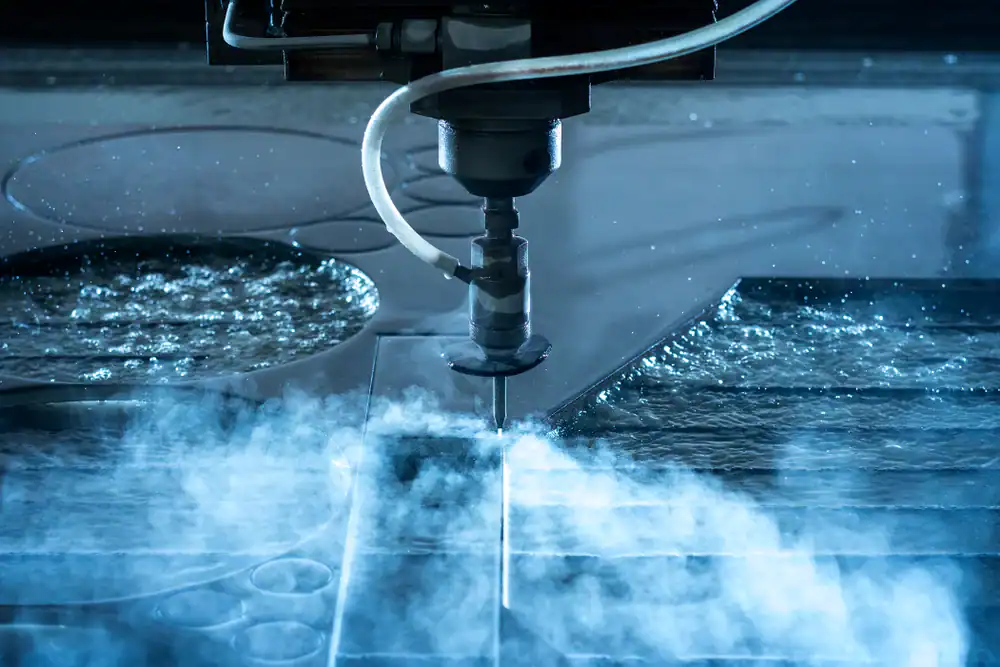
You’re not dealing with blade marks, micro-cracks, or edges that need hours of finishing work. Waterjet cutting uses high-pressure water and abrasive to slice through glass without generating heat, which means no thermal stress and no structural compromise.
The edge quality is clean enough that most projects need minimal post-processing. You save time on finishing, reduce material waste from breakage, and get parts that fit right the first time.
Complex curves, tight inside corners, intricate patterns—waterjet handles shapes that would crack or chip with traditional scoring and breaking methods. If you’re working on architectural installations in Uniondale, NY where design flexibility matters, this process gives you options other cutting methods simply can’t deliver.
You also avoid the safety hazards that come with blade dust and sharp fragments. The cutting process is contained, cleaner, and doesn’t fill your workspace with airborne particles.
We operate out of West Islip, serving architects, contractors, and fabricators throughout Long Island, NY, including Uniondale, NY. We focus on precision CNC glass waterjet cutting for commercial and residential projects that require accuracy you can measure and edges you can see.
Our equipment handles laminated glass, tempered glass, decorative panels, and custom architectural components. We work with designers who need intricate patterns and contractors who need production runs with consistent results.
Uniondale’s mix of commercial development and residential renovation creates steady demand for custom glass work. We’ve cut everything from storefront panels to decorative interior features, and we understand the timelines and tolerances that matter in this market.
You send us your design file or specifications. We review dimensions, material type, and edge requirements to confirm the setup before cutting begins.
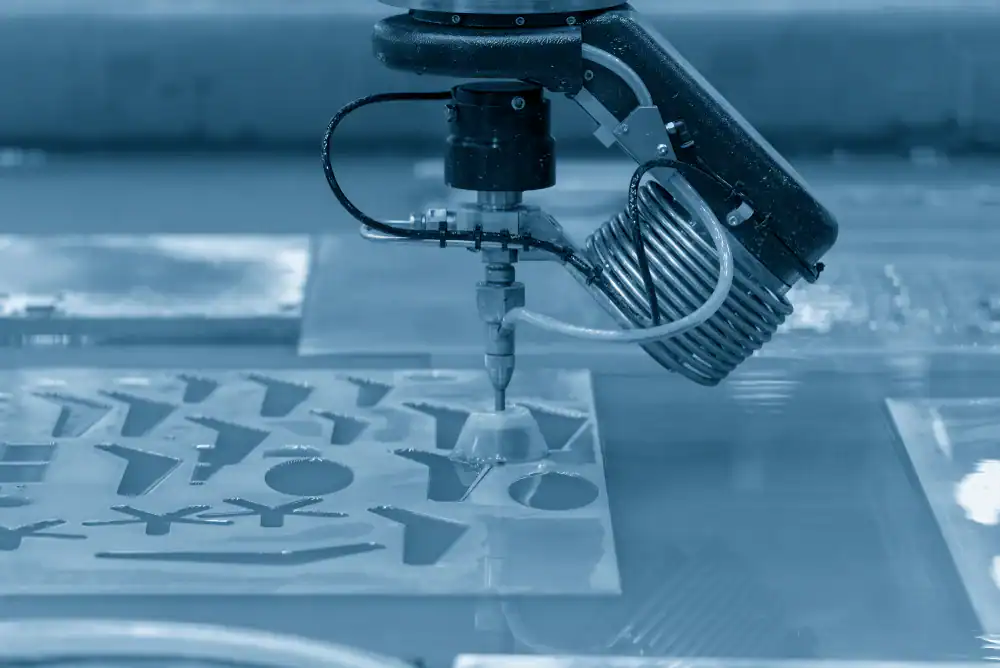
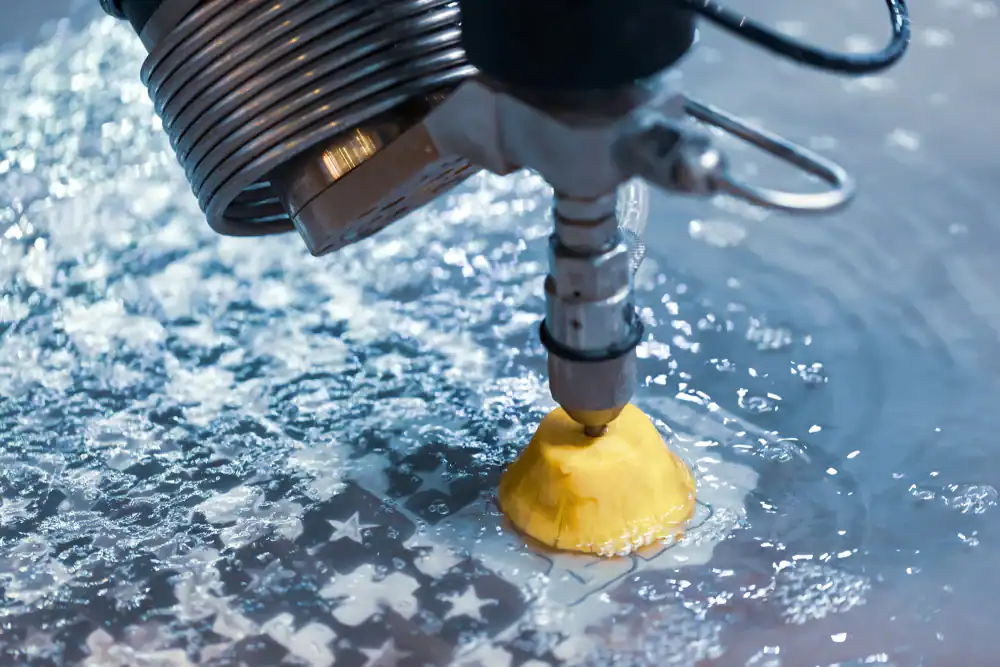
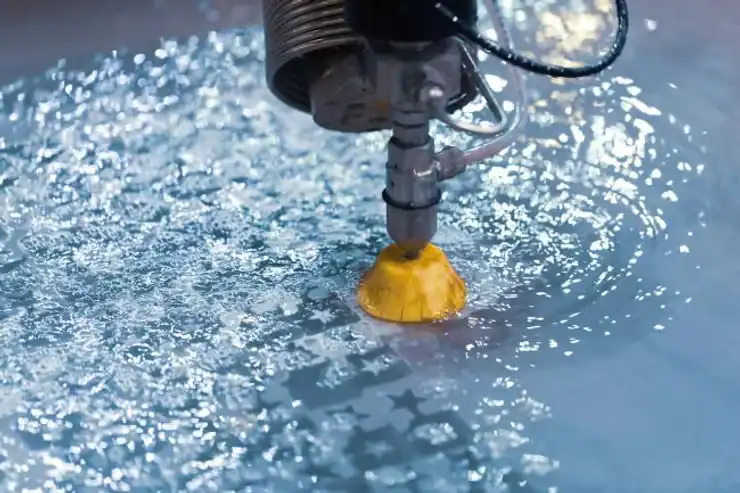
The glass is positioned on the cutting bed and secured. Our CNC system controls a cutting head that directs a thin stream of water mixed with fine abrasive particles. This stream moves along your programmed path, cutting through the glass at high speed without applying mechanical force that could cause cracking.
Because there’s no blade contact and no heat generation, the glass doesn’t experience thermal expansion or stress fractures. The cutting stream is narrow—often less than a millimeter—which means tight tolerances and minimal kerf waste.
For piercing, the system uses a controlled entry technique that prevents the shock cracks you’d get from drilling or aggressive mechanical starts. Once the cut is complete, edges are smooth and consistent, typically requiring only light finishing depending on your application.
You get parts that match your CAD file, edges that won’t chip during handling, and material that hasn’t been compromised by heat or mechanical stress.
Ready to get started?
We handle material consultation upfront. If you’re not sure whether your glass type works with waterjet cutting, or if you need guidance on thickness and edge finish, we walk through those details before you commit to an order.
Design review is part of the process. We check your files for potential issues—tight radiuses that might need adjustment, piercing locations that could be optimized, or nesting opportunities that reduce waste and cost.
The cutting itself is CNC-controlled, which means repeatability. If you need one prototype panel or a hundred production pieces, each one matches the programmed dimensions. We cut laminated glass without delaminating the interlayer, and we handle tempered glass carefully to avoid edge stress that could trigger spontaneous breakage later.
In Uniondale, NY, where architectural glass is used in both new commercial construction and historic building renovations, edge quality and dimensional accuracy matter. Modern glass facades require precision fits, and decorative installations demand clean lines. Waterjet cutting delivers both without the chipping, cracking, or thermal distortion that plague traditional methods.
You also get faster turnaround compared to methods that require multiple finishing steps. Less secondary processing means your project moves forward without waiting for grinding, polishing, or rework.
Waterjet cutting works well with laminated glass because the process doesn’t generate heat or mechanical shock that could separate the interlayer. The cutting stream slices cleanly through both glass layers and the laminate between them without delamination.
Tempered glass is trickier. The tempering process puts the glass under internal stress, and any edge work after tempering can trigger spontaneous breakage. If you need tempered glass with custom shapes, the cutting has to happen before the tempering process. We can cut the glass to your specifications, then you send it out for tempering.
For laminated architectural panels or automotive glass applications, waterjet is often the best option because it maintains the integrity of the laminate bond while delivering the complex shapes you need.
Traditional glass cutting uses a scoring tool to create a controlled fracture line, then applies mechanical force to break the glass along that line. It works fine for straight cuts and simple shapes, but it struggles with curves, tight corners, and intricate designs. You also get edge chipping and micro-cracks that require grinding and polishing.
Waterjet cutting doesn’t rely on fracturing. The abrasive stream erodes the material in a controlled path, which means you can cut any shape the CNC system can follow—circles, sharp inside corners, complex patterns. The edges come off the machine much cleaner, often ready for installation with minimal finishing.
You also avoid the heat-affected zones you’d get from laser cutting, which can cause thermal stress and discoloration in glass. Waterjet keeps the material cool throughout the process, so there’s no risk of heat-related cracking or warping.
Waterjet systems handle glass from thin sheet stock up to several inches thick. Most architectural and decorative glass falls in the range of 1/4 inch to 1 inch, which cuts quickly and produces excellent edge quality.
Thicker glass takes longer because the cutting stream needs more time to penetrate the full depth, but the process still works. For very thick glass—over two inches—you might see a slight taper on the cut edge due to the way the abrasive stream disperses as it moves through the material. In most applications, this taper is minimal and doesn’t affect fit or function.
If you’re working with specialty glass or unusual thicknesses for a project in Uniondale, NY, we can run test cuts to confirm edge quality and cutting time before committing to a full production run.
Waterjet-cut edges are smoother than traditionally scored and broken glass, but they’re not polished. The finish depends on cutting speed, abrasive type, and material thickness. For most industrial and architectural applications, the edge quality straight off the waterjet is acceptable for installation.
If you need a polished edge for aesthetic reasons—like exposed edges on decorative panels or furniture—you’ll still want to run a finishing step. But you’re starting with a much cleaner edge than you’d get from mechanical cutting, which means less material removal and faster finishing.
For applications where the edge will be framed, sealed, or otherwise concealed, waterjet edges typically go straight to installation without additional work. That saves time and labor compared to methods that require grinding to remove chips and cracks before the glass is usable.
CNC waterjet systems hold tolerances in the range of ±0.005 to ±0.010 inches, depending on material thickness and cutting parameters. For most architectural and industrial glass applications, that level of precision is more than sufficient.
The accuracy comes from computer-controlled motion and consistent cutting stream characteristics. Once the system is programmed and calibrated, every part comes out the same. You don’t have operator variability like you’d get with manual scoring and breaking.
If your project in Uniondale, NY requires parts that fit together with minimal gaps—like multi-panel installations or assemblies with tight joints—CNC waterjet cutting gives you the repeatability you need. Each piece matches the CAD file, and each piece in a production run matches every other piece.
Any project that involves complex shapes, tight curves, or intricate patterns benefits from waterjet cutting. Architectural features like decorative panels, custom signage, and interior partitions often require cuts that traditional methods can’t handle without excessive breakage or finishing time.
Laminated glass for storefronts and automotive applications cuts cleanly without delamination. Decorative glass for lighting fixtures, furniture, and art installations gets the precision needed for proper fit and finish.
In Uniondale, NY, where commercial and residential projects increasingly use glass as a design element, waterjet cutting opens up options that weren’t practical before. You’re not limited to straight lines and simple curves. If you can draw it, we can cut it—without the chipping, cracking, or thermal damage that limits other methods.
Useful Links
Other Services we provide in Uniondale