
Hear from Our Customers
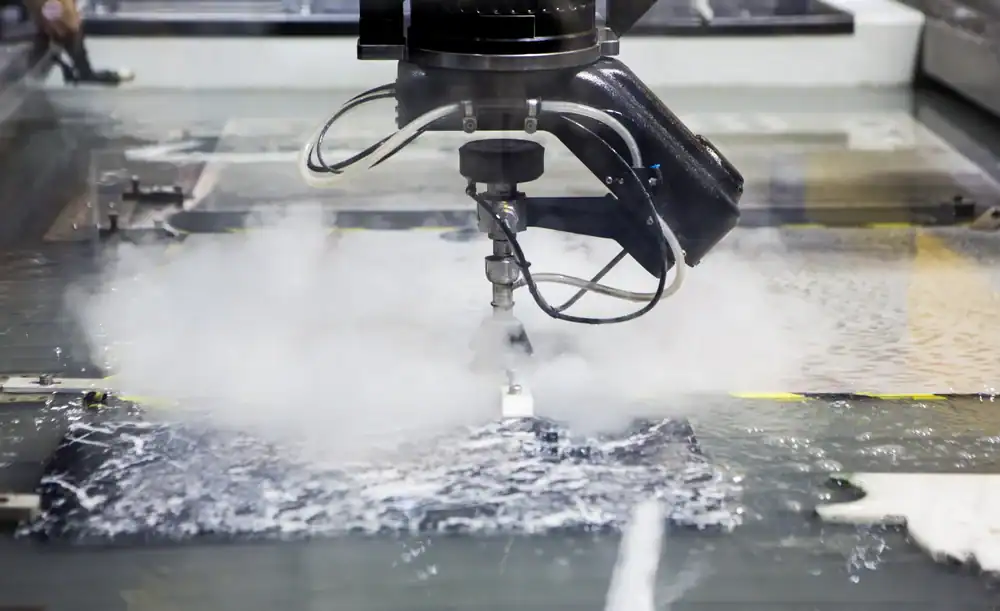
Your marble doesn’t crack under pressure when there’s no heat involved. Waterjet cutting uses high-pressure water mixed with fine abrasive to slice through marble without generating the thermal stress that causes chipping, discoloration, or structural weakness.
You’re looking at cuts accurate within 0.005 inches. That means faucet holes line up perfectly, sink cutouts fit flush on the first try, and intricate edge patterns come out exactly as designed. No secondary grinding to fix rough edges or uneven surfaces.
Material costs drop because you’re not throwing away sections that cracked during cutting or pieces that didn’t meet tolerance. The kerf width—the amount of material removed during cutting—stays minimal, so you get more usable square footage from each slab. For high-end marble running hundreds per square foot, that difference shows up in your project budget.
The edges come out smooth enough that most installations skip the polishing step entirely. You’re saving time on finishing work and labor costs on secondary processes that traditional cutting methods require.
We handle precision cutting for contractors, designers, and homeowners across Elmont, NY and the surrounding Tri-State area. We’ve worked on projects for Ralph Lauren, Coach, and the Port Authority—jobs where tolerances matter and rework isn’t an option.
Elmont’s residential market runs toward high-end renovations, with median home values pushing $590,000 and kitchen remodels that justify premium materials. You’re investing in Calacatta or Statuario marble because you want the look—our job is making sure the fabrication matches that investment.
We’re equipped with CNC-controlled waterjet systems that handle everything from standard countertop cutouts to complex inlay patterns. You bring the design specs, we deliver the cuts that fit right the first time.
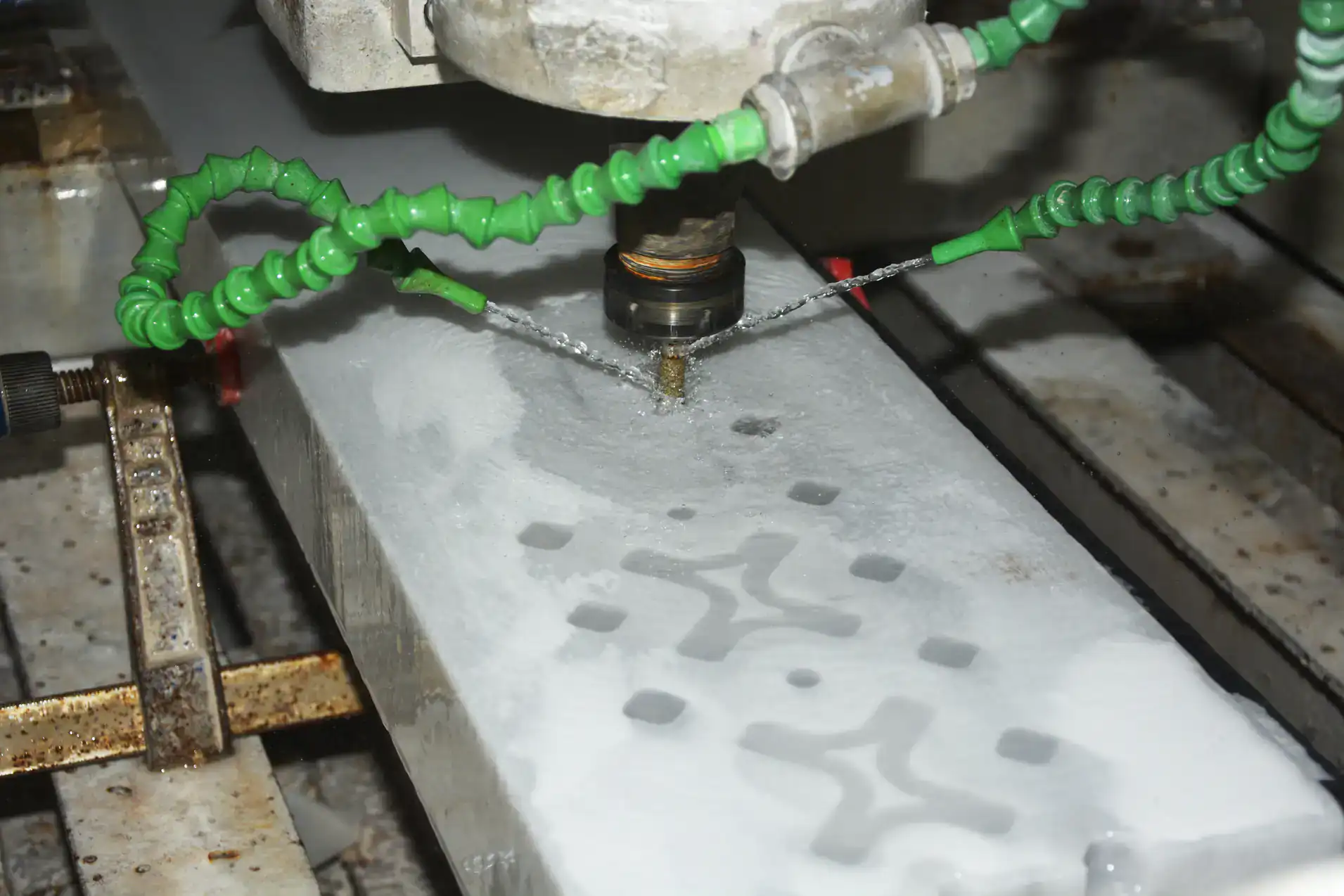
You start by sending us your design file—CAD drawings, templates, or even detailed sketches work. We program those specs into our CNC system, which controls the waterjet head’s movement with computer precision. No manual tracing, no eyeballing measurements.
The marble slab gets secured to the cutting bed. Our system pumps water at 60,000 PSI through a nozzle smaller than a pinhole, mixed with garnet abrasive that does the actual cutting. The stream moves along your programmed path, slicing through marble up to 120mm thick without generating heat or vibration that could fracture the stone.
Complex shapes—curved edges, tight interior corners, multiple sink holes—get cut in a single pass. The waterjet handles direction changes and intricate patterns that would require multiple tool changes and setups with traditional methods. You’re looking at 40% faster completion on detailed work compared to saw cutting.
Once cutting finishes, the slab comes off the bed ready for installation or minimal edge finishing. Most pieces go straight to the job site. There’s no cooling-down period, no stress cracks to inspect for, no thermal warping to correct.
Ready to get started?
You get precision cutting on marble slabs from 0-120mm thickness. That covers everything from delicate 10mm backsplash tiles to substantial 4-inch countertop edges. Our waterjet handles the full range without requiring different equipment or setup changes.
Elmont’s renovation market leans heavily toward custom kitchens and luxury bathrooms—spaces where standard dimensions don’t cut it. We process custom shapes for kitchen islands, curved vanity tops, shower benches, and fireplace surrounds. If you can draw it, we can cut it.
The process generates zero dust, which matters for fabrication shops operating in Nassau County’s commercial zones where air quality regulations apply. Water used in cutting gets filtered and recirculated, keeping the operation clean and reducing environmental impact—something Elmont’s environmentally conscious homeowners appreciate.
You’re also getting material efficiency that traditional methods can’t match. Waterjet cutting reduces waste by up to 30% compared to saw cutting, which means your marble budget stretches further. On a high-end kitchen remodel running $40,000-$60,000, that waste reduction translates to real money saved or reinvested in upgraded materials.
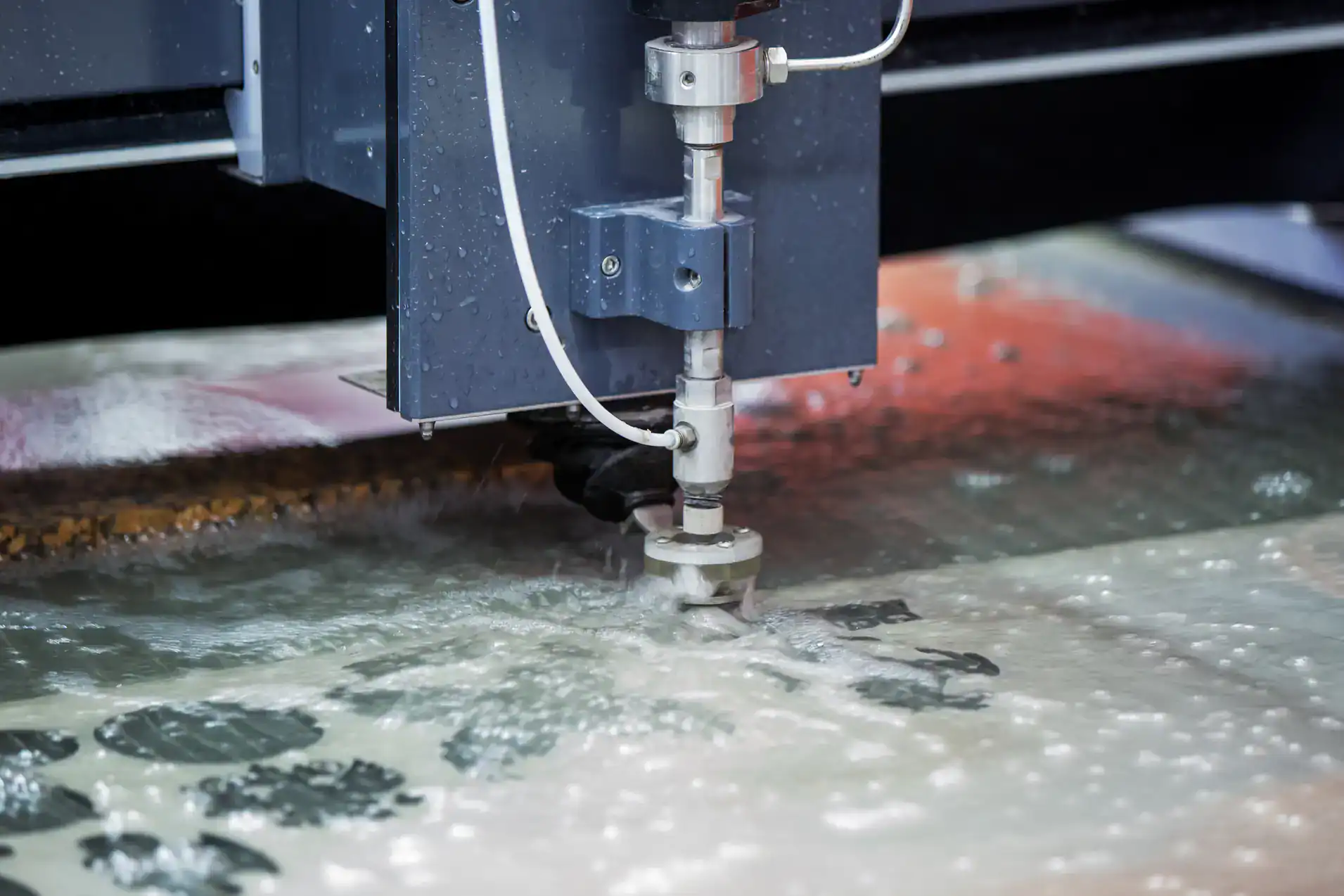
Marble cracks under heat and vibration—two things waterjet cutting completely eliminates. Traditional saws generate friction heat that causes thermal expansion in the stone. When that heat concentrates along the cut line, you get micro-fractures that either show up immediately or develop into cracks weeks after installation.
Waterjet cutting uses room-temperature water, so there’s zero thermal stress on the marble. The cutting action comes from abrasive particles suspended in the water stream, not from a blade making contact with the stone. No contact means no vibration traveling through the slab that could trigger fractures along natural veining or weak points in the marble’s structure.
The process also applies consistent pressure across the entire cut. Saws can bind or skip, creating uneven stress that leads to chipping. Our CNC-controlled waterjet maintains steady pressure and speed, which keeps the cutting force uniform and prevents the kind of sudden stress spikes that cause breakage.
We’re hitting tolerances within plus or minus 0.005 inches—that’s five-thousandths of an inch, or about half the thickness of a human hair. For context, most fabrication work considers anything within 1/16 inch acceptable. We’re operating at a precision level 12 times tighter than standard tolerances.
That accuracy matters most on sink cutouts and faucet holes. When your undermount sink needs to sit perfectly flush with the marble edge, a variance of even 1/32 inch creates gaps that show or require shimming. Our cuts eliminate that problem—the sink drops in and sits exactly where it should.
For kitchen islands or bathroom vanities with multiple penetrations—sink, faucet, soap dispenser, maybe an outlet—each hole’s position relative to the others has to be exact. If the faucet hole is off by even a millimeter, you’re either drilling a new hole or living with a faucet that doesn’t center on the sink. CNC waterjet cutting programs all those positions simultaneously, so the spatial relationships stay perfect across the entire piece.
Yes, and that’s where waterjet cutting separates itself from traditional methods. The cutting stream is 0.020 inches wide—narrow enough to execute tight radius curves, sharp interior corners, and detailed patterns that router bits or saw blades can’t physically access.
For edge profiles, we can cut ogee curves, waterfall edges, or custom geometric patterns directly into the marble slab. Traditional fabrication would require multiple passes with different router bits, each setup introducing potential for error and each tool change risking slight variations in the profile. Waterjet does it in one continuous cut with zero tool changes.
Inlay work—where you’re fitting different marble colors or materials into cutouts for decorative patterns—requires cuts that match perfectly on both the base slab and the inlay piece. We’re talking about tolerances tight enough that the pieces fit together without visible gaps or epoxy lines. Waterjet cutting produces those matching edges because the same CNC program controls both cuts, eliminating the human error that comes from trying to hand-match complex shapes.
You’re looking at roughly 30% less waste with waterjet cutting compared to saw-based methods. That reduction comes from three factors: narrower kerf width, better nesting efficiency, and elimination of breakage-related waste.
The kerf—the width of material removed during cutting—runs about 0.020 inches with waterjet versus 0.125 inches or more with diamond saw blades. On a 10-foot countertop run, that difference alone saves nearly an inch of usable marble. Multiply that across multiple cuts and complex shapes, and you’re recovering significant material.
CNC programming also lets us nest multiple pieces onto a single slab more efficiently. The software calculates optimal layouts that minimize scrap, something that’s harder to achieve when you’re manually measuring and cutting. We can fit odd-shaped pieces into spaces that would normally become waste, maximizing yield from each slab.
Then there’s breakage. Traditional cutting generates enough vibration and heat that you’ll lose pieces to cracking—sometimes during cutting, sometimes during handling afterward when stress fractures propagate. Waterjet cutting produces zero breakage from thermal or vibration stress, so every piece that comes off the cutting bed is usable. For expensive marble varieties running $200-$400 per square foot, eliminating breakage waste directly impacts your material budget.
We cut marble from paper-thin 10mm tiles up to 120mm thick slabs—basically anything you’d encounter in residential or commercial applications. The waterjet stream penetrates the full thickness regardless of how thick the material is, maintaining the same precision at 10mm as it does at 120mm.
Thickness doesn’t degrade cut quality because the cutting mechanism stays consistent. We’re not relying on blade depth or multiple passes that could introduce variation. The high-pressure water stream cuts through in a single pass, top to bottom, with the same 0.005-inch tolerance whether you’re working with a delicate backsplash tile or a 4-inch-thick countertop edge.
Thicker material does slow cutting speed slightly—physics dictates that cutting through 120mm takes longer than cutting through 20mm. But that speed difference doesn’t affect accuracy or edge quality. You’re still getting the same smooth, burr-free edge that requires minimal finishing. For most applications, the cut edges are installation-ready straight off the cutting bed, regardless of material thickness.
Most waterjet-cut edges are smooth enough for direct installation, especially on edges that won’t be highly visible or tactile. The cutting process produces what’s called a “satin” finish—not quite mirror-polished, but smooth and uniform without the rough saw marks or chipping that traditional cutting leaves behind.
For exposed edges where you want that high-gloss polished look—like the front edge of a kitchen island or a waterfall countertop edge—you’ll still want to polish. But you’re talking about a quick polish pass to bring up the shine, not aggressive grinding to remove saw marks or repair chipped edges. The time and labor savings are substantial compared to cleaning up traditionally cut edges.
Interior cuts like sink holes or faucet penetrations typically don’t need any finishing at all. Those edges sit hidden under the sink rim or faucet base, so the as-cut finish is perfectly adequate. You’re eliminating an entire finishing step on every penetration, which adds up quickly on complex installations with multiple cutouts.
Useful Links
Other Services we provide in Elmont