Hear from Our Customers
When you’re working with premium marble slabs in the $3,000-$8,000 range, traditional cutting methods cost you twice. Once in wasted material from wide kerfs and imprecise cuts. Again in time lost to rework when pieces don’t fit right.
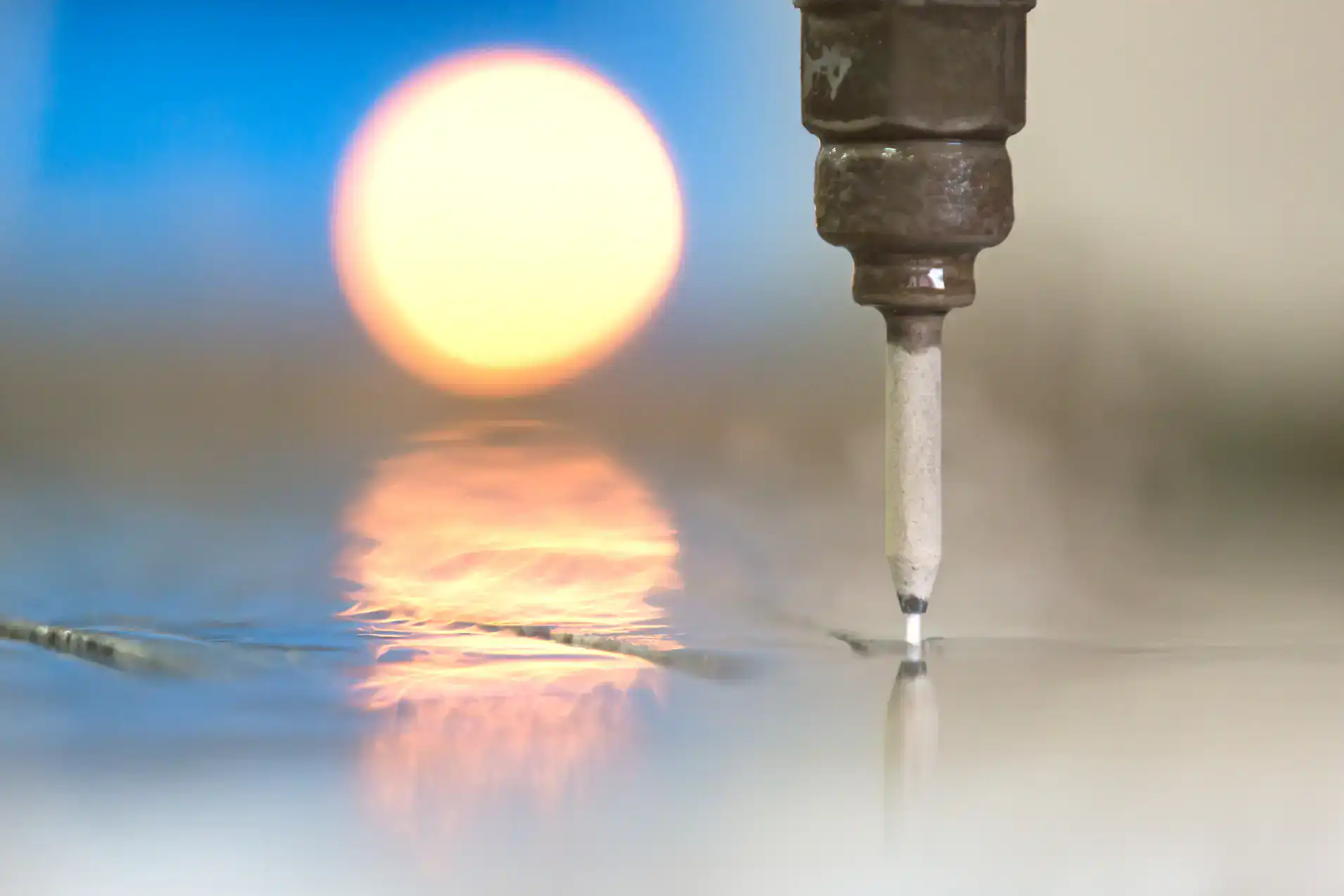
Waterjet cutting changes that math completely. The cutting stream is thinner than a credit card, which means you lose almost nothing to waste. You get clean edges that fit together the first time, no secondary grinding needed.
This matters most when you’re creating something specific—a kitchen island with radius corners, a fireplace surround with geometric inlays, or a bathroom feature wall where every piece needs to align perfectly. The cold-cutting process means no burn marks, no micro-cracks from heat stress, and no discoloration along cut lines. Your marble looks exactly how it should.
For architects and contractors managing high-end renovations in Greenlawn, this level of precision means fewer callbacks and faster installations. Your timeline stays intact because the pieces arrive ready to install.
We run Flow Mach 500 CNC systems—the same technology used in 62% of high-precision marble processing facilities. We work directly from your CAD files or help you develop cut plans from sketches and measurements.
Most of our Greenlawn clients are managing renovations where the marble work is a focal point, not an afterthought. You’re dealing with complex permitting, tight schedules, and homeowners who expect flawless results. We get that. Our job is to deliver marble components that install correctly the first time so you can move to the next phase without delays.
We’ve handled everything from simple countertop cutouts to multi-piece medallions with dozens of individual stones. The process is the same regardless of complexity: your design gets programmed into our CNC system, and the waterjet follows that path with repeatable accuracy across every piece in your order.
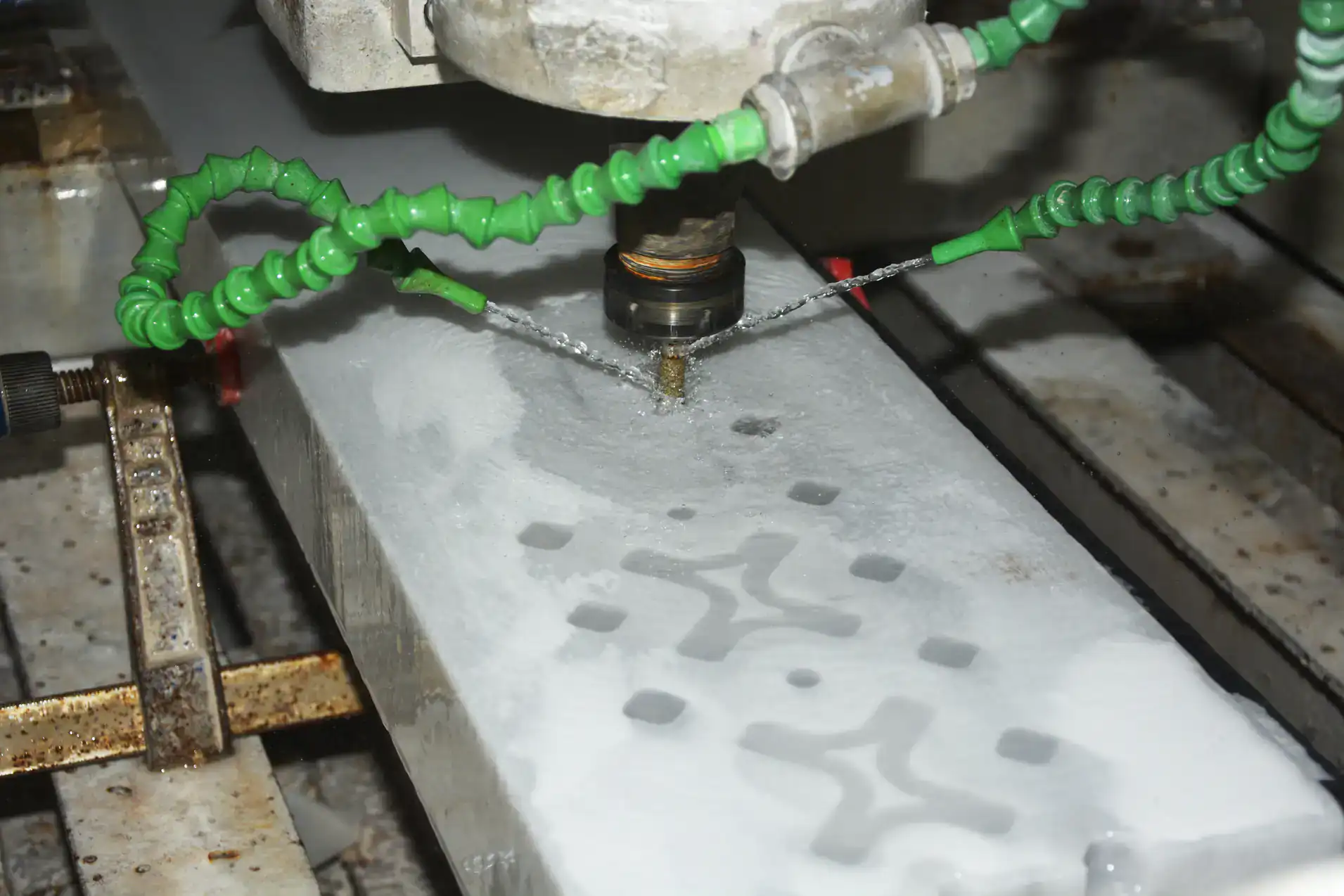
You send us your design files—DXF, DWG, or even detailed PDFs work. If you don’t have CAD drawings yet, we can create them from your dimensions and specifications. This is where most potential issues get caught, so we review everything before cutting begins.
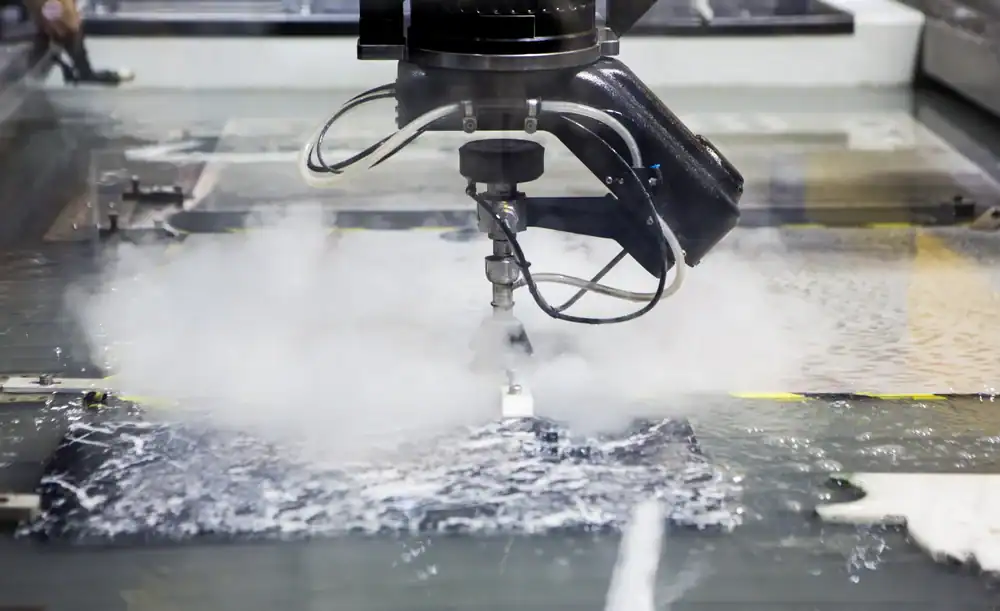
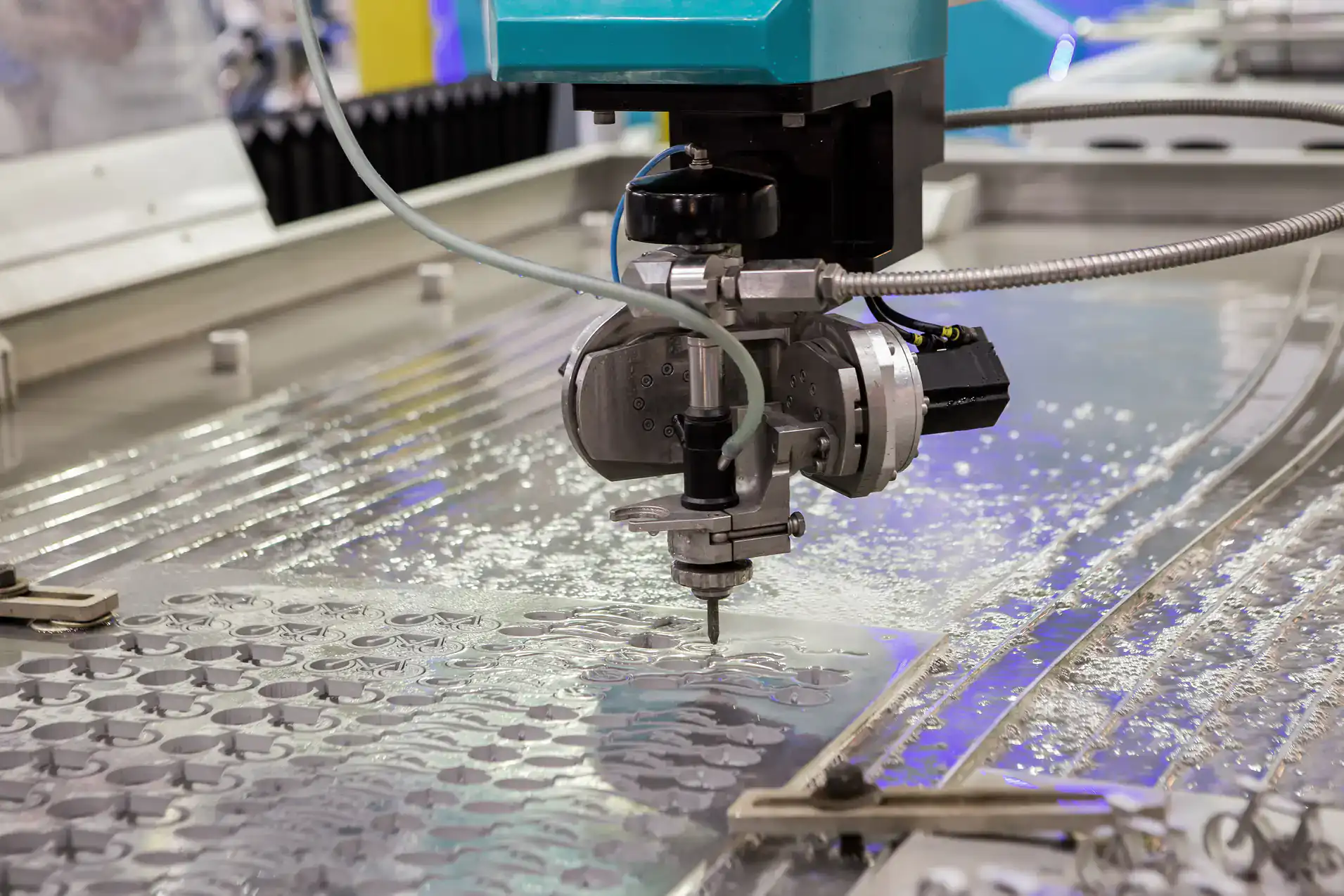
Once the design is confirmed, we program the cut path into our CNC system. The waterjet uses a high-pressure stream mixed with fine garnet abrasive to cut through marble at roughly 1-3 inches per minute, depending on thickness. Thicker slabs take longer, but the edge quality stays consistent.
The cutting happens in a contained tank, so there’s no dust and no mess beyond our shop. Water and garnet get filtered and recycled. What you receive are marble pieces cut to your exact specifications, with edges clean enough for most installations without additional finishing.
For industrial projects involving multiple pieces or repeated patterns, the CNC system ensures every component matches perfectly. Cut the same design once or a hundred times—the tolerance stays within 0.003″ to 0.005″ across the entire run.
Ready to get started?
You’re not just getting cuts—you’re getting a manufacturing process that handles complexity other methods can’t touch. Radius corners, interior cutouts, intricate inlay patterns, and tight-tolerance joinery all happen in a single setup. No tool changes, no repositioning, no accumulated error from multiple operations.
This matters in Greenlawn’s renovation market where projects routinely involve custom marble work in homes valued between $600,000 and $2.1 million. Your clients expect perfection, and the margin for error is essentially zero. Waterjet cutting delivers that consistency because the computer controls every movement—there’s no hand-eye coordination variable or blade deflection to account for.
Material thickness isn’t a limiting factor either. We cut everything from 3/8″ decorative pieces to 3″ thick architectural slabs. The same setup handles white Carrara, dark Emperador, or heavily veined Calacatta without adjustment. Different hardness levels don’t require different tooling.
The environmental aspect is straightforward: no toxic fumes, no hazardous dust, just water and natural garnet that’s inert and recyclable. For contractors working in occupied homes or buildings with strict air quality requirements, this eliminates a significant concern. You’re not managing dust containment or ventilation—the cutting happens here, and you receive finished components ready for installation.
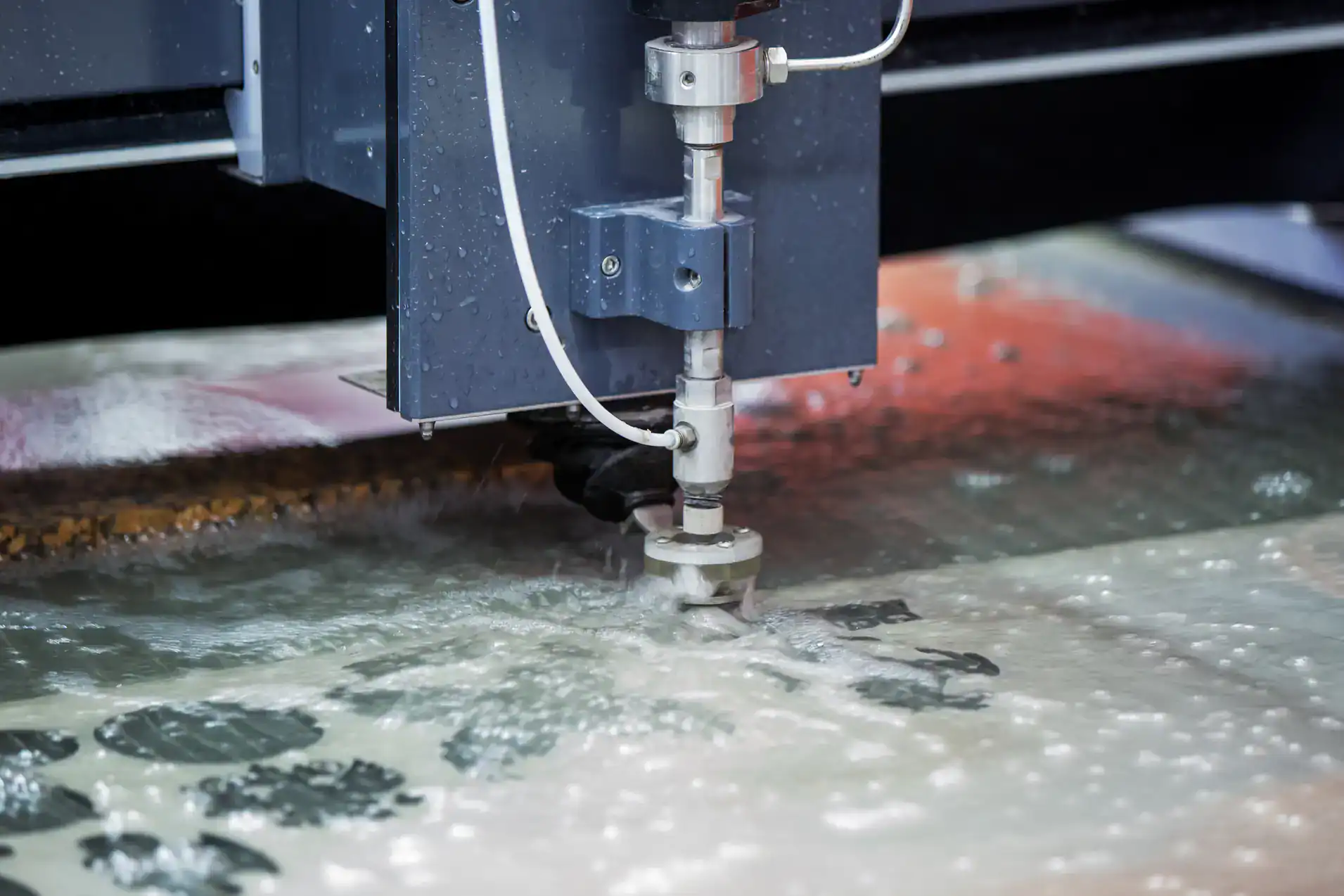
Bridge saws excel at straight cuts and basic shapes—they’re fast and cost-effective for simple work. But they’re limited when your design includes curves, interior cutouts, or intricate patterns. The blade width also creates more waste, typically 1/8″ to 1/4″ per cut.
Waterjet cutting uses a stream about 0.030″ wide, which means you lose almost nothing to kerf. More importantly, the CNC system can follow any path your design requires. Circles, radiuses, complex geometries—it’s all the same to the machine. You’re not limited by blade diameter or operator skill.
The other major difference is heat. Bridge saws generate friction, which can cause thermal stress in certain marbles, especially lighter colors that show discoloration easily. Waterjet is a cold process. The water actually cools the material during cutting, so there’s zero risk of heat-related damage or micro-cracking along cut lines.
This is where waterjet cutting really separates itself from other methods. When you’re creating a medallion or inlay pattern with multiple marble types, every piece needs to fit together with almost no gap. We’re talking about tolerances under 0.005″ across dozens of individual components.
The CNC system cuts each piece from the same programmed file, so the fit is mathematically precise. You can create patterns with 50+ individual stones, and they’ll assemble like a puzzle because each cut is controlled to the same standard. There’s no accumulated error from repositioning or operator variation.
We’ve handled custom projects ranging from simple border inlays to full floor medallions with intricate geometric patterns. The process is the same: your design gets programmed once, and every piece gets cut to match. When you’re working with multiple marble colors or types in a single pattern, this consistency is non-negotiable. The pieces either fit perfectly, or the entire installation looks off.
Simple projects—countertop cutouts, basic shapes, single-piece work—usually run 3-5 business days from approved design to finished product. That includes programming time, cutting, and quality inspection before it leaves our facility.
Complex projects with multiple components, intricate patterns, or large-scale installations take longer. A detailed floor medallion might need 7-10 days. Large architectural installations with dozens of custom pieces could run two weeks. The actual cutting time isn’t usually the constraint—it’s the programming, material handling, and quality control that determine the schedule.
Rush situations happen, especially in renovation work where timelines shift. We can often accommodate faster turnarounds if you’re in a bind, but that depends on our current queue. The key is communication early in your project. If we know your installation date upfront, we can plan accordingly and flag any potential conflicts before they become problems. Most delays happen because design changes come in after cutting has started, which means scrapping work and starting over.
Yes, but some marbles are more forgiving than others. Dense, uniform marbles like Carrara or Emperador cut cleanly with minimal edge chipping. Heavily veined marbles or those with natural fissures require more attention because the stone’s internal structure affects how it responds to cutting.
The waterjet process itself doesn’t discriminate—it’ll cut through any marble you put in front of it. But the quality of the finished edge depends partly on the stone’s characteristics. Softer marbles may show slight edge friability. Stones with pronounced veining might have minor chipping where the vein meets the cut line.
This is why material consultation matters before cutting begins. If you’re working with an unusual marble or one known for challenging characteristics, we’ll discuss edge finishing options upfront. Most premium marbles used in Greenlawn’s high-end renovations—your Calacattas, Statuarios, and similar stones—cut beautifully with waterjet. You get clean edges that need minimal finishing, if any. But it’s worth a conversation before committing to a specific stone, especially if your design includes intricate cuts or tight inside corners.
Waterjet cutting typically costs more per linear foot than bridge saw work—roughly 30-50% higher depending on material thickness and cut complexity. But that’s not the full picture. You need to factor in material waste, secondary finishing, and rework costs.
Traditional cutting methods lose more material to wide kerfs and imprecise cuts. On a $5,000 marble slab, that waste adds up quickly. Waterjet’s narrow kerf and first-time accuracy mean you’re maximizing yield from expensive material. You’re also eliminating or drastically reducing grinding and polishing time because the edges come off the machine nearly finished.
The real cost advantage shows up in complex projects. When you’re creating something with curves, interior cutouts, or multiple fitted pieces, traditional methods require multiple setups, specialized tooling, and skilled hand-finishing. Waterjet handles all of that in a single automated process. You’re paying for precision and consistency that’s difficult or impossible to achieve otherwise. For straightforward cuts on simple shapes, a bridge saw makes more sense economically. For everything else, waterjet cutting delivers better value when you account for the complete project cost, not just the cutting fee.
DXF and DWG files work best because they translate directly into our CNC programming software without conversion issues. These CAD formats preserve exact dimensions and geometry, which is critical when you’re working to tight tolerances.
We can also work from PDF files if they’re drawn to scale and include clear dimensions. The process takes a bit longer because we need to recreate the geometry in CAD, but it’s completely doable. Some contractors send us hand sketches with measurements, and we’ll develop the CAD drawings from those. That adds a design consultation step, but it ensures we’re cutting exactly what you need.
The important part is clarity. We need to know material thickness, edge finishing requirements, and how pieces relate to each other if you’re ordering multiple components. A quick conversation usually clears up any ambiguity. Once we have a clean CAD file, the cutting process is straightforward. The CNC system follows that file precisely, so what you approve in the design phase is what you’ll receive. No interpretation, no approximation—just your design executed in marble with 0.003″ accuracy.
Useful Links
Other Services we provide in Greenlawn