Hear from Our Customers
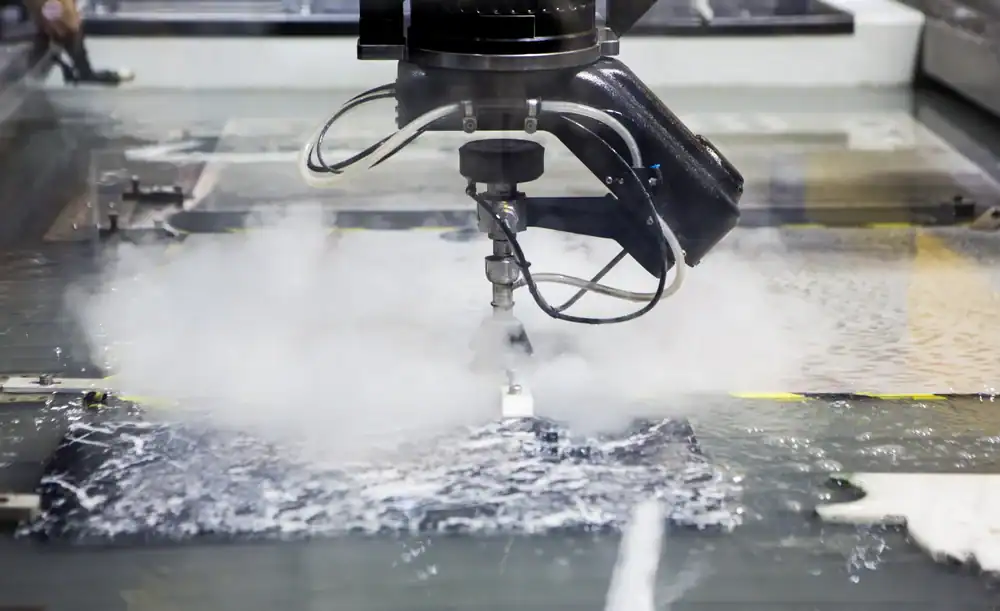
Your marble arrives intact. No heat-induced cracks running through expensive slabs. No chipped edges that need hand-finishing. No wondering if that intricate inlay pattern is even possible.
Waterjet cutting handles what traditional saws can’t. Complex curves, tight interior cuts, and detailed patterns all happen in one setup. You’re looking at tolerances down to ±0.001 inches, which means your pieces fit the first time.
The process is cold. Water and abrasive do the work, so there’s no thermal stress fracturing your stone. You don’t lose material to wide blade kerfs or vibration damage. What you design is what you get, with edges clean enough that you might skip secondary finishing altogether.
We operate right here in Shirley, NY, where Long Island, NY’s stone fabrication industry has deep roots. You’re working with a shop that understands the local market, from residential countertop installers to commercial contractors handling high-end architectural projects.
Our CNC waterjet systems handle everything from single custom pieces to production runs. We’ve cut marble for kitchen islands, intricate floor medallions, decorative wall panels, and restoration work on historic properties throughout Suffolk County.
You get the advantage of local turnaround times without sacrificing the precision that larger industrial operations offer. Drop off your material, walk through your design requirements, and we’ll program cuts that match your specifications exactly.
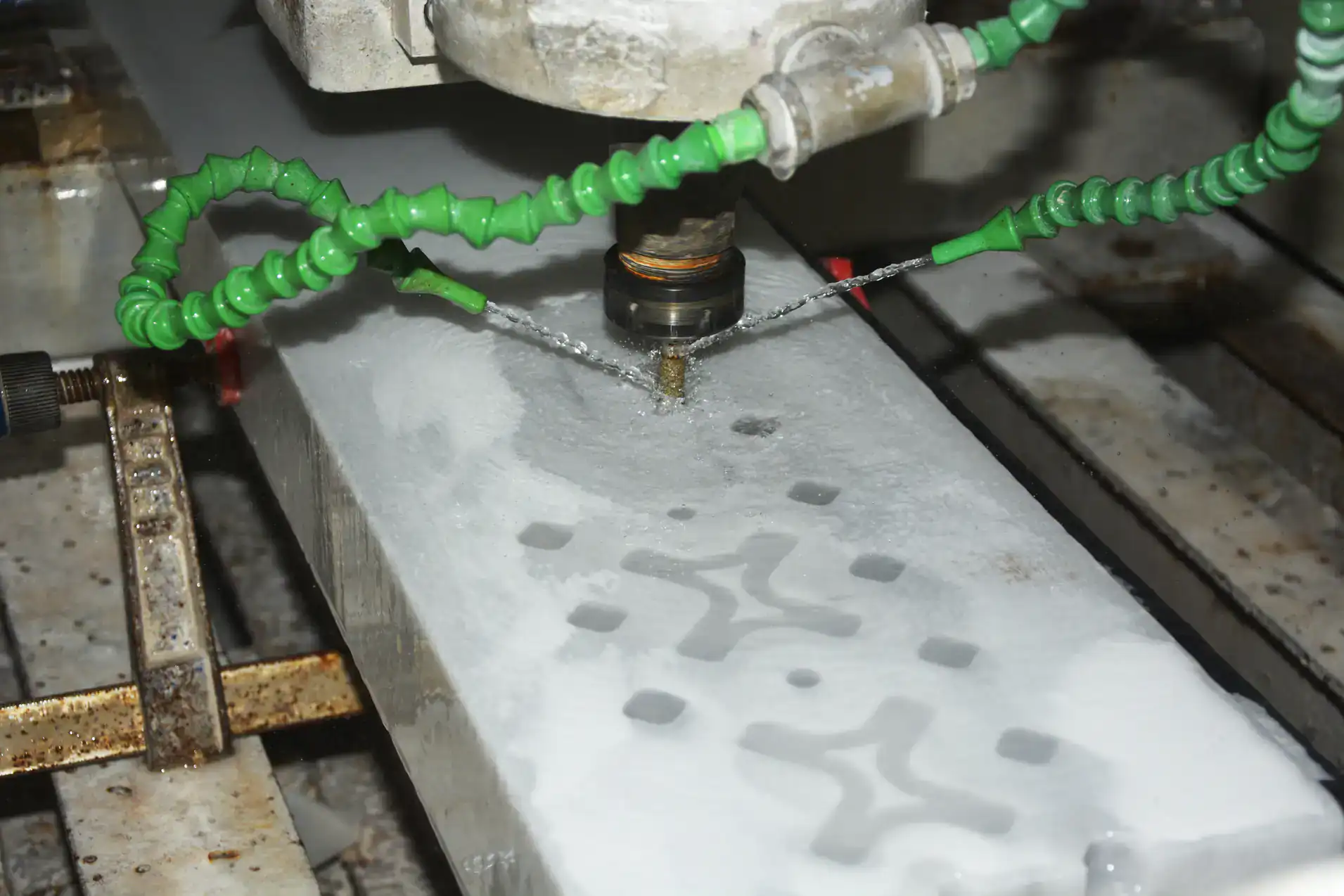
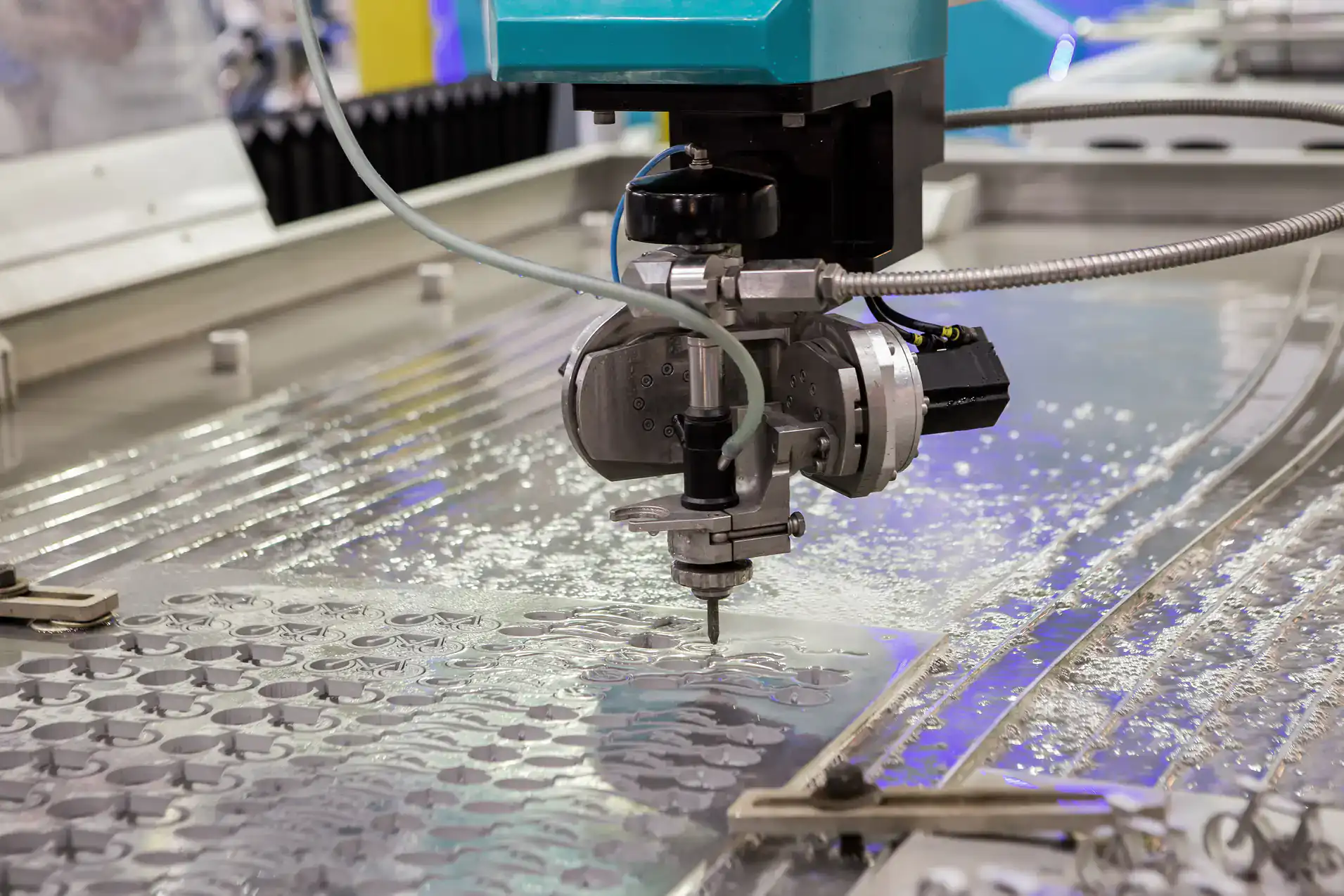
You start with a design. CAD file, hand sketch, or template—we’ll work with what you have. Our programming translates that into tool paths that guide a high-pressure water stream mixed with garnet abrasive.
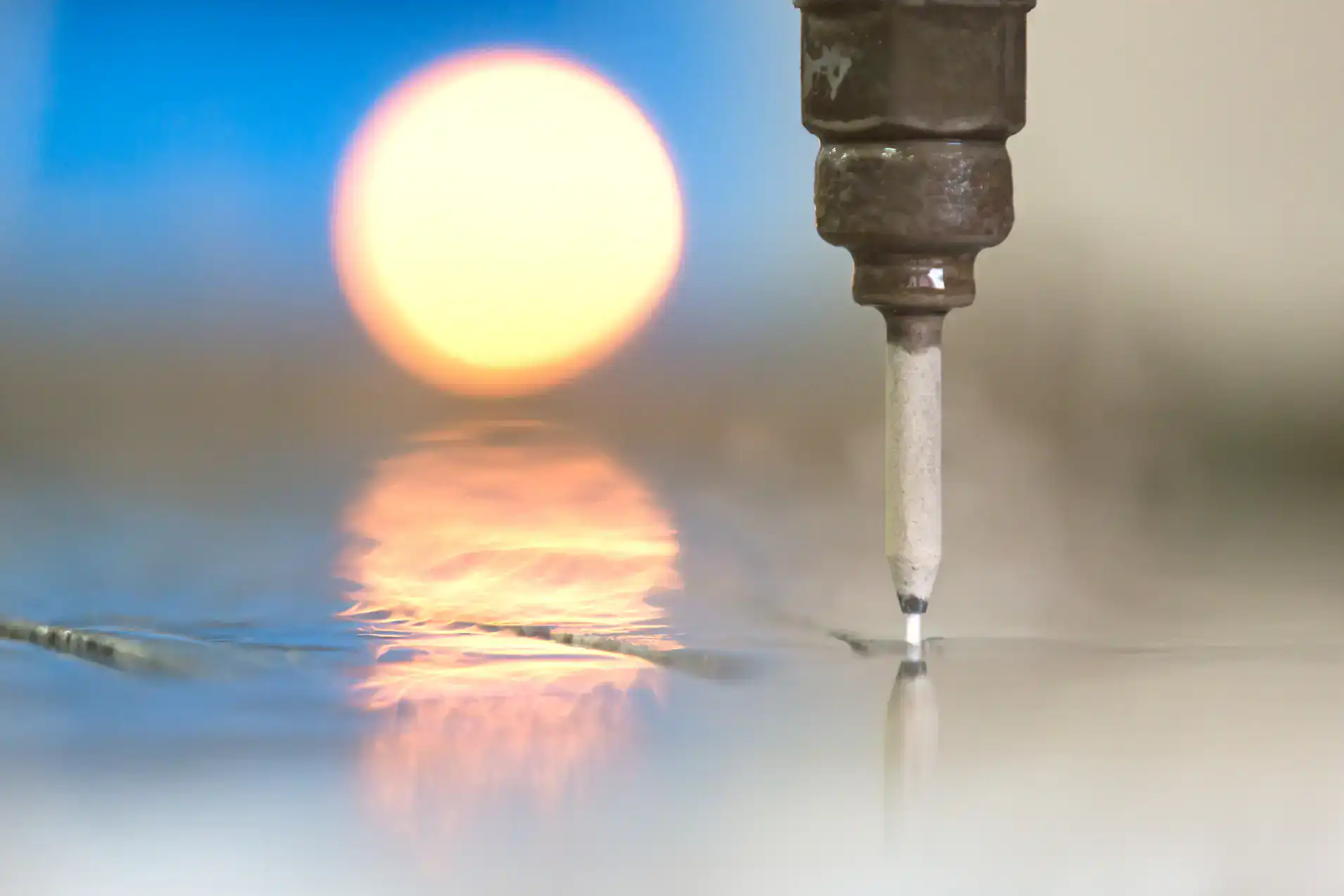
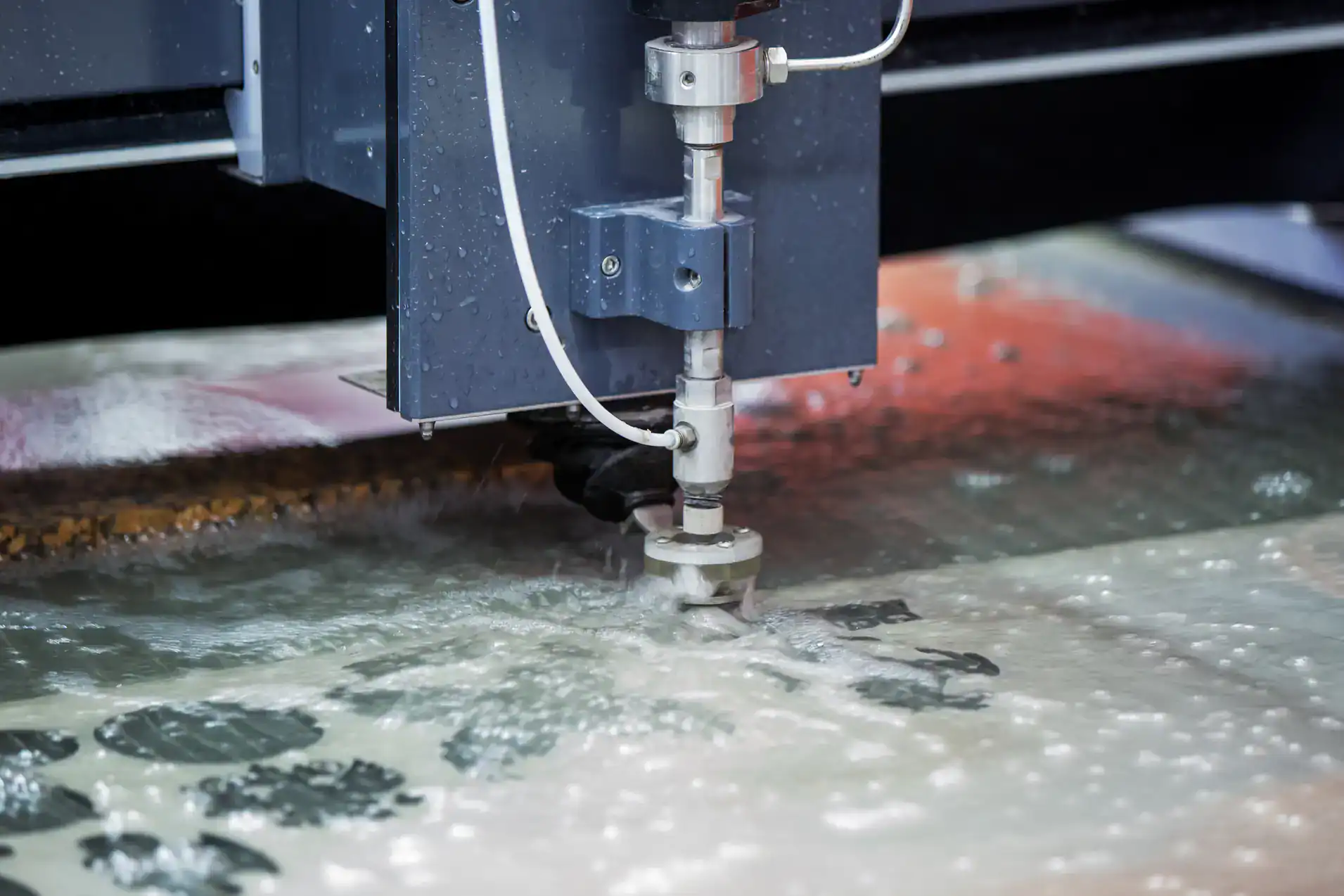
The cutting head moves across your marble slab following those programmed paths. Pressure runs between 50,000 and 60,000 PSI, focused through a nozzle opening smaller than a pinhole. The stream cuts through stone without generating heat, eliminating the thermal stress that causes micro-cracks.
For complex patterns, the machine handles interior cutouts, sharp corners, and radius curves without repositioning your material. One setup, one pass, done. You get consistent edge quality across the entire cut because there’s no tool wear changing dimensions halfway through.
After cutting, your pieces come off the table ready for installation or whatever finishing steps your project requires. Most edges are smooth enough for immediate use, though you can request specific edge treatments if your application demands it.
Ready to get started?
Material consultation comes first. Not every marble responds identically to waterjet cutting, and we’ll flag potential issues with your specific stone before we start. Softer marbles, heavily veined pieces, or slabs with existing stress fractures all need different approaches.
Programming and setup are part of the service. Bring your design, and we’ll optimize the cutting path to minimize material waste and cycle time. For production runs, we’ll nest multiple pieces to maximize yield from each slab.
Shirley’s position on Long Island, NY means you’re close to major stone suppliers and fabrication shops. If you’re working with material from local yards, we’re familiar with the inventory and can coordinate directly. For specialized or imported marbles, our system handles the full range of hardness and composition you’ll encounter.
Quality control happens during the cut. Our operators monitor stream pressure, abrasive flow, and cutting speed in real-time. If something’s off, we catch it before it ruins your material. You don’t pay for mistakes caused by equipment drift or programming errors.
Yes, and that’s exactly where waterjet cutting outperforms traditional methods. The process doesn’t create vibration or mechanical stress that would snap delicate marble pieces.
When you’re cutting inlay components—especially thin sections under a quarter-inch—blade-based tools generate enough force to fracture the material. The blade pushes against the stone as it cuts, creating lateral pressure that thin pieces can’t withstand. Waterjet cutting eliminates that contact force entirely.
The water stream removes material through erosion, not mechanical pressure. Your thin inlay pieces stay intact because nothing is physically pushing against them. This matters especially for complex geometric inlays where you need matching pieces cut from different marble types. The digital precision means your cutouts and inserts fit together with gaps measured in thousandths of an inch, not the sixteenths you’d get from hand-cutting or template work.
Chipping happens when a blade’s teeth exit the bottom of a marble slab. The rotating action creates an upward force that breaks off small chunks along the cut edge, especially on brittle stones.
Waterjet cutting doesn’t have an exit-side problem because there’s no rotational force. The stream passes straight through the material in one direction. What you get is a consistent edge from top to bottom of the slab, without the breakout that requires grinding and polishing to fix.
This becomes critical when you’re cutting finished surfaces where the edge will be visible. Countertop edges, decorative panels, and architectural elements all benefit from edges that don’t need extensive remediation. You save labor time on finishing, and you preserve more of the original slab thickness because you’re not grinding away damaged material.
The abrasive particles in the water stream are doing the cutting work, and they’re small enough—typically 80 mesh garnet—that they don’t create the fracture patterns you see with larger mechanical tools.
You’re looking at ±0.001 inches on straight cuts and ±0.005 inches on complex curves. That’s tight enough for architectural installations where panels need to align across large surfaces without visible gaps or misalignment.
For context, traditional marble cutting with bridge saws typically delivers ±0.030 inches, sometimes worse depending on blade wear and operator skill. That difference matters when you’re installing multiple pieces that need to line up. A thirty-thousandth variance across a ten-foot span becomes visible. A one-thousandth variance doesn’t.
CNC control is what makes this possible. The cutting head position is monitored and adjusted continuously during the cut. If the system detects any deviation from the programmed path, it corrects immediately. You don’t have the accumulated error that comes from manual tool guidance or mechanical linkages with play in them.
This precision holds across the entire cut, not just at measurement points. Your marble pieces fit together the way your CAD model shows they should, without field adjustments or shimming to compensate for dimensional errors.
Waterjet handles the full range of marble hardness, from soft Carrara to dense Emperador. The difference is in cutting speed and abrasive flow rate, not whether the process works.
Softer marbles cut faster because they erode more easily under the water stream. Harder, denser marbles require slower traverse speeds and sometimes increased abrasive concentration. But both deliver the same edge quality and precision. You don’t sacrifice accuracy when working with harder stone—you just need more time.
The advantage over blade cutting is significant with softer marbles. Saw blades tend to grab and tear soft stone rather than cutting cleanly. You get rough edges and sometimes deeper fractures that propagate into the slab. Waterjet cutting doesn’t grab or tear because there’s no mechanical contact. The stream erodes material uniformly regardless of hardness.
Heavily veined marbles also benefit from waterjet processing. Veins represent different mineral compositions with different hardness levels. A blade hits those transitions and can deflect or cause breakout. The waterjet stream doesn’t deflect—it cuts through veins and matrix material with the same consistency.
Waterjet cutting removes roughly 0.030 to 0.040 inches of material along the cut path—that’s your kerf width. Bridge saws remove 0.125 to 0.250 inches depending on blade thickness. You’re saving significant material on every cut.
That difference compounds when you’re nesting multiple pieces on a single slab. Tighter kerfs mean you can fit more components into the same square footage. For expensive marble varieties, that material savings directly impacts your project cost.
There’s also less waste from mistakes. Because waterjet cutting is CNC-controlled and doesn’t generate heat stress or vibration damage, you’re not scrapping pieces due to cracks, chips, or dimensional errors. The first cut is typically the final cut.
Edge finishing waste is minimal too. Most waterjet edges are smooth enough for direct installation, so you’re not grinding away additional material to clean up rough or damaged edges. What you cut is what you use, with very little secondary processing required.
Yes. Many customers source their own material, either because they’re working with specific marble varieties or because they’ve already purchased slabs for a larger project.
Bring your material to our Shirley location, and we’ll assess it before cutting. We’re looking for existing cracks, areas of weakness in the stone structure, and any characteristics that might affect how the slab responds to cutting. Some marbles have internal stress from quarrying or shipping that isn’t visible on the surface. Identifying those issues before we start prevents mid-cut failures.
You’ll need to provide dimensions and design specifications. CAD files work best, but we can work from physical templates or detailed drawings. For complex cuts, we’ll review the design with you to optimize cutting paths and minimize cycle time.
Turnaround depends on current workload and job complexity, but most custom marble cutting projects are completed within a few days. Rush service is available when your installation schedule demands it. You’re working with a local shop, so coordination is straightforward—no shipping delays or communication gaps with distant facilities.
Useful Links
Other Services we provide in Shirley