Hear from Our Customers
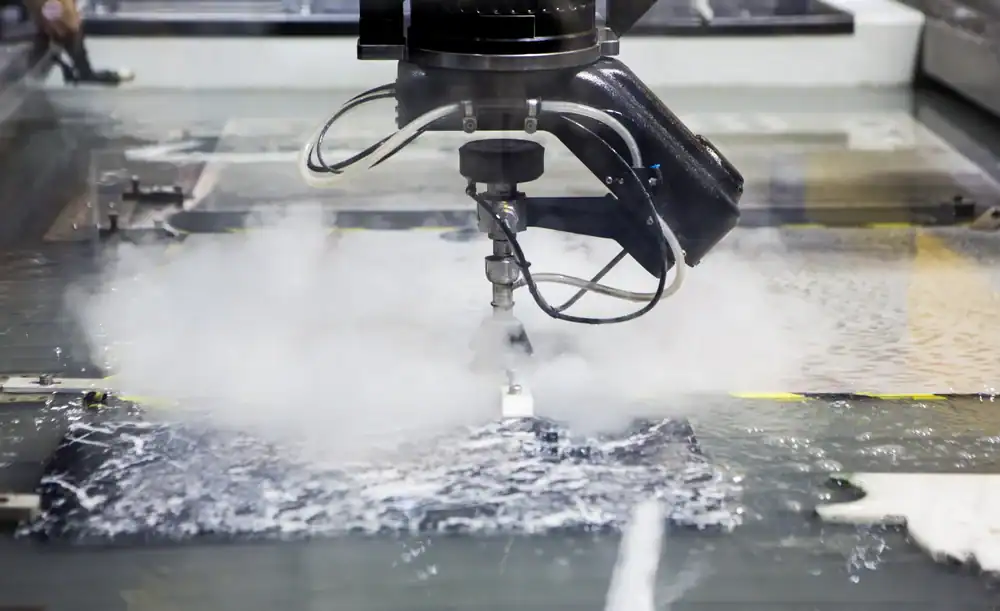
You’re working with marble that costs real money. A bad cut doesn’t just waste material—it pushes your timeline back, eats into your budget, and creates problems you didn’t sign up for.
Waterjet cutting removes those risks. No heat means no micro-cracks forming along your cut lines. No saw blades means no chipping at the edges or dust covering everything in sight. You get accuracy within 0.003 to 0.005 inches, which matters when you’re fitting inlays, creating mosaics, or matching seams on a countertop install.
The process works through high-pressure water mixed with fine abrasive—it erodes the marble mechanically instead of burning or forcing its way through. That’s why edges come out smooth enough that most projects don’t need secondary finishing. It’s also why complex curves, inside corners, and detailed patterns happen in one pass instead of requiring multiple setups or specialized tooling.
If you’re in West Babylon, NY and you’re dealing with marble fabrication for kitchens, bathrooms, commercial spaces, or architectural features, this is how you avoid the headaches that come with traditional cutting methods.
We’ve spent decades working with marble, granite, stone, and composite materials across Long Island, NY and the surrounding areas. We’re not new to precision cutting, and we’re not experimenting with your slabs.
Our equipment handles everything from thin decorative pieces to stone over 12 inches thick. We’ve worked with contractors, architects, designers, and homeowners throughout West Babylon, NY who needed cuts that couldn’t afford to go wrong. The projects we’ve completed for industry names and local businesses alike come down to the same thing—accuracy, consistency, and no surprises.
You’re not getting a sales pitch here. You’re getting a shop that knows how marble behaves, what tolerances actually matter, and how to turn a CAD file into a finished piece without the back-and-forth that wastes your time.
You send us your design—whether that’s a CAD file, a template, or detailed specs. We program the waterjet system to follow those exact dimensions, accounting for material thickness and edge requirements.
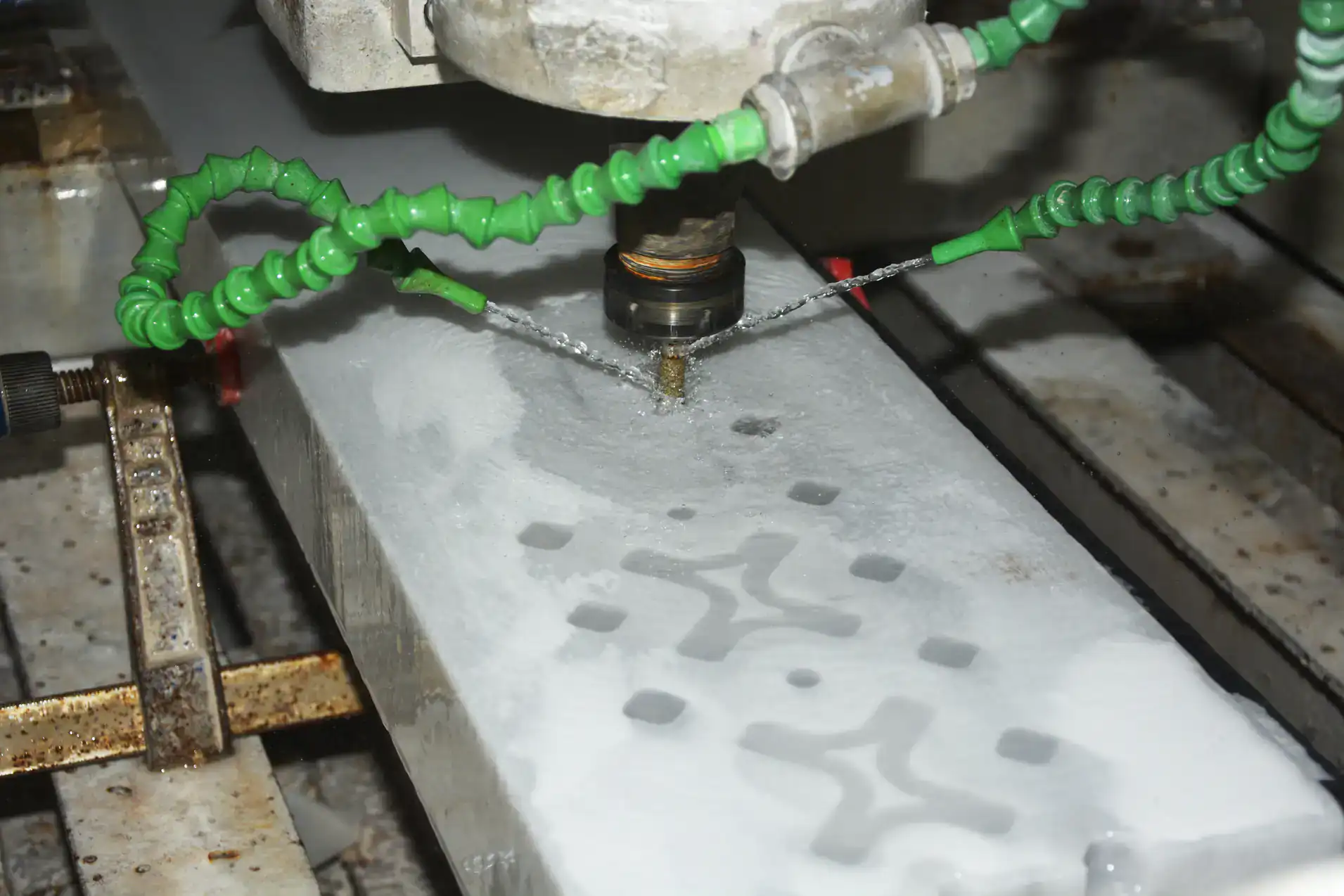
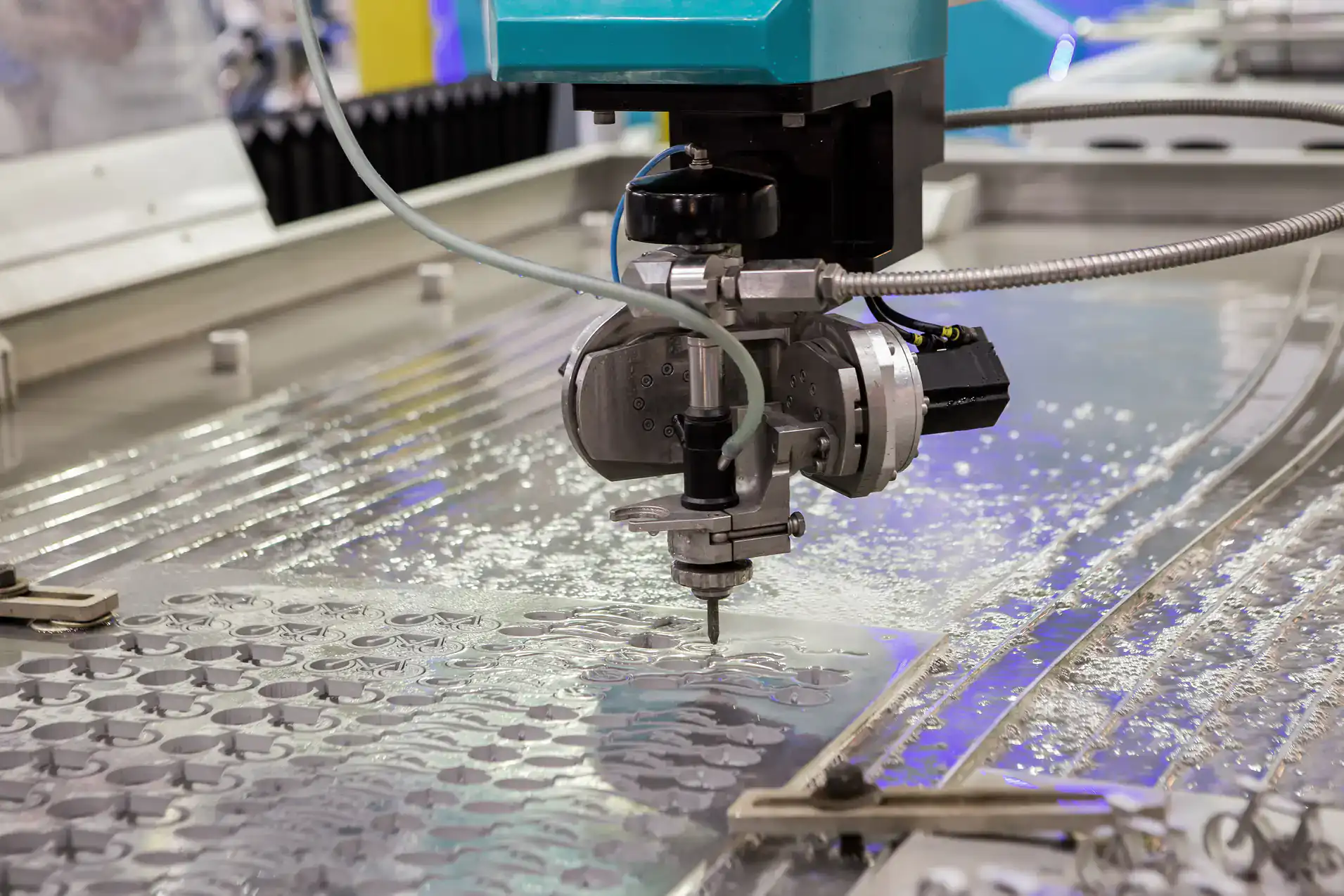
The cutting head uses a stream of water pressurized up to 60,000 PSI, mixed with garnet abrasive. That stream moves across your marble slab, eroding material away with mechanical precision instead of heat or force. Because there’s no blade contact and no thermal stress, the stone doesn’t crack, chip, or develop internal tension that shows up later.
For complex shapes, the system cuts curves, angles, and interior cutouts in a single continuous path. You don’t need multiple machines or setups. Intricate inlays, custom edge profiles, logos, and tight-radius corners all happen without switching tools or repositioning the slab.
Once the cut finishes, edges are smooth and dimensionally accurate. Most applications move straight to installation. If your project requires polished edges or specific finish work, that happens after—but the cut itself is already clean enough that you’re not fixing mistakes or grinding down rough spots.
Ready to get started?
Custom marble waterjet cutting in West Babylon, NY means you’re working with a process built for accuracy and material preservation. Tolerances stay within 0.003 to 0.005 inches across the entire cut, which matters when you’re matching seams, creating repeating patterns, or fitting stone into existing frameworks.
You’re also avoiding the dust problem. Traditional saws generate clouds of silica dust that create respiratory hazards and cover your workspace. Waterjet cutting keeps all material suspended in water, collected, and disposed of properly. Your site stays cleaner and safer.
Material waste drops significantly because the cutting stream is narrow—often less than a millimeter wide. That means more usable stone from each slab and less expensive marble turning into scrap. For commercial projects or high-volume residential work in West Babylon, that difference adds up quickly.
The process handles marble in virtually any thickness and works across different types—Carrara, Calacatta, Statuario, or any other variety you’re specifying. Because there’s no heat involved, the natural veining and color stay intact. You don’t get discoloration or surface changes along the cut line that show up after installation.
Marble cracks when you introduce heat or apply uneven force across its surface. Traditional saws generate friction, which creates localized heating and internal stress. That stress turns into micro-cracks that either show up immediately or appear later after installation.
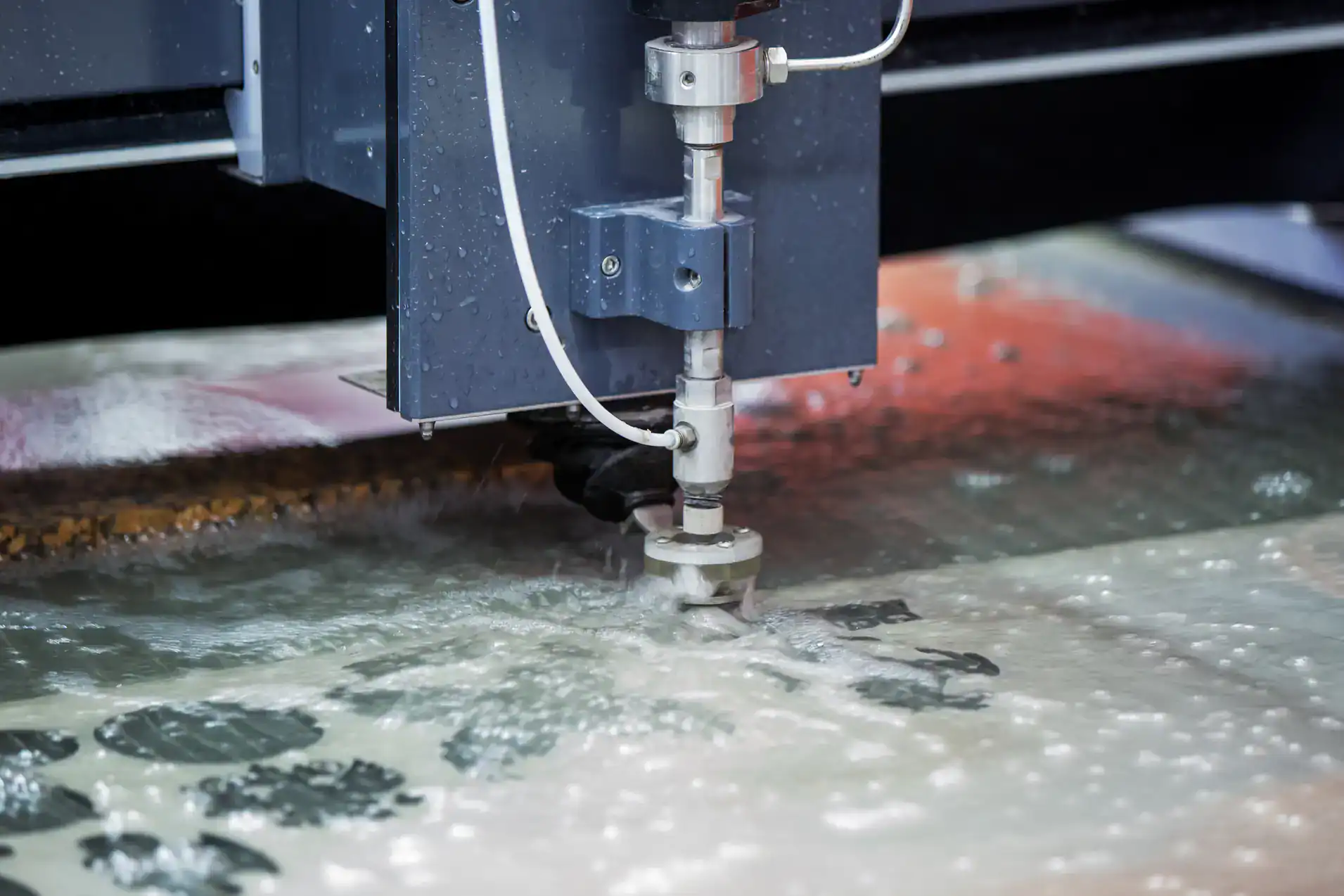
Waterjet cutting eliminates both problems. The process uses high-pressure water mixed with abrasive to erode material mechanically—there’s no blade contact and no heat generation. Because the cutting happens through controlled erosion rather than force, there’s no lateral pressure pushing against the stone’s structure.
That’s especially important with marble, which has natural veining and variations in density. A saw blade can catch on those variations and cause chipping or fractures. Waterjet follows the programmed path regardless of what’s happening inside the stone, so you get clean cuts even when the material isn’t perfectly uniform.
You’re looking at tolerances between 0.003 and 0.005 inches across the cut. That level of precision means components fit together without gaps, seams align properly, and repeating patterns stay consistent across multiple pieces.
For context, that’s accurate enough for mosaic work where individual tiles need to interlock, inlay projects where different materials meet at visible seams, and countertop sections that join at corners or along long runs. If your design requires tight inside corners or complex curves, the waterjet maintains that same accuracy throughout the entire path.
The consistency matters as much as the raw numbers. You’re not getting variation from one cut to the next or drift over the length of a long cut. The system follows the programmed toolpath exactly, which means the tenth piece comes out the same as the first. That reliability matters when you’re fabricating multiple components for a single project or running production work where dimensional consistency determines whether installation goes smoothly.
If you can draw it in a CAD program, waterjet can cut it. The system handles sharp inside corners that would require multiple setups with traditional methods. Complex curves, whether gradual or tight-radius, happen in the same pass as straight cuts. Interior cutouts, detailed lettering, logo work, and pictorial designs all translate directly from your file to the finished piece.
The limitation isn’t complexity—it’s thickness. Most marble waterjet cutting in West Babylon, NY handles material up to 12 inches thick efficiently, with capability beyond that for specific applications. As long as your design fits within the cutting bed dimensions and the material thickness falls within range, the geometry itself isn’t a constraint.
That’s different from saw-based cutting, where inside corners require plunge cuts or pre-drilling, and curves need specialized blades or multiple passes. With waterjet, the cutting head moves in any direction without changing tools or stopping to reposition. Your design determines what gets cut, not the limitations of the cutting method.
Most edges come off the waterjet smooth enough for direct installation, especially for applications where the edge won’t be highly visible or where a honed finish is acceptable. The cut surface has a slightly textured finish from the abrasive, but it’s uniform and clean—not rough or damaged.
If your project requires polished edges, mirror finishes, or specific edge profiles like bullnose or ogee, those finishing steps happen after cutting. But you’re starting with a dimensionally accurate edge that doesn’t have chips, cracks, or heat damage to repair first. That means finishing is actual finishing, not fixing problems created during the cut.
For many commercial applications, architectural installations, and underlayment work, the as-cut edge is the final edge. You’re not paying for secondary operations that don’t add value to the finished project. When polishing is necessary, it’s faster and more predictable because the waterjet edge is consistent across the entire cut length.
The water and abrasive mixture runs through the cutting area and into a catch tank below the cutting bed. The abrasive—typically garnet—along with the eroded marble particles, settles out of the water in the tank. That material gets collected and disposed of properly according to local regulations in West Babylon, NY.
The water itself can be filtered and recirculated in some systems, though it eventually needs replacement as the abrasive concentration and particle content build up. The key point is that nothing becomes airborne. All the material removed from your marble stays suspended in water instead of turning into dust that spreads through your workspace or job site.
That’s a significant difference from traditional cutting methods. Marble dust contains crystalline silica, which creates serious respiratory hazards and requires extensive ventilation, dust collection, and cleanup. Waterjet cutting contains all that material in liquid form from the start, which means cleaner working conditions and fewer health and safety concerns for everyone involved in the project.
Pricing depends on cutting time, material thickness, and design complexity. Straight cuts through thin material cost less than intricate patterns through thick slabs because they require less machine time and abrasive consumption.
The calculation accounts for linear cutting distance, number of pierces (where the waterjet starts cutting through the material), and how much detail work is involved. A simple rectangular cutout prices differently than a detailed inlay pattern with multiple interior features, even if both are cut from the same size slab.
Most projects start with you sending your design specs and material details. We review the file, calculate the actual cutting time required, and provide a quote based on those specifics. That’s more accurate than per-square-foot estimates because it reflects what your particular project actually requires. For ongoing production work or multiple pieces with the same design, per-unit pricing becomes more straightforward once we’ve run the first piece and know exactly how long it takes.
Useful Links
Other Services we provide in West Babylon