Hear from Our Customers
When you’re working with glass, there’s no room for a second attempt. Thermal cutting methods introduce stress that leads to micro-fractures along cut lines. Those fractures don’t always show up immediately, but they compromise structural integrity and create weak points that fail under load or temperature changes.
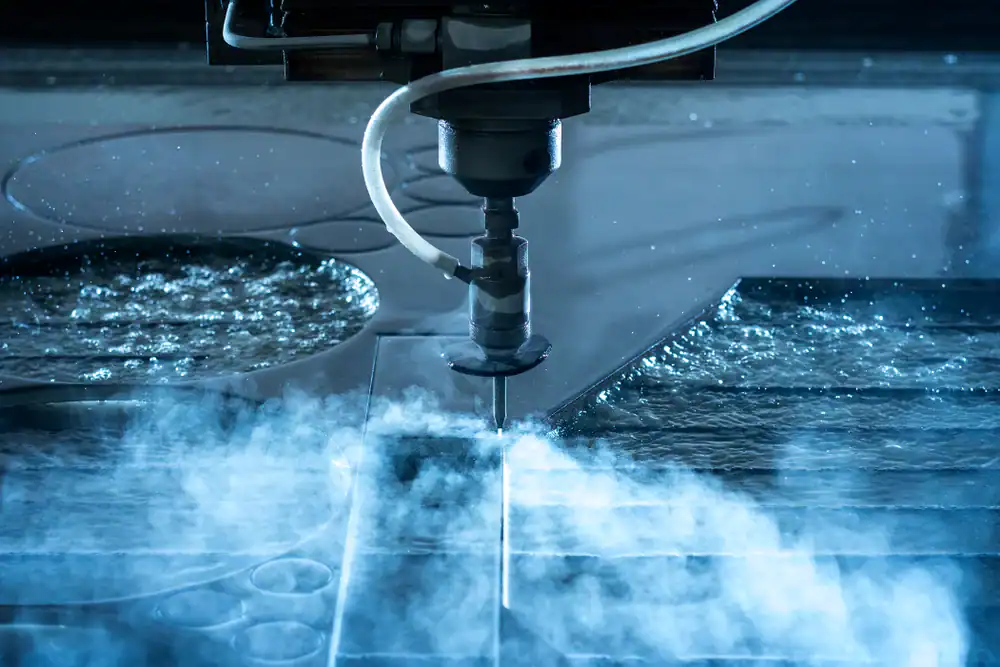
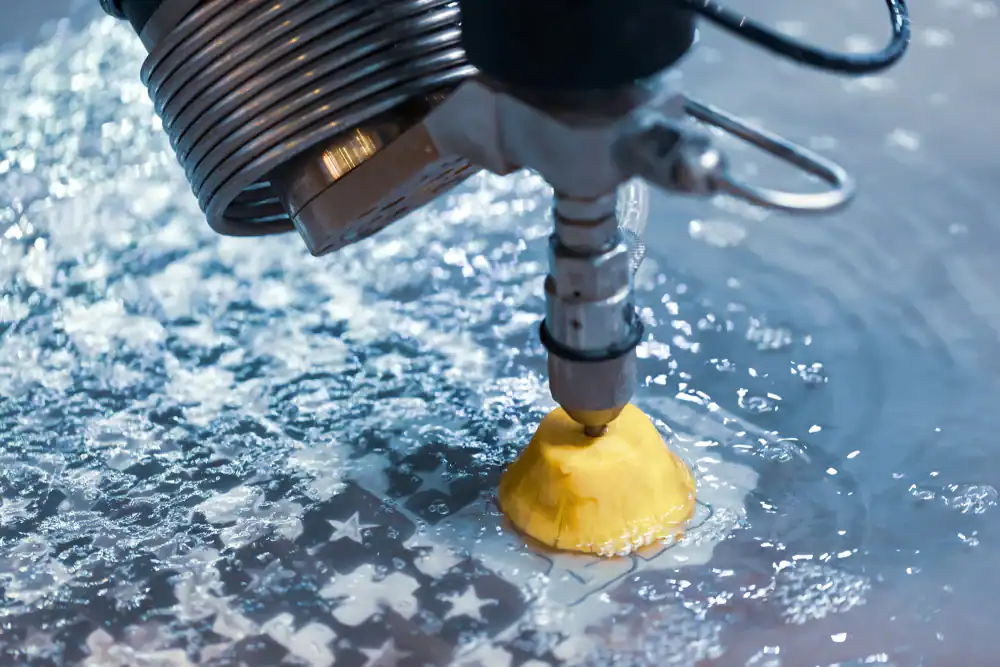
Water jet glass cutting near me in Suffolk County eliminates heat from the process entirely. Our cutting head follows your CAD file with CNC precision, using high-pressure water and abrasive to cut through glass up to 6 inches thick without introducing a single degree of thermal stress. No warping. No hardened edges. No chipping that eats into your schedule with secondary grinding.
You get components that match your design specifications the first time. Complex curves, tight radiuses, internal cutouts—all executed in a single setup without repositioning or tool changes. Edge quality comes out clean enough that most pieces move straight to installation, cutting days off your project timeline and eliminating the material waste that comes from failed cuts.
We operate out of West Islip, close enough to understand what’s happening across Suffolk County. The construction boom stretching from Brookhaven to the East End isn’t slowing down—commercial developments, industrial facilities, and residential projects all need precision glass components that fit right the first time.
We cut glass because waterjet technology handles it better than any other method. Our Flow Mach 500 system translates your design files into finished parts without the thermal damage, chipping, or tolerance stacking that comes from conventional cutting methods. Every file gets reviewed by our engineering team before programming to catch errors before they become expensive mistakes.
You’re not coordinating between multiple fabricators or dealing with the headaches of parts that don’t fit. Architectural glass waterjet cutting in Suffolk County, NY means one facility, one process, and components that arrive ready for your installation schedule.
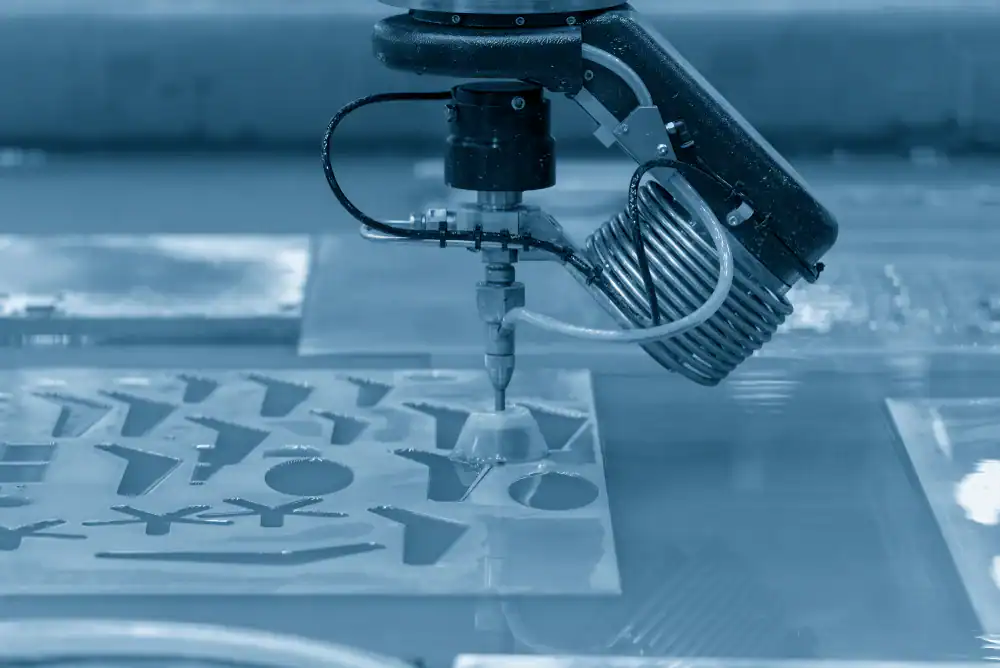
Send us your design file—DXF, DWG, or most CAD formats work. Our engineering team reviews it to verify dimensions, check for potential issues, and optimize the cutting path. If something looks off or could be improved for better results, you’ll hear about it before we start cutting.
Once the file is programmed, our CNC system takes over. The cutting head moves across your glass with precision measured in thousandths of an inch, following every curve and corner exactly as designed. High-pressure water mixed with abrasive garnet does the cutting—no heat, no mechanical stress, just clean separation of material.
Complex geometries that would crack under conventional methods come out intact. Internal cutouts happen in the same setup as perimeter cuts. Sharp corners, gradual curves, whatever your design requires gets executed without compromising the glass structure. Most edge finishing happens during the cut itself, so components come off the table ready for the next step in your process.
Turnaround depends on complexity and queue, but the process itself is faster than you’d expect. No waiting on multiple attempts. No dealing with waste from parts that didn’t survive the cut. Just components that match your specifications, delivered on a timeline that keeps your project moving.
Ready to get started?
Tolerances down to 0.001 inches across the entire cut. That level of precision matters when components need to fit together without gaps or when you’re creating architectural elements where visual alignment is critical. CNC control means repeatability—if you need multiples, every piece matches exactly.
Material thickness up to 6 inches, handled in a single pass. Tempered glass, laminated glass, standard annealed glass—the process works across different glass types without the thermal stress that causes problems with heat-based cutting. You’re not limited to straight cuts or simple shapes. Curves, radiuses, intricate patterns, all executable without the cracking risk that comes from mechanical scoring methods.
Suffolk County’s mix of commercial construction and high-end residential projects demands quality that holds up under scrutiny. Custom glass waterjet cutting in Suffolk County, NY delivers edge quality that typically eliminates extensive grinding or polishing. Components arrive ready for installation or assembly, not halfway through the finishing process.
The real advantage shows up when projects involve multiple materials. Glass paired with metal, stone, or composite materials—all cut in the same facility with the same precision standards. No tolerance stacking from different fabricators. No coordination headaches between vendors. Just components that fit together the way your design intended.
Traditional glass cutting uses scoring wheels or thermal methods that introduce stress into the material. Scoring wheels typically achieve only 15% penetration, then rely on breaking the glass along that score line. That breaking action creates lateral stress and often leads to chipping when those lateral cracks reach the surface.
Thermal cutting methods—lasers or plasma—generate intense heat that creates temperature differentials across the glass surface. Glass doesn’t handle sudden temperature changes well. Those differentials cause thermal stress that leads to cracking, either immediately or later when the component experiences normal temperature variations during use.
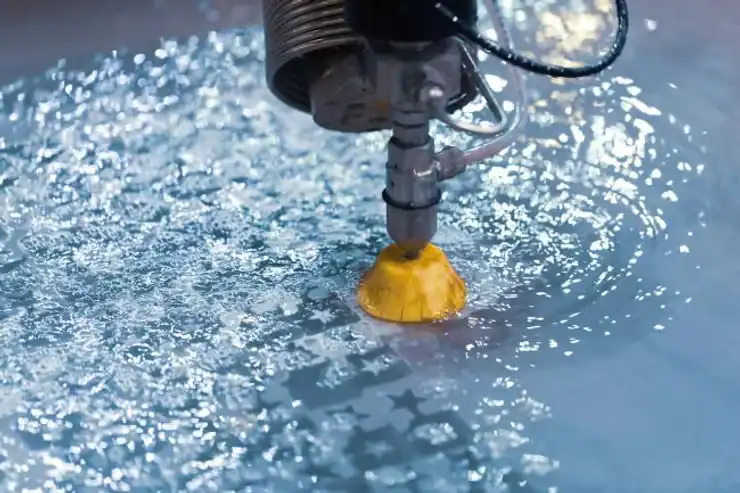
Water jet glass cutting removes both problems entirely. High-pressure water mixed with abrasive garnet cuts through the glass without heat and without mechanical stress. The material separates cleanly along the cut line without micro-fractures forming in the surrounding area. Edge quality comes out smooth enough that most applications skip secondary finishing entirely, and the structural integrity of the glass remains completely intact because you never introduced stress in the first place.
Yes, and that’s where the process really separates itself from conventional methods. CNC control means the cutting head follows your design file exactly, whether that’s straight lines, gradual curves, or tight radiuses that would crack glass under mechanical cutting methods.
The cutting head can execute sharp corners, internal cutouts, and intricate patterns all in a single setup. You’re not repositioning the material or changing tools. The same cutting stream that handles straight cuts navigates curves with the same precision—down to 0.001 inches across the entire path.
Complex geometries that would require multiple operations with traditional methods happen in one pass. That eliminates the tolerance stacking that occurs when you’re combining results from different processes, and it eliminates the handling that increases breakage risk with delicate cuts. Your design translates directly into the finished component without simplification or compromise.
Our system handles glass up to 6 inches thick in a single pass. Thickness doesn’t change the fundamental process—the high-pressure water and abrasive cut through regardless of how much material they’re moving through.
Thicker glass does mean longer cutting time because the stream needs to penetrate deeper, but it doesn’t compromise precision or edge quality. You get the same tolerances and the same clean edges whether you’re cutting quarter-inch architectural glass or multi-inch structural components.
That thickness capacity matters for industrial applications and custom architectural elements where standard glass thicknesses don’t meet structural or design requirements. You’re not limited to what’s readily available in thin sheets. If your project needs it and it’s glass, waterjet cutting handles it without the cracking risk that comes from trying to cut thick glass with methods designed for thinner material.
Turnaround depends on project complexity, material thickness, and current queue, but the process itself moves faster than most people expect. Simple cuts on thinner glass might be same-day or next-day. More complex geometries or thicker materials take longer, but you’re still looking at days, not weeks.
The real time savings shows up in what doesn’t happen. No waiting on second attempts because the first batch cracked. No delays for extensive edge finishing because the cuts came out rough. No rework because parts don’t fit together due to tolerance issues. Components come off the waterjet table ready for the next step in your process.
For projects on tight timelines—and most Suffolk County construction and renovation projects are—that reliability matters more than raw cutting speed. You can actually plan around the delivery date instead of building in buffer time for potential failures. Rush jobs get prioritized when possible, and our engineering team reviews files quickly to keep projects moving without sacrificing the precision that makes waterjet cutting worth doing in the first place.
Waterjet cutting works on annealed glass without issues. Tempered glass is a different situation—the tempering process puts the glass under internal stress, and cutting through tempered glass releases that stress, which typically causes the entire piece to shatter. That’s not a waterjet limitation; that’s fundamental to how tempered glass works. Any cutting method will cause the same result.
The solution is cutting before tempering. You waterjet cut the annealed glass to your exact specifications, then send it out for tempering if your application requires it. That gives you both the precision of waterjet cutting and the strength characteristics of tempered glass.
Laminated glass—multiple layers bonded together—handles waterjet cutting fine. The process cuts through each layer cleanly without delaminating the bond between them. You get clean edges through the entire laminated thickness, which is difficult to achieve with mechanical cutting methods that can catch on the interlayer material and cause separation or chipping at the boundaries between layers.
Per-cut cost for waterjet is typically higher than simple scoring and breaking methods. But that’s not the number that matters for your project budget. What matters is total cost including material waste, rework, finishing time, and whether components actually fit together when they arrive.
Waterjet cutting eliminates the material waste that comes from cracks and chips during conventional cutting. When you’re working with expensive architectural glass or custom-sized pieces, that waste adds up fast. One failed batch from thermal stress can cost more than the difference in cutting methods for the entire project.
Edge quality from waterjet cutting typically eliminates or drastically reduces finishing time. Components that come out of traditional cutting often need extensive grinding and polishing to achieve acceptable edge quality. That’s labor time and equipment cost that doesn’t happen when edges come off the waterjet clean enough for installation.
The precision also means parts fit together correctly the first time. No gaps from tolerance issues. No field modifications because components don’t align. For contractors and fabricators working on fixed bids, that predictability has real value that doesn’t show up in a simple per-cut price comparison.
Useful Links
Other Services we provide in Suffolk County