Hear from Our Customers
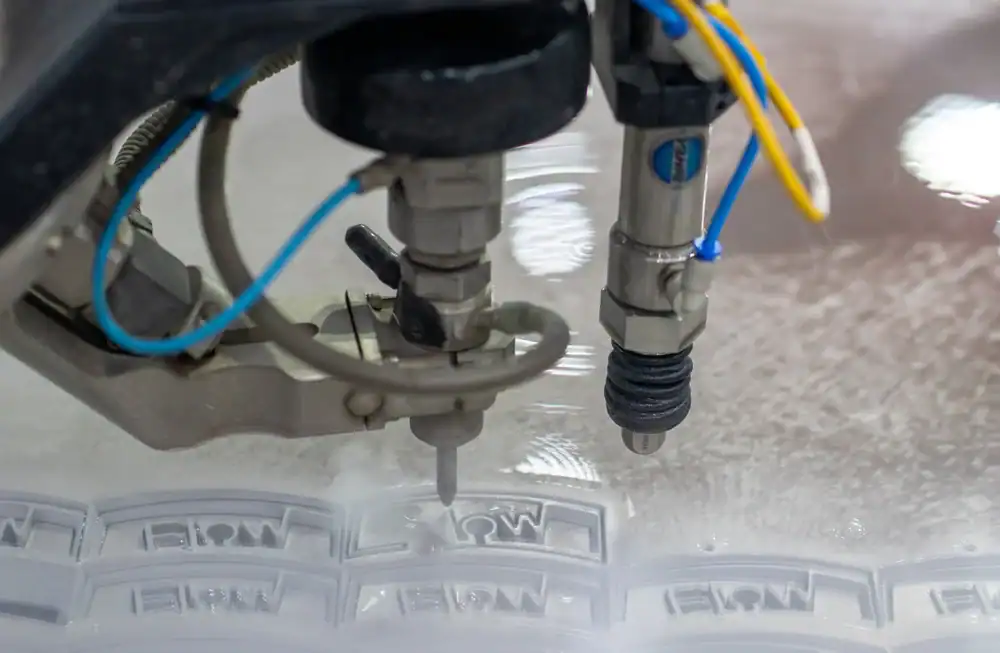
You send the file. We cut it to spec. No heat-affected zones that crack during welding. No burrs that need grinding down. No distortion that throws your assembly off.
Custom waterjet cutting in Baldwin, NY means you’re working with a process that handles steel up to 6 inches thick, aluminum, titanium, glass, stone, ceramics, plastics, and composites—all without changing the material properties. The edge quality you get often eliminates the need for secondary finishing, which means your parts move faster through production.
When you’re holding tolerances down to ±0.003 inches, you can’t afford a cutting method that introduces variables. High pressure water cutting in Baldwin, NY keeps your material cold, your dimensions accurate, and your timeline on track. Most jobs turn around in 2-3 business days, so you’re not waiting weeks to find out if the parts work.
We serve the Long Island manufacturing corridor where precision matters. Baldwin’s aerospace legacy—rooted in Grumman’s decades of aircraft production—created a local ecosystem that demands tight tolerances and reliable turnaround.
We cut parts for aerospace, medical device manufacturers, metal fabricators, architectural firms, and custom job shops across the Tri-State area. Our in-house design team reviews every CAD file before it hits the cutting table, catching potential issues early so you don’t waste material or time on a bad run.
You’re working with a waterjet cutting shop in Baldwin, NY that understands what happens when parts don’t fit. We’ve seen the cost of rework, the delays, the customer conversations you don’t want to have. That’s why we focus on getting it right the first time.
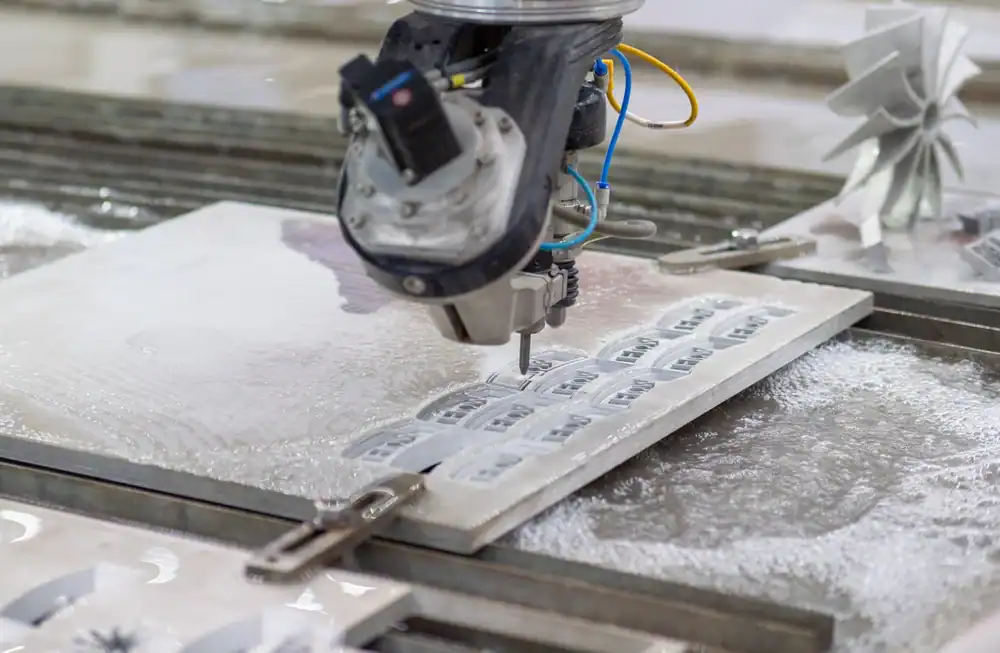
You start by sending us your design file—DXF or DWG formats work best because they maintain vector precision and layer organization. If you’re working with STEP or IGES files, we can import those too. Our design team reviews your file to verify dimensions, check for potential cutting issues, and confirm material specifications.
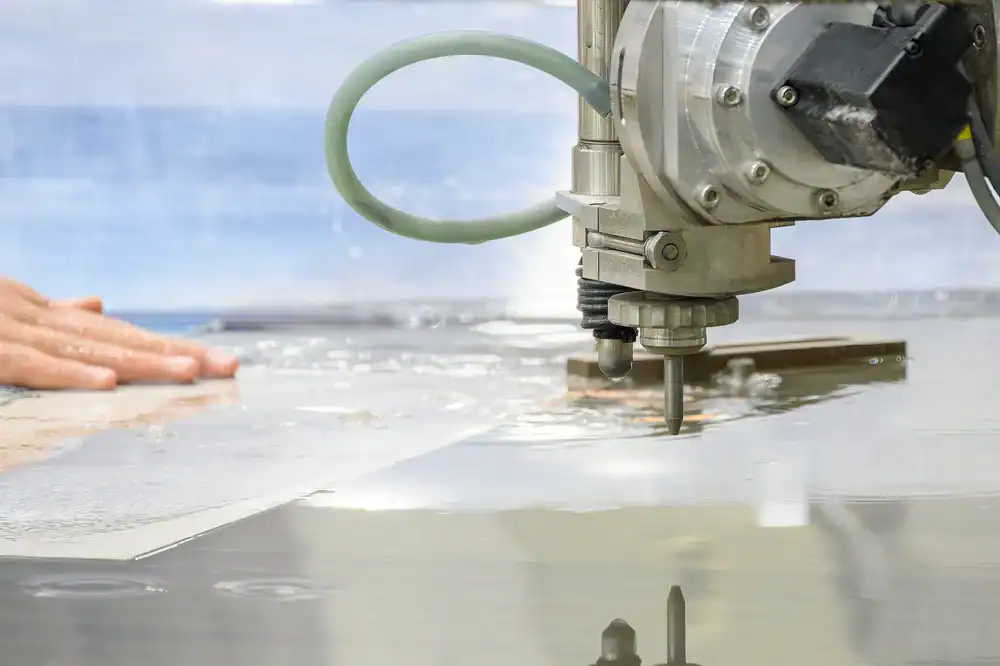
Once the file is approved, we program the CNC waterjet system and secure your material on the cutting table. The abrasive waterjet cutting process in Baldwin, NY uses a high-pressure stream of water mixed with garnet abrasive to cut through your material with precision measured in thousandths of an inch. There’s no heat, no melting, no hardening of edges—just clean cuts that follow your design exactly.
After cutting, we inspect the parts to confirm they meet your specifications. If you need multiple pieces or full production runs, the process scales efficiently without sacrificing accuracy. You get parts that fit your assembly the first time, with lead times around 2-3 business days for most waterjet cutting services in Baldwin, NY.
Ready to get started?
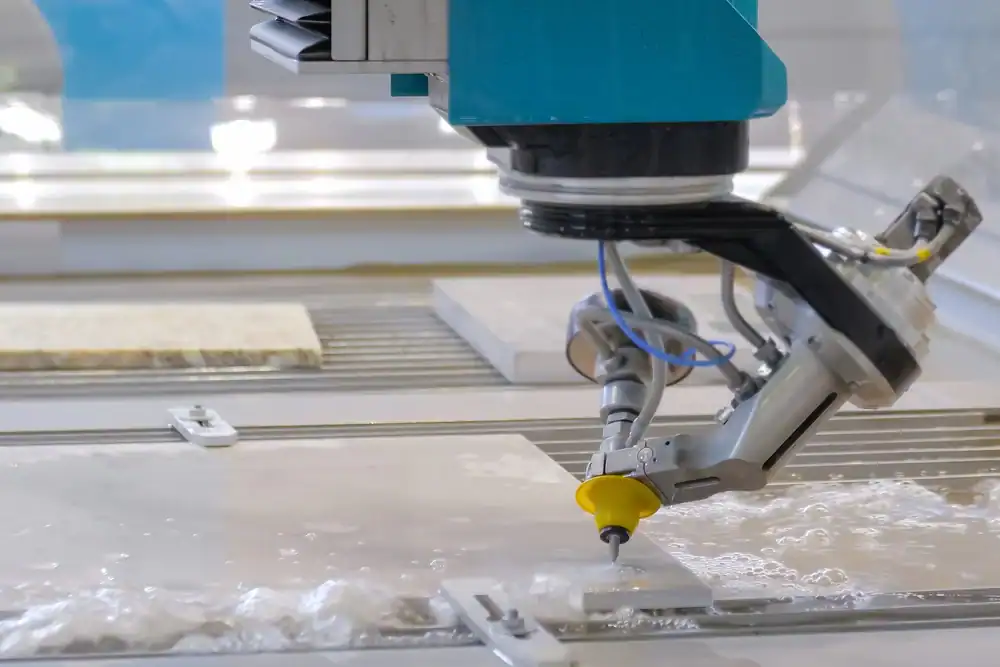
You get access to 5-axis CNC waterjet systems that handle complex geometries—undercuts, tapers, contoured surfaces—without needing multiple setups or tool changes. The cutting process works on materials from soft rubber to hardened tool steel, all with the same equipment.
For Baldwin’s aerospace and precision machining companies, that means you can prototype a part in aluminum and move to production in titanium without changing vendors or processes. Architectural firms cutting decorative screens or custom panels get the same intricate detail in steel, glass, or composite materials. Metal fabricators serving the marine and heavy industry sectors can cut thick plate steel without worrying about heat distortion affecting weld quality.
The environmental side matters too—waterjet cutting produces no hazardous fumes, and the water and abrasive can be filtered and recycled. You’re not dealing with disposal issues or ventilation requirements that come with plasma or laser cutting. The process reduces material waste by up to 30% compared to conventional cutting methods, which means you’re getting more usable parts from each sheet of material. That efficiency shows up in your material costs and your project timeline.
Waterjet cutting works on virtually any material you’re likely to spec. Metals like steel, stainless steel, aluminum, titanium, copper, and brass cut cleanly without heat-affected zones. Non-metals including glass, stone, granite, marble, ceramics, plastics, rubber, foam, and composite materials all process through the same system.
The thickness range depends on material hardness. Steel cuts up to 6 inches thick with maintained accuracy. Softer materials like aluminum or plastics can go up to 12 inches or more. If you’re working with exotic alloys for aerospace applications or specialized composites for marine use, the cold-cutting process won’t change the material properties or introduce stress points.
You don’t need different equipment or processes when you switch materials between jobs. That flexibility matters when you’re prototyping in one material and moving to production in another, or when you’re a job shop handling diverse customer requirements across multiple industries in the Baldwin area.
CNC waterjet systems control the cutting stream position with precision that achieves tolerances down to ±0.003 inches. The computer-guided cutting head follows your CAD file’s exact path, and because there’s no heat distortion or mechanical force pushing against the material, your dimensions stay accurate throughout the cut.
The abrasive waterjet stream is only about 0.030 inches in diameter, which allows for intricate detail work and tight inside corners. When you’re cutting flanges that need to bolt up perfectly or aerospace components with critical dimensions, that level of control eliminates the fit-up issues you’d get with less precise cutting methods.
Before cutting starts, our design team reviews your file to verify that the tolerances you’ve specified are achievable and that there aren’t any geometric issues that could affect accuracy. That front-end review catches problems before they become expensive mistakes. You get parts that measure correctly the first time, which means less time spent on rework and faster movement through your production schedule.
You save money in places that aren’t immediately obvious. First, the burr-free edges often eliminate secondary finishing operations—no grinding, no deburring, no additional machining to clean up the cut. That’s labor and time you’re not spending.
Second, the narrow cutting stream means less material waste. You can nest parts closer together on the sheet, and the kerf width is minimal compared to plasma or mechanical cutting. When you’re working with expensive materials like titanium or specialized alloys, that material savings adds up quickly.
Third, there’s no tooling cost. You’re not buying drill bits, end mills, or specialized cutting tools that wear out and need replacement. The waterjet system uses water and garnet abrasive—consumables that cost significantly less than maintaining a tool inventory. When you factor in the reduced rework from getting parts right the first time, the total cost per part often comes in lower than methods that seem cheaper on the surface but create hidden costs downstream.
Most waterjet cutting jobs in Baldwin, NY complete within 2-3 business days from file approval to finished parts. That timeline includes design review, programming, cutting, and quality inspection. If you need a single prototype part to test fit before committing to a production run, that can often happen faster.
The turnaround depends on material thickness, part complexity, and current shop capacity. A simple 2D profile in quarter-inch aluminum cuts faster than a complex 3D contour in 4-inch steel plate. Rush jobs can be accommodated when your project timeline demands it—we understand that manufacturing schedules don’t always give you weeks of lead time.
What matters most is that you’re not waiting for parts only to discover they don’t fit. The combination of design review before cutting and precision during cutting means you get usable parts on the first run. That reliability in both quality and timing helps you plan your production schedule with confidence instead of building in buffer time for potential rework.
5-axis waterjet systems cut geometrically complex profiles including undercuts, tapers, angled edges, and contoured surfaces that would require multiple setups or specialized tooling with conventional machining. Your CAD file defines the path, and the cutting head follows it exactly—even when that path involves compound angles or 3D contours.
For architectural work like decorative screens or custom panels with intricate patterns, the waterjet traces fine details without the limitations of mechanical cutting tools. Aerospace components with complex pocket geometries or marine parts with compound curves process through the same system. You’re not constrained by tool access or worrying about whether a specific geometry is “machinable.”
The process also handles piercing and inside cuts without pre-drilling. The waterjet stream pierces through the material and starts cutting from that point, which means you can create complex internal features without additional operations. When you’re designing parts, you can focus on what the part needs to do rather than limiting your design based on manufacturing constraints.
DXF or DWG file formats work best because they maintain vector precision and layer organization that translates directly to cutting paths. Make sure your file shows the actual cut lines, not just the part outline—we need to know what gets cut and what stays. If you’re working with 3D models, STEP or IGES files import into our CAM software for programming.
Include material specifications and thickness in your file notes or accompanying documentation. If certain dimensions are critical and need tighter tolerances than others, call those out. When you have specific edge quality requirements or need particular surfaces to be the “finished” side, that information helps us set up the cut for the best results.
Our design team reviews every file before cutting and will contact you if there are any questions or potential issues. That review catches things like dimensions that don’t close properly, overlapping lines that could cause double cuts, or features that are too small for the material thickness. Getting those details sorted up front means your job runs smoothly and you get parts that match your expectations without back-and-forth revisions.
Useful Links
Other Services we provide in Baldwin