Hear from Our Customers
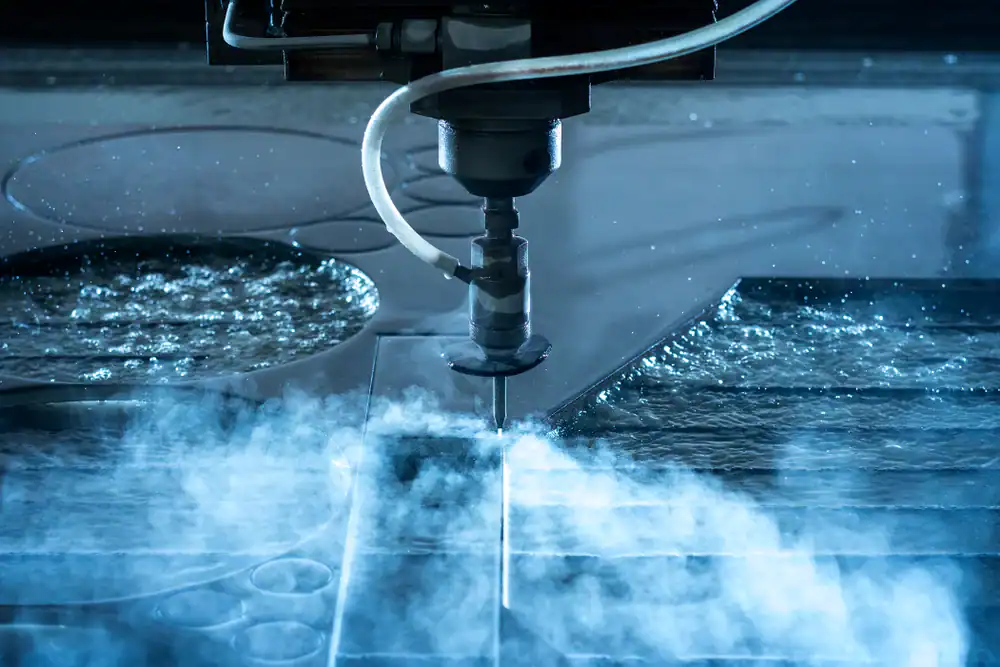
You send parts to aerospace clients who demand ±0.005″ tolerances. You can’t afford warping, burn marks, or edges that need grinding. That’s where high pressure water cutting changes everything.
Abrasive waterjet cutting in Bay Shore uses a needle-thin stream of water mixed with garnet to slice through virtually any material without transferring heat. No thermal distortion means your aluminum doesn’t warp. Your composites don’t delaminate. Your stainless keeps its properties right to the edge.
The result is parts that come off the table ready to use. No deburring. No secondary machining to correct what heat ruined. Just clean edges that match your file and meet your tolerances the first time.
You’re not just cutting faster. You’re eliminating the steps that slow you down after cutting and cost you more than the cut itself.
We serve manufacturers across Long Island who can’t compromise on precision. We work with companies in Bay Shore’s industrial sector where tolerances matter and deadlines don’t move.
Our in-house team reviews every CAD file before it hits the table. We catch tolerance issues, nesting problems, and design conflicts before they become expensive mistakes. That’s not extra service—it’s how we operate.
Bay Shore’s manufacturing community includes precision machine shops like AGC Machine Corp. and fabricators supplying aerospace, medical, and defense industries. When your clients demand regulatory compliance and zero-defect parts, our waterjet cutting services in Bay Shore give you the process control you need.
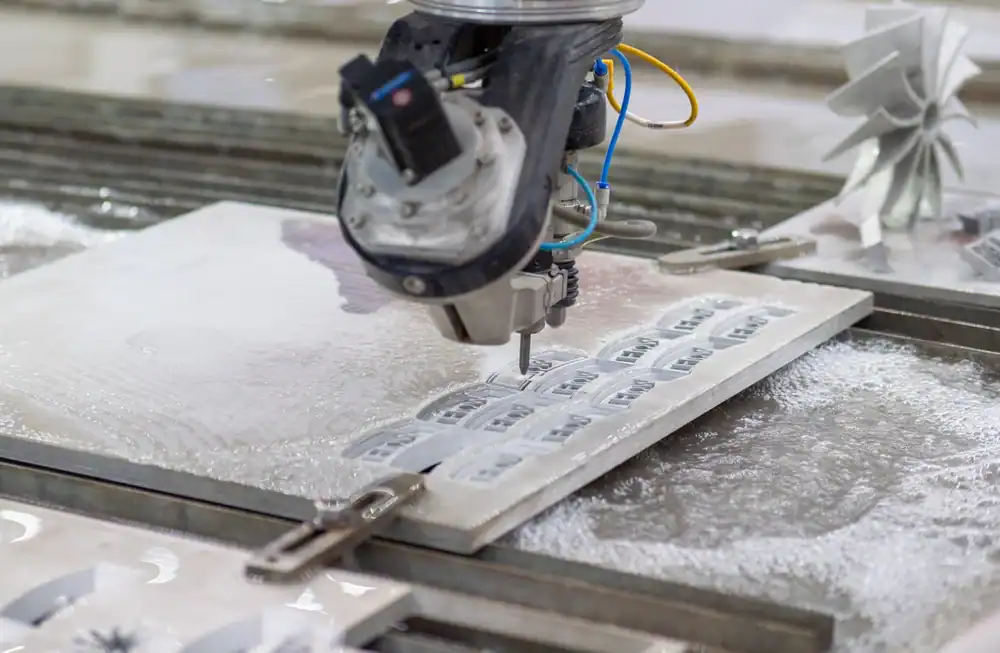
You send us your DXF or DWG file. Our team reviews it for cuttability—checking for tight radiuses, small features, or tolerance conflicts that could cause problems. If we spot something, we tell you before we cut.
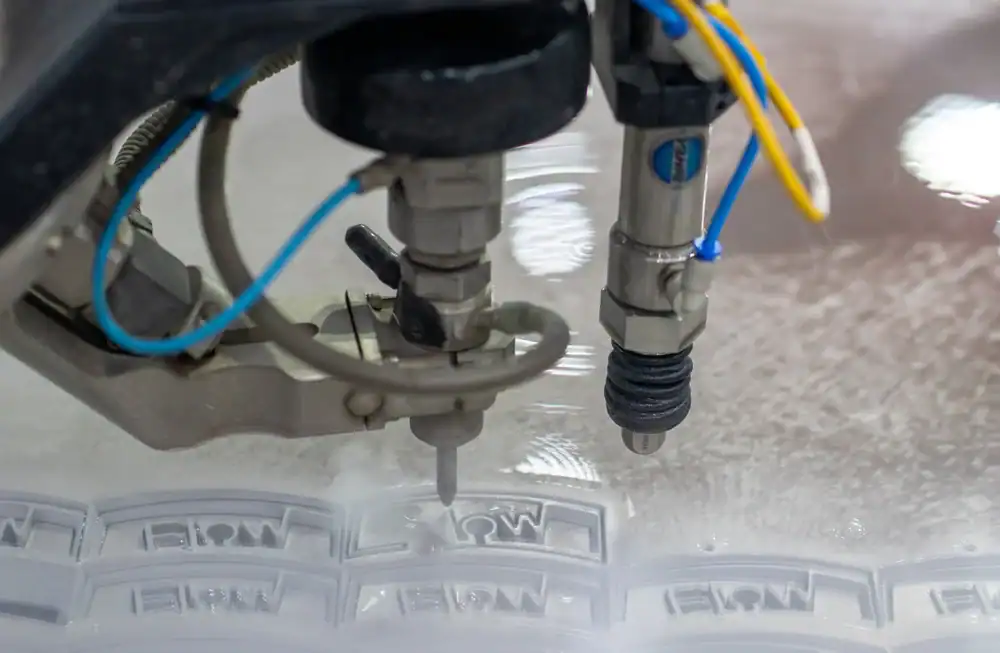
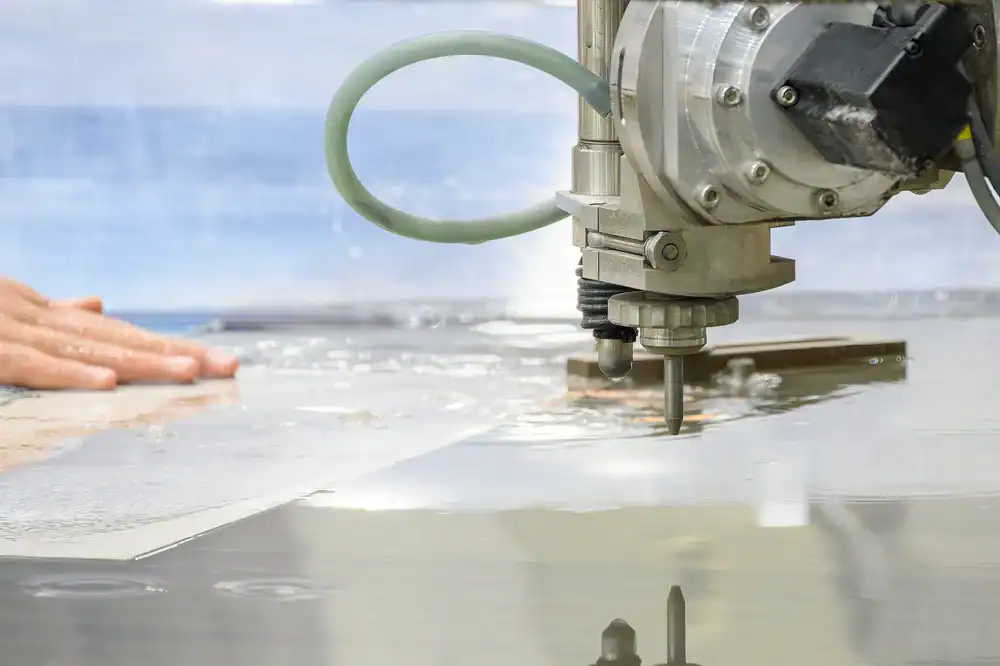
Once the file is approved, we load your material onto our CNC waterjet table. The cutting head follows your programmed path using a stream of water pressurized to 60,000 PSI, mixed with fine garnet abrasive. The stream is about 0.030″ wide, which means tight nesting and minimal waste.
Because there’s no heat, there’s no hardened edge or HAZ to deal with. The material doesn’t warp or change properties. What comes off the table matches what you designed—dimensionally and metallurgically.
You get parts that are ready for assembly or finishing. If you need prototypes, we can turn them fast. If you need production runs, we can repeat the same cut with the same precision hundreds of times.
Ready to get started?
Waterjet handles materials that give other methods trouble. Reflective metals like copper and aluminum. Thick plate up to 6 inches. Composites that delaminate under heat. Stone, glass, rubber, foam—if it’s not water-soluble, we can cut it.
You get tolerances between ±0.003″ and ±0.005″ depending on material thickness and machine calibration. Edge quality is smooth and burr-free, which eliminates grinding and secondary finishing in most applications. That saves you time and labor costs on every part.
Bay Shore’s manufacturing sector includes 449 active job listings, signaling strong demand for precision components. Industries here supply aerospace, automotive, and medical markets where regulatory compliance isn’t optional. Custom waterjet cutting in Bay Shore supports that supply chain with a process that maintains material integrity and meets strict dimensional requirements.
The kerf width stays narrow—around 0.030″ to 0.040″—so you can nest parts tighter and reduce material waste by up to 30%. For high-value materials, that’s not a minor detail. It’s a cost advantage that compounds across every job.
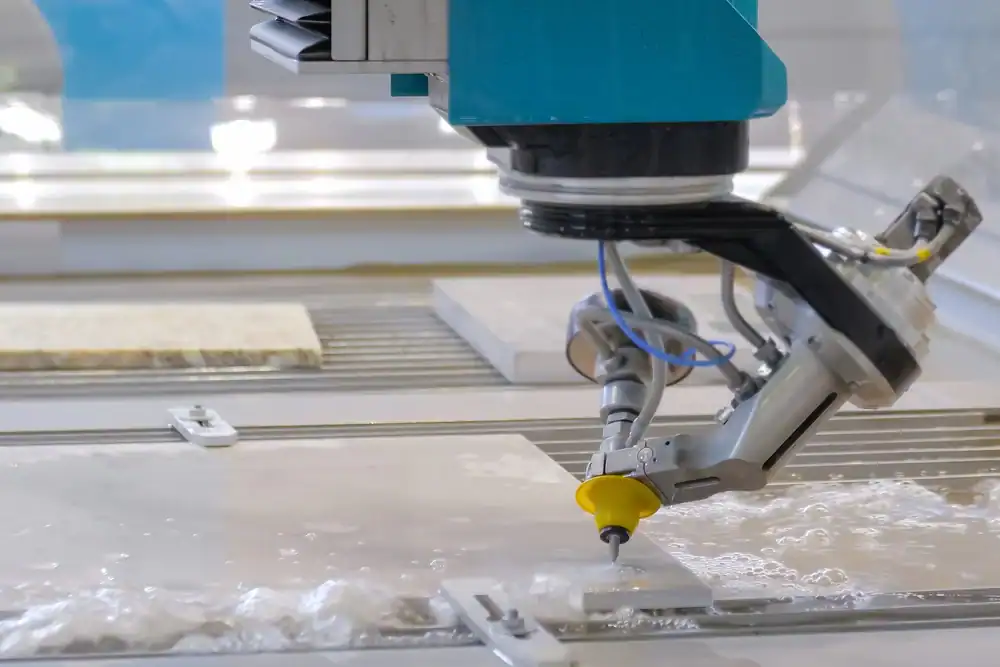
Waterjet cuts materials that cause problems for lasers and plasma. Reflective metals like copper and aluminum don’t deflect the stream the way they reflect laser light. Transparent materials like acrylic and glass cut cleanly without cracking from thermal shock.
Composites are where waterjet really separates itself. Carbon fiber, fiberglass, and layered materials delaminate under heat. Waterjet’s cold cutting process keeps those layers bonded and intact. You also avoid the resin charring and edge damage that thermal methods cause.
Thick materials—up to 6 inches or more depending on tolerance requirements—are no issue. Lasers lose effectiveness as thickness increases. Waterjet maintains cut quality through the entire depth because the stream doesn’t weaken like a focused beam does.
Waterjet doesn’t introduce heat, which is the main cause of dimensional variation in thermal cutting. When lasers or plasma cut metal, they create a heat-affected zone that warps the material as it cools. Even if the cut path is perfect, the part changes shape afterward.
Waterjet eliminates that variable. The cutting stream stays cold, so there’s no thermal expansion or contraction. The material doesn’t move during or after cutting. That means the dimensions you program are the dimensions you get—consistently, across the entire production run.
Modern CNC waterjet systems also compensate for stream lag and taper. As the abrasive stream passes through thick material, it can lag slightly behind the top surface. Advanced machines adjust the cutting path in real time to keep the kerf vertical and the edges square, which is how you achieve ±0.003″ tolerances even on thicker plate.
In most cases, no. The abrasive stream produces a smooth, clean edge that’s free of burrs and sharp edges. Parts come off the table ready for powder coating, anodizing, or assembly without additional grinding or sanding.
Compare that to laser cutting, which leaves a hardened edge with dross buildup that needs grinding. Or plasma, which creates a rough, oxidized edge that requires significant finishing work. Those secondary operations add labor time and cost to every part.
There are exceptions. If you’re cutting very thick material—over 4 inches—or if you need a polished edge for aesthetic reasons, some light finishing might be required. But for the vast majority of industrial and architectural applications, waterjet edges are ready to use as-cut. That’s a real time-saver when you’re running production volumes.
Turnaround depends on material availability, complexity, and our current queue. For prototypes and small custom jobs, we can often cut parts within a few days of file approval. Production runs take longer but we work with your timeline.
The advantage of waterjet is that setup time is minimal compared to other methods. There’s no tooling to fabricate, no dies to build. We load your CAD file, secure your material, and start cutting. If you need design changes between prototype and production, we adjust the file and run it again without retooling costs.
Bay Shore’s industrial activity means fast turnaround matters. When you’re supplying aerospace or medical manufacturers with tight deadlines, waiting two weeks for parts isn’t an option. We built our process around responsiveness because we know how Long Island’s supply chain operates.
DXF and DWG files work best because they maintain vector precision. These CAD formats give us clean, scalable paths that translate directly to cutting instructions. If you’re working in AutoCAD, SolidWorks, or similar programs, exporting to DXF is straightforward.
We can also work with STEP, AI, and EPS files depending on the project. The key is that the file needs to be vector-based, not raster. A JPEG or PNG of your part doesn’t give us the dimensional data we need to cut accurately.
Before we cut anything, our team reviews your file for potential issues. We check for features that are too small for the kerf width, radiuses that are too tight, or tolerance callouts that conflict with material thickness. If something won’t cut the way you designed it, we’ll tell you and suggest adjustments. That review process catches expensive mistakes before they happen.
Yes, because there’s no expensive tooling or setup cost. With stamping or laser cutting, you often need custom dies or fixtures that only make sense at high volumes. Waterjet runs straight from your CAD file, so the cost per part stays relatively consistent whether you’re cutting 10 pieces or 1,000.
Material waste is also lower. The narrow kerf lets you nest parts tighter, and you can often share cut lines between adjacent parts. For expensive materials like titanium, stainless, or composites, that waste reduction adds up quickly.
The real cost advantage shows up when you factor in secondary operations. If you’re not spending labor hours deburring, grinding, or fixing heat distortion, your total cost per part drops significantly. For Bay Shore manufacturers supplying precision industries, that efficiency matters more than the cutting cost itself.
Useful Links
Other Services we provide in Bay Shore