Hear from Our Customers
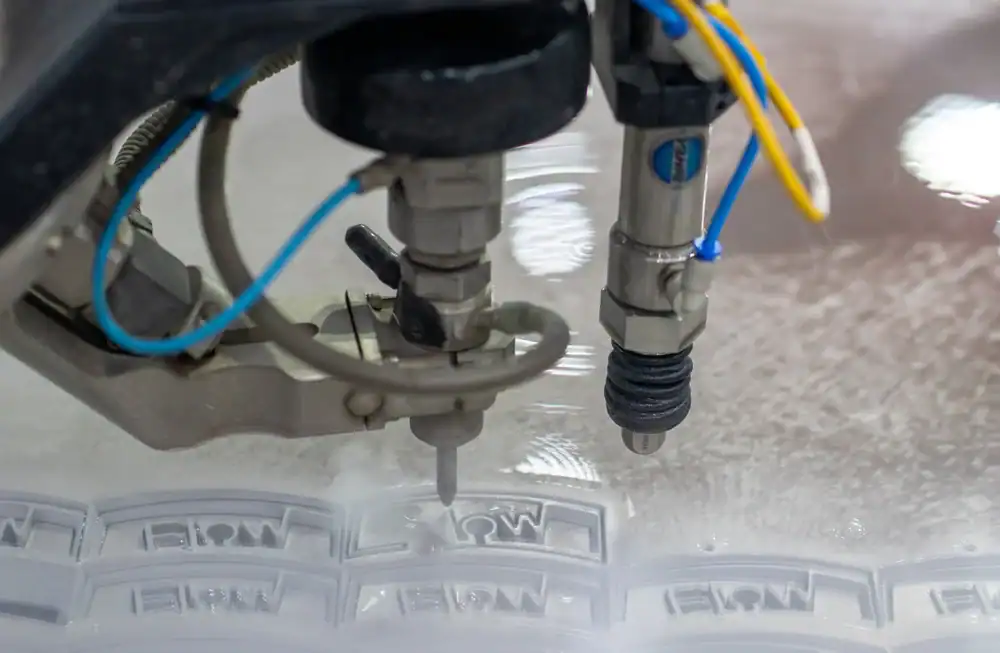
You’re looking at edges that come off the machine ready to use. No burrs to grind down. No heat-affected zones that compromise your material. No secondary operations eating into your timeline.
Waterjet cutting services in Bethpage give you accuracy within +/- 0.003 inches. That’s the kind of tolerance aerospace manufacturers require, and it’s what you get on every cut we make.
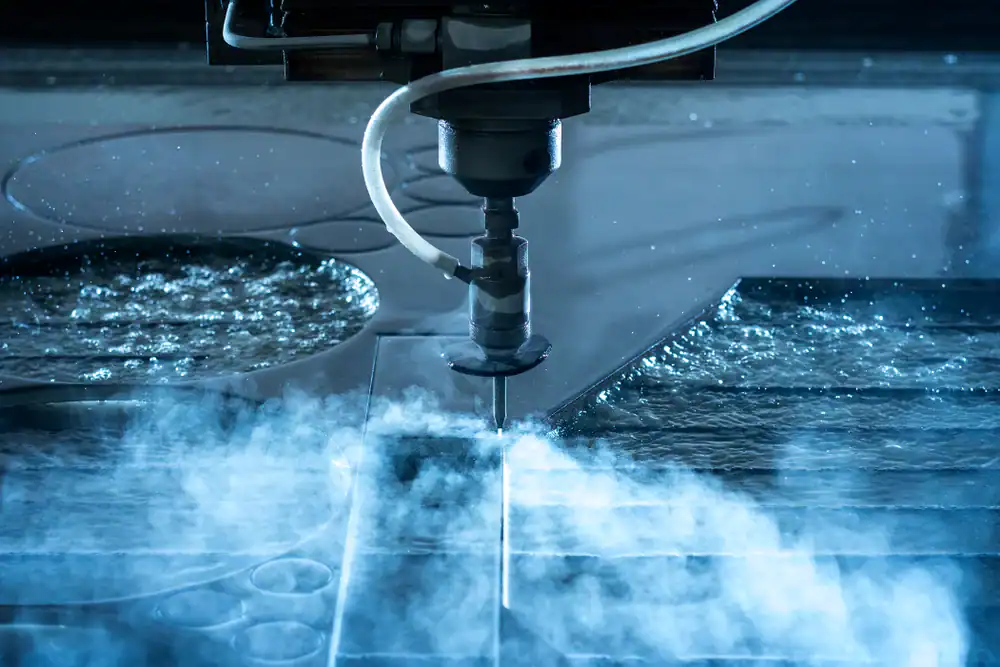
The process uses high pressure water cutting—up to 60,000 PSI—mixed with garnet abrasive when needed. It cuts steel, aluminum, titanium, glass, stone, rubber, foam, and composites without changing their properties. Cold cutting means your material stays exactly as engineered, with no thermal distortion affecting performance or fit.
You skip the deburring station. You skip the secondary machining. The part comes off our table ready for assembly or installation, which means you’re not paying twice for the same edge.
We serve manufacturers, fabricators, and contractors throughout Bethpage and Nassau County who need precision cuts without the limitations of traditional methods. We work with the automotive shops building custom truck components, the aerospace suppliers who can’t tolerate heat zones, and the architectural firms specifying intricate stone or metal designs.
Bethpage has a strong manufacturing presence—companies like Peerless Electronics and established fabricators who’ve been here since the early 1900s. That industrial backbone means you understand what precision actually costs when you get it wrong.
We handle custom waterjet cutting for production runs and one-off prototypes. You send us your file or sketch, we program the cut, and you get parts that fit without adjustment.
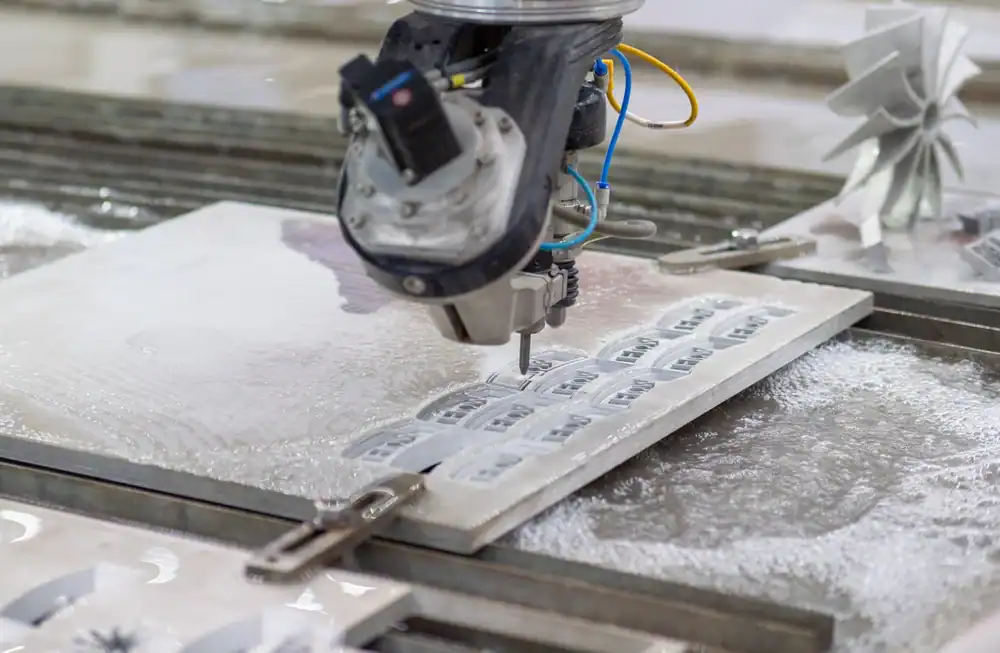
You provide your design file—DXF, DWG, or even a PDF we can work from. We program the cutting path into our CNC system, accounting for material thickness and the kerf width of the waterjet stream.
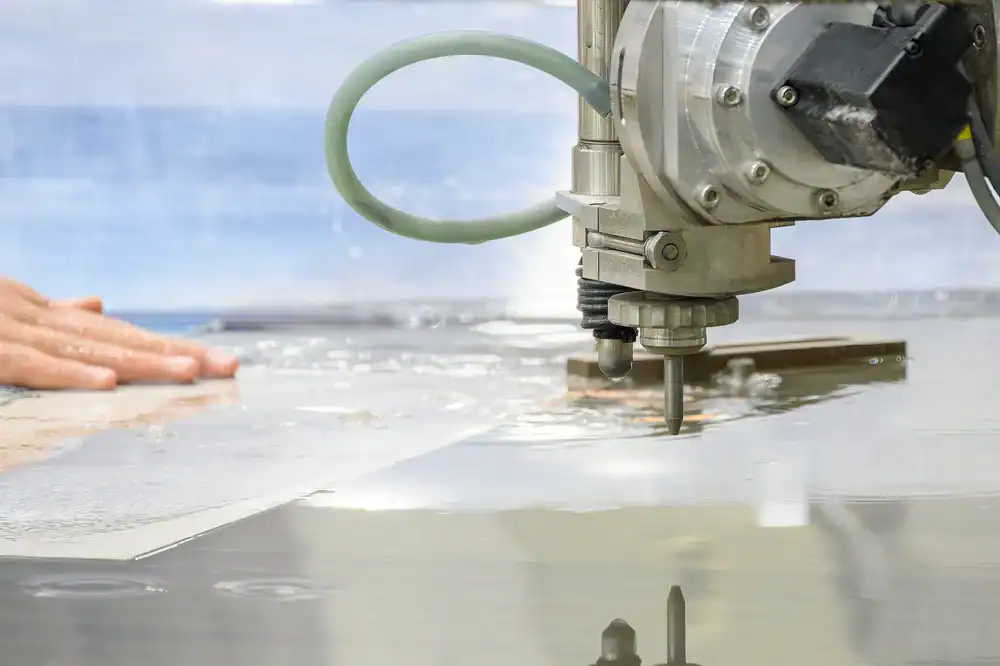
The nozzle directs a focused stream of water at pressures up to 60,000 PSI. For softer materials like foam, rubber, or gaskets, pure water does the job. For metals, glass, stone, and composites, we add garnet abrasive to the stream. This abrasive waterjet cutting process accelerates the garnet particles to speeds that erode through the hardest materials without generating heat.
Because there’s no heat-affected zone, you don’t get the warping, hardening, or discoloration that comes with plasma, laser, or torch cutting. The material’s structural integrity and chemical properties stay intact. Medical device manufacturers rely on this when they can’t risk altering material specs.
The system can handle complex geometries, tight inside corners, and intricate patterns that would require multiple setups with conventional machining. Stack cutting lets us process multiple sheets at once when you need matching parts. You get consistent results across the entire run because the machine follows the same programmed path every time.
Ready to get started?
You’re working in a market where Kravet has been manufacturing home furnishings since 1918, and precision isn’t negotiable. Waterjet cutting in Bethpage serves industries that need exact specs—automotive fabricators building bed liners and bumpers, electronics manufacturers cutting circuit boards, and contractors installing custom architectural elements.
The process cuts materials up to six inches thick in a single pass. Thicker materials just take more time, not different equipment. You can cut stainless steel, Inconel, and titanium without tool wear because there’s no physical contact between the cutting head and your material.
Environmental compliance matters here. Abrasive waterjet cutting produces no hazardous fumes, no dust clouds, and no chemical waste. The garnet abrasive is inert and recyclable. Water gets filtered and recirculated. You’re not dealing with ventilation requirements or disposal costs that come with thermal cutting methods.
Speed depends on material and thickness, but abrasive waterjet cutting runs up to four times faster than pure waterjet while still delivering finished edges. You’re looking at production-level throughput without sacrificing the accuracy that keeps parts interchangeable across your entire run.
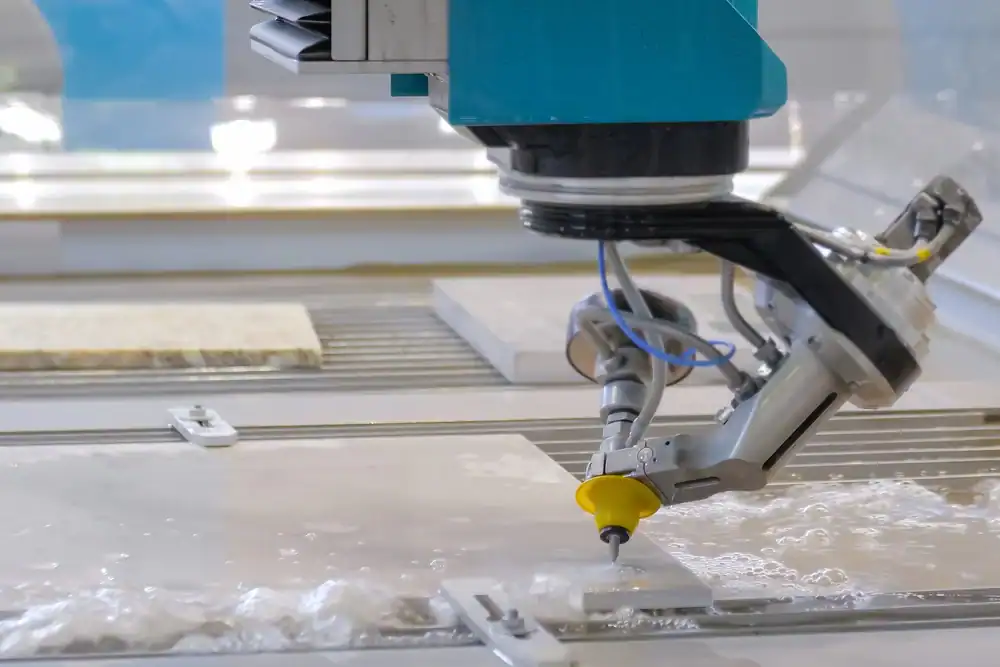
Waterjet cuts materials that would crack, melt, or delaminate under heat-based cutting. Tempered glass stays intact because there’s no thermal shock. Laminated composites don’t separate at the bond line. Rubber and foam cut cleanly without compression or tearing.
You can cut reflective materials like copper and brass that deflect laser beams. Thick acrylic cuts without the edge melting and yellowing you get from laser or router cutting. Stone, tile, and quartz cut without chipping because the abrasive stream erodes rather than fractures the material.
The process handles material combinations in a single setup. If you’re cutting a part that’s steel bonded to rubber, or aluminum with foam backing, waterjet goes through both layers without delaminating the bond. That’s something you can’t do with saws, lasers, or plasma without multiple operations and fixtures.
Waterjet delivers tolerances down to +/- 0.003 inches, which matches or exceeds what you get from laser cutting on thin materials. The difference shows up when you’re cutting thicker stock or materials that react to heat.
Laser cutting loses accuracy as material thickness increases because the beam diverges through the cut depth. You get taper and dross on the bottom edge that requires secondary cleanup. Plasma cutting runs even wider tolerances and leaves a heat-affected zone that hardens the edge, making it difficult to drill or tap without breaking bits.
Waterjet maintains the same kerf width and edge quality through the entire thickness of the material. The stream doesn’t widen or lose energy as it cuts deeper. You get perpendicular edges without taper, which means parts fit together exactly as designed without shimming or adjusting during assembly.
The CNC control on modern waterjet systems compensates for stream lag and acceleration, so you get sharp corners and accurate radii even on intricate cuts. That level of control matters when you’re cutting parts that mate with other components and can’t be off by even a few thousandths.
The exit edge comes off clean. You’re not grinding, filing, or deburring like you would after plasma, laser, or mechanical cutting. The abrasive stream erodes the material uniformly, so you don’t get the torn or rolled edges that happen when a cutting tool exits the workpiece.
Surface finish depends on cutting speed and abrasive flow rate. Slower cuts with higher abrasive concentration produce smoother edges that measure under 125 Ra—smooth enough for sealing surfaces or parts that slide against each other. Faster production cuts still deliver edges that are cleaner than sawing or shearing, typically around 250 Ra.
There’s no hardened layer to machine away. Laser and plasma cutting change the material structure at the cut edge, creating a hardened zone that dulls tools and causes problems if you need to drill, tap, or weld near the edge. Waterjet leaves the material in its original condition, so secondary operations go exactly as they would on uncut stock.
You save the labor cost of finishing and the time delay of moving parts to a secondary operation. Parts go straight from the waterjet table to assembly or coating, which tightens your production schedule and eliminates handling damage.
Pure waterjet uses only pressurized water and works for soft materials—foam, rubber, gaskets, food products, and thin plastics. The stream cuts by exceeding the material’s shear strength without needing abrasive particles. It’s faster for these materials and leaves an exceptionally clean edge.
Abrasive waterjet adds garnet particles to the water stream. The garnet accelerates to supersonic speeds and erodes through hard materials like metal, glass, stone, and composites. This is what you need for steel, aluminum, titanium, ceramics, and anything with significant hardness or thickness.
The abrasive system uses a mixing tube where garnet gets drawn into the water stream by venturi effect. The mixture exits through a focusing nozzle that keeps the stream coherent over the cutting distance. You’re looking at cutting forces that erode through virtually any material without generating enough heat to affect properties.
Switching between pure and abrasive cutting is straightforward—it’s a matter of turning the abrasive feed on or off. That flexibility means you can cut gasket material and the metal flange it mounts to in the same setup without changing equipment or processes.
Standard waterjet systems cut up to six inches thick in most materials. Specialized setups can go thicker, but six inches covers the vast majority of industrial and architectural applications. Steel plate, aluminum billet, stone slabs, and stacked materials all fall within that range.
Thickness affects cutting speed but not edge quality if you adjust parameters correctly. Thicker materials need slower traverse speeds to give the abrasive stream time to erode through the full depth. The edge quality stays consistent because the stream diameter and cutting force remain constant through the entire thickness.
You don’t see the taper or bevel that shows up with laser or plasma cutting on thick materials. The waterjet stream stays parallel through the cut, so the top edge and bottom edge are the same width. That’s critical when you’re cutting parts that need to fit together with tight tolerances or when you’re cutting features like bolt holes that need to be perpendicular.
Stack cutting lets you process multiple sheets at once when you need identical parts. The stream goes through all layers with the same accuracy, and you get matching parts without setting up each sheet individually. That’s a significant time saver on production runs where you need dozens or hundreds of the same component.
Simple cuts on standard materials typically run within a few days from file submission to finished parts. Complex geometries, thick materials, or large quantities take longer, but you’re still looking at faster turnaround than conventional machining for most projects.
Programming time is minimal. Once we have your design file, the CAM software generates the cutting path automatically. We verify the program, load your material onto the cutting table, and start the cut. There’s no tooling to build, no fixtures to machine, and no setup time beyond securing the workpiece.
The actual cutting speed depends on material type and thickness. Thin aluminum might cut at 20 inches per minute. Thick stainless steel might run at 3 inches per minute. We can give you accurate time estimates once we see your design and know your material specs.
Rush jobs are possible because waterjet doesn’t require the lead time that tooling-dependent processes need. If you’ve got a deadline, we can often prioritize your project and get parts out faster than you’d expect. The key is getting us your specifications early so we can confirm material availability and schedule machine time.
Useful Links
Other Services we provide in Bethpage