
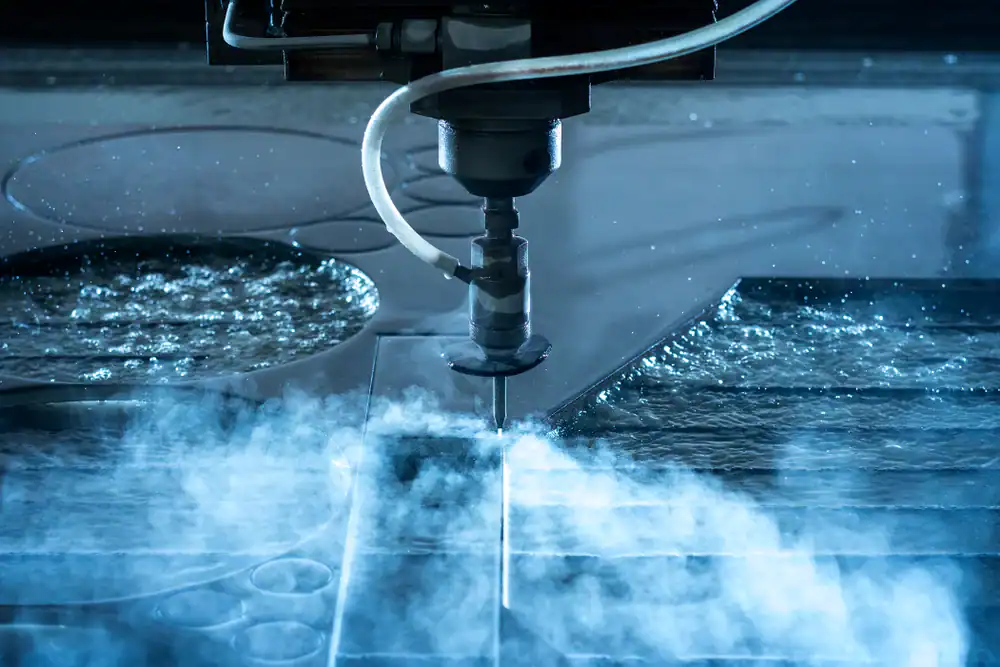
Hear from Our Customers
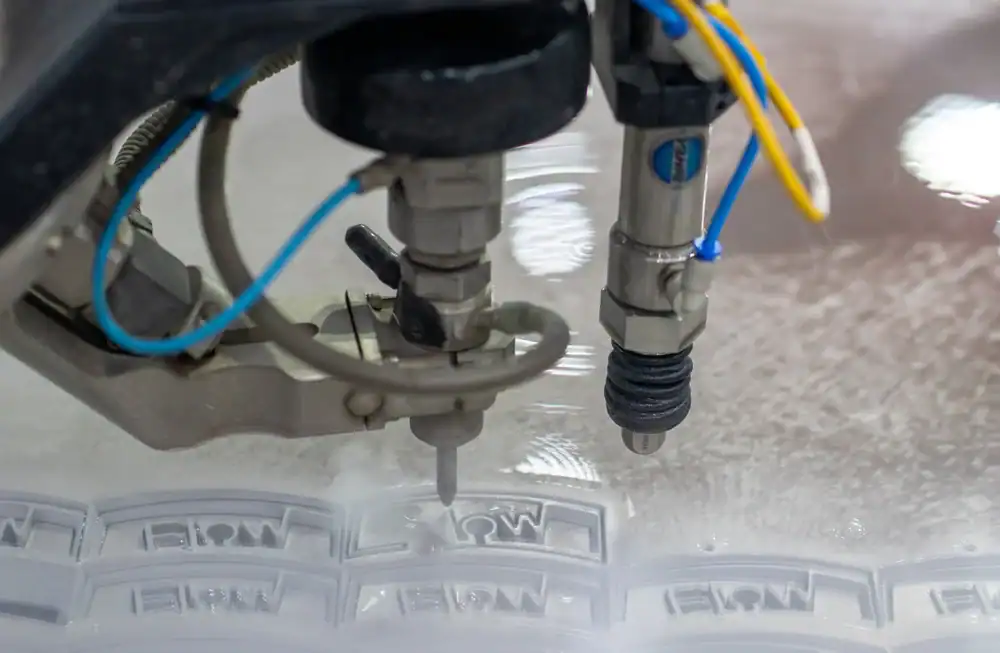
When you send parts out for cutting, you need them back fast and accurate. Not almost right. Not close enough. Right.
Waterjet cutting services in Coram, NY give you that. The Flow Mach 500 reads your CAD file and cuts directly from it—no heat-affected zone, no warping, no secondary grinding to clean up rough edges. What comes off the table is what you specified.
That means your flanges fit. Your tolerances hold. Your welds don’t crack because the material wasn’t compromised by heat. You’re not calling around for someone to fix what another shop messed up.
Whether it’s stainless, Inconel, aluminum, or plastic, the cut is clean. The edge is smooth. And your project keeps moving.
We serve manufacturers, contractors, and fabricators across Coram, NY and Long Island who need precision without the runaround. With over 15,000 contractors in the Coram area alone, the demand for reliable cutting is real—and so is the frustration when suppliers fall short.
We run a Flow Mach 500, CNC-controlled and built for accuracy. It’s not the cheapest equipment, and we’re not the cheapest option. But if you’ve dealt with plasma burns, inconsistent tolerances, or shops that can’t handle your material, you already know what cheap costs you.
We work with architects who need intricate designs, machine shops that outsource complex cuts, and manufacturers who can’t afford downtime. If you’re in Coram, NY and need high pressure water cutting that doesn’t add problems to your process, that’s what we do.
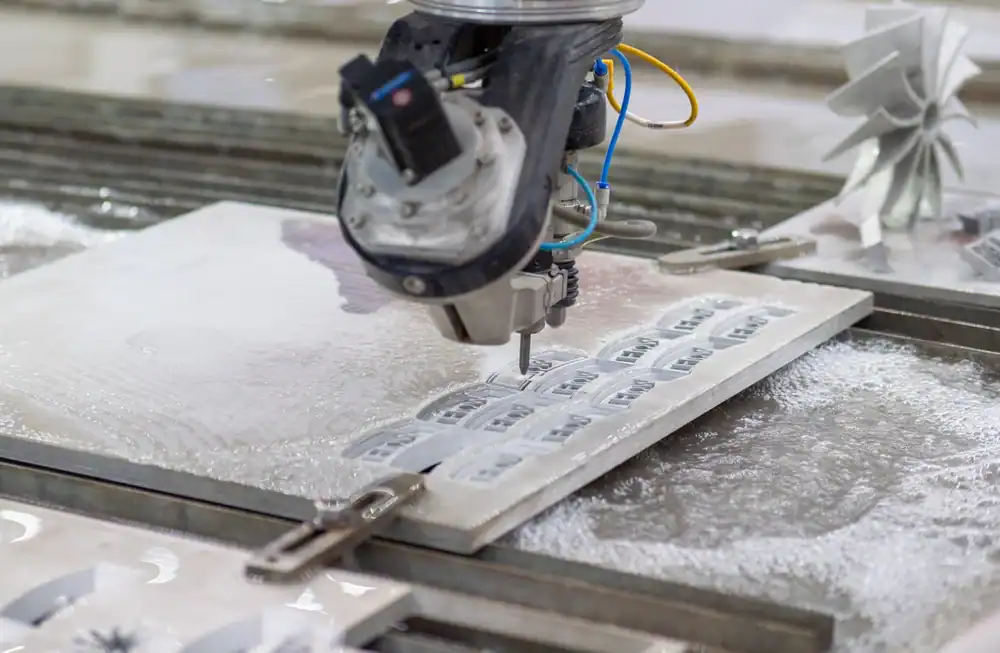
Start by sending your CAD file. DXF, DWG, whatever format you work in. We load it directly into the CNC system—no redrawing, no interpretation errors.
The Flow Mach 500 uses abrasive waterjet cutting in Coram, NY to cut your material. A high-pressure stream mixed with garnet abrasive slices through metal, plastic, composites—whatever you’re working with. No torch. No blade. No heat.
Because there’s no heat-affected zone, the material doesn’t warp or harden at the edge. That’s why your parts fit together correctly and why you don’t need to grind, drill, or rework them after. The edge quality is clean enough for most applications as-is.
Tolerances? We hold +/- 0.005″ consistently. If you need one prototype or a hundred production parts, the process is the same. Load the file, set the material, run the cut. What you designed is what you get.
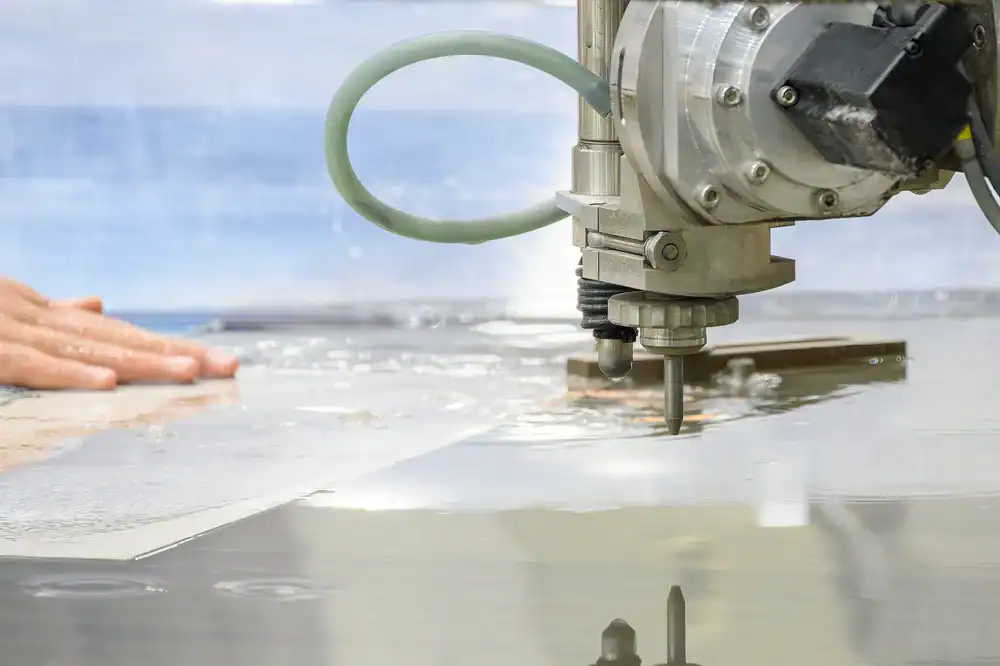
Ready to get started?
Custom waterjet cutting in Coram, NY isn’t just about the equipment—it’s about what that equipment lets you do. You get multi-material capability: stainless, steel, copper, brass, bronze, Hastelloy, Inconel, aluminum, and plastics all cut on the same machine.
You get speed. Abrasive waterjet cutting is up to four times faster than conventional methods, and because the edge comes out finished, you skip secondary operations. No deburring. No grinding. No extra labor eating into your timeline.
You get design freedom. Intricate shapes, tight inside corners, artistic patterns—if you can draw it, we can cut it. The CNC control handles complexity that would be impossible or prohibitively expensive with traditional machining. That’s why aerospace and automotive manufacturers rely on this process for carbon-fiber composites and hard-to-machine alloys.
And you get consistency. One part or one thousand, the tolerances don’t drift. The quality doesn’t drop. Your production stays predictable, and your customers stay happy.
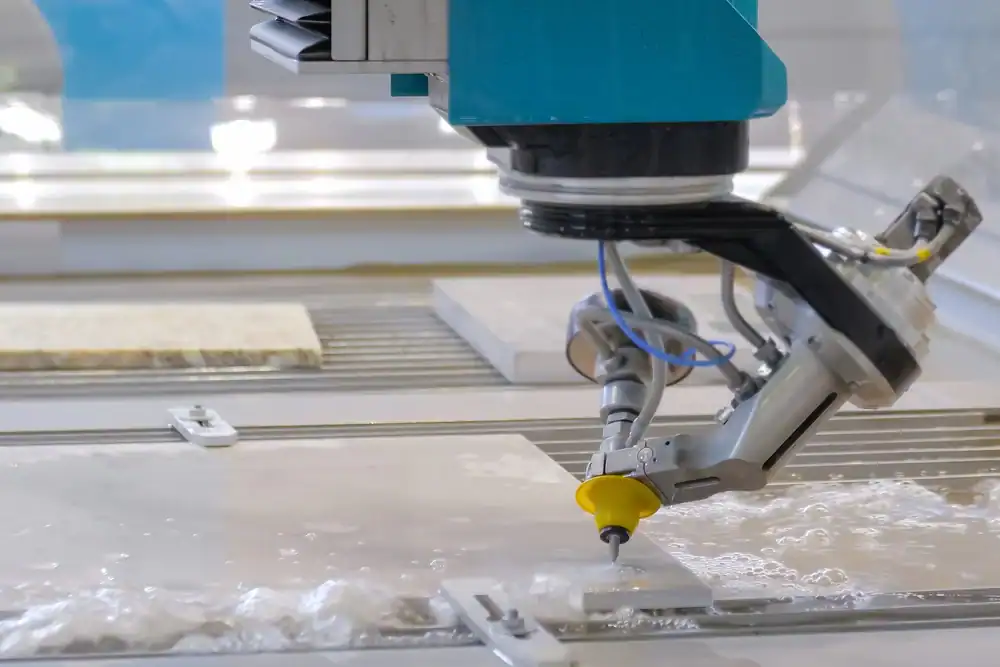
We cut metals, plastics, and composites—basically anything that doesn’t absorb water. That includes stainless steel, aluminum, copper, brass, bronze, Hastelloy, Inconel, titanium, tool steel, and various plastics.
The abrasive waterjet process works across all these materials because it’s a mechanical cutting method, not a thermal one. There’s no melting, no burning, no chemical reaction. Just high-pressure water mixed with garnet abrasive that erodes the material along your cut line.
Thickness matters more than material type. We can cut up to several inches thick depending on the material. Thicker cuts take longer, but the quality stays consistent. If you’re not sure whether your material will work, send us the specs and we’ll tell you straight.
Waterjet holds tolerances around +/- 0.005″ consistently, which puts it in the same range as laser for most applications. The difference is that waterjet doesn’t create a heat-affected zone.
Laser and plasma both use heat to cut, which changes the material properties at the edge. You get hardening, micro-cracks, and sometimes warping—especially in thinner materials. That’s why welders hate plasma-cut flanges. The heat-affected zone causes problems when you try to weld.
Waterjet cutting services in Coram, NY avoid that entirely. The edge comes out at the same hardness and structure as the rest of the material. No stress. No distortion. For parts that need to be welded, formed, or machined after cutting, that matters. You’re not fighting the material to make it work.
Turnaround depends on complexity, material, and thickness—but most jobs are done within a few days. Simple cuts in thinner material can often be completed in 24-48 hours.
The CNC control speeds things up because we’re not manually setting up each cut. Your CAD file loads directly into the system, the machine calculates the tool path, and the cutting starts. No programming lag. No setup errors.
Thicker materials and intricate designs take longer because the waterjet moves slower to maintain edge quality. But even complex jobs are usually faster than traditional machining, and you’re skipping secondary operations like deburring or grinding. When you factor in the total time from raw material to finished part, waterjet is often the fastest option.
If you’re on a tight deadline, let us know upfront. We’ll tell you what’s realistic and whether we can prioritize your job.
A CAD file makes the process faster and more accurate, but it’s not required. If you have a DXF, DWG, or similar file, that’s ideal—we load it straight into the CNC system and start cutting.
If you don’t have a CAD file, we can work from a detailed drawing or sketch. We’ll convert it into a digital file that the machine can read. There’s usually a small setup charge for that, and it adds a bit of time to the process, but it’s not a dealbreaker.
For repeat jobs or production runs, it’s worth getting a CAD file created once. After that, reorders are quick because the file is already in the system. We can store your files and pull them up whenever you need more parts.
If you’re not sure what format works best, just send what you have. We’ll let you know if we need anything else.
Waterjet makes sense when you need clean edges, tight tolerances, or you’re working with materials that don’t respond well to heat. It’s also the right call when your design has intricate shapes or inside corners that would be difficult to machine.
High pressure water cutting in Coram, NY costs about $14 per hour to run, which is competitive with other methods. But the real savings come from eliminating secondary operations. No grinding. No deburring. No rework because the part warped or the edge cracked.
If you’re cutting materials like Inconel, Hastelloy, or composites, waterjet is often the only practical option. These materials are expensive and hard to machine—you can’t afford to scrap parts because a torch burned through or a blade dulled halfway through the cut.
For prototyping, waterjet is fast and flexible. You can test a design, make changes, and recut without retooling. For production, it’s consistent and repeatable. The first part and the thousandth part come out the same.
Yes. The process is the same whether you need one part or a thousand. The CNC system runs from your CAD file, so there’s no difference in setup or accuracy between a prototype and a production run.
For prototypes, that’s a big advantage. You’re not paying for custom tooling or minimum order quantities. Cut one part, test it, make changes, and cut another. The cost per part is higher than high-volume manufacturing, but the speed and flexibility often make it worth it.
For production runs, waterjet cutting in Coram, NY stays consistent. The tolerances don’t drift. The edge quality doesn’t degrade. You’re not dealing with tool wear or heat buildup that affects quality over time. Each part matches the CAD file, and each part matches the one before it.
If your production volume is high enough that stamping or laser makes more sense, we’ll tell you. But for low to mid-volume runs, or for parts with complex geometry, waterjet is usually the most cost-effective and reliable option.
Useful Links
Other Services we provide in Coram