Hear from Our Customers
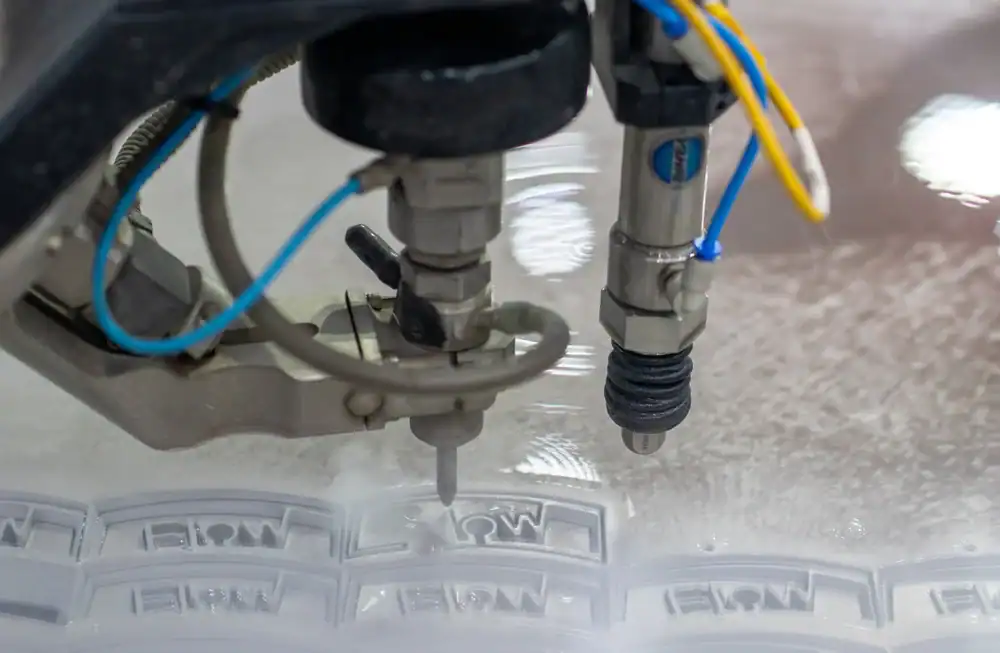
You’re not looking for someone to just cut material. You need parts that meet spec without the rework, without the heat-affected zones that create microscopic cracks, and without the waste that eats into your budget.
High pressure water cutting in Massapequa Park, NY gives you that. Tolerances hold at ±0.001″ consistently. Your edges come out smooth and burr-free, which means no secondary finishing in most cases. That’s time back in your schedule and cost out of your operation.
The process works on virtually any material—metals, composites, stone, glass, rubber. No tool changes. No thermal distortion. Just clean cuts that match your CAD file, whether you’re running one prototype or a full production batch.
We operate out of West Islip, serving the Massapequa Park area and the broader Long Island manufacturing community. This region has deep roots in aerospace and defense—companies here don’t accept sloppy work or missed tolerances.
We’ve built our reputation on understanding what that means for your operation. When you’re supplying parts for aerospace components, automotive assemblies, or architectural installations, precision isn’t negotiable. Neither is turnaround time.
You get CNC-controlled abrasive waterjet cutting in Massapequa Park, NY that’s designed for repeatability. Same part, same dimensions, every single time.
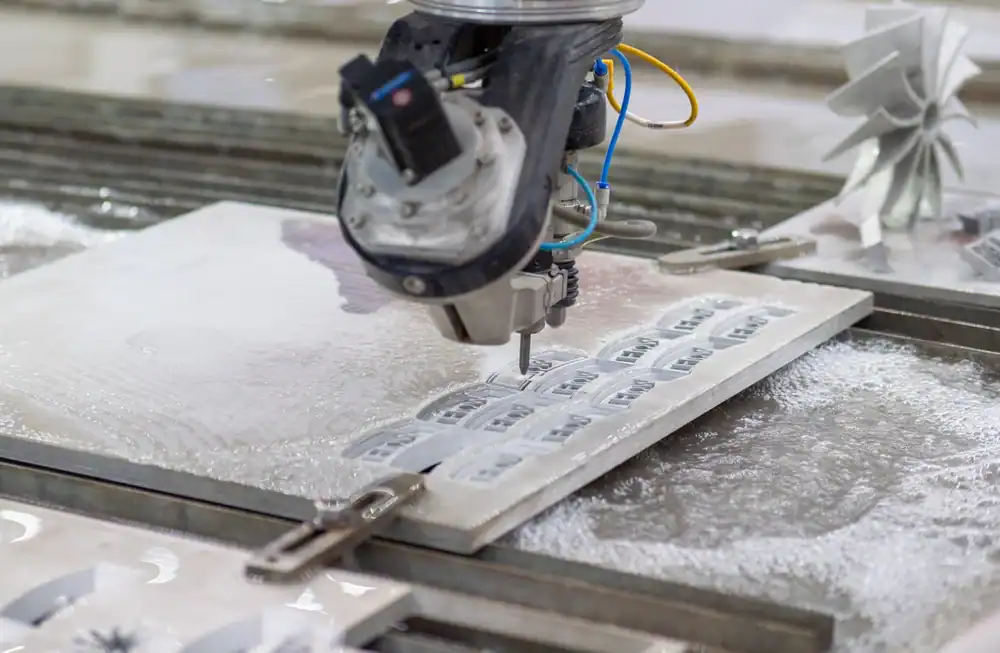
You send us your design file or specifications. We review it for manufacturability and flag anything that might cause issues before we start cutting. That conversation happens upfront, not after you’ve already paid for scrap.
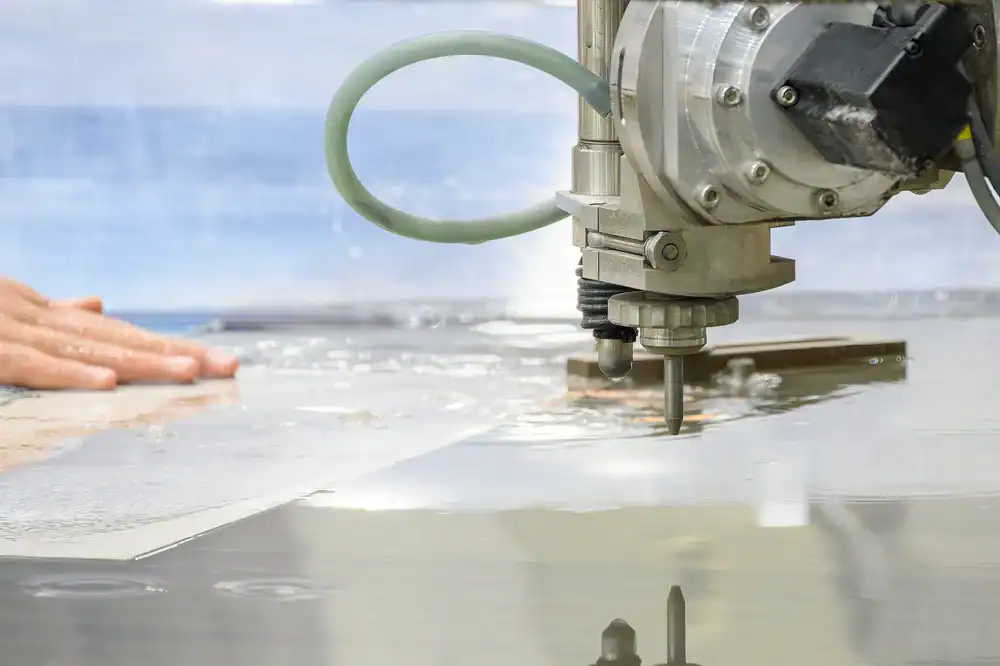
Once we’re aligned, we program the CNC system. The waterjet stream—pressurized up to 60,000 PSI and mixed with garnet abrasive—cuts your material with a kerf width thinner than most blades. There’s no heat transfer, so your material properties stay intact.
We run in-process checks using precision measuring tools to verify tolerances as we go. If it’s a complex geometry or tight corner, our system adjusts dynamically to maintain accuracy. When the job’s done, you get parts that are ready to install or assemble—no deburring, no grinding, no extra steps unless your application specifically requires it.
Ready to get started?
Custom waterjet cutting in Massapequa Park, NY means you’re not limited by material type or thickness. We cut stainless steel, aluminum, titanium, Inconel, composites, stone, glass, and rubber—all without changing tooling or worrying about heat damage.
You get parts with edge quality that often eliminates secondary operations. That’s a real cost savings when you’re running production volumes. It also means faster turnaround, because you’re not waiting on additional processes to finish what the cut should have handled in the first place.
Long Island’s manufacturing sector—especially aerospace and defense—relies on precision that holds up under inspection. Waterjet cutting delivers that because there’s no mechanical force deforming the material and no thermal stress creating weak points. You’re left with dimensionally accurate parts that meet your engineering requirements without compromise.
The process is also environmentally cleaner than alternatives. No hazardous fumes, no toxic chemicals. The water recycles, and the garnet abrasive is inert. If you’re working within environmental compliance standards, that matters.
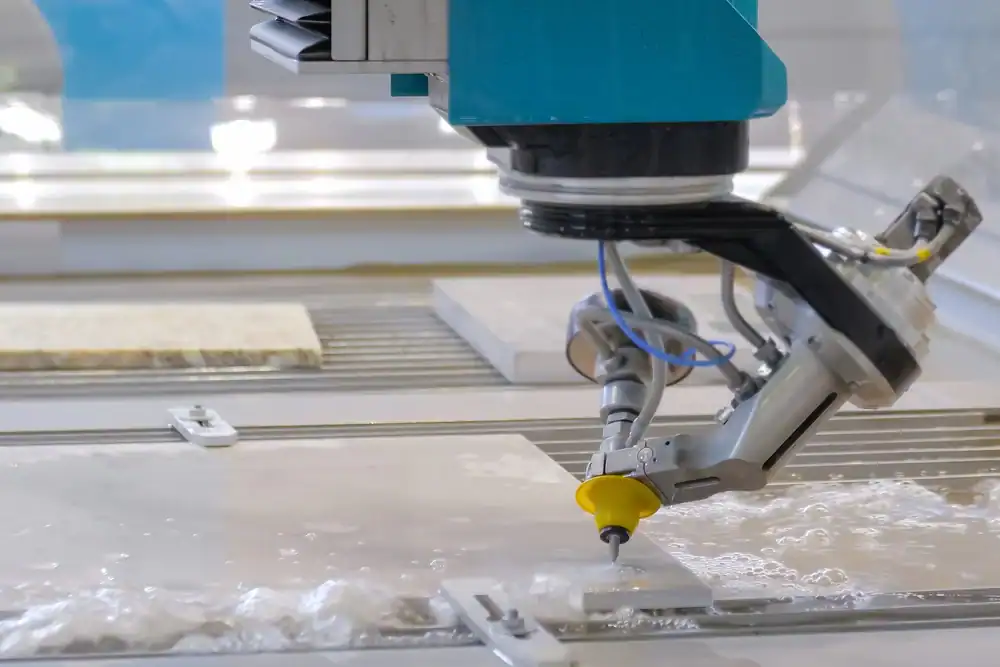
Once the initial pierce is complete and the cutting stream is stable, you’re looking at tolerances of ±0.001″ with consistency across the run. That’s not a best-case scenario—that’s repeatable performance on standard jobs.
The key is in the CNC control and the cutting stream dynamics. Modern systems adjust for variables like material density and thickness in real time. If you’re cutting tight corner geometries or intricate patterns, technologies like Dynamic Waterjet keep the stream focused and accurate even as direction changes.
This level of precision matters when you’re manufacturing aerospace components, automotive parts, or any application where dimensional accuracy affects assembly or performance. You’re not getting parts that “mostly” fit. You’re getting parts that meet spec, and that holds true whether it’s the first piece or the five hundredth.
Waterjet cutting is a cold process. There’s no heat transfer into your material because the cutting mechanism is purely mechanical—high-pressure water mixed with abrasive garnet eroding through the workpiece.
Laser cutting, by contrast, melts material as it cuts. That introduces a heat-affected zone where the material’s properties change. You can end up with microscopic cracks, warping, or hardness variations that compromise structural integrity. For critical applications, that’s a dealbreaker.
With waterjet, your material comes off the table in the same condition it went on—just shaped to your specifications. No thermal stress, no metallurgical changes, no hardened edges that make secondary machining difficult. If you’re working with metals that are sensitive to heat or composites that delaminate under thermal load, waterjet is often the only viable option.
Yes, because there’s no hard tooling involved. You’re not building dies or fixtures that only make sense at high volumes. The CNC program is your “tool,” and changing from one part to another is just a matter of loading a different file.
That makes prototyping cost-effective. You can run a single piece to test fit and function, make revisions to the design, and run another without eating into your budget with setup costs. Once the design is locked in, the same program scales to whatever production volume you need.
The other advantage is material flexibility. If your prototype is in aluminum but your production run switches to stainless steel or a composite, the waterjet handles both without retooling. You’re not locked into a process that only works for one material or one quantity. That flexibility matters when timelines are tight and design changes happen.
Waterjet cuts virtually anything, but there are a few exceptions. Tempered glass shatters under the pressure. Certain ceramics can crack. Very soft materials like foam or rubber below a certain durometer might compress rather than cut cleanly, though that’s more about thickness and application than an outright limitation.
For everything else—metals, composites, stone, hardened tool steel, titanium, Inconel—waterjet works. That matters because you’re not stuck choosing a cutting method based on what it can’t do. You can bring us a multi-material assembly and we’ll cut all the components without switching equipment.
It also means you’re not compromising on material selection for your project. If the engineering calls for a high-strength alloy or a composite layup, you don’t have to redesign around the limitations of the cutting process. Waterjet adapts to your material, not the other way around.
The kerf width—the amount of material removed by the cutting stream—is extremely narrow, typically around 0.03″ to 0.04″. Compare that to plasma or mechanical cutting, where the kerf can be two to three times wider. Over the course of a full sheet or a production run, that difference adds up.
Narrower kerf means tighter nesting of parts on your material sheet. You fit more parts per sheet, which directly reduces your material cost per piece. If you’re running high volumes or working with expensive alloys, that’s a measurable impact on your bottom line.
There’s also less scrap from mistakes. Because waterjet is CNC-controlled and doesn’t introduce heat or mechanical stress, parts come out right the first time more consistently. You’re not scrapping pieces due to warping, burn marks, or dimensional errors that happen when the process itself distorts the material. Fewer rejected parts means less wasted material and less wasted time.
Edge quality determines whether your part is ready to use or needs additional finishing. A rough, burred, or inconsistent edge means you’re adding deburring, grinding, or machining steps before the part can be assembled or installed. That’s extra labor, extra time, and extra cost.
Waterjet produces smooth, burr-free edges in most applications. The finish quality depends on factors like cutting speed and abrasive flow rate, but even at higher speeds, you’re getting an edge that’s clean enough for many assemblies without further work. If your application requires a specific surface finish, we adjust parameters to hit that target during the cut.
This is especially important in industries like aerospace or medical device manufacturing, where edge condition affects both performance and inspection results. A clean edge isn’t just cosmetic—it’s functional. It reduces stress concentrations, improves fit during assembly, and meets the quality standards your customers or regulators expect.
Useful Links
Other Services we provide in Massapequa Park