Hear from Our Customers
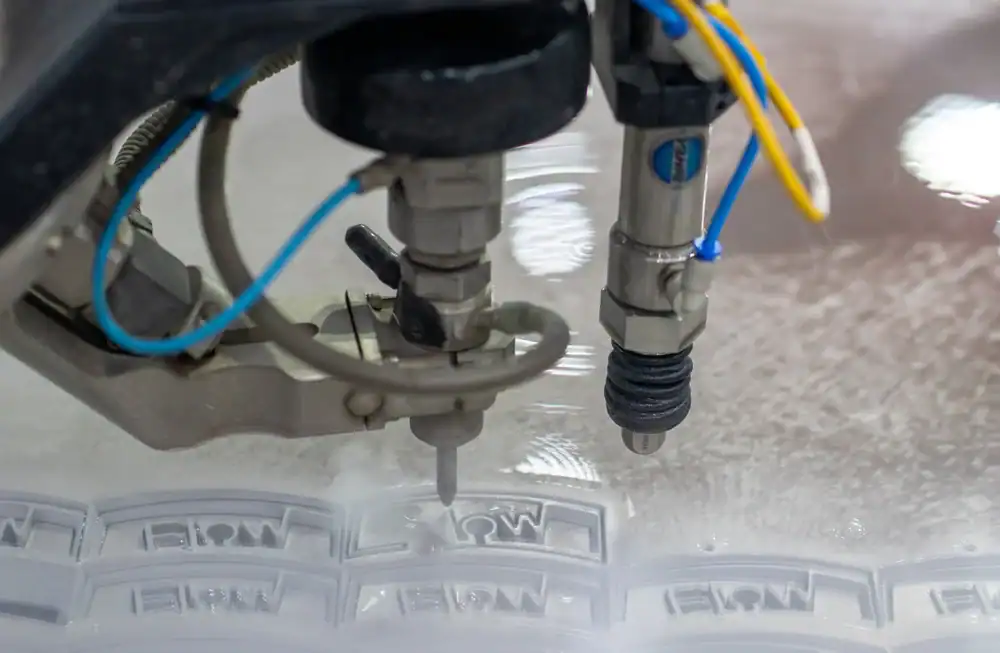
When you’re working with materials that don’t tolerate mistakes, heat is your enemy. Traditional cutting methods melt softer materials and change the physical properties of harder ones, leaving you with warped parts, discolored edges, and expensive rework.
High pressure water cutting eliminates that problem entirely. The process stays cold from start to finish, so your aluminum doesn’t warp, your titanium doesn’t harden, and your composites don’t delaminate. You get smooth, burr-free edges that don’t need grinding, sanding, or any other secondary operation.
That means faster turnaround and lower total costs. Your parts move straight from cutting to assembly or installation. No waiting on finishing work. No surprises when you try to fit components together. Just accurate cuts that match your specs every time.
We’ve been handling precision cutting projects for North New Hyde Park businesses and the broader New York manufacturing sector for over two decades. That includes work for aerospace suppliers, architectural metal fabricators, marine component manufacturers, and custom design shops throughout the region.
Our facility serves the dense industrial corridor between Long Island and New York City, where turnaround times matter and tolerances are tight. You’re not dealing with a shop that’s still learning the equipment—we’ve cut everything from 1/8″ brass to 6″ steel plate, often on the same day.
North New Hyde Park sits in the middle of one of the country’s most demanding manufacturing markets. We understand that context and can keep pace with it.
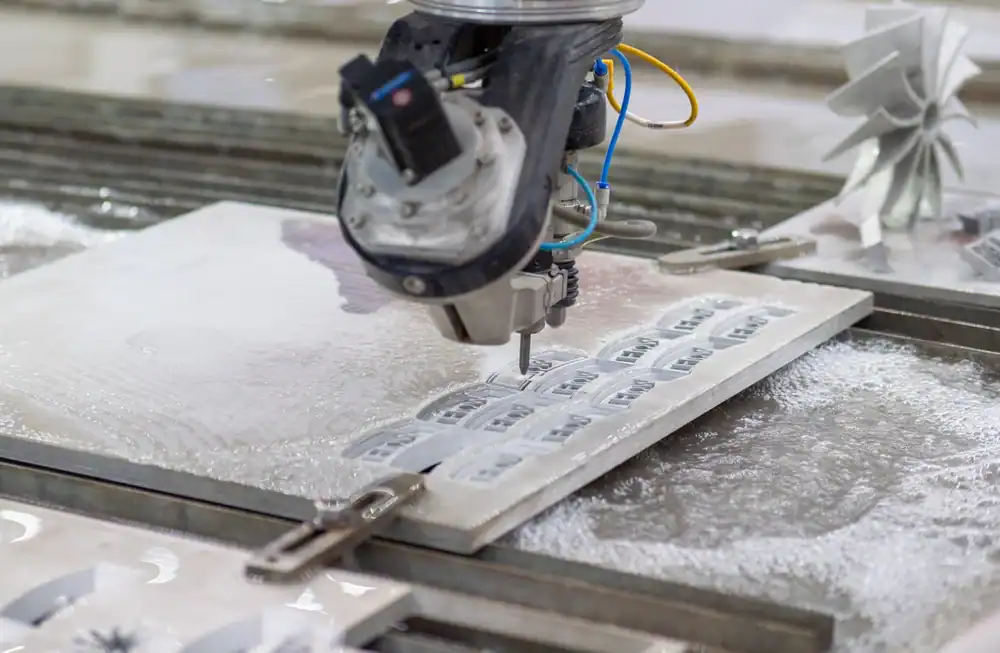
You send your CAD file or drawing. The programming happens quickly—CNC waterjet cutting means going from design to cut path without lengthy setup. If you’re working with a new material or complex geometry, we’ll consult with you to confirm feed rates and abrasive levels.
Once the file is loaded, the cutting head moves along your programmed path while a mixture of water and garnet abrasive exits the nozzle at up to 60,000 PSI. The stream is thinner than a credit card but cuts through metal, stone, glass, rubber, and composites without generating heat. For thicker materials, the process just slows down—there’s no practical thickness limit.
If you need multiples, stack cutting handles several layers at once. If your part has angles or bevels, five-axis capability takes care of it. The process is fast, and because there’s no heat-affected zone, your material properties stay consistent from edge to center. You can machine, weld, or finish the parts immediately after cutting.
Ready to get started?
You’re not limited by material type. Ferrous and non-ferrous metals, titanium, aluminum, stainless steel, brass, copper—all cut cleanly. So do stone, ceramic, glass, rubber, foam, and layered composites. If a laser would burn it or a saw would crack it, waterjet handles it.
Tolerances run as tight as ±0.005″ on thinner materials, which matters when you’re building assemblies or architectural elements that need to fit precisely. North New Hyde Park’s architectural and design community has relied on this level of accuracy for decorative metalwork, custom facades, and structural components that can’t be off by even a few thousandths.
The process is also cleaner than plasma or laser cutting. No fumes, no slag, no hazardous dust. The abrasive gets filtered out of the water and disposed of safely. For shops operating in mixed-use or residential-adjacent areas around North New Hyde Park, that makes a difference in terms of environmental compliance and neighbor relations.
You also get faster project timelines. Because parts come off the table ready to use, you’re not waiting on deburring, grinding, or heat treatment. That’s especially valuable in New York’s fast-moving manufacturing environment, where delays cascade quickly across contractors, installers, and end clients.
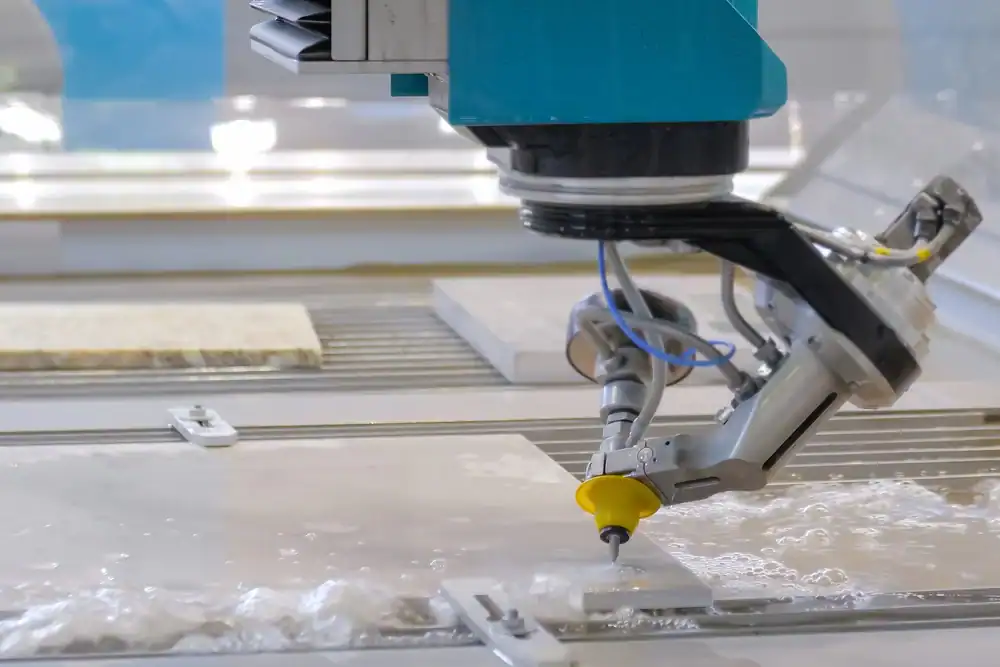
Waterjet cuts materials that would burn, melt, crack, or deform under heat-based methods. That includes heat-sensitive metals like aluminum and copper, which warp under plasma or laser cutting. It also handles layered materials like carbon fiber composites, where heat causes delamination between layers.
You can cut rubber, foam, and gasket materials without compression or tearing. Glass and stone cut cleanly without cracking. Even hardened tool steels and titanium alloys—materials that dull saw blades quickly—cut smoothly because the abrasive stream doesn’t wear down the way a blade does.
The cold cutting process also means you can work with pre-finished materials. If you’ve got powder-coated metal or polished stone, the cut won’t damage the finish around the edge. That saves you from having to refinish parts after cutting, which is a common issue with thermal methods that discolor or burn coatings.
Laser cutting is faster on thin materials—usually anything under 1/4″. But it creates a heat-affected zone that hardens the edge of the material, making it brittle and harder to machine later. If you’re drilling, tapping, or welding near a laser-cut edge, you’ll notice the difference.
Waterjet doesn’t change the material at all. The edge has the same hardness, ductility, and machinability as the rest of the sheet. That’s critical if you’re doing secondary operations or if the part will be under stress in its final application.
Waterjet also handles thicker materials without issue. Laser cutting loses accuracy and speed as material thickness increases, and most lasers top out around 1″. Waterjet cuts 6″ plate as easily as 1/4″ sheet—it just takes longer. For structural components, marine parts, or heavy equipment fabrication common in the North New Hyde Park industrial area, that capability matters.
On materials up to 1″ thick, you’re looking at ±0.005″ without much trouble. Thinner materials can hit even tighter tolerances if the setup is dialed in. That’s tight enough for most mechanical assemblies, architectural panels, and precision components.
As material thickness increases, tolerance opens up slightly—usually to ±0.010″ on materials over 2″. That’s still well within spec for structural work, and it’s significantly better than plasma cutting or oxy-fuel methods, which can drift by several hundredths on thick plate.
The key factor is that waterjet doesn’t create taper the way some processes do. A laser cut often shows a slight angle from top to bottom of the material due to beam divergence. Waterjet stream stays parallel, so your part dimensions are consistent through the thickness. If you’re stacking parts or fitting them into tight assemblies, that consistency eliminates fit-up problems.
Cutting speed depends on material type and thickness. On thin metals—1/4″ or less—waterjet is slower than laser or plasma. But when you factor in the time you’d spend deburring, grinding, or heat-treating parts cut with those methods, waterjet often comes out ahead on total cycle time.
For thicker materials, waterjet is competitive or faster. A 2″ steel plate that would take multiple torch passes or require sawing and milling can be cut in a single waterjet pass. And because there’s no heat distortion, you’re not spending time afterward trying to flatten warped parts.
Setup time is also faster than traditional machining. Going from CAD file to first cut takes minutes, not hours. If you’re prototyping or running short production batches—common in North New Hyde Park’s diverse manufacturing base—that quick turnaround lets you iterate designs faster and get to market sooner.
Yes, especially with stack cutting. If you’re producing multiples of the same part, you can layer materials and cut through several sheets at once. That multiplies output without adding much time. A part that takes five minutes to cut can produce ten pieces in six or seven minutes when stacked.
The process is also highly repeatable. CNC control means every part matches the first one, even on runs of hundreds or thousands. There’s no tool wear to account for, no blade dulling that changes cut quality halfway through a job. The abrasive stream cuts the last part as cleanly as the first.
For industries like automotive suppliers, electronics enclosures, or marine hardware—sectors with a strong presence in the New York metro area—that repeatability is essential. You’re not adjusting offsets or recalibrating between parts. You set the program once and let it run.
Per-cut cost can be higher than laser or plasma on thin, simple shapes. But when you account for the full job—including secondary operations you’d need with other methods—waterjet often costs less overall. You’re not paying for deburring, grinding, or stress-relieving heat-treated parts.
You also avoid scrap from warped or damaged parts. Heat-based cutting methods produce rejects when materials distort or when heat-affected zones crack during forming. Waterjet’s cold process eliminates those failures, so your material yield is higher.
For complex shapes, tight tolerances, or difficult materials, waterjet is frequently the only practical option. Trying to achieve the same result with traditional machining would cost significantly more in tool wear, setup time, and labor. North New Hyde Park manufacturers working with exotic alloys, architectural metals, or precision assemblies typically find waterjet delivers better value than trying to force other methods to work.
Useful Links
Other Services we provide in North New Hyde Park