Hear from Our Customers
You’re not cutting parts just to cut them. You’re meeting specs that determine whether a component gets installed or rejected. Heat-affected zones from laser or plasma cutting compromise material properties, create micro-cracking, and turn tight-tolerance work into scrap.
Precision CNC waterjet cutting in Bellmore, NY eliminates that risk entirely. No heat means no distortion, no hardening, and no structural changes to your material. The abrasive waterjet stream cuts stainless steel, titanium, tool steel, and hardened plates up to 6 inches thick with tolerances reaching ±0.001″.
You get crisp, clean edges that meet aerospace and medical device specifications without grinding, deburring, or secondary machining. That’s fewer rejected parts, faster turnaround, and less money spent fixing what other cutting methods get wrong.
We serve Bellmore, NY and the broader Long Island manufacturing community from our West Islip facility. We’re positioned in a region with over 3,000 manufacturing companies, many supplying aerospace, defense, and advanced manufacturing sectors that don’t tolerate imprecision.
We understand what’s at stake when you’re fabricating landing gear components, brake assemblies, or custom architectural metalwork. Our precision water jet cutting services in Bellmore, NY handle everything from prototype development to production runs, with material consultation and custom design support from concept through completion.
Long Island’s aerospace heritage demands cutting technology that matches the precision standards set by companies like Collins Aerospace and CPI Aero. That’s exactly what waterjet delivers.
You send us your design file or work with our team to develop the specifications you need. We program the CNC waterjet system based on your exact tolerances, material type, and thickness requirements. Setup is fast because there’s no tooling to fabricate or dies to machine.
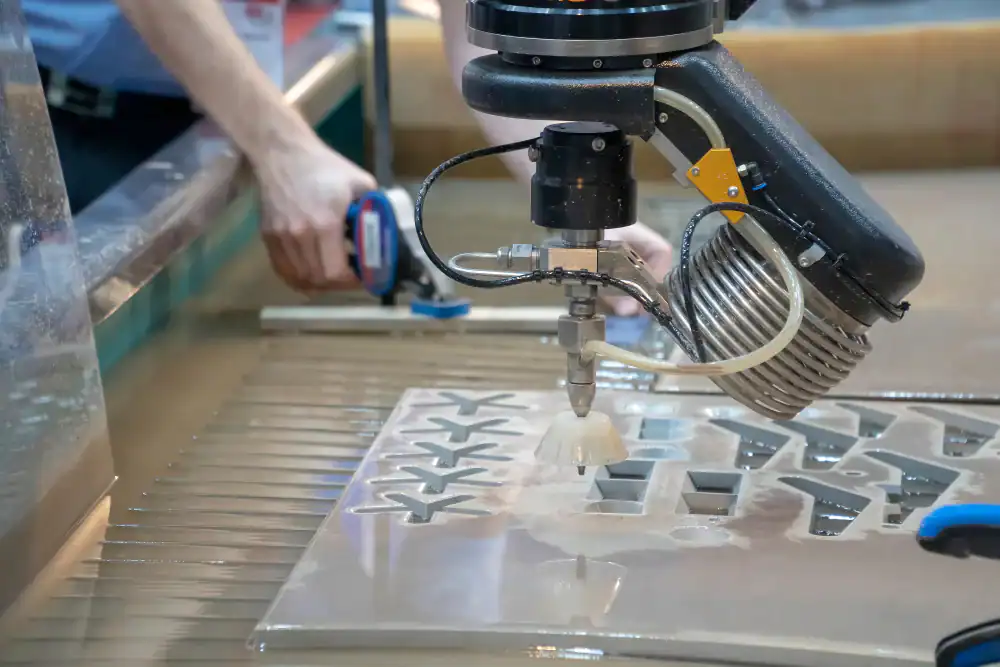
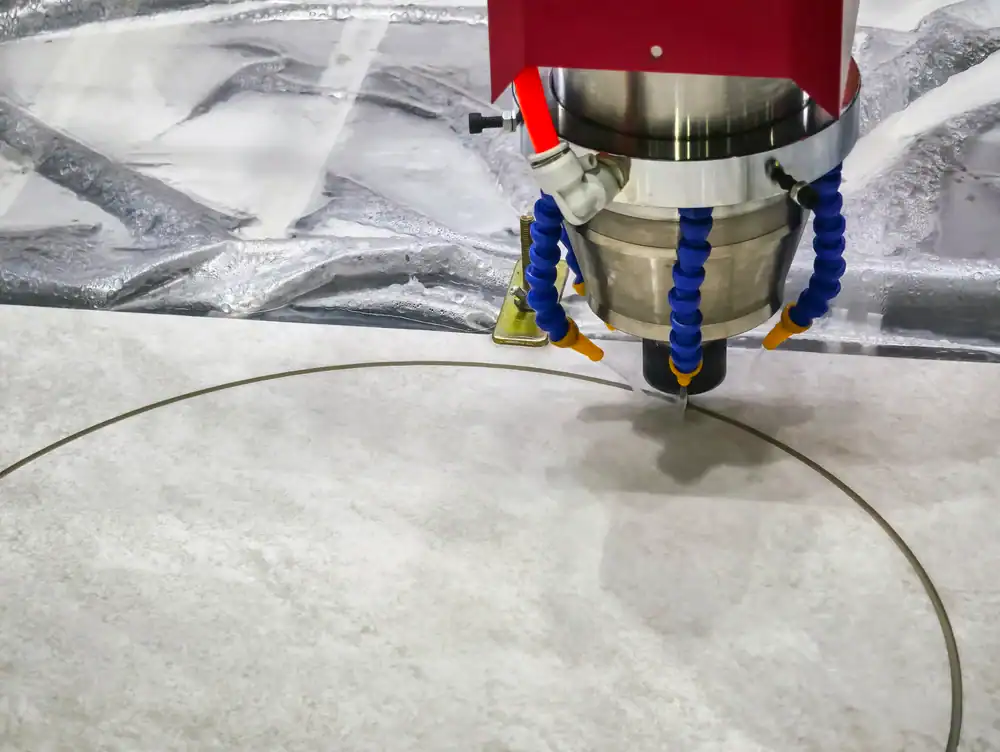
The abrasive waterjet stream—a mixture of ultra-high-pressure water and garnet abrasive—cuts through your material at pressures exceeding 60,000 PSI. The stream never heats the material beyond ambient temperature, so there’s no thermal distortion, no slag, and no dross waste.
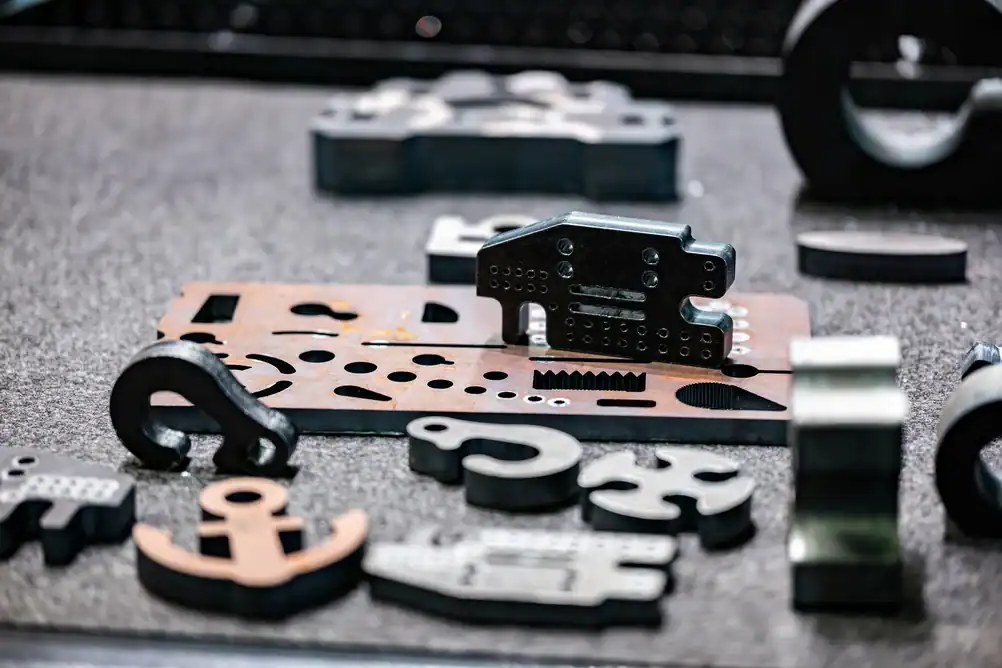
What you get back are parts with satin-smooth edges, accurate to within thousandths of an inch, ready for assembly or installation. Complex geometries, internal cutouts, and intricate profiles that would require multiple setups with conventional methods get completed in a single pass. If you need secondary services like bending, welding, or finishing, we coordinate that too.
Ready to get started?
Our precision waterjet cutting shop in Bellmore, NY processes metals and composites that other cutting methods struggle with or damage outright. Aluminum, brass, Inconel, titanium, stainless steel, tool steel, hardened plates—materials common in aerospace, automotive, and defense applications. We cut thicknesses from 1/16 inch to over 10 inches depending on material density and your tolerance requirements.
Bellmore’s proximity to Long Island’s aerospace and advanced manufacturing sectors means we regularly handle components for aircraft assemblies, medical devices, custom architectural features, and prototype development. The waterjet process works equally well whether you’re ordering a single prototype or a production run of 500 identical parts.
Because there’s no heat-affected zone, materials maintain their structural integrity and metallurgical properties. You’re not introducing stresses that lead to warping or failure down the line. For industries where consistency and reliability determine safety and performance, that matters more than cutting speed alone.
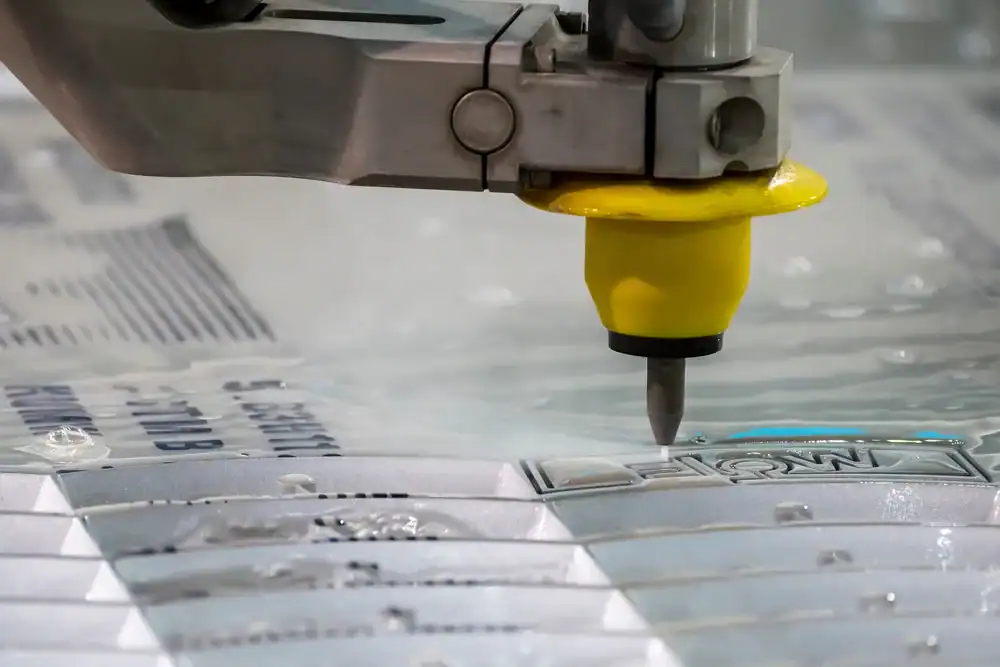
Standard precision waterjet cutting holds tolerances between ±0.004″ and ±0.002″. With proper machine calibration, material selection, and cutting parameters, high precision waterjet cutting can achieve ±0.001″ on critical dimensions.
That level of accuracy meets the specifications required for aerospace components like landing gear, brake assemblies, and structural brackets where dimensional precision directly impacts safety and performance. Unlike laser or plasma cutting, waterjet doesn’t create a heat-affected zone that can cause dimensional shift as the material cools.
The key is understanding that tolerance capability depends on material thickness, hardness, and edge quality requirements. Thicker materials or harder alloys may require slightly wider tolerances, but waterjet still outperforms thermal cutting methods that introduce warping and micro-cracking.
Waterjet cutting uses a stream of ultra-high-pressure water mixed with abrasive garnet particles. The material never gets hot because the cutting mechanism is erosion, not thermal energy. The water itself acts as a coolant, keeping the material at or near ambient temperature throughout the entire cutting process.
Laser and plasma cutting generate intense heat that melts or vaporizes material along the cut line. That heat spreads into the surrounding material, creating a heat-affected zone where the metal’s structure changes—hardening, softening, or developing internal stresses that lead to warping or cracking.
For materials like titanium, Inconel, or hardened tool steel, eliminating heat distortion isn’t just preferable—it’s essential. These materials are expensive and often destined for critical applications where structural integrity can’t be compromised. Waterjet cutting preserves the material’s original properties from edge to edge.
Yes. CNC waterjet systems cut complex geometries, internal cutouts, sharp corners, and intricate profiles in a single setup. The cutting head follows the programmed tool path without physical contact with the material, so there’s no tool deflection or wear that would require repositioning.
Traditional machining methods require different tools for different features—drill bits for holes, end mills for pockets, saws for external profiles. Each tool change adds time and introduces potential alignment errors. Waterjet completes all those features in one continuous cutting operation.
This is especially valuable for prototype development and low-volume production where tooling costs and setup time would otherwise make the project uneconomical. You can iterate designs quickly without investing in custom dies or fixtures, and move from concept to finished part in days instead of weeks.
Programming and setup for waterjet cutting is fast because there’s no physical tooling to fabricate. Simple parts can often be programmed and cut the same day you submit the design file. More complex projects with tight tolerances or thick materials typically take 2-5 business days from file submission to finished parts.
The actual cutting time depends on material type, thickness, and complexity. Thicker materials and harder alloys require slower cutting speeds to maintain edge quality and dimensional accuracy. But even with those considerations, waterjet is often faster than conventional machining for complex shapes because it eliminates multiple setups and tool changes.
If you need secondary operations like deburring, bending, or surface finishing, that adds time depending on the specific requirements. We can coordinate those services to deliver complete, ready-to-install components rather than just cut parts that still need additional work.
Waterjet cutting is one of the most economical options for low-volume production and prototype work because there are no tooling costs. Stamping, punching, or die cutting require expensive dies that only make financial sense when amortized across thousands of parts.
With waterjet, you draw the part, program the machine, and cut. If you need design changes between runs, you update the CAD file and reprogram—no new tooling required. That flexibility is valuable when you’re refining prototypes or producing custom components where each order might have slight variations.
The cost per part does decrease with volume since setup time gets distributed across more pieces, but waterjet remains competitive even for single-digit quantities. For materials that are expensive or difficult to machine, the lack of heat distortion and minimal material waste often makes waterjet the most cost-effective choice regardless of volume.
Abrasive waterjet cutting handles virtually any material: stainless steel, aluminum, brass, copper, titanium, Inconel, tool steel, hardened plates, carbon fiber composites, and ceramics. The process works on materials from 1/16 inch to over 10 inches thick depending on density and your tolerance requirements.
This versatility matters in Bellmore’s manufacturing environment where aerospace, medical device, and custom fabrication projects often involve specialized alloys. Titanium for aerospace components, Inconel for high-temperature applications, hardened tool steel for dies and fixtures—materials that are expensive and difficult to machine with conventional methods.
Because waterjet cutting doesn’t generate heat, it won’t alter the material’s properties or create stresses that lead to warping. That’s critical for pre-hardened materials or components that have already undergone heat treatment. You maintain the material’s engineered characteristics from the raw stock through the finished part.
Useful Links
Other Services we provide in Bellmore