Hear from Our Customers
You’re not paying for cutting. You’re paying to eliminate the problems that come after bad cutting.
Heat distortion that throws your tolerances off. Burrs that require secondary finishing. Material waste that eats into your budget. Delays because the first run didn’t meet spec.
High precision waterjet cutting in Dix Hills solves that. The cold cutting process means zero heat-affected zones. Your materials don’t warp, don’t harden, don’t change properties. The abrasive waterjet stream is precise enough to hold tolerances between ±0.002″ and ±0.001″ depending on material and thickness.
The edge quality is clean enough that most parts don’t need secondary finishing. That’s time saved, labor saved, and one less step where something can go wrong. You get parts that fit right, perform right, and don’t come back as problems later.
Whether you’re working with aerospace-grade aluminum, thick steel plate, exotic alloys, or heat-sensitive composites, the process adapts. No tooling changes. No thermal stress. Just accurate cuts that match your CAD file.
We operate as a precision waterjet cutting shop in Dix Hills, NY, serving manufacturers, fabricators, architects, and contractors across Long Island and the tri-state area. We’re in a region with over 3,000 manufacturing companies, many requiring tight-tolerance work that traditional cutting methods can’t deliver without compromising the material.
Our equipment handles materials up to 8 inches thick. We cut everything from thin plastics to hardened tool steel, from glass and stone to titanium and Inconel. If you’ve been told a material is too hard, too thick, or too sensitive for conventional cutting, that’s exactly what waterjet cutting was designed for.
You work with people who understand what “tight tolerance” actually means in your industry. We’ve handled aerospace components, automotive prototypes, architectural installations, and custom fabrication projects where the margin for error is essentially zero.
You send us your CAD file or specifications. We review it for any potential issues with geometry, tolerances, or material selection. If something won’t work as drawn, you’ll know before we start cutting, not after.
Programming happens fast. Precision CNC waterjet cutting in Dix Hills means your design goes directly into our system. We set up the material, verify zero points, and configure the abrasive flow and cutting speed based on what you’re cutting and how tight the tolerances need to be.
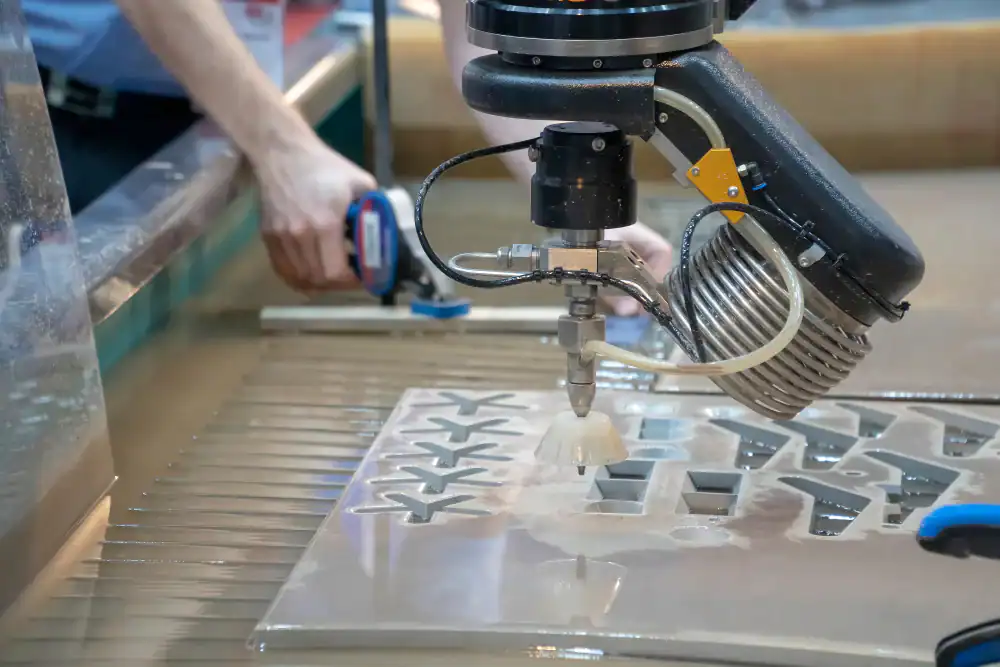
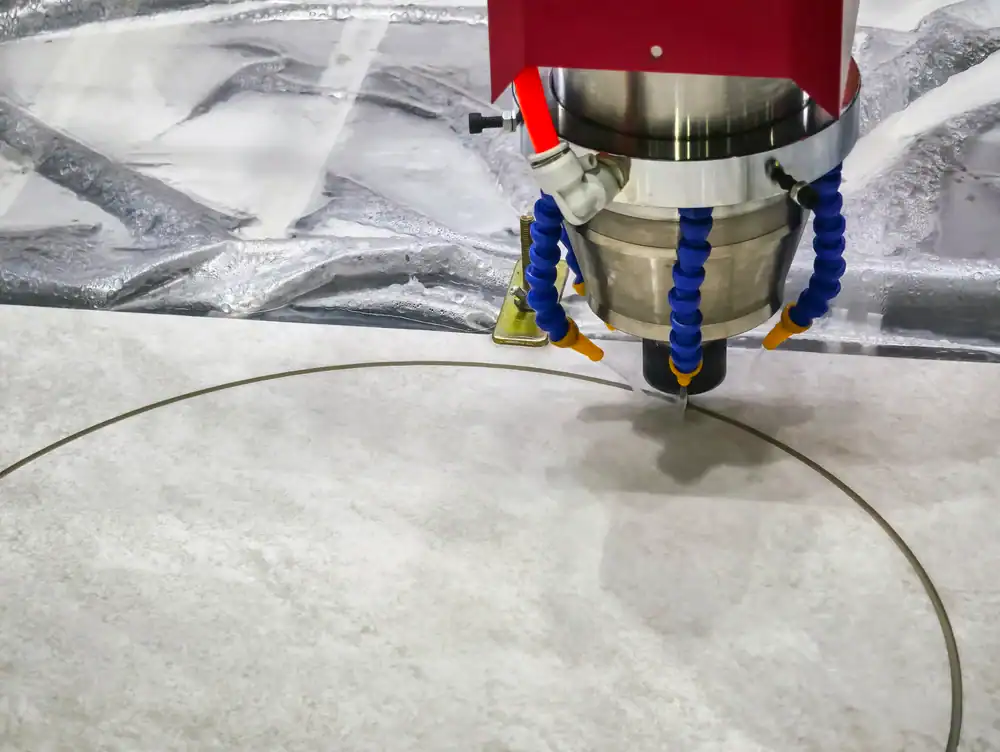
The cutting process itself is cold. A high-pressure stream of water mixed with fine abrasive garnet does the work. No flames, no plasma, no friction heat. The material stays at room temperature, which means no warping and no change in material properties.
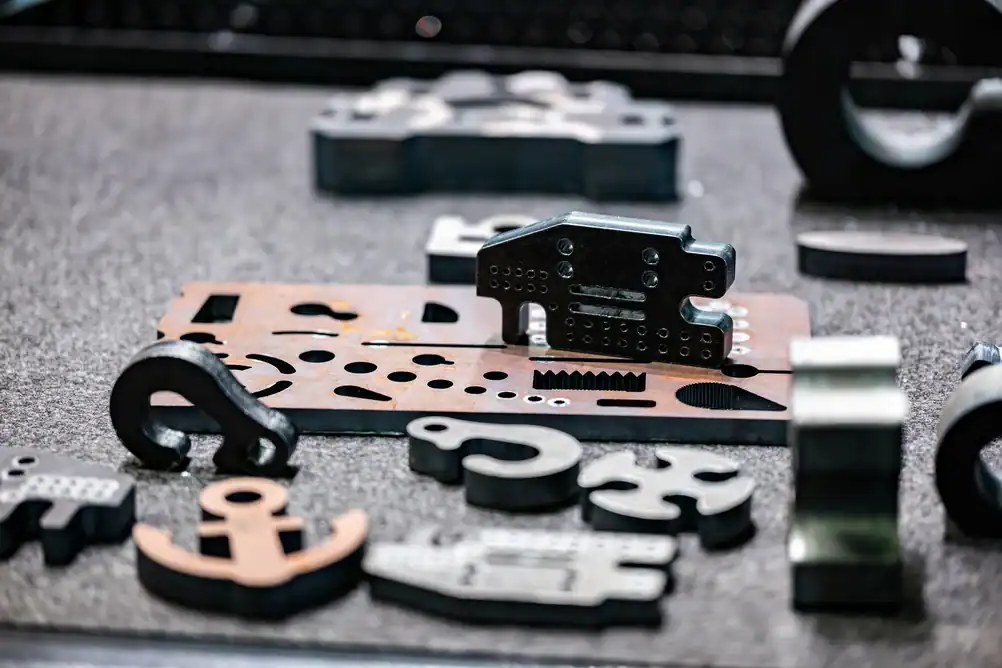
Most jobs produce finished edges that don’t require grinding, deburring, or additional machining. Complex geometries, tight inside corners, and intricate patterns get cut in a single pass. You’re not waiting on multiple setups or tool changes.
Once cutting is complete, we inspect dimensions to verify they match your specifications. Then your parts are ready to ship or pick up. The whole process from file to finished part is faster than you’d expect, especially for complex shapes that would take days with conventional methods.
Ready to get started?
You get material consultation before cutting starts. Not every material cuts the same way, and thickness, hardness, and internal stress all affect results. We’ll tell you if your material choice will create problems or if there’s a better option for your application.
Design review is part of the service. If your CAD file has features that will cause issues—like corners too tight for the jet stream diameter or tolerances that require secondary operations—you’ll know upfront. We’d rather solve it in the design phase than after cutting starts.
The precision water jet cutting services in Dix Hills include setup, programming, cutting, and basic quality inspection. For materials that require it, we can handle nested layouts to minimize waste. For high-volume runs, we optimize cutting paths to reduce cycle time without sacrificing accuracy.
Long Island’s manufacturing sector relies heavily on precision cutting for aerospace, automotive, and custom fabrication work. The local demand for tight-tolerance work means we’re set up to handle both prototype quantities and production runs. You’re not waiting weeks for capacity. Most jobs turn around in days, and rush work is available when your timeline demands it.
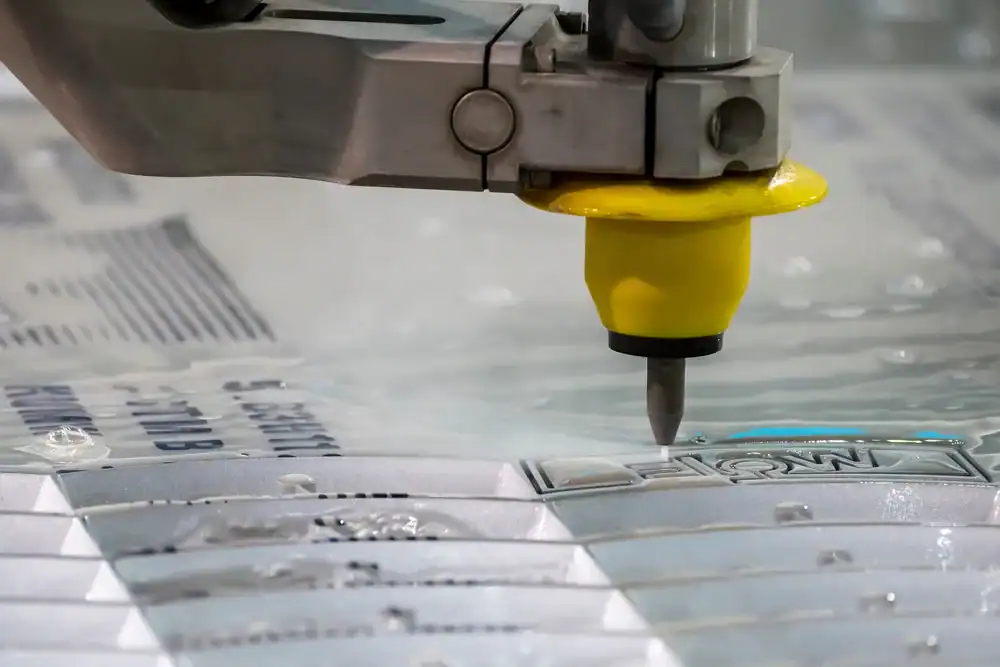
Standard precision waterjet cutting in Dix Hills holds tolerances around ±0.005″ on most materials. When you move to high precision waterjet cutting with advanced systems, you’re looking at ±0.002″ to ±0.001″ depending on material type and thickness.
Thicker materials—say, 4 to 8 inches—will have slightly wider tolerances than thin plate, but we’re still talking about ±0.005″ to ±0.010″ on heavy sections. That’s significantly tighter than plasma or oxy-fuel cutting, which typically run ±0.030″ or wider.
The key factor is taper. As the jet cuts through thick material, it loses some energy, which can create a slight taper from top to bottom. On precision work, we adjust cutting speed and abrasive flow to minimize taper to nearly zero. For parts where top-to-bottom consistency matters, we can also use dynamic cutting head technology that compensates in real time.
If your print calls for tolerances tighter than ±0.001″, you’re likely looking at secondary grinding or EDM after waterjet cutting. But for the vast majority of applications, precision waterjet cutting for tight tolerances in Dix Hills delivers finished parts straight off the table.
Yes. That’s one of the main reasons to use waterjet over laser, plasma, or torch cutting. The process is completely cold—no heat-affected zone, no hardening, no thermal distortion.
Materials like titanium, Inconel, tool steel, and hardened alloys don’t see any temperature change during cutting. That means no change in material properties, no warping, and no need to re-heat-treat after cutting. For aerospace and medical applications where material certification matters, cold cutting preserves the integrity of the base material.
Composites, laminates, and plastics also benefit. These materials can melt, delaminate, or release toxic fumes when cut with heat. Waterjet cutting leaves clean edges without melting or fraying. You can cut carbon fiber, fiberglass, acrylic, and polycarbonate without any of the edge damage you’d see from a laser or router.
Even softer materials like rubber, foam, and gasket material cut cleanly. The narrow jet stream and lack of heat mean you get accurate cuts without compression or tearing. If your material can’t handle heat, waterjet is often the only option that works.
Laser cutting is faster on thin materials—usually under 1/2 inch—and works well for high-volume production of simple shapes in mild steel, stainless, and aluminum. But it has limits that waterjet doesn’t.
Laser can’t cut reflective materials like copper or brass effectively. It struggles with thicker sections—anything over 1 inch gets slow and expensive. And the heat from laser cutting creates a heat-affected zone that can warp thin materials or change hardness near the cut edge.
Waterjet handles all of that without issue. You can cut 8-inch-thick steel plate, copper bus bars, hardened tool steel, glass, stone, and composites—all with the same machine. There’s no heat-affected zone, so thin materials don’t warp and hardened materials don’t lose their temper.
The trade-off is speed. Laser is faster on thin sheet metal. Waterjet is slower but more versatile. If you’re cutting a variety of materials, thick sections, or anything heat-sensitive, waterjet is the better process. If you’re running thousands of identical parts in thin mild steel, laser might make more sense. For precision work across a range of materials, waterjet wins.
Our equipment handles materials up to 8 inches thick. That includes steel, aluminum, stainless, titanium, and most other metals. For non-metals like plastic, stone, glass, or composites, thickness capacity is similar, though cutting speed varies by material density.
Thicker materials take longer to cut, but the process stays consistent. You’re not limited by heat buildup or tool wear like you would be with milling or sawing. The abrasive waterjet stream cuts all the way through without losing accuracy, though you may see a slight taper on very thick sections unless we adjust parameters or use a dynamic cutting head.
For materials over 4 inches thick, we often recommend a test cut if tolerances are critical. That way, you can verify edge quality and dimensional accuracy before committing to a full production run. Most customers are surprised at how clean the cut is, even on heavy plate.
If you’re working with thicker materials and you’ve been told they’re too thick for precision cutting, waterjet is likely your best option. We’ve cut 6-inch steel plate, 4-inch aluminum billet, and 8-inch stone slabs without issue.
Most don’t. The abrasive waterjet process produces a satin-smooth edge that’s clean enough to use as-is for the majority of applications. You’re not dealing with the slag, dross, or rough edges you’d get from plasma or torch cutting.
For parts that need a specific surface finish—like a polished edge or a deburred radius—you might need light finishing. But that’s usually a quick pass with a file or grinder, not a full secondary operation. Compare that to laser or plasma cutting, where every part needs deburring and often grinding to meet print requirements.
The edge quality depends on cutting speed and abrasive flow. For rough cuts where edge finish doesn’t matter, we can run faster and leave a slightly rougher edge. For precision work, we slow down and increase abrasive flow to produce a smoother finish. You tell us what you need, and we adjust the process accordingly.
In architectural and decorative applications, waterjet-cut edges are often left as-is because the finish is clean and consistent. For mechanical parts, the edge quality is usually good enough for welding, bolting, or assembly without additional prep. You save time and labor by eliminating the finishing step entirely.
Most jobs turn around in 3 to 5 business days from the time we receive your file and material specifications. That includes programming, setup, cutting, and basic quality inspection. For simpler jobs or smaller quantities, we can often finish in 1 to 2 days.
Rush work is available if your timeline is tight. We’ve handled same-day and next-day jobs when the situation requires it. That usually depends on current shop capacity and material availability, but we’ll tell you upfront whether we can meet your deadline.
Programming is fast because precision CNC waterjet cutting in Dix Hills runs directly from CAD files. There’s no tooling to build, no fixtures to design, and no lengthy setup. For repeat jobs, we save your program, so subsequent runs start even faster.
Material availability can affect turnaround. If you’re supplying the material, we can start as soon as it arrives. If we’re sourcing it, add a day or two depending on what you need. For common materials like aluminum plate or stainless sheet, we often have stock on hand or can get it locally within a day.
Useful Links
Other Services we provide in Dix Hills