Hear from Our Customers
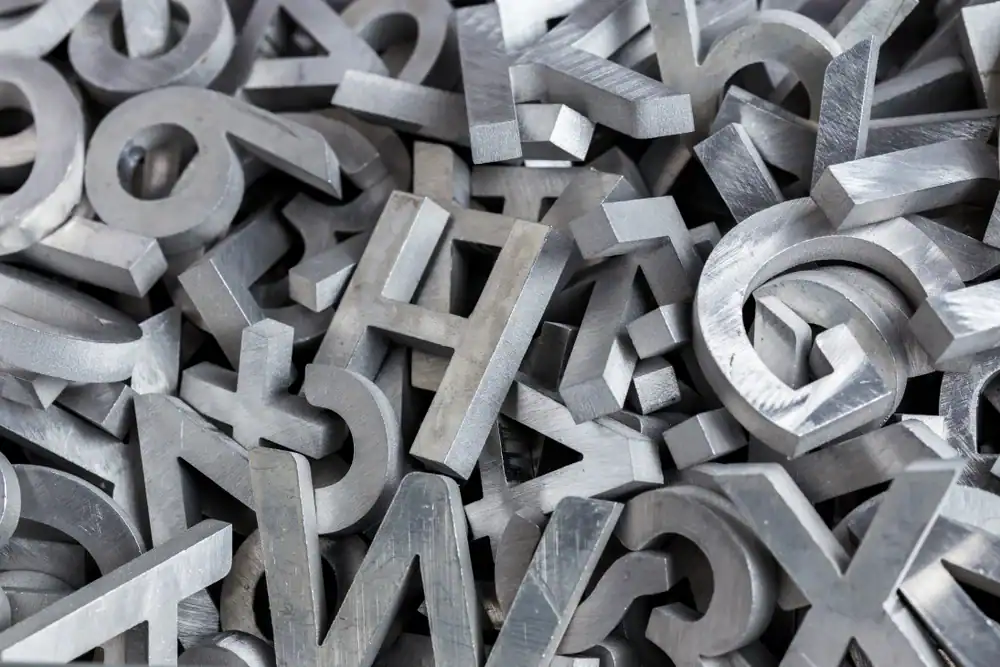
You stop dealing with warped edges from torch cutting. You eliminate the secondary finishing that eats into your timeline and budget. Your parts fit together the way they’re supposed to, and your production schedule stays on track.
Our precision water jet cutting services in Farmingville, NY handle materials that other methods can’t touch without damaging them. Thick aluminum plates, hardened tool steel, heat-sensitive composites—the cold cutting process means no thermal stress, no melting, no hardened edges that require grinding down later.
The edge quality you get often eliminates finishing work entirely. That’s not marketing speak—it’s what happens when you’re cutting with a stream that’s thinner than a human hair, controlled by CNC programming that repeats the same path within 0.005 inches every single time.
Tri-State Waterjet serves manufacturers, fabricators, architects, and engineers across Long Island’s industrial corridor. Farmingville sits in the heart of Suffolk County’s manufacturing hub, where Hauppauge Industrial Park alone houses thousands of makers who need precision cutting services they can count on.
We’re not the cheapest option in the area, and that’s intentional. You’re paying for equipment that holds tolerances, operators who understand nesting strategies to minimize your material costs, and turnaround times that don’t leave you waiting three weeks for a prototype.
The shops and facilities around Farmingville know what happens when a cutting service misses a tolerance or delivers parts late. We built our reputation by not doing that.
You send us your CAD file or technical drawing with your material specs and tolerance requirements. We review it for any potential issues—tight inside corners that need adjustment, nesting opportunities that could save you material, edge finish requirements that affect cutting speed.
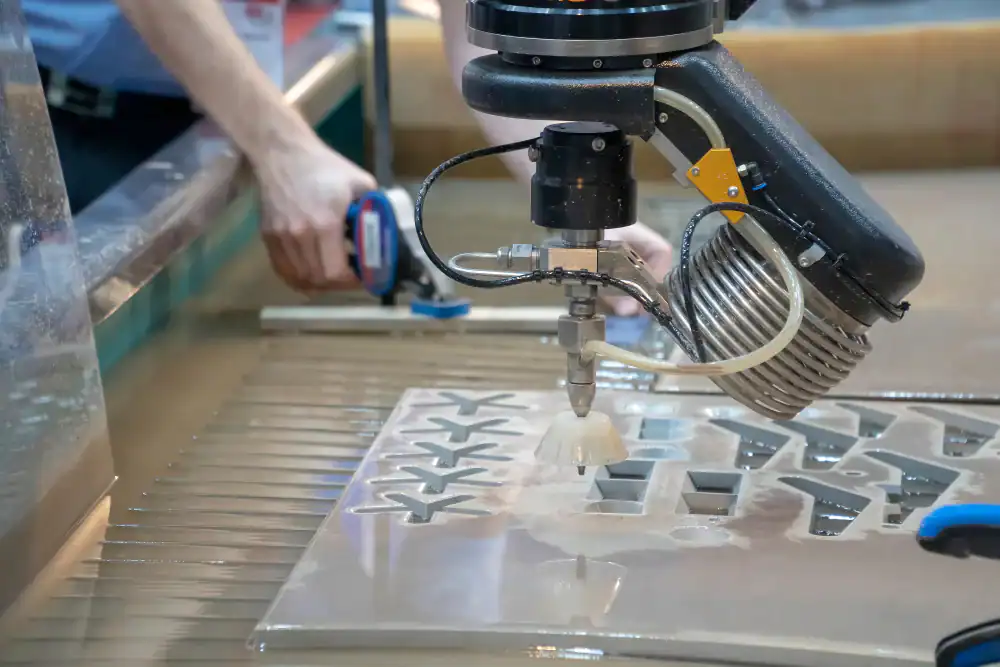
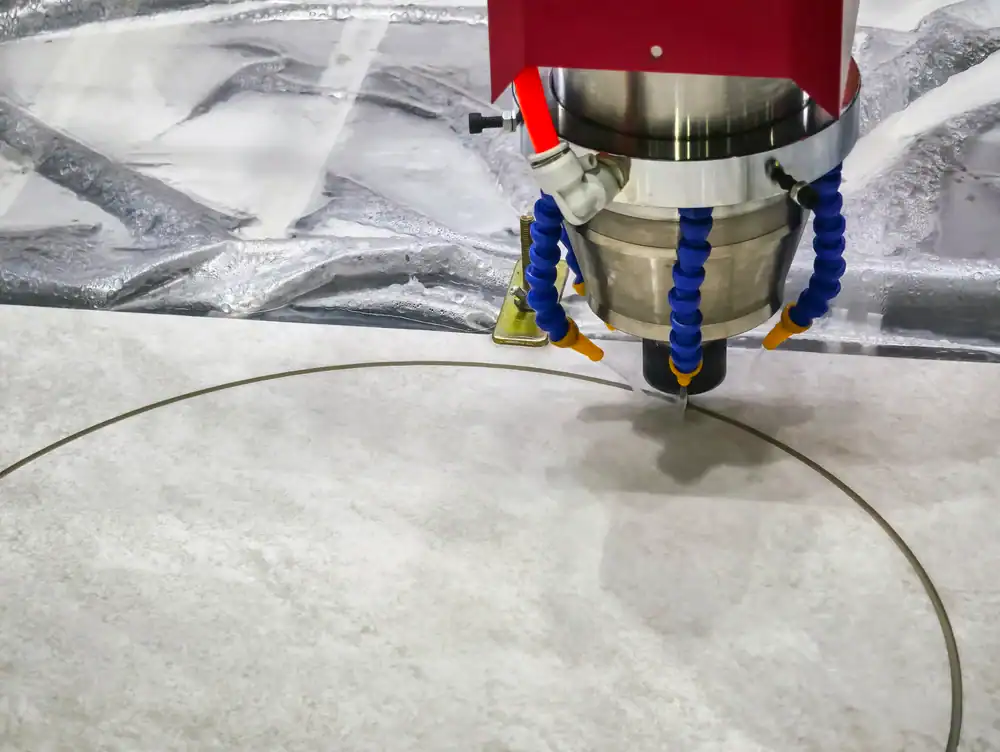
Once the programming is set, your material gets secured to the cutting bed. The waterjet nozzle positions itself and starts cutting, using either pure water for softer materials or an abrasive mixture for metals and hard composites. There’s no starting hole needed, no tool changes between different geometry types, no heat building up in your material.
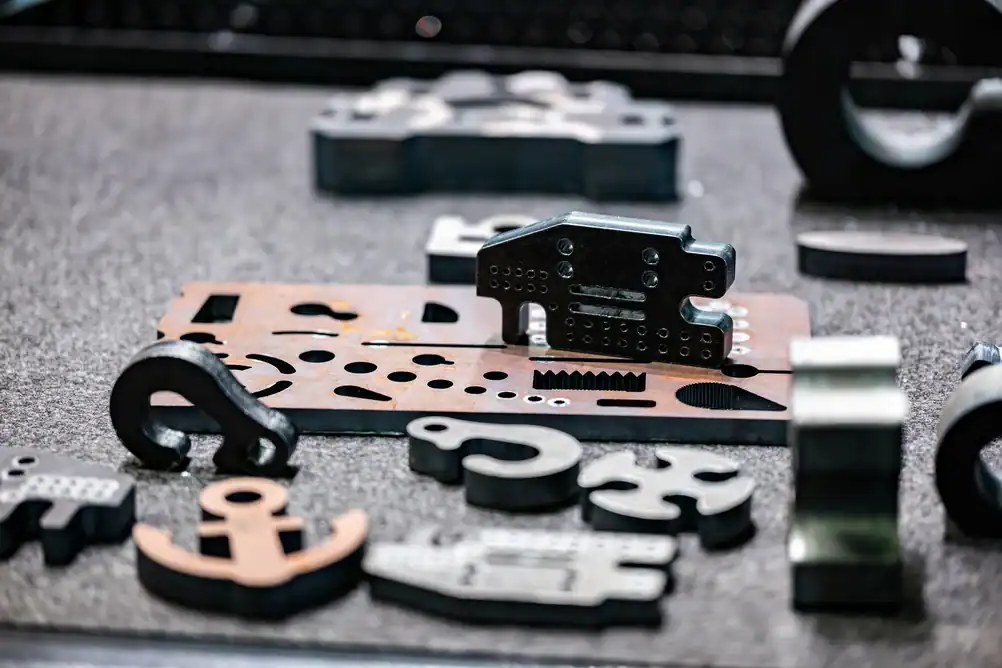
After cutting, parts come off the table ready to use or move to your next operation. If you need specific edge finishes—a Q3 for functional parts or Q5 for visible surfaces—that gets programmed into the cut. The whole process from file to finished part typically runs faster than you’d expect, especially for complex shapes that would take forever on a mill or require multiple setups on conventional equipment.
Ready to get started?
You get cuts through materials up to 8 inches thick with the same accuracy you’d expect on thin sheet. Complex geometries—tight radii, narrow slots, intricate patterns—get cut in a single setup without repositioning or secondary operations.
The process works across your material list: aluminum, stainless steel, titanium, tool steel, brass, copper, plastics, composites, stone, glass, rubber. If you’re running prototypes in Farmingville, NY, you get parts back fast enough to test and iterate without burning weeks. If you’re doing production runs, the CNC programming means every part matches the first one.
Long Island’s aerospace and marine fabricators use precision waterjet cutting for parts that can’t tolerate heat-affected zones. The automotive shops use it for custom brackets and panels. Architects and designers use it for decorative metalwork and signage that needs clean edges without grinding marks. You’re not limited by what the process can handle—you’re limited by what you need cut.
Material waste drops because the kerf width is minimal and nesting software packs parts tight. You’re not paying for large scrap percentages like you would with punch presses or plasma tables.
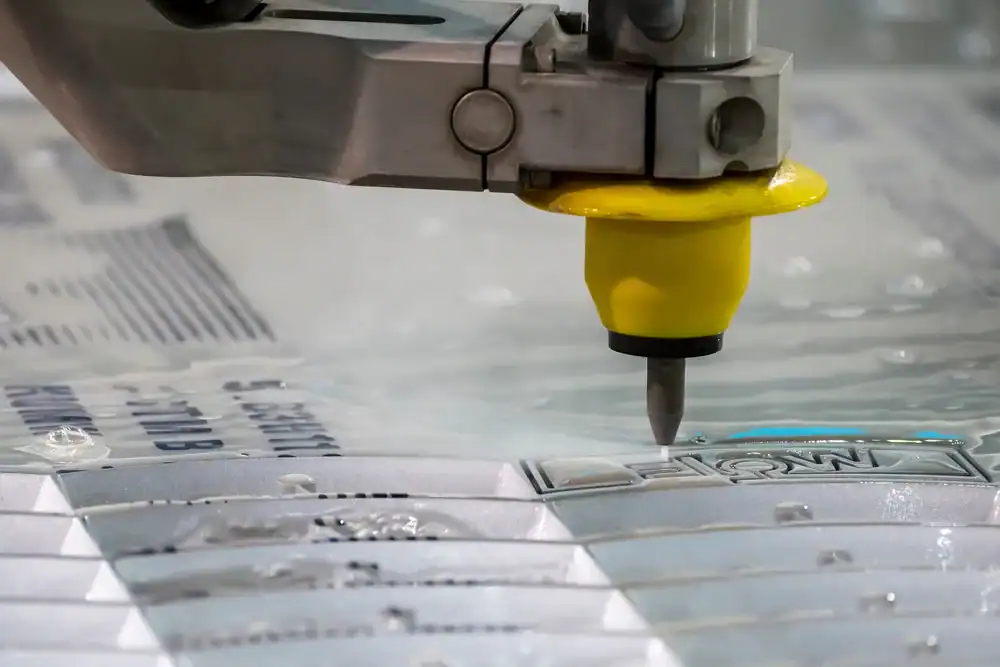
Standard precision waterjet cutting holds ±0.005 inches on most materials and geometries. That’s five thousandths, which covers the majority of mechanical parts, brackets, panels, and components that don’t require ground finishes.
Tighter tolerances are possible depending on material thickness, edge quality requirements, and part geometry. Thinner materials generally hold tighter tolerances than thick plate. Simple shapes hold better than complex curves with multiple direction changes.
If your prints call for tolerances tighter than ±0.003 inches, that’s the conversation to have up front. Some features might need secondary grinding or EDM. But for most production work and prototyping in Farmingville, NY, waterjet cutting hits the numbers without additional operations.
Laser cutting works great for thinner metals—typically under half an inch—and delivers fast cuts on simple shapes. But it creates a heat-affected zone that hardens the edge and can warp thin material. You’ll see discoloration and sometimes need grinding to clean up the edge.
Waterjet cutting handles thicker materials without any heat input. No warping, no hardened edges, no discoloration. The edge comes off the table ready to weld or assemble. You can cut materials that would reflect or absorb laser energy—brass, copper, aluminum, reflective stainless.
The trade-off is speed on thin sheet. Laser cuts thin steel faster than waterjet. But when you factor in the edge quality, material thickness capability, and elimination of heat distortion, waterjet often makes more sense for precision work, especially on parts thicker than a quarter inch.
Simple parts from standard materials usually ship within a few days. Complex parts, thick materials, or large quantities take longer—typically one to two weeks depending on current shop load.
Rush service is available when you’re genuinely up against a deadline. That costs more because it means bumping other jobs, but it’s there when you need it.
The biggest factor in turnaround is how quickly we get clean files and complete specs. If your CAD file needs cleanup or we’re waiting on material thickness confirmation, that adds time. Send complete information up front and you’ll get parts faster.
Minimum hole diameter is roughly 1.5 times the material thickness for abrasive waterjet cutting. So on half-inch plate, you’re looking at holes around 0.75 inches minimum. Thinner material allows smaller holes.
Inside corners will have a radius equal to the jet diameter—typically 0.020 to 0.040 inches. You can’t get a perfectly sharp 90-degree inside corner with waterjet. If your design requires that, the corners need a secondary operation or the design needs adjustment.
This is why the file review matters. We catch these geometry issues before cutting and suggest solutions—either design modifications or secondary operations—so you don’t get parts that don’t work for your application.
Waterjet cutting makes sense for single prototypes all the way up to production quantities. There’s no hard tooling to build, no dies to machine, no setup costs that only make sense when spread across thousands of parts.
You can cut one prototype, test it, revise the design, and cut another without paying setup fees each time. The CNC program adjusts in minutes, not hours.
For Farmingville area engineers and designers working through design iterations, that flexibility matters. You’re not locked into a design before you’ve tested it. And when the design is finalized, the same process scales to production without retooling.
Tempered glass shatters under the waterjet stream pressure. Certain ceramics crack. Very soft materials like foam or thin rubber can compress under the jet rather than cutting cleanly, though thicker rubber cuts fine.
Beyond those exceptions, waterjet handles nearly everything—all metals, most plastics, composites, stone, tile, wood, even bullet-resistant materials. If you’re not sure about a specific material, that’s a quick conversation.
The real limitation is usually thickness versus edge quality requirements. Cutting 8-inch steel plate is possible, but the edge quality won’t match what you get on 1-inch plate. Thicker cuts also take longer, which affects cost. For most work in Farmingville, NY—parts under 4 inches thick—you’ll get excellent results.
Useful Links
Other Services we provide in Farmingville