Hear from Our Customers
You’re not looking for a cutting service that gets close enough. You need parts that meet spec the first time, because rejected components cost you more than money—they cost you credibility with your customers and time you can’t get back.
Our precision water jet cutting services eliminate the heat-affected zones that warp your material and throw off your tolerances. The cold cutting process keeps your metal, composites, or glass structurally sound from edge to edge. No discoloration, no hardness changes, no explaining to your customer why the part doesn’t fit.
When you’re cutting materials up to 12 inches thick and still need to hold tight tolerances, most processes fall apart. Waterjet doesn’t. The stream cuts straight through with the same accuracy at the bottom as the top, which means your thick plate work actually comes out square and usable.
We operate in Hempstead, NY, where aerospace and defense manufacturing isn’t just an industry—it’s the standard. Companies like Alpal Precision Machining and Air Industries Group don’t accept parts that are “close enough,” and neither do we.
Our precision waterjet cutting shop uses Flow Dynamic Waterjet technology with taper compensation software that adjusts the cutting head in real time. That’s how we hold ±0.003″ to ±0.005″ tolerances on complex geometries without the guesswork that comes from operator-dependent processes.
We’ve built our operation around the demands of Long Island’s industrial base: ballistic laminates for security applications, architectural panels that need clean edges, and production runs where every piece has to match. You’re working with a shop that understands what’s at stake when the part doesn’t fit.
You send us your specs and material requirements. We program the cut path into our CNC system, accounting for material type, thickness, and the tolerances you need to hit. The software calculates taper compensation before the first cut ever happens.
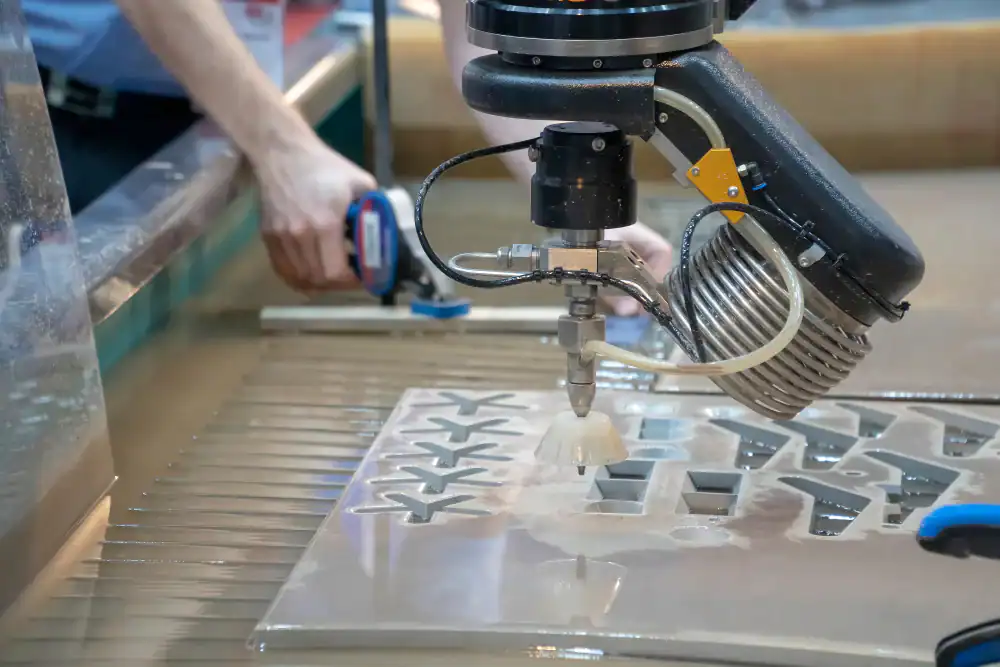
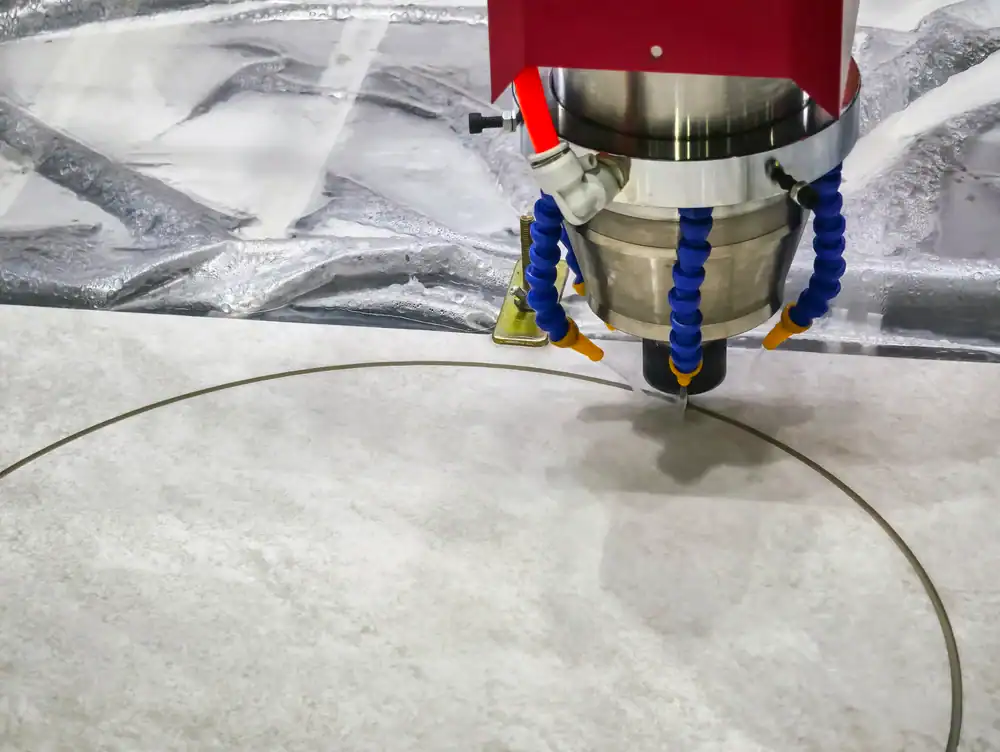
The cutting head positions itself within thousandths of an inch using precision motion control. A high-pressure water stream mixed with fine garnet abrasive cuts through your material at roughly 60,000 PSI. The kerf width stays around 0.040 inches, so you’re not wasting material on wide cuts.
Because there’s no heat involved, your material doesn’t warp, harden, or change properties. The edge comes out clean—what the industry calls satin-smooth—which usually means you can skip secondary finishing operations. For complex shapes, the dynamic system tilts the head automatically to counteract stream taper, keeping your edges square instead of angled.
You get parts that are dimensionally accurate, structurally sound, and ready to use. That’s the process.
Ready to get started?
Precision waterjet cutting for tight tolerances means you can spec ±0.003″ and actually get it. Not “we’ll try our best” accuracy—repeatable, measurable precision that holds up under inspection. This matters in Hempstead, NY, where local aerospace manufacturers require documented tolerances and zero room for error.
You get cold cutting with no heat-affected zones, which keeps your material properties intact. Stainless steel doesn’t harden at the edge. Aluminum doesn’t warp. Composites don’t delaminate. The structural integrity you started with is the integrity you end with.
Thick material capability up to 12 inches means your heavy plate work gets the same attention to detail as thin sheet. The cutting stream maintains accuracy through the full depth, so you’re not dealing with taper issues that throw off your bottom edge. For Hempstead’s metal fabrication and industrial manufacturing sectors, this translates to fewer rejected parts and less time spent on rework.
The edge quality eliminates most secondary operations. You’re not deburring, grinding, or trying to clean up burn marks. The cut is clean enough to weld against or assemble directly, which speeds up your production timeline and cuts your labor costs.
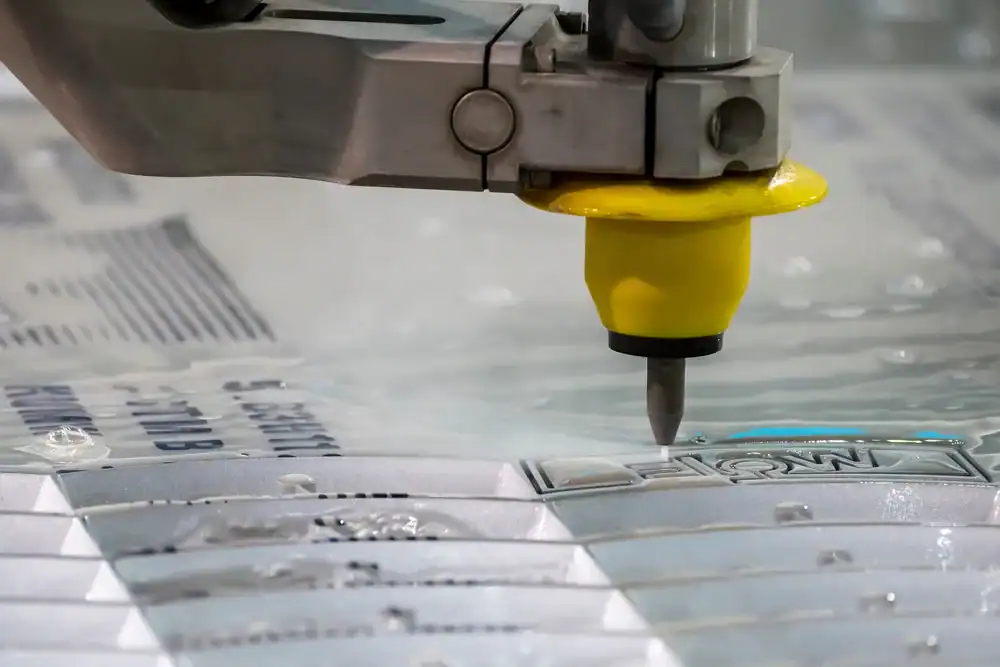
Our precision waterjet cutting holds ±0.003″ to ±0.005″ tolerances on materials up to 12 inches thick when using dynamic taper compensation technology. That’s not marketing language—that’s what our Flow Dynamic Waterjet system delivers with proper setup and calibration.
The key difference is in how the system handles taper. Standard waterjet cutting creates a tapered edge because the stream loses energy as it cuts deeper. On a 6-inch thick piece of steel, that taper can throw your bottom edge off by 0.1 inches or more, which makes the part useless for precision applications.
Dynamic taper compensation tilts the cutting head in real time to counteract that taper. The software calculates the exact angle needed based on material type, thickness, and cutting speed, then adjusts automatically throughout the cut. Your edge stays square, and your tolerances stay tight from top to bottom. For aerospace and defense work in Hempstead, NY, where parts get inspected with CMM equipment, this level of accuracy is what keeps components in spec and out of the scrap bin.
Our waterjet cutting uses high-pressure water and abrasive particles instead of heat, so there’s no thermal energy transferring into your material. Laser and plasma cutting work by melting or vaporizing material at temperatures exceeding 1,000°F, which creates a heat-affected zone that changes the material’s properties and can cause warping.
When you cut steel with a laser, the area around the cut hardens due to rapid heating and cooling. That hardened zone can be brittle and difficult to machine or weld. Aluminum warps from thermal expansion, especially on thin sheets or complex shapes. Composites delaminate when the resin matrix breaks down from heat.
Waterjet cutting eliminates all of that because the process stays cold. The water actually cools the material during cutting, keeping temperatures near ambient. Your stainless steel maintains its corrosion resistance. Your aluminum stays flat. Your carbon fiber composites keep their layer integrity. For manufacturers in Hempstead, NY working with materials where structural properties matter—ballistic laminates, aerospace components, medical device parts—this cold cutting process is often the only way to meet spec without compromising the material.
Standard waterjet cutting uses basic motion control and operator adjustment to guide the cutting head. Our precision CNC waterjet cutting uses computer-controlled positioning, automated taper compensation, and vibration-dampened cutting tables to achieve tolerances that standard systems can’t touch.
The CNC system positions the cutting head within thousandths of an inch based on programmed tool paths. There’s no manual guiding or eyeballing the cut. The motion control is repeatable, which means part 100 comes out the same as part 1. That consistency matters when you’re running production quantities or need parts to be interchangeable.
Our precision systems also include dynamic waterjet technology that adjusts cutting parameters in real time. The software monitors cutting speed, abrasive flow, and water pressure, then compensates for variables that would normally affect accuracy. Vibration dampening keeps the cutting table stable during operation, preventing micro-movements that show up as irregularities in the cut edge. For high precision waterjet cutting in Hempstead, NY, especially for industries like aerospace where dimensional accuracy isn’t negotiable, the difference between standard and precision CNC systems is the difference between parts that pass inspection and parts that get rejected.
Yes, but only if the system has precision motion control and taper compensation. Complex shapes create challenges because the cutting head has to change direction, speed up, slow down, and maintain consistent stream angle through curves, corners, and intricate geometries.
Basic waterjet systems struggle with this because the operator has to manually adjust parameters for each section of the cut. Corners come out rounded when they should be sharp. Inside radii don’t match the programmed dimensions. Edges that should be perpendicular end up tapered because the stream angle wasn’t compensated for direction changes.
Our precision CNC waterjet cutting solves this with automated control. The software calculates the optimal path, adjusts cutting speed through curves to maintain edge quality, and tilts the head dynamically to keep edges square regardless of direction. The motion control system positions the head accurately enough to cut fine details—think kerf widths around 0.040 inches—without overcutting or leaving material behind.
For architectural panels, industrial components, and security applications common in Hempstead, NY manufacturing, this means you can design complex parts and actually get them cut to spec. The geometry you model is the geometry you receive, with clean edges and accurate dimensions throughout.
Our precision waterjet cutting handles materials up to 12 inches thick while maintaining ±0.003″ to ±0.005″ tolerances, assuming you’re using a system with adequate pressure and taper compensation. Standard systems start losing accuracy around 2-3 inches because they can’t compensate for stream deflection and energy loss through thick materials.
The challenge with thick materials is that the abrasive waterjet stream loses cutting power as it penetrates deeper. On a 10-inch thick steel plate, the bottom of the cut receives less energy than the top, which normally results in a tapered edge and reduced accuracy. Without compensation, you might hold tight tolerances at the surface but end up 0.1 inches off at the bottom.
Our dynamic waterjet technology maintains accuracy through full depth by adjusting the cutting head angle based on material thickness and type. The system tilts the head to counteract stream deflection, keeping the cut perpendicular through the entire thickness. Water pressure around 60,000 PSI and carefully graded garnet abrasive maintain cutting power from top to bottom.
For Hempstead, NY manufacturers working with thick plate for industrial frames, heavy equipment components, or structural applications, this capability means you can cut thick material without sacrificing the precision you’d expect from thinner stock. The part comes out square, dimensionally accurate, and ready to use.
Aerospace and defense manufacturing drives the highest demand for our precision water jet cutting services in Hempstead, NY. Companies supplying parts to the aerospace industry need tolerances as tight as ±0.005 inches with zero heat distortion, which makes waterjet cutting one of the few processes that meets their requirements without secondary operations.
Metal fabrication shops serving construction, automotive, and industrial manufacturing also rely on our precision waterjet cutting for complex shapes and thick materials. When you’re cutting architectural panels, structural components, or custom fabrications that need clean edges and exact dimensions, waterjet delivers results that traditional cutting methods can’t match.
Medical device manufacturing requires precision cutting with no material contamination or property changes. The cold cutting process keeps surgical instruments, implant components, and device housings within spec without introducing heat-affected zones that could compromise biocompatibility or performance.
Security applications, including ballistic laminates and protective panels, need precise cuts through layered materials without delamination. Waterjet cutting handles these composite materials without the heat or mechanical stress that causes layers to separate. Given Hempstead’s concentration of aerospace companies like Air Industries Group and precision manufacturers like Alpal Precision Machining, the local industrial base understands what precision waterjet cutting delivers and why it matters for their applications.
Useful Links
Other Services we provide in Hempstead