Hear from Our Customers
You’re dealing with tight deadlines and tighter tolerances. A part that’s off by even a few thousandths means delays, rework, or worse—scrapped material and missed delivery windows.
Our precision water jet cutting services in Hicksville, NY eliminate that risk. The process is cold, so there’s no heat-affected zone warping your material. No melting. No compromised integrity. Just clean edges that meet your CAD specs exactly as drawn.
That means assemblies that fit together on the first try. It means less waste from your sheet goods. It means you’re not explaining to your customer why their order is late because you had to recut half the run.
When you’re working with exotic alloys for aerospace applications or thick composites for defense contracts, precision matters more than speed. You get both here—without trading one for the other.
We operate out of West Islip and serve the aerospace and defense manufacturers that make Long Island a hub for precision work. You know the names—Triumph Structures, Air Industries Group, Sol Aerospace—and you know the standards they demand.
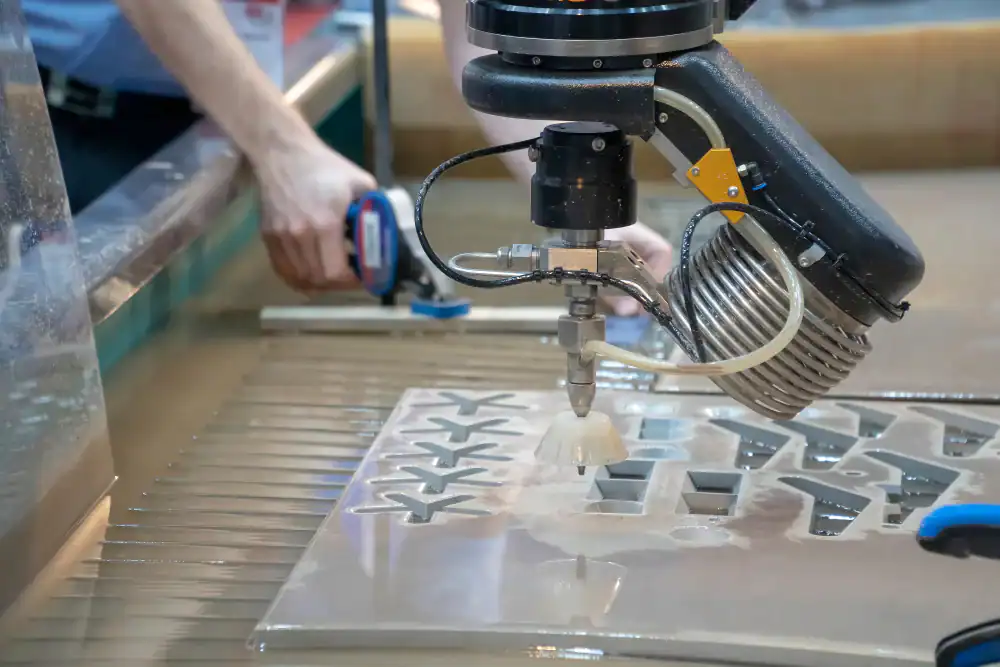
This isn’t a shop that dabbles in waterjet between other services. We’re a precision waterjet cutting shop serving Hicksville, NY and the surrounding region, built around a Flow Mach 500 CNC system that cuts directly from your CAD files. That means what you design is what you get, down to the thousandth.
We understand what it takes to support the local aerospace and defense ecosystem. Fast turnaround when you need it. Material consultation when you’re not sure which alloy will hold up. Design support when you’re still working through prototypes. You’re not getting a vendor—you’re getting a shop that knows what’s at stake when parts have to be right.
You send over your CAD file or bring in a sample of what you need cut. If you’re working through design, we can help translate your concept into a production-ready plan using advanced CAD tools.
Once the file is dialed in, it loads directly into our Flow Mach 500 CNC system. No manual programming. No room for interpretation errors. The machine reads your geometry and calculates the optimal path and pressure for your specific material and thickness.
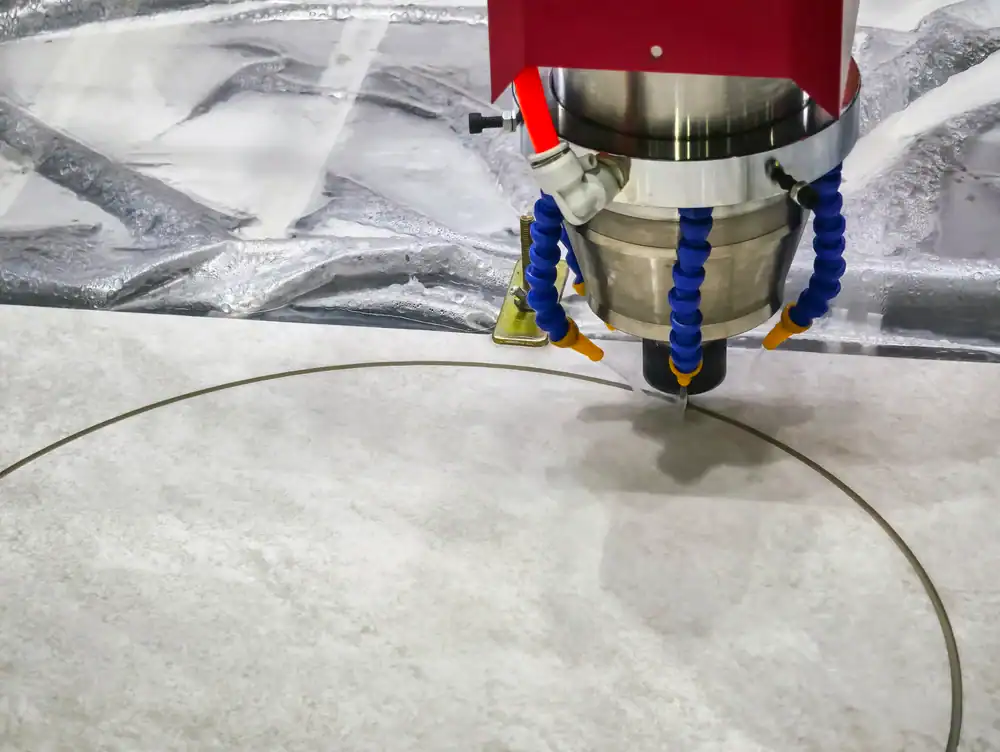
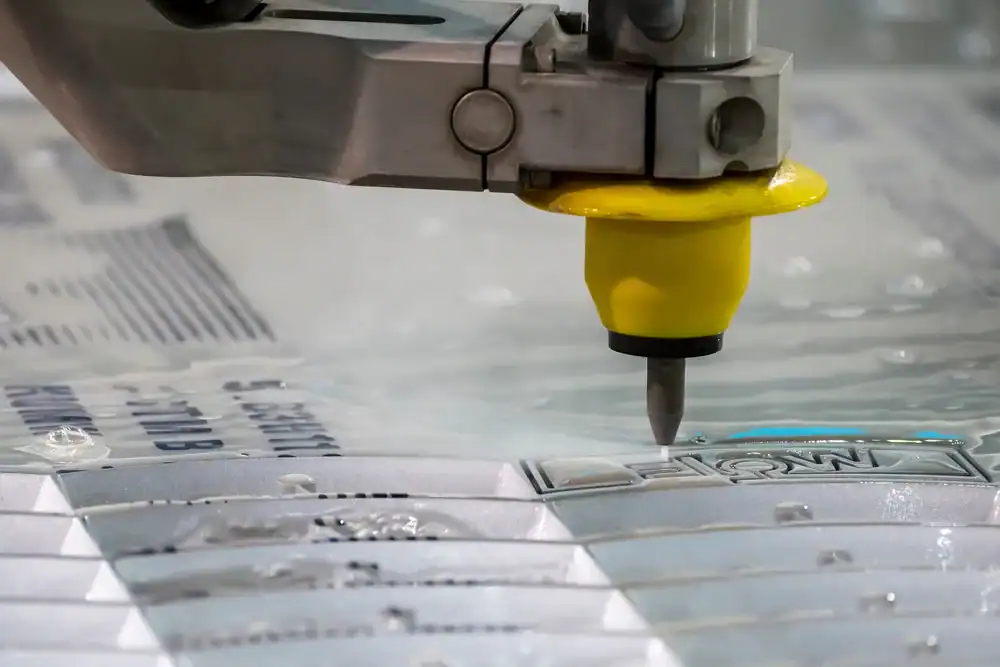
The cutting head moves across your material using a high-pressure stream of water mixed with abrasive garnet. It’s cold cutting—no heat, no HAZ, no material distortion. The jet handles everything from thin gasket material up to 3.25 inches thick, whether that’s titanium, aluminum, stainless, composites, or plastics.
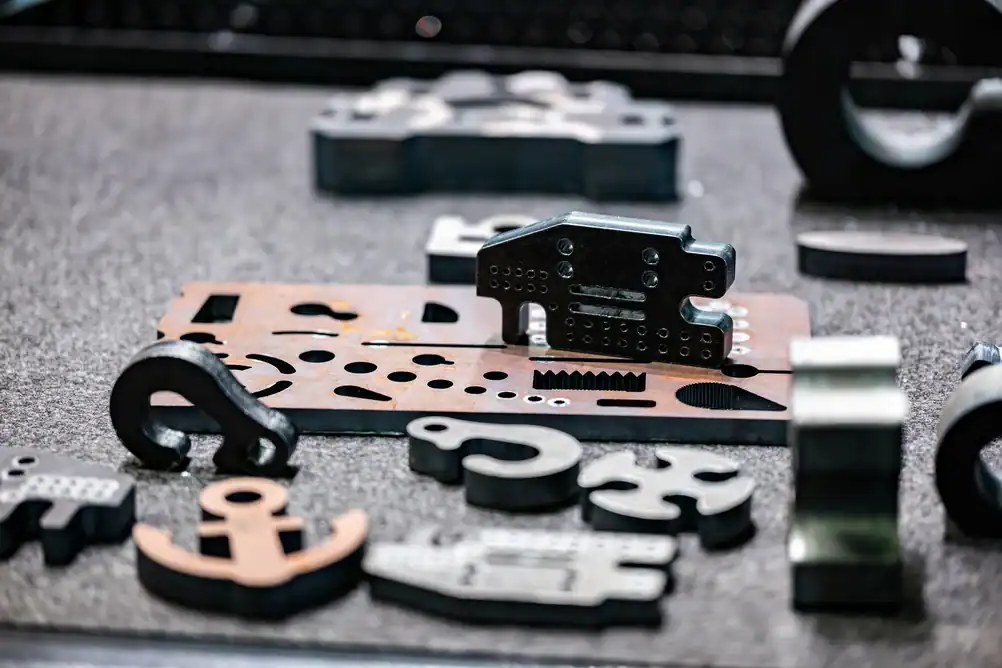
After cutting, parts come off the table with clean edges. No secondary deburring in most cases. No additional machining to hit tolerance. For most jobs, turnaround is two to three business days. Rush work gets handled when the timeline demands it.
You get parts that match your specs, ready for assembly or finishing, without the usual headaches that come from thermal cutting methods.
Ready to get started?
Our precision waterjet cutting for tight tolerances in Hicksville, NY means you’re working with a process that holds ±0.002″ on most materials, and ±0.001″ when the application calls for it. That level of repeatability matters when you’re producing multiple parts that need to be identical across a production run.
You’re not limited by material type. Metals, composites, glass, ceramics, rubber, stone—if it’s a solid material, the waterjet cuts it. Thickness ranges from 0.005 inches up to over 3 inches, which covers everything from intricate gaskets to structural aerospace components.
Because there’s no heat involved, your material properties stay intact. Hardness doesn’t change. Temper doesn’t shift. There’s no warping to correct later. For manufacturers working with expensive exotic alloys or pre-treated metals, that’s not a convenience—it’s a requirement.
The process also reduces waste. Tight nesting means you’re getting more parts per sheet. Minimal kerf width means less material turns into dust. When you’re buying titanium or Inconel by the pound, that adds up fast.
Hicksville’s proximity to major aerospace and defense manufacturers means local support for an industry that doesn’t tolerate delays. You’re not shipping parts across the country and waiting. You’re working with a shop that understands the standards, the timelines, and the stakes involved in precision manufacturing on Long Island.
Our precision waterjet cutting in Hicksville, NY holds ±0.002″ without issue. On certain materials and with optimized parameters, we can push that to ±0.001″. That’s tight enough for aerospace assemblies, defense components, and custom fabrication where parts need to fit together with minimal clearance.
The tolerance you’ll hit depends on material type, thickness, and edge quality requirements. Softer materials like aluminum tend to cut cleaner than fibrous composites. Thinner stock holds tighter tolerance than something pushing three inches thick. But for the majority of metal fabrication and machining work, ±0.002″ is the standard you’ll see consistently.
If your application demands even tighter specs, secondary operations like grinding can get you there. But in most cases, parts come off the waterjet table ready to use. No additional machining. No cleanup. That’s the advantage of cold cutting—you’re not chasing tolerances that shifted because of heat distortion.
Laser and plasma both introduce heat, which limits how thick you can cut before edge quality suffers or the material warps. Laser cutting typically maxes out around 1 inch on steel, and plasma gets messy past 2 inches. Both leave a heat-affected zone that changes the material properties along the cut edge.
Our waterjet handles thickness up to 3.25 inches or more without heat distortion. There’s no HAZ. No hardness change. No temper shift. The edge quality stays consistent whether we’re cutting 0.25 inches or 3 inches of the same material. For aerospace and defense work, that’s critical—you can’t have material properties changing mid-part.
Waterjet is also faster than EDM (electrical discharge machining) on materials under an inch thick—often five to ten times faster. And unlike EDM, waterjet isn’t limited to conductive materials. We can cut composites, ceramics, glass, plastics, and rubber with the same setup. That versatility matters when you’re prototyping or running mixed-material jobs without switching equipment.
Yes, but there are practical limits. The waterjet stream has a diameter—usually around 0.03 to 0.04 inches depending on the nozzle and abrasive size. That means your smallest inside radius will be roughly half that kerf width. You’re not getting a true sharp 90-degree inside corner, but you’re getting close enough for most applications.
For complex geometries, intricate curves, and detailed cutouts, waterjet excels. Our CNC system follows your CAD file exactly, so if you can draw it, we can cut it. That includes parts with multiple inside pockets, angled edges, or overlapping features that would be difficult or impossible with punch presses or manual machining.
Where waterjet really shines is cutting shapes that would require multiple setups on a mill or lathe. You load the material once, and the machine completes the entire part in a single operation. That reduces handling, eliminates setup errors, and speeds up production. For one-off prototypes or short production runs, that efficiency is hard to beat.
Most jobs turn around in two to three business days from the time your CAD file is approved and material is confirmed. That includes programming, cutting, and quality checks. If you’re supplying your own material, lead time depends on when it arrives and whether it needs any prep before cutting.
Rush work gets prioritized when the timeline demands it. Aerospace and defense projects often operate on tight schedules, and delays in one part can hold up an entire assembly. If you’re facing a hard deadline, communicate that up front. We can often accommodate faster turnaround when capacity allows.
Larger production runs or jobs requiring special materials may take longer. Exotic alloys sometimes need to be sourced, and thicker stock might require slower cutting speeds to maintain edge quality. But for standard materials in typical thicknesses, two to three days is the norm. That’s faster than most machine shops can turn around milled or EDM parts, especially when you factor in setup time and secondary operations.
It works well for both, but it’s especially cost-effective for prototypes and low-to-mid volume production. There’s no tooling to build, no dies to cut, and no setup costs beyond programming the CNC file. That means you’re not spending thousands of dollars before the first part gets made.
For prototyping, that’s a huge advantage. You can iterate on designs quickly without committing to expensive tooling. Cut a part, test fit it, revise the CAD file, and cut another version the next day. That speed and flexibility help you get to a final design faster and with less waste.
Production runs benefit from the same precision and repeatability. Once the program is dialed in, every part comes out identical. There’s no tool wear changing dimensions over time like you’d see with punch presses or routers. For runs of 10, 50, or even a few hundred parts, waterjet stays competitive on cost while delivering better edge quality than most mechanical cutting methods. If you’re scaling into the thousands, other processes might make more sense—but for the volumes most custom fabricators and aerospace suppliers run, waterjet hits the sweet spot.
Waterjet cuts almost everything, but there are a few exceptions. Tempered glass shatters because the internal stress can’t handle the localized pressure of the jet. Some ceramics are too brittle and crack before the cut completes. Certain composite laminates with honeycomb cores can cause the jet to diffuse, leading to poor edge quality.
Very soft or flexible materials like foam or rubber can be tricky. The jet can compress or deform the material instead of cutting cleanly through it. In those cases, results depend on thickness, density, and how well the material is supported during cutting. It’s not impossible, but it requires testing to see if the edge quality meets your needs.
For everything else—metals, stone, plastics, wood, composites, gasket materials—waterjet handles it without issue. The process doesn’t care about hardness, and it doesn’t generate heat, so even materials that would be difficult or impossible to cut with thermal methods work fine. If you’re not sure whether your material will cut cleanly, bring a sample. A test cut will tell you everything you need to know before committing to a full run.
Useful Links
Other Services we provide in Hicksville