Hear from Our Customers
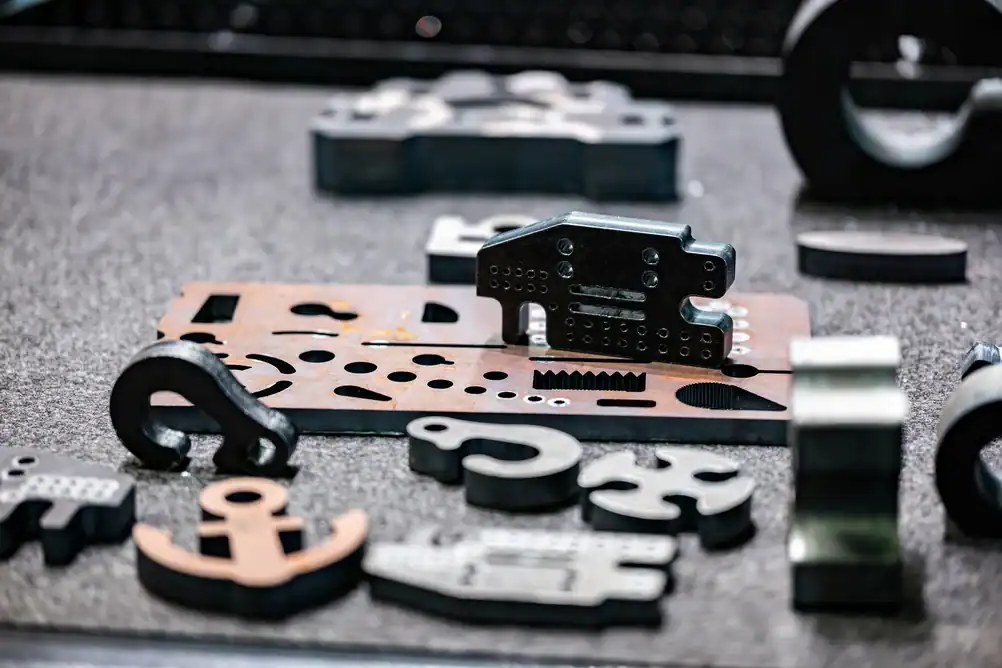
You’re looking at parts that come off the machine ready to use. No burrs to grind down. No heat-affected zones that changed your material properties. No warping that throws off your assembly.
Precision CNC waterjet cutting in Mastic Beach, NY handles metals, composites, stone, plastics, and specialty alloys up to several inches thick. The process uses pressurized water mixed with garnet abrasive to cut through your material without generating heat. That means titanium keeps its strength, aluminum doesn’t distort, and stainless steel maintains its corrosion resistance.
You get tolerances down to ±0.001 inches when your design calls for it. Complex geometries, tight radii, small holes, intricate patterns—all cut in a single setup without tool changes. Your CAD file goes directly to the CNC system, and the machine follows your specifications exactly, part after part.
We operate in Mastic Beach, NY, serving the manufacturing, aerospace, marine, automotive, and architectural sectors across Long Island and the surrounding tri-state area. The local manufacturing industry here employs thousands and demands precision work—which is exactly what drives our operation.
Our CNC waterjet systems maintain linear positional accuracy and repeatability within 0.001 inches over 12-inch spans. That level of consistency matters when you’re building aerospace components, custom marine hardware, or architectural metalwork where fit and finish can’t be approximated.
You’re working with a shop that understands material behavior, cutting parameters, and project timelines. We’ve processed everything from 1/8-inch acrylic to 6-inch stainless plate, and we know what it takes to deliver clean parts on schedule.
You send us your CAD file or technical drawing with your material specifications and tolerances. We review it for manufacturability and flag anything that might cause issues—like radii too tight for the kerf width or features that would benefit from a different approach.
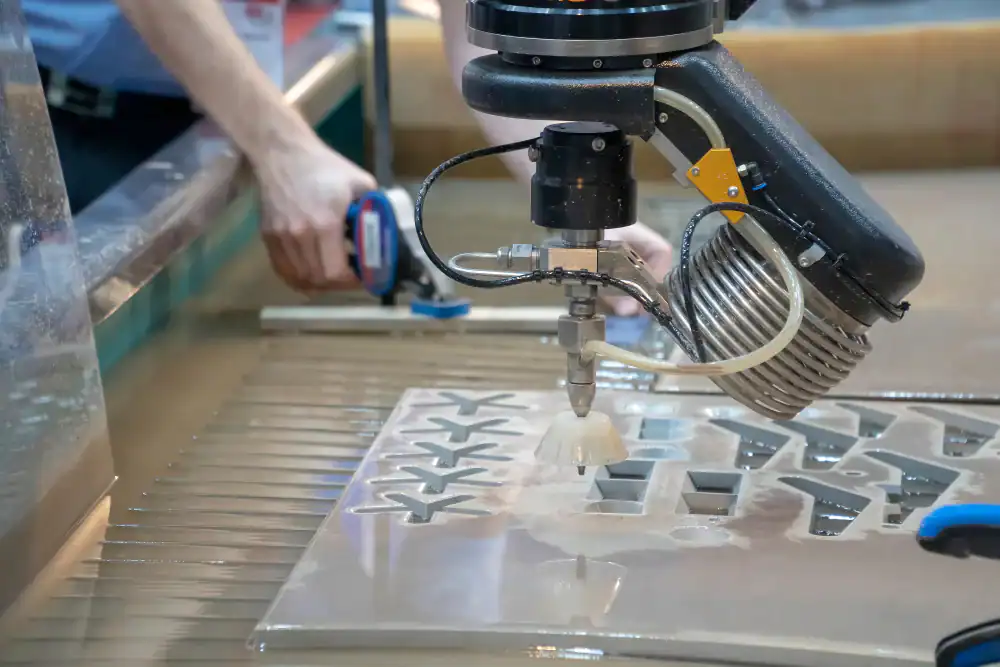
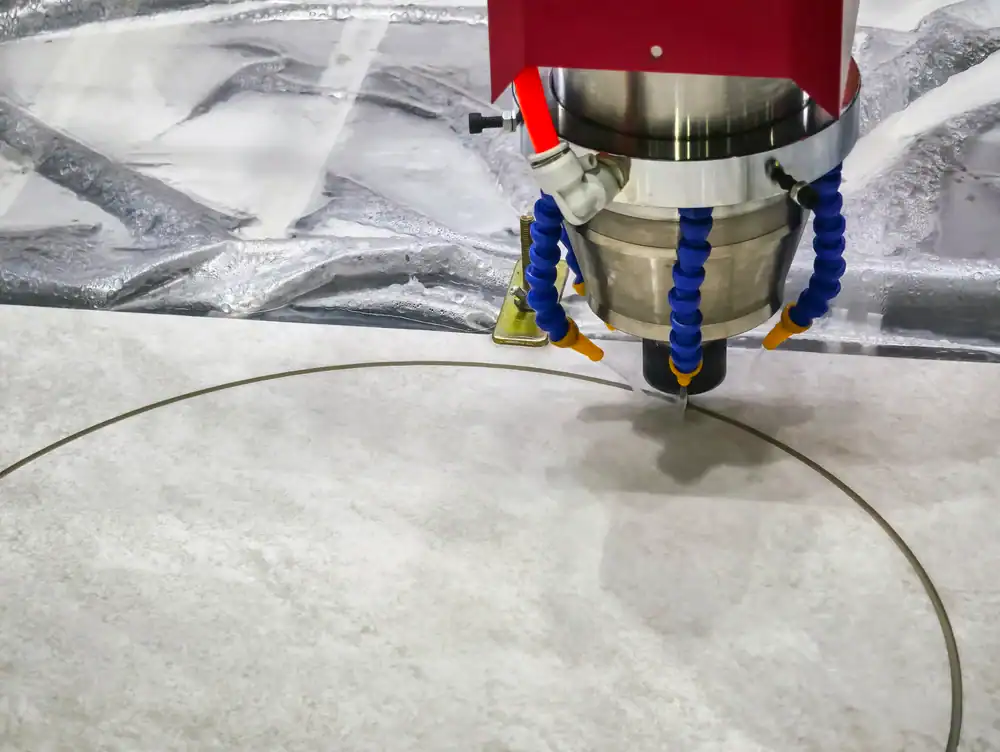
Once the file is optimized, our nesting software arranges your parts to maximize material usage and minimize waste. The CNC system loads the toolpath, and the cutting head positions over your material. A high-pressure pump forces water through a tiny orifice, mixing it with garnet abrasive just before it exits the nozzle at speeds exceeding twice the speed of sound.
The waterjet follows your design, cutting through the material with a stream thinner than a credit card. There’s no clamping pressure distorting thin materials, no heat changing the microstructure, and no mechanical force that could crack brittle substrates. The machine runs continuously until your parts are complete, then we inspect dimensions, deburr any minor edge inconsistencies if needed, and prepare your order for pickup or delivery.
Ready to get started?
Your parts come out with edge quality that typically eliminates secondary finishing. The cold-cutting process means there’s no hardened edge to machine away, no oxidation to clean up, and no thermal stress that could cause cracking down the line.
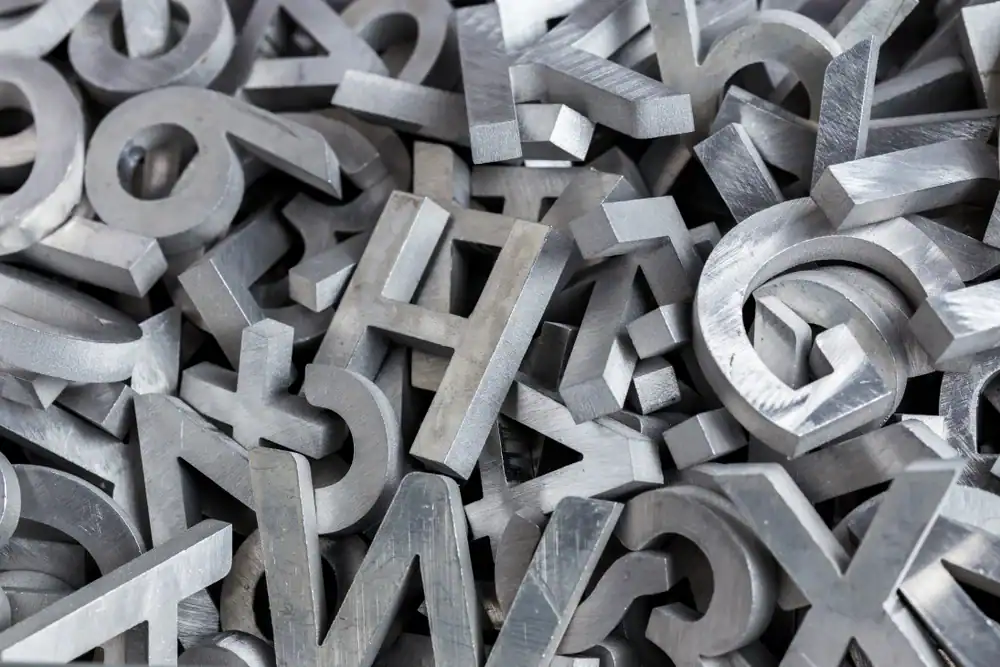
Material versatility covers nearly everything you’d specify. Metals like aluminum, stainless steel, titanium, Inconel, and tool steel. Composites including carbon fiber and fiberglass. Plastics from acrylic to PTFE. Stone, glass, ceramics, and rubber. If you’re working with specialty alloys or materials that are difficult to machine, precision waterjet cutting for tight tolerances in Mastic Beach, NY handles them without the tool wear or heat buildup that limits other processes.
Thickness capacity extends beyond what most shops can laser or plasma cut. We’ve cut steel over 12 inches thick and aluminum blocks 8 inches deep. For thinner materials, the narrow kerf width means you can nest parts closer together and get more pieces per sheet.
Turnaround depends on complexity and queue, but the process itself is fast. No tooling to fabricate, no setup fixtures to build, no programming delays. Prototypes and short runs move through quickly because there’s no economic penalty for small quantities. Manufacturing sectors here in Mastic Beach, where the median manufacturing wage tops $86,000, expect fast turnaround on precision work—and that’s what the technology delivers.
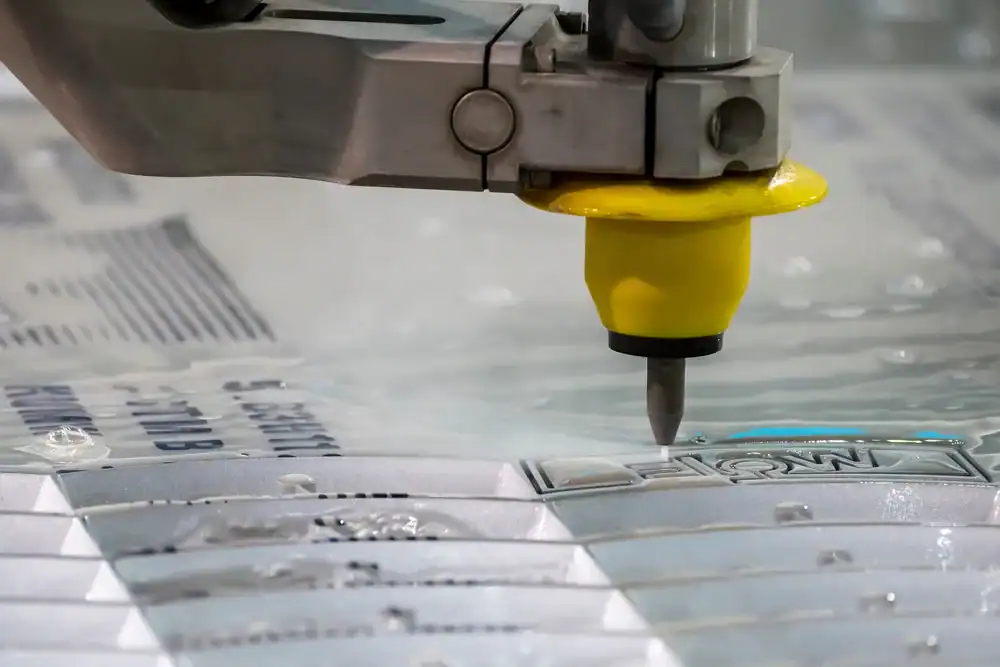
Industrial CNC waterjet systems hold linear positional accuracy and repeatability to ±0.001 inches, which puts them in the range needed for aerospace brackets, medical device components, and precision tooling. The actual achievable tolerance on your part depends on material thickness, edge quality requirements, and geometry.
Thinner materials and simpler shapes hit tighter tolerances more consistently. As you move into thicker materials or intricate details, you’re typically looking at ±0.003 to ±0.005 inches, which still exceeds what most mechanical cutting methods deliver without secondary operations.
The advantage for critical parts is that there’s no heat-affected zone altering material properties. Titanium components for aerospace applications maintain their strength and fatigue resistance. Stainless steel medical parts keep their corrosion resistance and biocompatibility. You’re not introducing thermal stress that could cause failure under load or in sterilization cycles.
Abrasive waterjet systems cut steel over 12 inches thick and aluminum beyond 8 inches. Practical limits depend more on your quality requirements than the machine’s raw capability. As material thickness increases, the waterjet stream disperses slightly, which affects edge straightness and kerf width.
For thick cuts where you need vertical edges, the top surface edge will be sharper than the bottom exit edge. That taper is measurable but often within acceptable limits for structural components, mounting plates, or parts that get machined after cutting. If you need dead-straight edges through 6-inch plate, we adjust cutting speed, abrasive flow, and pressure to minimize taper.
Edge quality on thick materials is still superior to torch cutting or band sawing. You’re getting a surface that’s smooth enough for welding prep without grinding, and there’s no hardened layer from heat that would dull your tools during secondary machining. For heavy fabrication work—common in marine and industrial applications around Mastic Beach—that combination of thickness capacity and edge quality saves time in downstream operations.
The limiting factor on small holes is the kerf width, which is typically 0.030 to 0.040 inches depending on abrasive size and nozzle diameter. You can cut holes as small as the kerf width allows, but for clean results, a diameter at least twice the kerf width works better. That puts practical minimums around 0.060 to 0.080 inches for through-holes in most materials.
Inside corners will have a radius equal to roughly half the kerf width because the waterjet stream is round. If your design requires sharp internal corners, you’d need to specify a corner relief or plan for secondary EDM or broaching. For most applications, a 0.015 to 0.020-inch radius in corners is acceptable and doesn’t affect function.
Tight geometries are where waterjet cutting outperforms punching or laser cutting on thicker materials. There’s no die wear limiting your design, and there’s no heat buildup that restricts how close you can place features. Complex parts with multiple holes, slots, and cutouts come off the machine in one operation instead of requiring multiple setups or processes.
Edge finish varies with cutting speed and material type, but most parts come off the machine ready to use. The top edge where the stream enters is clean and sharp. The bottom exit edge can show slight striations—visible lines that follow the cutting direction—but they’re usually fine enough that they don’t interfere with fit or function.
If you’re assembling parts where edges mate together, or if surface finish affects sealing or aesthetics, you can specify a slower cutting speed that produces a smoother edge. The tradeoff is time, but for parts where appearance or precision fit matters, it’s worth it. Architectural metalwork and decorative panels typically get cut at slower speeds for that reason.
For structural or hidden components, the standard edge finish is adequate. There are no burrs to deburr, no slag to chip off, and no heat scale to remove. You can weld directly to waterjet-cut edges without prep beyond a solvent wipe. That’s a significant time saver compared to plasma or laser cutting, where edge cleanup is a separate operation.
Simple parts with standard materials can be cut the same day if the queue allows. More complex jobs or specialty materials might take a few days, depending on current workload and whether we need to source specific material stock. The advantage of waterjet cutting for prototypes is that there’s no tooling lead time eating up your schedule.
You send a file, we program it directly into the CNC, and cutting starts. Changes are just as fast—if you need to revise a dimension or add a feature, it’s a file edit, not a new tool order. That flexibility matters when you’re iterating on a design or responding to field feedback.
For production runs, we can operate the equipment continuously to meet your delivery requirements. The machines run 24/7 if needed, and since there’s no tool wear to manage, long runs don’t degrade quality or slow down as the job progresses. Manufacturing operations in Mastic Beach often need quick turnaround to keep production lines moving, and waterjet cutting supports that without sacrificing precision.
Waterjet cuts virtually any material except tempered glass, which shatters from the impact pressure, and certain very soft or fragile materials that would erode rather than cut cleanly. Everything else—metals, composites, stone, ceramics, plastics, rubber—processes without issue.
You’d choose waterjet over laser when heat is a problem. Laser cutting creates a heat-affected zone that hardens the edge, changes material properties, and can warp thin sections. If you’re cutting aluminum, titanium, or stainless steel where you need the material to behave exactly as specified, waterjet keeps the microstructure intact.
You’d choose waterjet over plasma for thicker materials and better edge quality. Plasma cuts fast but leaves a rough, oxidized edge with significant taper on thick plate. Waterjet produces a cleaner edge with minimal taper, and it doesn’t introduce any of the fumes or hazardous gases that plasma generates. For shops working with specialty alloys or doing precision work where secondary finishing eats into margins, waterjet cutting eliminates those extra steps and delivers parts that meet spec right off the machine.
Useful Links
Other Services we provide in Mastic Beach