Hear from Our Customers
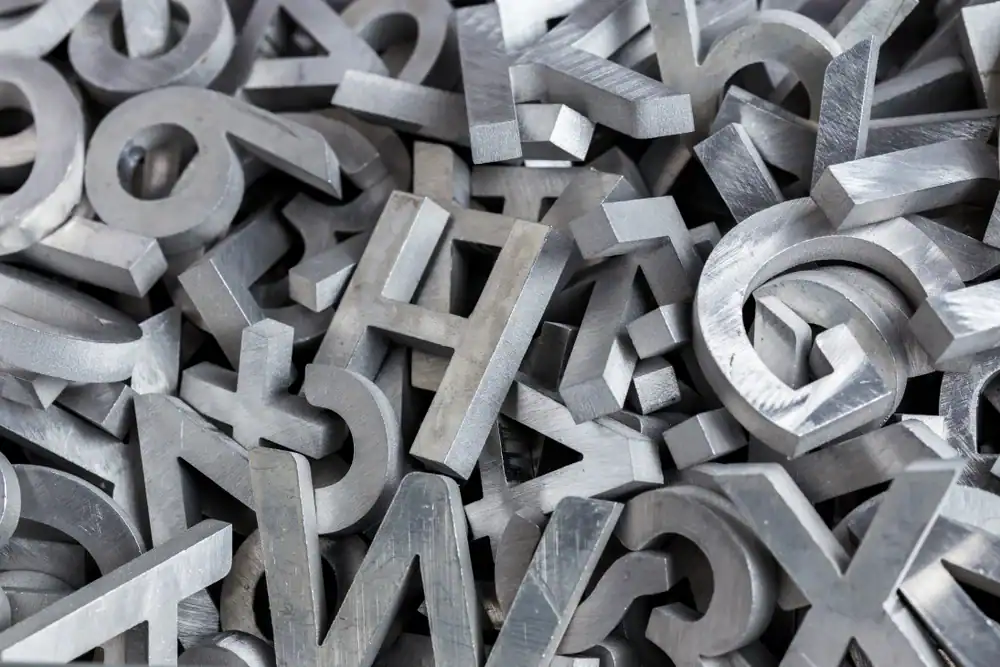
You need parts that fit the first time. No warping from heat. No secondary finishing eating into your schedule. No explaining to your customer why the tolerances are off.
Precision water jet cutting services handle that pressure because the process runs cold—no heat-affected zones, no material stress, no distortion. You’re working with aerospace-grade accuracy on everything from 1/8″ aluminum to 3″ stainless steel, and the edge quality comes off the machine ready to use.
That means faster turnaround on prototypes when you’re testing a design. It means production runs that don’t slow down because you’re not fixing mistakes. And it means you’re not paying for extra machining steps to clean up rough cuts or burnt edges.
We operate right here in New Hyde Park, NY, serving the manufacturers, fabricators, and engineers who keep Long Island’s industrial sector moving. You’re not dealing with a distant shop that doesn’t understand local turnaround expectations or the industries you’re in.
Long Island has a deep manufacturing history—aerospace, medical devices, automotive components, custom fabrication. The companies here don’t settle for “close enough,” and neither do we. When you need precision CNC waterjet cutting that holds tight tolerances without the back-and-forth, you’re working with a team that knows what’s on the line.
You send over your drawings or CAD files—DXF, DWG, whatever format works for you. We review the specs, confirm material type and thickness, and program the cut path into our CNC system. No tooling to build. No dies to wait on.
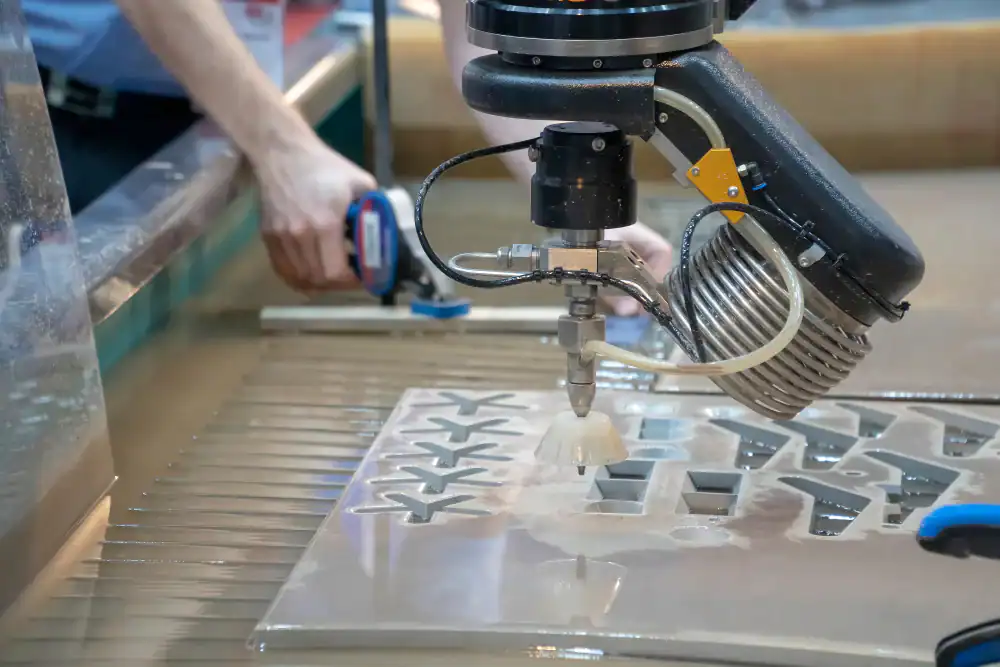
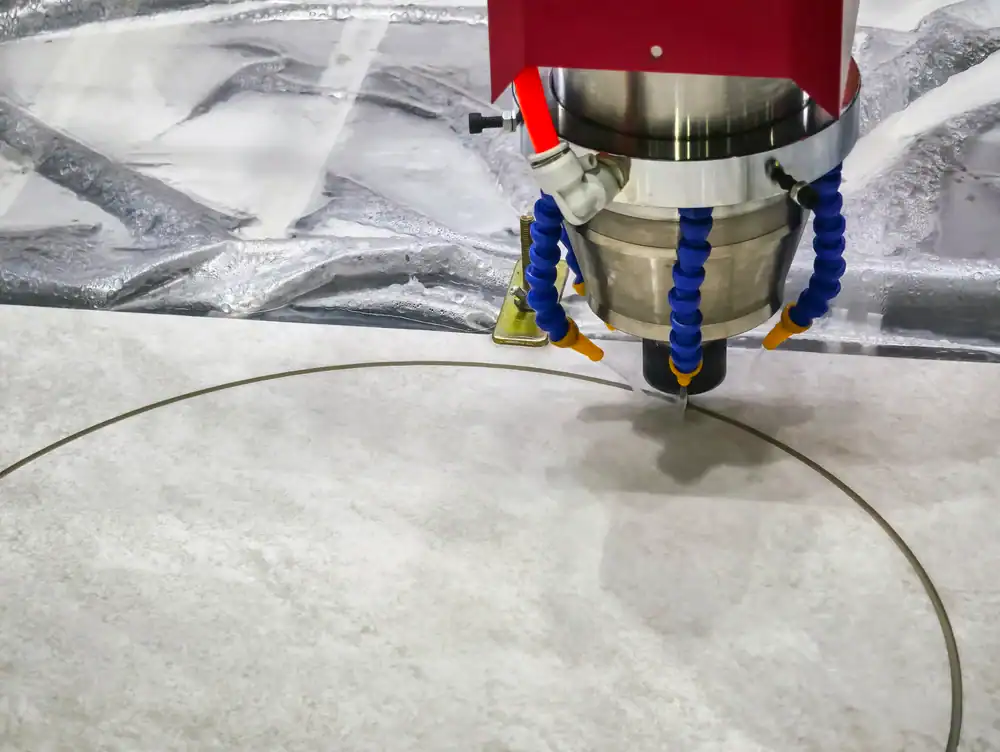
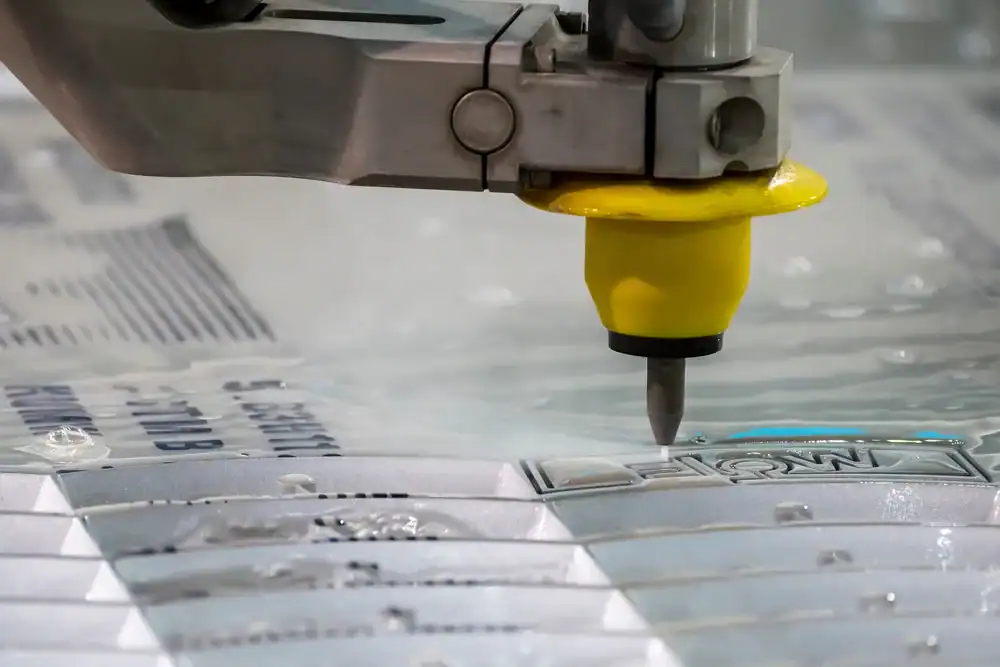
The waterjet runs a high-pressure stream—up to 60,000 PSI—mixed with garnet abrasive when cutting harder materials like metal or stone. For softer materials, it’s just water. The system follows your programmed path with precision down to ±0.001″, cutting complex shapes, tight radii, small holes, whatever the design calls for.
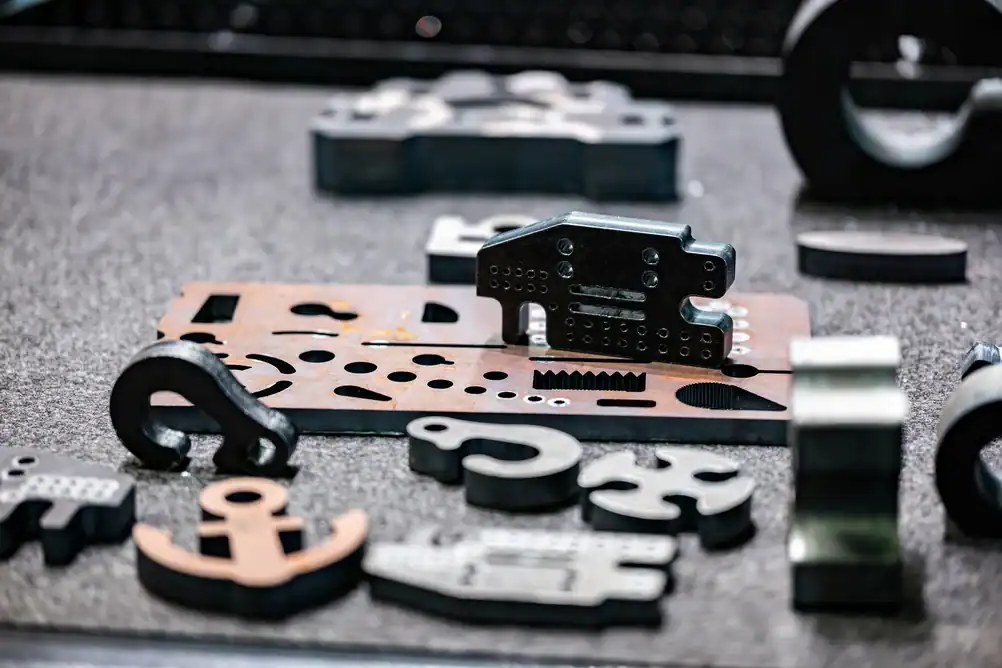
Once the cut is complete, parts come off the table with clean edges and no heat damage. You’re not dealing with slag, burrs, or hardened zones that need grinding down. Most jobs go straight to assembly or the next stage of production without extra finishing work.
Ready to get started?
You get material versatility that other cutting methods can’t match. Metals—aluminum, stainless, titanium, tool steel. Composites, plastics, rubber, glass, stone, ceramics. If it’s up to 3-1/4″ thick, the waterjet handles it without changing tooling or process.
You get tolerances tight enough for aerospace and medical applications—±0.005″ standard, ±0.001″ on advanced jobs. That level of accuracy matters when you’re building components that can’t afford to be off by even a few thousandths.
And you get speed where it counts. Prototypes can turn around in a day or two because there’s no die to fabricate. Production runs move faster because the machine operates continuously without tool changes, and you’re not adding time for secondary finishing. For New Hyde Park manufacturers competing on both quality and delivery, that combination keeps projects on schedule and customers satisfied.
Standard industrial waterjet systems hold ±0.005″ without issue. That’s tight enough for most metal fabrication, automotive parts, and general manufacturing applications where fit and function matter.
Advanced systems—like the CNC waterjet cutting equipment we use for aerospace and medical work—can hit ±0.001″. That’s the range you need when parts have to mate perfectly, when assembly tolerances are unforgiving, or when you’re working with expensive materials that don’t allow room for error.
The key difference comes down to machine calibration, nozzle condition, and how the cut path is programmed. If your drawings call for tolerances in the ±0.001″ range, make sure the shop you’re working with has the equipment and experience to deliver it consistently—not just on one part, but across an entire production run.
Yes, but thickness does affect cut quality, and you need to know what to expect. Waterjet systems cut materials up to 3-1/4″ thick in most cases, and thicker in some setups—but as material thickness increases, the stream loses a small amount of energy as it passes through.
On thinner materials—under 1″—the cut is nearly perpendicular with minimal taper. As you move into 2″ or 3″ stock, you might see slight taper on the exit side of the cut, usually a few thousandths. That’s where nozzle angle, abrasive flow rate, and cutting speed get dialed in to keep the edge within tolerance.
For critical applications, we can use multiple passes or adjust parameters to tighten up the kerf. The point is, thickness doesn’t disqualify waterjet cutting—it just means the process gets tuned to match the material and the specs you’re holding.
Most waterjet cuts come off the table ready to use. You’re not dealing with the slag you’d get from plasma, the burrs from laser on thicker metals, or the rough edges from mechanical cutting. The stream exits clean, and the edge quality reflects that.
There are cases where a light deburring pass makes sense—if you’re working with very soft materials that might have a slight fuzz on the exit side, or if the application has zero tolerance for any edge variation. But those situations are the exception, not the rule.
For the majority of jobs—metal parts going to powder coating, components heading to assembly, prototypes being test-fit—the waterjet edge is good as-is. That saves time and cost because you’re not adding another operation to clean up the cut. It’s one of the reasons waterjet often beats other methods on total cost per part, even if the cutting time is slightly longer.
Laser is faster on thin sheet metal—under 1/4″ mild steel or aluminum—and it’s a solid choice when you’re cutting high volumes of simple shapes. But laser creates a heat-affected zone. That means potential for warping, hardened edges, and discoloration, especially on stainless or materials sensitive to thermal stress.
Waterjet runs cold. No heat means no warping, no hardened zones, and no secondary annealing or stress relief. That matters when you’re cutting parts that need to stay flat, when you’re working with pre-hardened tool steel, or when the material can’t tolerate any change in properties.
Waterjet also cuts thicker materials without losing capability—2″ or 3″ plate is routine, and you’re not limited to metals. Composites, plastics, glass, stone—waterjet handles all of it with the same machine. If your work involves mixed materials, tight tolerances, or thicker stock, waterjet gives you more flexibility without the thermal concerns that come with laser.
Prototypes and short runs can turn around in 24 to 48 hours if the schedule allows and the material is in stock. There’s no tooling to fabricate, no die to build—just program the cut and run it. That speed matters when you’re testing a design or need a part to keep a project moving.
Production runs depend on complexity, material, and quantity. Simple shapes in thinner materials cut faster. Intricate designs with tight radii, small holes, or multiple pierces take longer because the machine slows down to maintain accuracy. Material thickness also affects cutting speed—3″ stainless takes more time per inch than 1/2″ aluminum.
The advantage is consistency. Once the program is set, the waterjet runs the same cut over and over without drift or tool wear. So even if the cutting time per part is longer than some methods, you’re not stopping to change tooling, adjust for heat distortion, or rework parts that came out wrong. That keeps the overall timeline predictable.
Yes. Waterjet excels at intricate cuts because the stream diameter is small—typically 0.020″ to 0.040″ depending on the nozzle—and the CNC system follows the programmed path exactly. You can cut inside corners with tight radii, pierce small holes, and navigate complex geometries that would be difficult or impossible with mechanical tooling.
The limitation is usually the material thickness relative to the hole size. Cutting a 0.050″ hole through 2″ plate is going to be challenging for any process. But for reasonable proportions—holes a few times the material thickness, radii that don’t require the stream to make impossibly tight turns—waterjet handles it without issue.
Intricate shapes also benefit from the lack of tool pressure. There’s no mechanical force pushing against the material, so delicate parts don’t deflect or distort during the cut. That’s why waterjet is common in aerospace and medical applications where complex parts need to come out dimensionally accurate without any stress or deformation.
Useful Links
Other Services we provide in New Hyde Park