Hear from Our Customers
You’re not cutting parts for fun. You need them accurate, clean, and ready to use without spending extra time or money fixing rough edges or heat damage.
That’s what precision water jet cutting services in North Bellmore, NY give you. No heat-affected zones that warp your material. No burned edges that need grinding down. No melted surfaces or hardened spots that throw off your tolerances.
Just clean cuts with crisp edges that typically fall within 0.002 to 0.005 inches of your specifications. The kind of accuracy that lets you move directly to assembly or installation without secondary processing eating into your timeline or budget.
It works on virtually any material you’re using—aluminum, stainless steel, titanium, Inconel, brass, copper alloys, carbon fiber, plastics, composites, even exotic materials up to 6 inches thick. One process handles it all, which means you’re not coordinating multiple vendors or dealing with the limitations of laser cutting or plasma that can’t touch certain materials without damaging them.
We operate right here in North Bellmore, NY, serving the Long Island manufacturing community with precision waterjet cutting for tight tolerances in North Bellmore, NY. We’re not a national chain with a local address—we’re a local shop that understands the industries driving this area.
Aerospace components. Automotive parts. Architectural metalwork. Marine fabrication. Defense applications. We’ve cut parts for all of them, and we know what’s at stake when your specs are non-negotiable.
You get direct access to people who understand your materials, your timelines, and your tolerance requirements. No runaround. No wondering if your parts are being cut correctly. Just straightforward communication and parts that match your drawings.
You send us your design files—CAD drawings, DXF files, or even sketches if you’re still working through the concept. We review your specifications, material requirements, and tolerances to make sure waterjet cutting is the right fit for what you need.
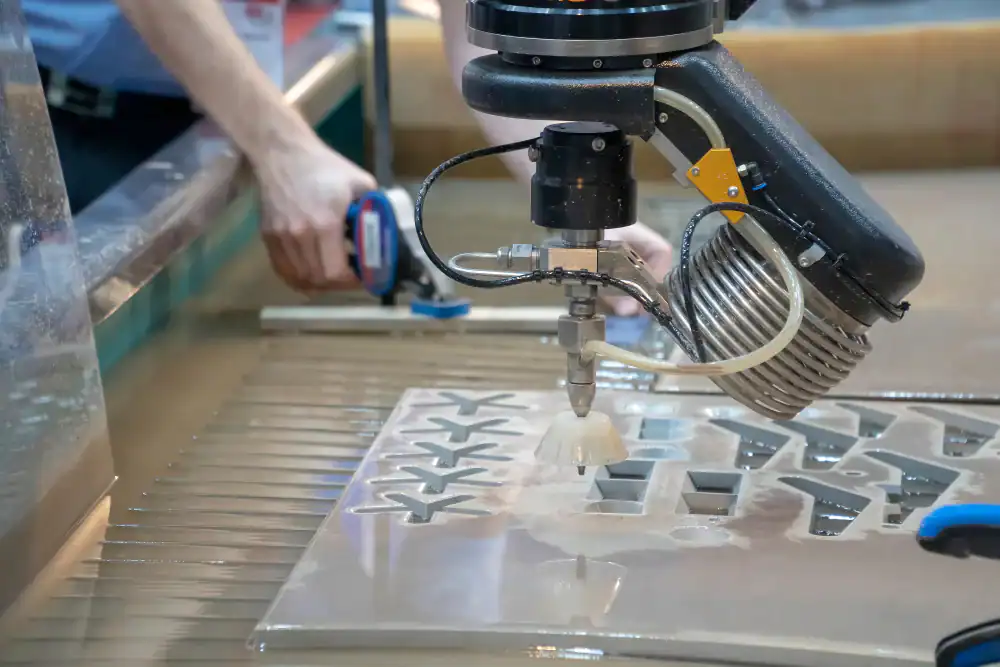
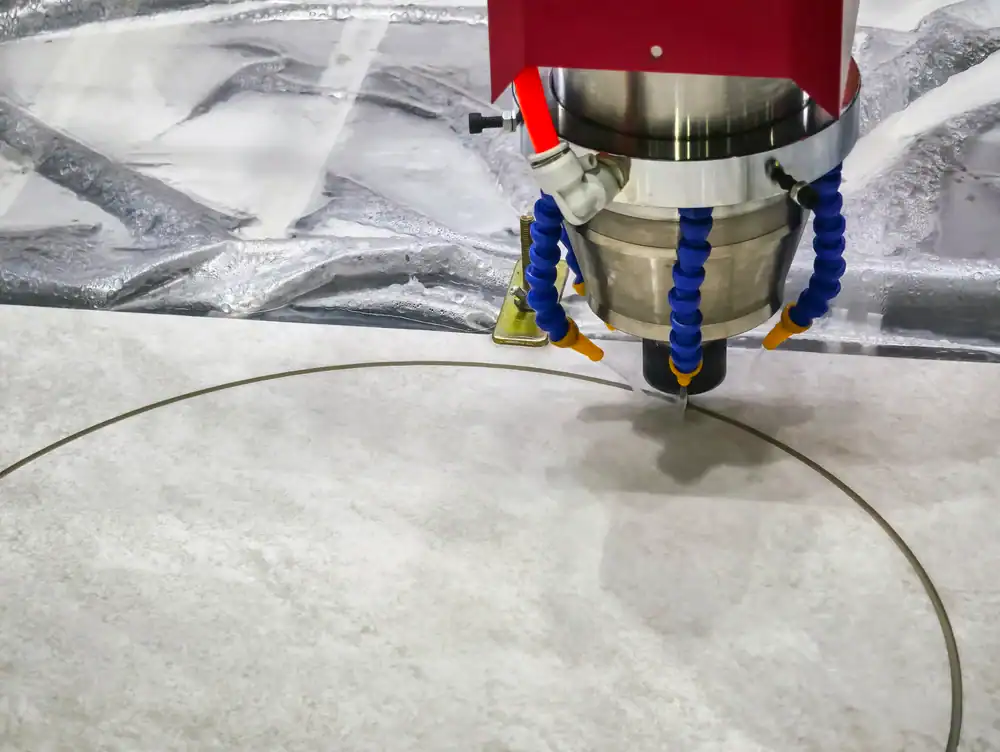
Once we confirm the details, we program the CNC waterjet system with your exact specifications. The cutting head follows your design with a high-pressure stream of water mixed with abrasive garnet, slicing through your material with a needle-thin kerf that minimizes waste and maintains tight tolerances.
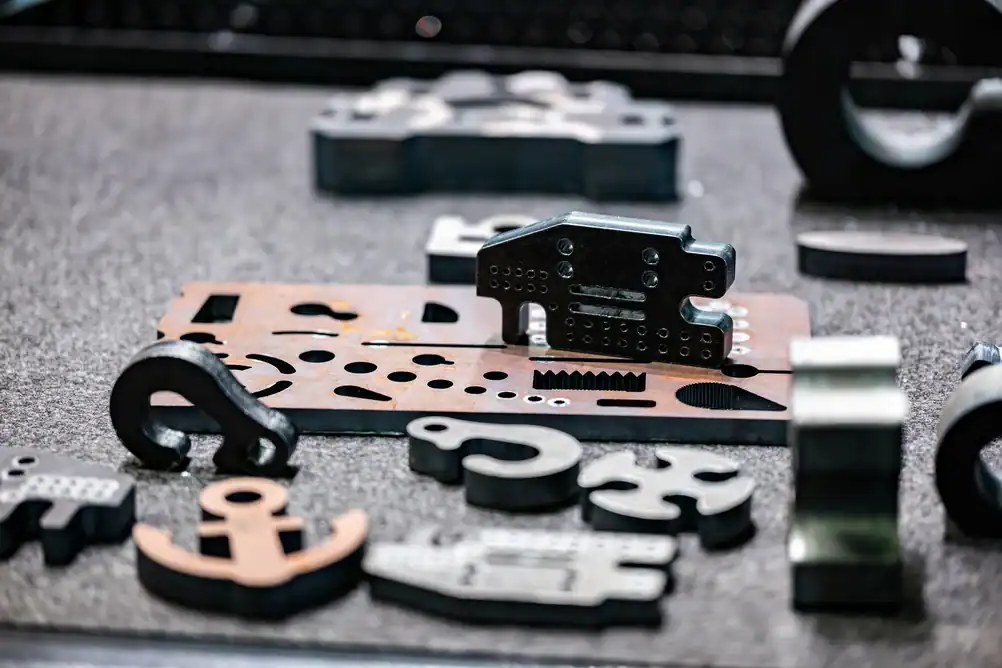
Because there’s no heat involved, your material doesn’t warp, melt, or develop a heat-affected zone that changes its properties. What you get back are parts with clean, burr-free edges that typically don’t require additional finishing.
For complex geometries—tight radii, narrow corners, small holes, intricate patterns—the 5-axis capability handles cuts that would be difficult or impossible with other methods. And because we’re not limited by material hardness or thickness, you can bring us challenging projects without worrying whether the process can handle it.
Ready to get started?
You get precision waterjet cutting in North Bellmore, NY with tolerances that typically hold to 0.002 inches, and on advanced cuts, as tight as 0.001 inches. That’s the kind of accuracy aerospace and defense manufacturers require, and it’s what you can expect on every job.
Material consultation is part of the process. If you’re not sure whether waterjet cutting is right for your material or application, we’ll walk through it with you. We work with everything from thin plastic films to 6-inch-thick metals, so we’ve seen most scenarios and can tell you what to expect.
Custom design support is available if you’re still refining your concept. From initial drawings to final production files, we help you get to a design that’s manufacturable and meets your functional requirements.
North Bellmore’s industrial base includes food processing, aerospace suppliers, automotive shops, and architectural fabricators—all industries where precision matters and mistakes are expensive. We’ve worked with local manufacturers who need fast turnaround on prototypes and production runs that can’t afford delays or rework. That’s why our process is built around getting it right the first time, so you’re not waiting on replacement parts or dealing with the cost of scrapped material.
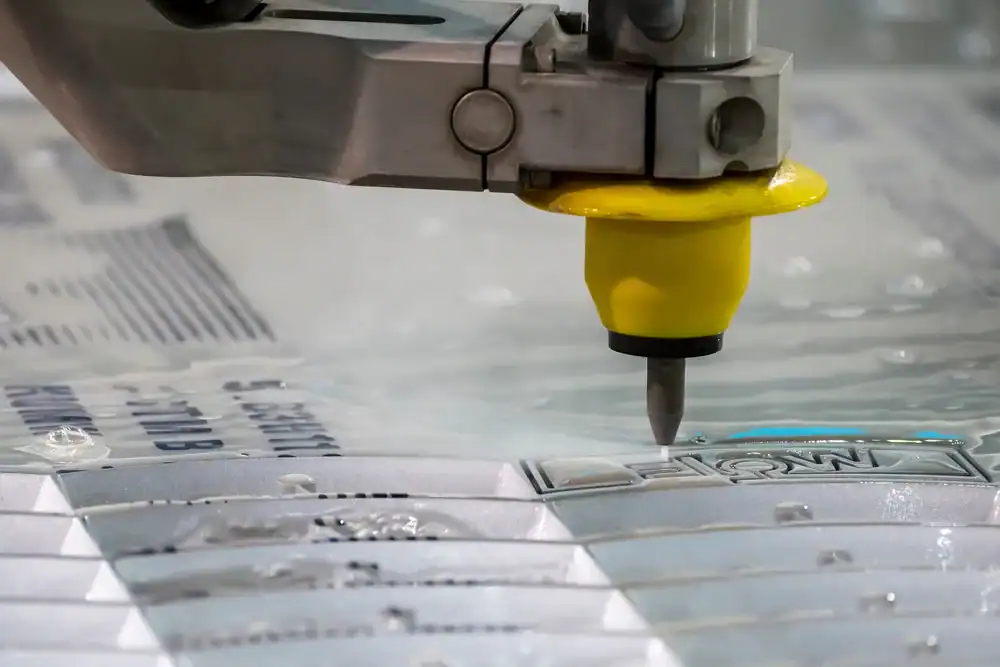
We cut metals like aluminum, stainless steel, titanium, Inconel, brass, and copper alloys. We also handle carbon fiber, composites, plastics, rubber, glass, stone, and ceramics.
The process works on materials from thin films up to 6 inches thick. If it’s a solid material, waterjet cutting can likely handle it—and without the heat damage you’d get from laser or plasma cutting.
That versatility matters when you’re working on projects that involve multiple material types. Instead of coordinating different cutting methods or vendors, you can get everything cut in one place with consistent quality across all your parts.
Standard industrial waterjet systems hold tolerances around 0.002 inches. Advanced systems can achieve 0.001 inches on specific applications.
For most manufacturing projects—aerospace components, automotive parts, architectural metalwork—that level of accuracy is more than sufficient. It’s tight enough to meet strict specifications without requiring secondary machining or finishing in most cases.
The key advantage is consistency. Because the process is CNC-controlled and doesn’t introduce heat that can warp or distort material, you get repeatable accuracy across production runs. That’s critical when you’re making multiple parts that need to fit together or match existing components exactly.
Laser and plasma cutting generate heat that creates a heat-affected zone around the cut edge. That heat can warp thin materials, change the hardness of metals, create slag that needs grinding off, or leave a recast layer that affects part performance.
Waterjet cutting uses cold water and abrasive, so there’s no heat-affected zone. Your material properties stay consistent right up to the cut edge. You don’t get warping, melting, burning, or hardening.
That matters most when you’re cutting materials sensitive to heat—like aluminum that warps easily, or hardened tool steels where you can’t afford to change the temper. It also matters when edge quality is critical and you don’t have time or budget for secondary finishing operations.
Yes. The cutting stream is needle-thin, which allows for tight radii, narrow corners, small holes, and intricate patterns that would be difficult with other cutting methods.
5-axis waterjet systems can cut beveled edges and complex three-dimensional shapes without repositioning the part. That capability is especially useful for architectural components, aerospace parts with compound angles, or any design where the cut needs to follow a non-linear path.
There’s no tooling to change out for different shapes or features, which keeps costs down and speeds up production. The CNC system follows your design file exactly, so what you draw is what you get—without the limitations of mechanical tooling or the risk of tool breakage on hard materials.
Turnaround depends on material thickness, complexity, and quantity. Simple cuts on thinner materials can often be completed within a few days. Thicker materials or high-volume production runs take longer but are still faster than methods requiring multiple setups or secondary finishing.
Abrasive waterjet cutting is up to four times faster than conventional waterjet cutting, which helps keep production times competitive. And because most parts come off the machine with finished edges, you’re not adding days or weeks for deburring, grinding, or other post-processing.
If you’re working under a tight deadline, let us know upfront. We can often prioritize rush jobs or adjust scheduling to meet critical project timelines—especially for local North Bellmore manufacturers who need quick turnaround on prototypes or replacement parts.
Yes, because there’s no expensive tooling to create or change out. The CNC system runs directly from your design file, so setup costs are minimal compared to processes that require custom dies, molds, or specialized cutting tools.
That makes waterjet cutting economical for prototypes, one-offs, or small production runs where traditional methods would be prohibitively expensive. You’re not amortizing tooling costs across thousands of parts—you’re paying for machine time and material.
The other cost advantage is reduced waste. The narrow kerf means less material is lost to the cutting process, and the precision means fewer rejected parts due to dimensional errors. When you factor in the elimination of secondary finishing operations, the total cost per part is often lower than alternative cutting methods—even on small quantities.
Useful Links
Other Services we provide in North Bellmore