Hear from Our Customers
Your production schedule doesn’t have room for do-overs. When parts come back warped from heat or need hours of secondary machining to hit spec, you’re losing time and money you can’t get back.
Precision CNC waterjet cutting in Oyster Bay, NY cuts materials without generating heat. No thermal distortion. No hardened edges that fight your tools during finishing. Just clean cuts that hold tolerances within .001 inches, ready for assembly or minimal touch-up.
That means faster turnaround on prototypes when you’re testing designs. It means production runs that don’t get held up by quality issues. And it means you’re not explaining to your customer why their deadline just moved.
Whether you’re cutting one prototype or a thousand production pieces, the process stays consistent. The tenth part matches the first. That’s what keeps your operation moving.
We operate from West Islip, serving the Long Island manufacturing community that’s been building aerospace, defense, and precision components for decades. This region knows what tight tolerances mean because companies here have been supplying OEMs and government contracts since the Grumman days.
You’re not explaining your requirements to someone who just learned what a kerf is. We’ve worked with the tier-two and tier-three suppliers that make Long Island’s manufacturing ecosystem function.
When you need precision water jet cutting services in Oyster Bay, NY, you’re working with a shop that understands your material challenges, your timeline pressures, and why that .001-inch tolerance actually matters to your application. Local proximity means faster communication and quicker delivery when your schedule gets tight.
You send your design file and material specifications. CAD files, DXF, or even marked-up drawings work. The more detail you provide about tolerances and edge finish requirements, the better.
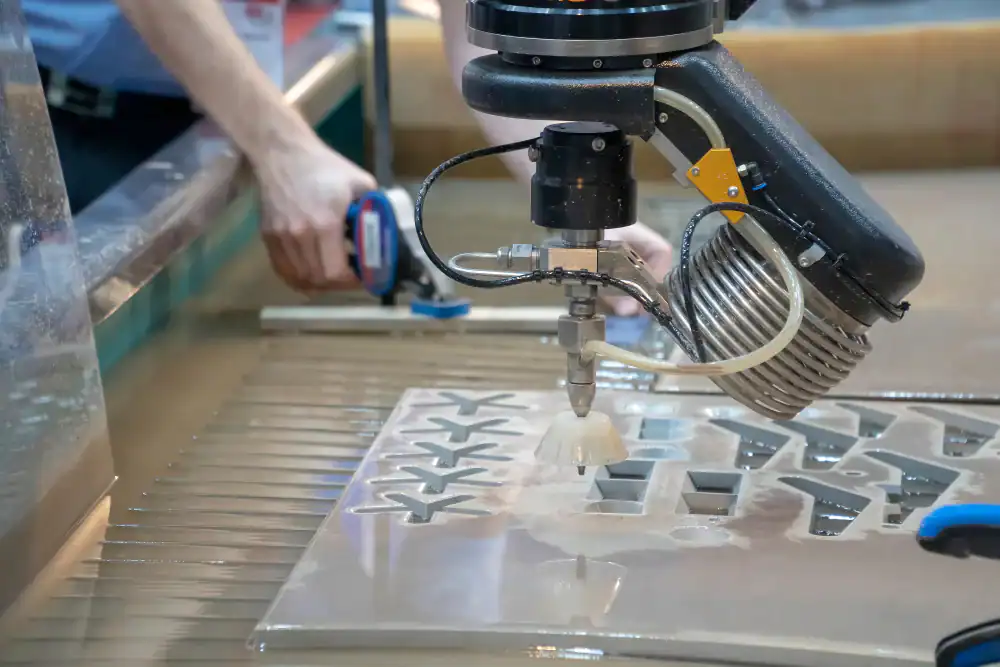
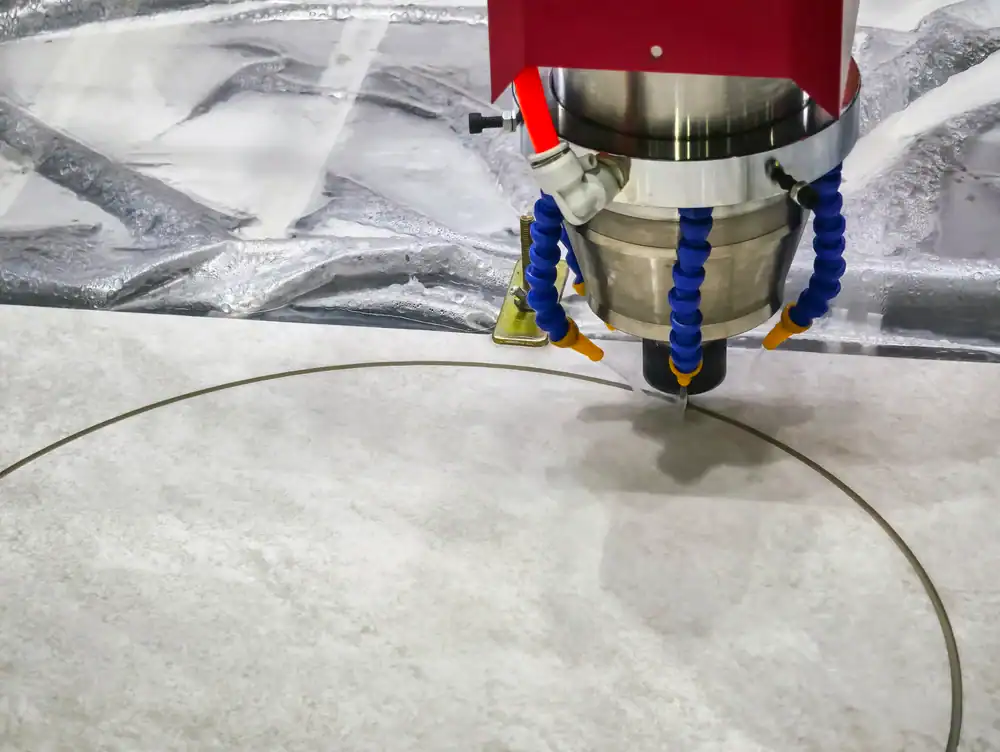
We secure the material on our 6-foot by 12-foot cutting bed. A nozzle measuring .010 inches in diameter delivers a high-pressure stream of water mixed with abrasive garnet. This stream cuts through your material—whether that’s eighth-inch aluminum or 8-inch stainless steel—following the programmed path with positioning accuracy of ±.001 inches.
There’s no torch heat. No laser reflection issues with brass or copper. No tool wear changing your dimensions halfway through a production run. The waterjet just removes material in a narrow kerf, leaving edges that are clean enough for many applications to skip secondary operations entirely.
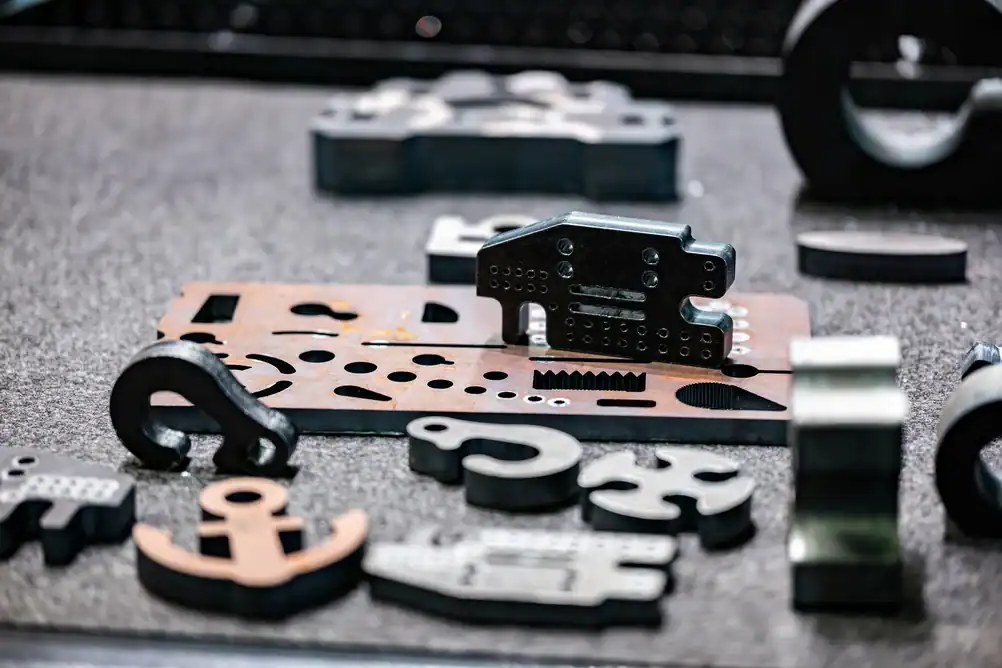
You get parts that match your specifications, cut from materials ranging from plastics and aluminum to Inconel and Hastelloy. If you need one piece to test fit and function, that’s what you get. If you need a full production run, the process scales without requiring expensive tooling or setup charges.
Ready to get started?
You get cuts through virtually any material up to 8 inches thick. Stainless steel, aluminum, copper, brass, bronze, Hastelloy, Inconel, titanium, plastics, composites—materials that would warp under torch heat or reflect laser energy get cut cleanly.
Complex geometries that would require multiple setups on traditional equipment get cut in one pass. That .010-inch kerf width allows intricate shapes and tight nesting to maximize your material usage. Less scrap means lower material costs, especially when you’re working with expensive alloys.
Edge quality comes out clean with minimal striations on most materials and thicknesses. Many parts go straight to assembly. Others need just light finishing instead of heavy grinding or machining to remove heat-affected zones or rough edges.
For Oyster Bay manufacturers dealing with the skilled labor shortage that’s hitting Long Island shops hard, waterjet cutting reduces the secondary operations that require experienced machinists. The automated cutting process handles the precision work, freeing up your skilled people for tasks that actually need their expertise. When Long Island economists point out that “the skill set isn’t matching” what manufacturers need, technologies like precision waterjet cutting help bridge that gap by delivering finished or near-finished parts without requiring extensive manual machining.
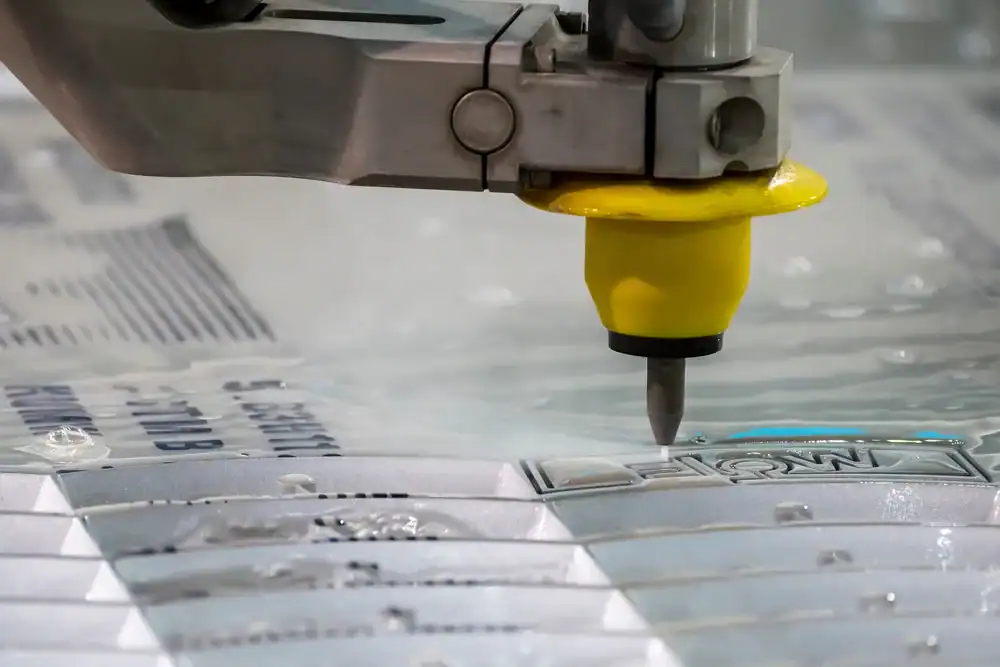
Positioning accuracy runs ±.001 inches on our cutting system. That’s the machine’s ability to place the cutting stream where the program tells it to go.
Your actual part tolerance depends on several factors. Material thickness affects it—thinner materials hold tighter tolerances than thick plates because there’s less opportunity for the stream to wander. Material type matters too, since some materials cut cleaner than others.
For most applications in the 0.25-inch to 2-inch thickness range, you can expect tolerances in the ±.003 to ±.005-inch range on critical dimensions. Thinner materials often come in tighter. Thicker materials may run slightly wider. If your application requires tolerances tighter than ±.003 inches, that’s a conversation worth having upfront about material selection, thickness, and whether waterjet is the right process or if you need a combination of waterjet rough cutting followed by precision machining.
Laser systems struggle with reflective metals like copper, brass, and polished aluminum because the beam reflects back into the optics instead of cutting efficiently. That reflection can damage equipment and creates inconsistent cut quality.
Waterjet doesn’t care about reflectivity. The abrasive stream cuts copper and brass just as effectively as it cuts steel or aluminum. You get consistent edge quality and cutting speed regardless of how shiny or reflective your material is.
This matters for Oyster Bay manufacturers working on electrical components, marine hardware, or architectural elements where copper and brass are common materials. You’re not limited in material selection because of process constraints. If your design calls for brass, you can cut brass without worrying about whether the cutting process can handle it or whether you’ll get quality issues from reflection.
Yes, and that’s one of the practical advantages. You don’t need to invest in stamping dies, cutting tools, or other setup costs that only make sense at high volumes.
For prototypes, we can cut one piece or ten pieces to test your design. Make changes to the CAD file, and the next version gets cut without any tooling changes or setup fees. This speeds up your development cycle when you’re iterating on a design.
For production runs, the same process scales up. The hundredth part comes out the same as the first part because there’s no tool wear changing dimensions. Our system can run 24/7 if your production schedule requires it, cutting parts while your shop is closed for the night.
This flexibility matters when you’re not sure whether a new product will require ten parts or ten thousand parts. You’re not making expensive commitments before you know actual demand. You can start with small quantities and scale up as orders increase, without changing processes or investing in new tooling.
Cutting time depends on material type, thickness, and part complexity. Simple shapes in thin material cut quickly—sometimes minutes per part. Complex geometries in thick stainless steel take longer because the cutting stream moves more slowly through dense material.
Most straightforward jobs with standard materials turn around within a few days from file approval to finished parts. Rush jobs can often be accommodated, especially for local Oyster Bay customers where delivery time is measured in minutes, not days.
The advantage of working with a local precision waterjet cutting shop in Oyster Bay, NY is that communication happens quickly. Questions about tolerances, edge finish, or material selection get answered in a phone call, not an email chain that stretches over days. File revisions don’t wait for the next business day in a different time zone.
If you’ve got a tight deadline because a production line is waiting or a customer moved up their schedule, having cutting capacity within the Oyster Bay area means you can actually hit those deadlines instead of explaining why the parts are still in transit.
Waterjet cutting produces minimal to no burrs on most materials. The abrasive stream exits the bottom of the material cleanly, especially on metals in typical thicknesses.
Compare that to plasma or laser cutting, where you’re often spending significant time grinding or deburring edges before parts are ready for welding, assembly, or finishing. Those secondary operations add labor cost and time to every part.
The edge quality from waterjet cutting is clean enough that many parts go directly to powder coating, anodizing, or assembly without any edge prep. Some applications require light deburring just to break sharp corners for handling safety, but you’re talking about a quick pass with a file or scotch-brite, not heavy grinding.
This matters when you’re calculating true part cost. A process that looks cheaper per cutting hour but requires two additional operations to get parts ready for use often ends up costing more in total labor and throughput time. High precision waterjet cutting in Oyster Bay, NY delivers parts that are closer to finished state, which means fewer touches and faster completion.
Waterjet cuts virtually any material, but there are practical limitations worth knowing. Tempered glass shatters because the cutting process releases the internal stresses. Some ceramics are too brittle and crack under the stream pressure.
Very soft, flexible materials like rubber or foam can be challenging because they absorb the stream energy instead of being cut cleanly. Thin, delicate materials may require special fixturing to prevent movement during cutting.
For everything else—metals, plastics, composites, stone, tile—waterjet handles it. The 8-inch maximum thickness covers most manufacturing applications. If you’re working with materials thicker than that, you’re into specialized territory that requires a different conversation.
The practical limitation is usually economics, not capability. Waterjet can cut 6-inch stainless steel, but it’s slow and expensive. If you’re doing that regularly, other processes might make more sense. For occasional thick cuts or materials that can’t be cut any other way, waterjet is often your only option. Understanding these limitations upfront helps you make smart decisions about which cutting process fits your specific application and production volume.
Useful Links
Other Services we provide in Oyster Bay