Hear from Our Customers
You’re not cutting parts for fun. You’re meeting specifications that determine whether a component gets approved or rejected. Whether it’s aerospace parts requiring ±0.005″ tolerances or custom architectural metalwork that needs to fit perfectly on-site, the margin for error is basically zero.
Precision waterjet cutting for tight tolerances in Salisbury, NY means you get parts that hold to ±0.001″ under strict conditions. No heat-affected zones that warp your material. No melting, burning, or hardening that throws off your specs. Just cold water and abrasive cutting through steel, aluminum, stainless, brass, copper, Inconel, Hastelloy, or plastic up to 6″ thick.
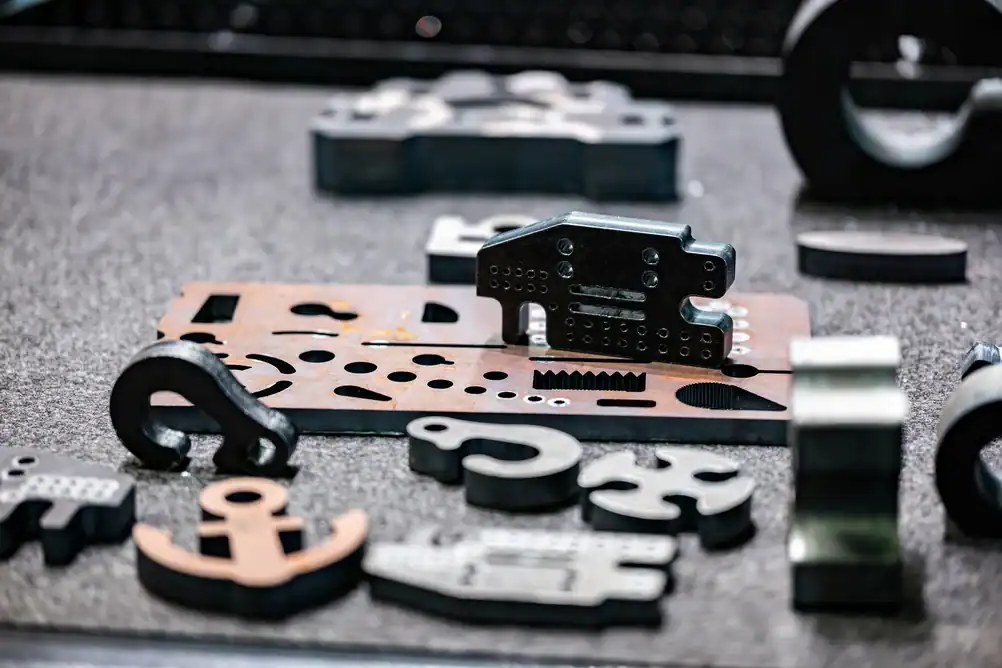
The edges come out clean and burr-free. Most parts don’t need secondary finishing, which means fewer process steps and fewer chances for something to go wrong. You send your specs, we cut your parts, and they show up ready to use.
We serve manufacturers, fabricators, architects, and contractors throughout Salisbury, NY and the surrounding region. We’re equipped with multi-axis CNC waterjet cutting systems that handle complex geometries, tight tolerances, and thick materials without the limitations of thermal cutting methods.
Salisbury’s manufacturing sector—from automotive suppliers to custom metal fabrication shops—needs reliable precision cutting that doesn’t create bottlenecks. We typically turn around most waterjet work in 2-3 business days, and we work with your material or source it for you.
You’re not dealing with a shop that views waterjet as a secondary service. This is what we do, and we’ve dialed in the process to consistently produce accurate parts.
You start by sending us your CAD files, drawings, or specifications. We review your tolerances, material requirements, and quantities to confirm the job parameters and provide a quote. If you need material consultation—maybe you’re not sure if 304 or 316 stainless is the right call for your application—we’ll walk through that with you.
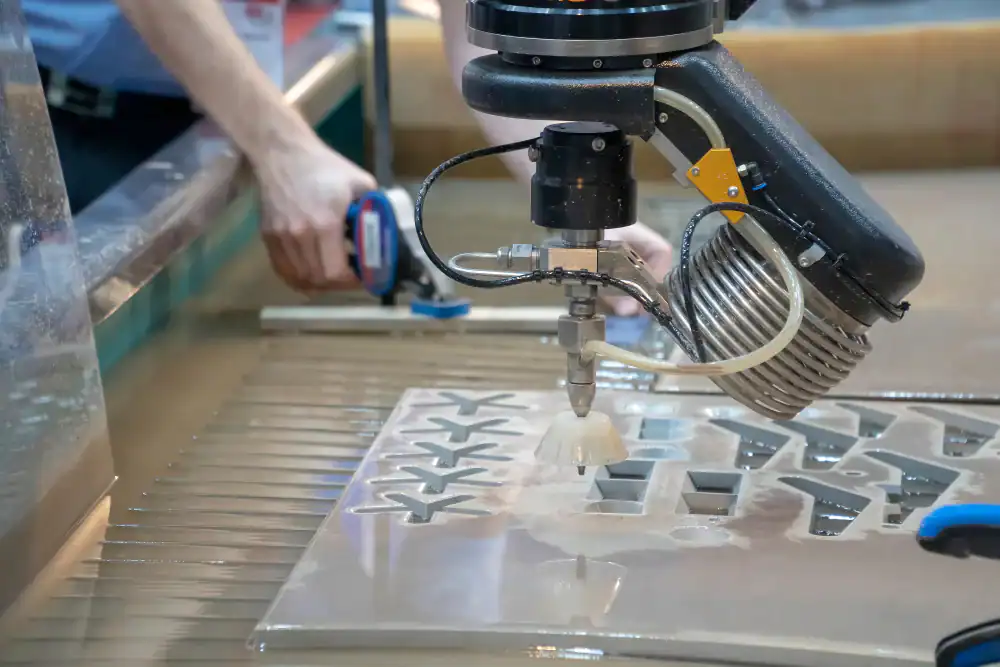
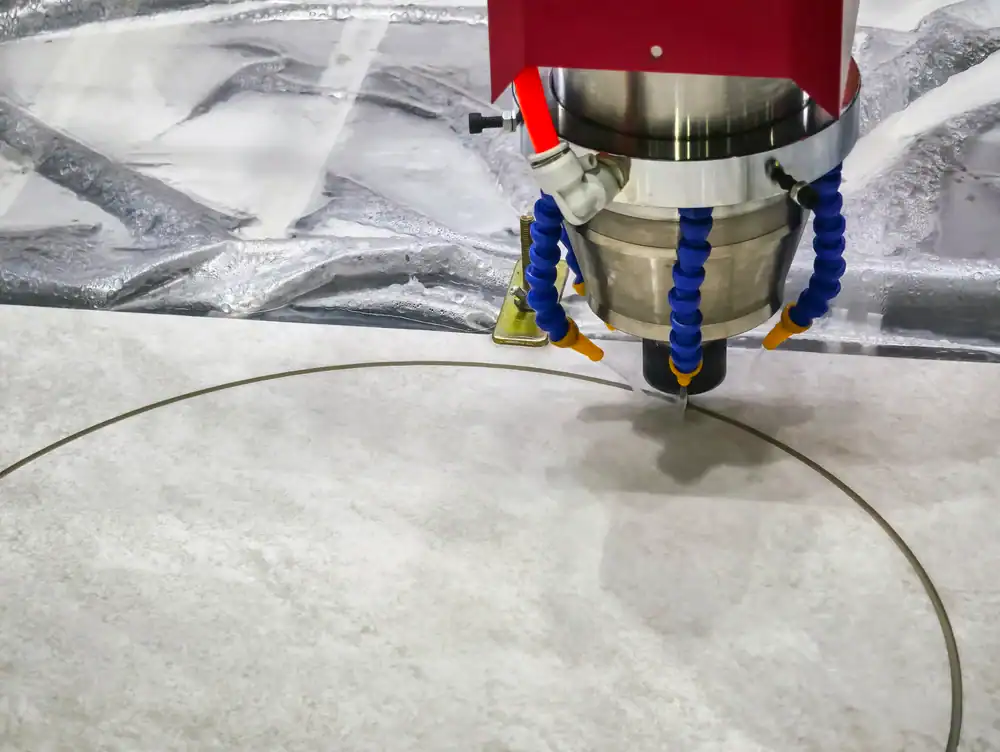
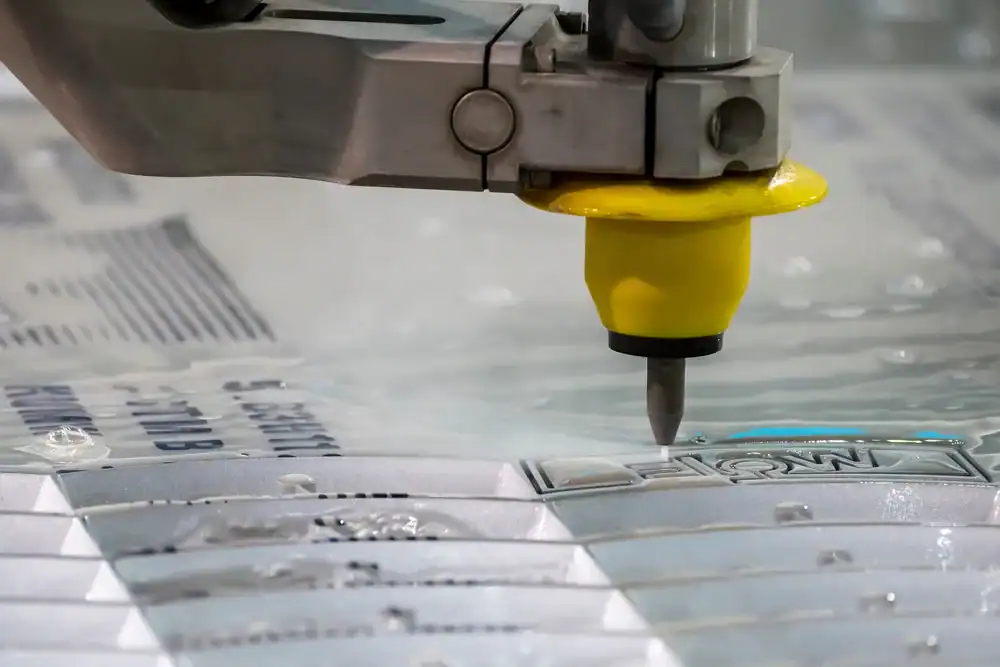
Once you approve, we program the CNC waterjet system based on your exact specifications. The cutting process uses a high-pressure stream of water mixed with abrasive garnet particles. This stream is typically 0.030″ to 0.040″ wide, which means minimal kerf and maximum material utilization. For complex parts, our multi-axis capability allows us to cut at angles from 0 to 90 degrees without repositioning your material.
During the cut, there’s no heat transfer to speak of, so your material properties stay intact. No warping, no hardening, no HAZ issues that would compromise your tolerances. After cutting, parts are inspected and prepped for delivery or pickup. Most jobs ship within 2-3 business days unless you need a faster turnaround—then we talk about what’s possible.
Ready to get started?
Precision water jet cutting services in Salisbury, NY handle materials that other processes struggle with. Thick stainless plate, hardened tool steel, heat-sensitive plastics, reflective metals like copper and brass—waterjet cuts them all without changing their properties. You can run small prototype batches or production quantities, and the setup doesn’t require custom tooling or dies.
Salisbury’s proximity to major manufacturing hubs in New York means fast access to materials and quick shipping to your facility. If you’re supplying parts to aerospace, automotive, or defense contractors, you already know that late deliveries and out-of-spec parts aren’t options. Waterjet cutting removes the risk of thermal distortion that comes with laser or plasma, and it handles thicker materials than wire EDM without the speed penalty.
The process also maximizes your material yield. Because the kerf is so narrow and we can nest parts efficiently, you’re not paying for excessive scrap. For architectural and design work—custom metal panels, intricate stone or glass inlays, decorative metalwork—the clean edges and intricate detail capability mean your designs actually translate to finished pieces without compromise.
Under standard production conditions, you’re looking at tolerances around ±0.005″. If you need tighter control and the job parameters allow for it, precision waterjet cutting can hit ±0.001″ on certain applications. That’s tighter than most laser or plasma systems, and you’re getting it without heat distortion.
The key factor is operator skill and equipment calibration. A waterjet system that’s properly maintained and programmed by someone who knows what they’re doing will consistently produce accurate parts. If your prints call for tight tolerances—especially on aerospace or medical components—waterjet is often the most reliable process because there’s no thermal expansion or HAZ to account for.
You’ll want to discuss your specific tolerance requirements upfront. Some geometries or material thicknesses affect achievable tolerances, so it’s worth a conversation before you commit to a process.
We can cut up to 6″ thick on both metal sheets and plate. That includes steel, stainless, aluminum, brass, copper, and exotic alloys like Inconel or Hastelloy. Plastics and composites in that thickness range are no problem either.
Thicker materials take longer to cut—that’s just physics—but the process remains consistent. You’re not dealing with the edge quality degradation that happens with plasma on thick plate, and you don’t have the heat input that warps heavy material. The cut stays perpendicular, and the edges stay clean.
If you’re working with something thicker than 6″, we can discuss options. Sometimes it makes sense to cut from both sides or look at alternative processes, but for most applications in the Salisbury area, 6″ covers what manufacturers and fabricators need.
Most of the time, no. The edges come off the machine clean and burr-free, which is one of the main reasons people choose waterjet over laser or plasma. You’re not grinding, filing, or sanding to get a usable edge. The part is ready for welding, assembly, or finishing as-is.
There are cases where you might want additional finishing—if you need a specific surface roughness for a sealing surface, or if cosmetic appearance requires polishing. But those are finishing operations you’d do anyway, not corrections for a rough cut. The waterjet process itself produces a smooth edge that typically measures under 125 Ra in surface roughness.
This matters when you’re trying to control costs and lead times. Every additional process step is another opportunity for error, another scheduling dependency, and another line item on your invoice. Waterjet eliminates most of that.
Most jobs are completed in 2-3 business days from approval. That includes programming, cutting, inspection, and prep for delivery or pickup. If you’re running a large production quantity or have especially complex parts, it might extend slightly, but we’ll tell you that upfront.
Rush jobs are possible depending on our current schedule. If you’ve got a deadline that’s tighter than our standard turnaround, call and we’ll see what we can do. Manufacturing in Salisbury and the surrounding region moves fast, and we understand that sometimes you need parts yesterday.
The advantage of waterjet is that there’s no tooling to build or dies to cut. Once we have your file and material, we’re programming and cutting. That’s faster than processes that require setup tooling, and it’s why waterjet works well for both prototypes and production runs.
Yes. Complex geometries, tight inside corners, small holes, intricate patterns—waterjet handles all of it. The stream is narrow enough (0.030″ to 0.040″) that you can cut fine details, and our multi-axis systems allow us to approach the material from different angles for bevels, chamfers, or complex 3D shapes.
There are some practical limits. You can’t cut an inside radius smaller than the width of the stream, so extremely tight radii might require a design adjustment. But for most applications—architectural metalwork, custom brackets, decorative panels, precision components—the level of detail is more than sufficient.
The CNC programming allows us to follow your CAD geometry exactly. If you can draw it, we can cut it. That’s especially useful for one-off custom pieces or prototype work where you’re still iterating on the design.
We cut metals, plastics, composites, stone, glass, and ceramics. On the metal side, that includes stainless steel, carbon steel, aluminum, copper, brass, bronze, titanium, Inconel, Hastelloy, and tool steels. Plastics like acrylic, polycarbonate, HDPE, and Delrin all cut cleanly without melting or chipping.
The process is cold, so heat-sensitive materials don’t distort or degrade. Reflective metals like copper and brass—which give laser systems trouble—cut without issue on waterjet. Layered or composite materials stay bonded because there’s no heat to separate the layers.
If you’re not sure whether your material is a good fit for waterjet, just ask. Some materials have specific considerations—like certain ceramics that might crack under the stream pressure—but the vast majority of industrial materials cut without any problem.
Useful Links
Other Services we provide in Salisbury