Hear from Our Customers
You’re working with tight specs. Maybe it’s aerospace components where a few thousandths matter, or architectural panels that need to align perfectly on-site. Traditional cutting methods introduce heat, and heat changes your material—warping edges, creating stress points, forcing you into secondary finishing that eats time and budget.
Precision CNC waterjet cutting in Shirley, NY uses a cold process. Water and abrasive cut through your material without altering its properties. No slag, no dross, no heat-affected zones that compromise strength or require cleanup.
The result is edges that come off the table ready to use. You’re not scheduling extra machining time. You’re not explaining to your client why parts don’t fit. You’re moving forward with components that meet the tolerances you promised, whether that’s ±0.004″ or tighter.
We run an in-house design review on every file before it hits the cutting table. We’re catching tolerance issues, material conflicts, and design problems while they’re still digital—not after you’ve already paid for the material.
Our team works across architectural, industrial, and security applications throughout Shirley, NY and Long Island. We’ve seen what happens when cutting shops skip the engineering step, and we’ve built our process around preventing those failures.
When you send us a file, you’re getting feedback from people who understand both the CAD side and the physical realities of waterjet cutting. That combination keeps your project on schedule and your parts within spec.
You send us your design file—DXF, DWG, or whatever format your team works in. Our engineering team reviews it for cuttability, checking for tolerance conflicts, kerf width issues, or design elements that won’t translate cleanly to the cutting table. If we spot something, we reach out before we start cutting.
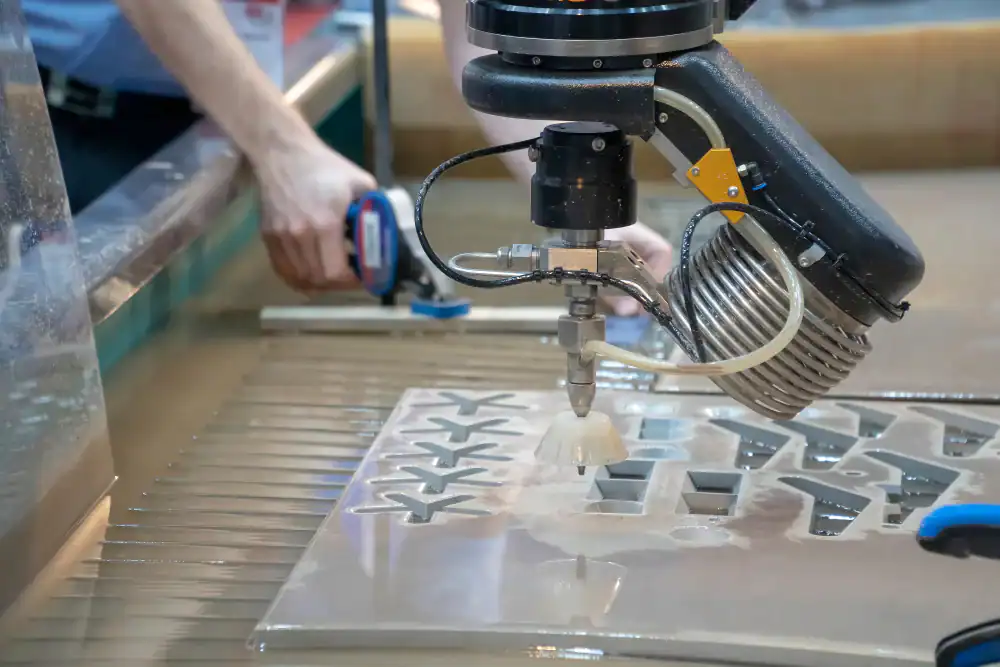
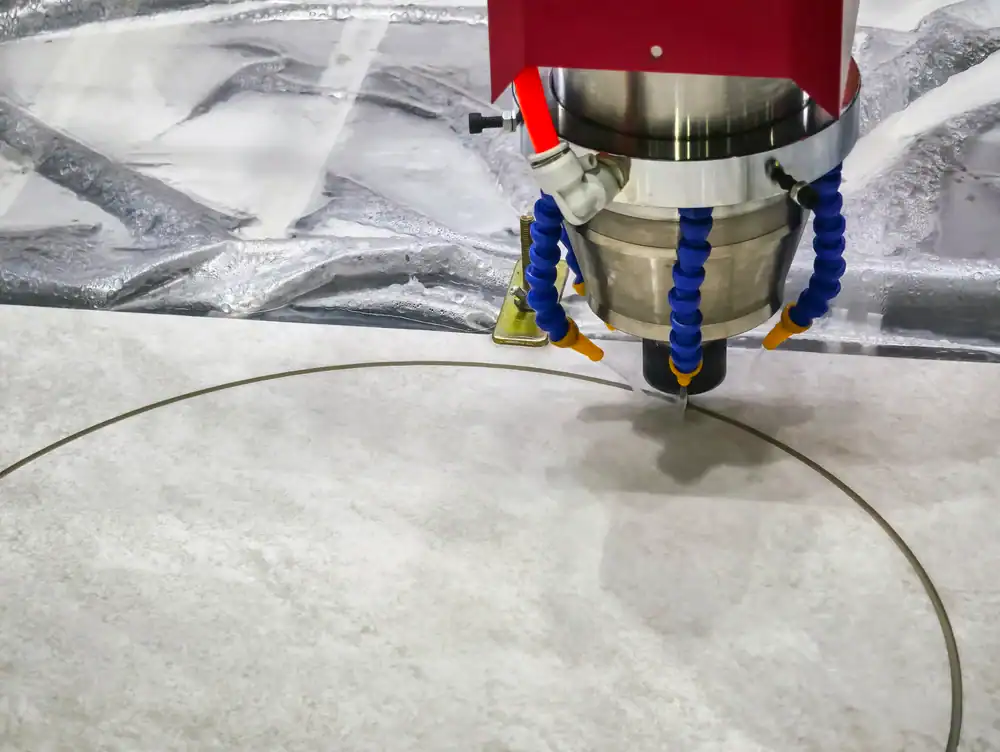
Once the file is approved, it goes to our precision waterjet cutting system. A high-pressure stream of water mixed with abrasive garnet cuts through your material following the exact path programmed from your design. The stream is thin—often narrower than many saw blades—which means less material waste and tighter nesting of parts.
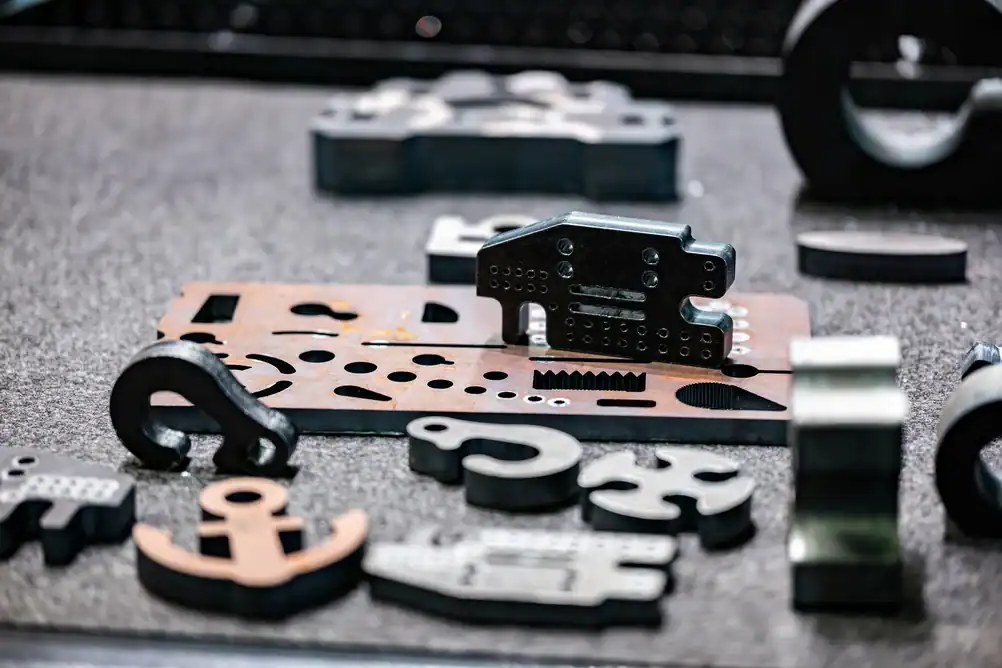
Because there’s no heat involved, your material stays at room temperature throughout the cut. Metals don’t warp. Composites don’t delaminate. Glass doesn’t crack from thermal stress. What you specified is what you get, with edge quality that often eliminates secondary finishing entirely.
Ready to get started?
Precision waterjet cutting in Shirley, NY handles materials you can’t trust to torch cutting or laser work. Flammables, thick composites, laminated glass, hardened metals—the cold cutting process works across all of them without the fire hazard or material limitations of thermal methods.
Tolerances run from ±0.004″ down to ±0.001″ depending on material type and thickness. That’s tighter than most machining processes, and it’s repeatable across production runs. If you need fifty identical parts, you’ll get fifty identical parts, not forty-nine good ones and a reject.
Long Island’s aerospace and automotive sectors have driven demand for this level of precision. Local manufacturers need components that meet strict regulatory standards without the lead times of traditional machining. Our location in Shirley puts us close to these industries, and our process is built around their requirements—fast turnaround on prototypes, consistent quality on production runs, and engineering support that catches problems early.
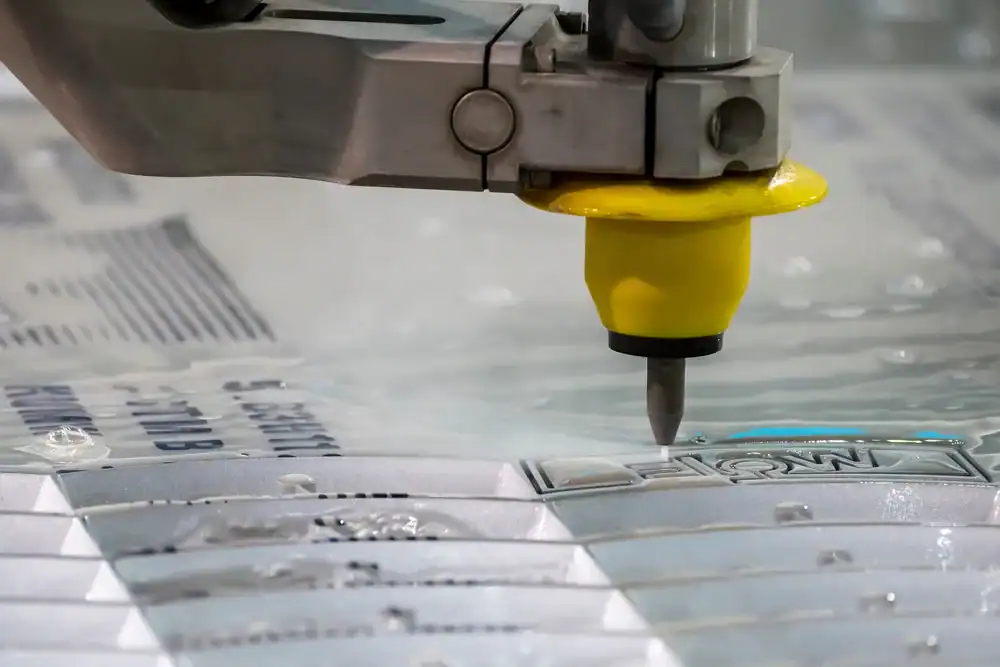
Standard precision waterjet cutting holds ±0.004″ to ±0.005″ across most materials. If you’re working with thinner stock—under half an inch—and the material is stable (metals, dense plastics, composites), you can push that to ±0.001″ or slightly tighter.
Thicker materials or softer substances like rubber will sit closer to the ±0.005″ range because the cutting stream has more distance to travel and some materials compress slightly under the water pressure. That’s still significantly tighter than plasma or torch cutting, which typically run ±0.030″ or looser.
The kerf width—the actual width of the cut—runs about 0.030″ to 0.040″ depending on the abrasive size and pressure settings. That narrow kerf is why waterjet works well for intricate patterns and tight nesting of parts. You’re not losing a quarter inch of material every time the stream changes direction.
Laser cutting is faster on thin metals—usually under a quarter inch—and it can hold similar tolerances in that range. But laser introduces heat, which means you’re dealing with a heat-affected zone along every cut edge. For hardened metals or materials where you can’t risk changing the temper, that’s a problem.
Waterjet stays cold, so there’s no metallurgical change to your material. You’re also not limited by reflectivity. Laser struggles with copper, brass, and highly reflective metals because the beam bounces rather than cuts cleanly. Waterjet doesn’t care what the surface looks like.
The other factor is thickness. Laser loses effectiveness above an inch on most metals and can’t touch materials like stone, glass, or thick composites. Precision water jet cutting services in Shirley, NY handle those materials routinely, often cutting several inches deep without quality degradation. If your project involves mixed materials or anything over an inch thick, waterjet is usually the only viable option.
Yes, and that’s one of the practical advantages. There’s no tooling to create—no dies, no molds, no fixtures that need to be machined before the first part gets cut. You send a file, we review it, and we’re cutting. That makes prototyping fast, often with turnaround in a day or two for simple parts.
When the prototype is approved and you’re ready for production, the same file runs the same way every time. The cutting path doesn’t change, the tolerances don’t drift, and there’s no tool wear to account for. Part one hundred looks like part one.
For short runs—ten to fifty pieces—this is often more cost-effective than setting up traditional machining. For longer runs, it depends on the complexity of the part and the material. Our precision waterjet cutting shop in Shirley, NY works with clients on both ends of that spectrum, and we’re upfront about when waterjet makes sense and when you might be better served by a different process.
Tempered glass is the main one. The internal stress in tempered glass means it shatters when you try to cut it, regardless of the method. Annealed glass cuts fine, but once it’s been tempered, it’s off the table for any cutting process.
Certain ceramics can be problematic depending on their hardness and brittleness. Very hard, very brittle ceramics sometimes fracture from the impact of the abrasive stream rather than cutting cleanly. It’s material-specific, so if you’re working with an unusual ceramic, we’d want to test a sample before committing to a full run.
Beyond that, waterjet handles nearly everything—metals, plastics, composites, stone, rubber, foam, wood, even some exotic materials like titanium or Inconel that are difficult to machine with traditional methods. The cold cutting process and the flexibility of the abrasive stream make it one of the most versatile cutting methods available.
The kerf width on precision waterjet cutting runs about 0.030″ to 0.040″, which is narrower than most saw blades and significantly narrower than plasma or torch cutting. That thin kerf means you can nest parts tightly on a sheet, minimizing the skeleton waste left behind.
For expensive materials—titanium, Inconel, thick stainless—that waste reduction adds up quickly. You’re often able to fit 10-15% more parts on a sheet compared to wider-kerf methods, which directly impacts your material cost per part.
The other waste factor is edge quality. Because waterjet produces clean edges without burrs or heat distortion, you’re usually not removing additional material in secondary finishing. What gets cut is what you use. For projects where material cost is a significant portion of the budget, precision waterjet cutting for tight tolerances in Shirley, NY often proves more economical than methods that seem cheaper per hour but waste more material or require additional processing.
Simple parts with straightforward geometry can often turn around in one to two days after file approval. That includes the engineering review, programming, cutting, and quality check. If you need it faster, rush service is available depending on our current queue.
More complex parts—intricate patterns, thick materials, or jobs requiring multiple setups—typically run three to five days. The actual cutting time might only be a few hours, but the engineering review, file prep, and quality assurance add time to ensure you’re getting parts that meet spec.
Production runs depend on quantity and complexity. A run of fifty identical parts might take a week, while a run of five hundred could take two to three weeks. We’re transparent about timing upfront, and our engineering team reviews your timeline during the file review stage to flag any potential delays before they become problems.
Useful Links
Other Services we provide in Shirley