Hear from Our Customers
You’re not looking for close enough. You need parts that meet spec without warping, without burrs, and without the delays that come from rework.
High precision waterjet cutting in Southampton, NY gives you that certainty. The process uses a focused stream of water mixed with abrasive garnet to cut through virtually any material without generating heat. That means no heat-affected zones that compromise material integrity, no thermal distortion that throws off your tolerances, and no hardened edges that require additional machining.
Your parts come off the table ready to use. Edges are clean and burr-free. Complex geometries that would require multiple setups on conventional equipment get cut in a single operation. Whether you’re working with titanium for aerospace components, stainless steel for marine hardware, or granite for architectural inlays, you get consistent accuracy across the entire cut.
The difference shows up when you’re assembling components or installing finished pieces. Everything fits. Your timeline stays intact. Your reputation for quality stays solid.
We operate out of West Islip, serving Southampton and the broader Long Island region with precision CNC waterjet cutting that meets the exacting standards this area is known for.
Long Island’s manufacturing heritage runs deep. From the aerospace innovations that earned this region the title “Cradle of Aviation” to the marine fabrication shops that have served the East End’s maritime economy for generations, precision has always mattered here. You’re working in an environment where tolerances aren’t suggestions and deadlines aren’t flexible.
We understand that context because we work in it every day. Our equipment handles the materials your industries demand—aluminum alloys, composites, hardened steel, stone, glass, and specialty plastics. Our process accommodates the complexity your projects require, from prototype development to production runs.
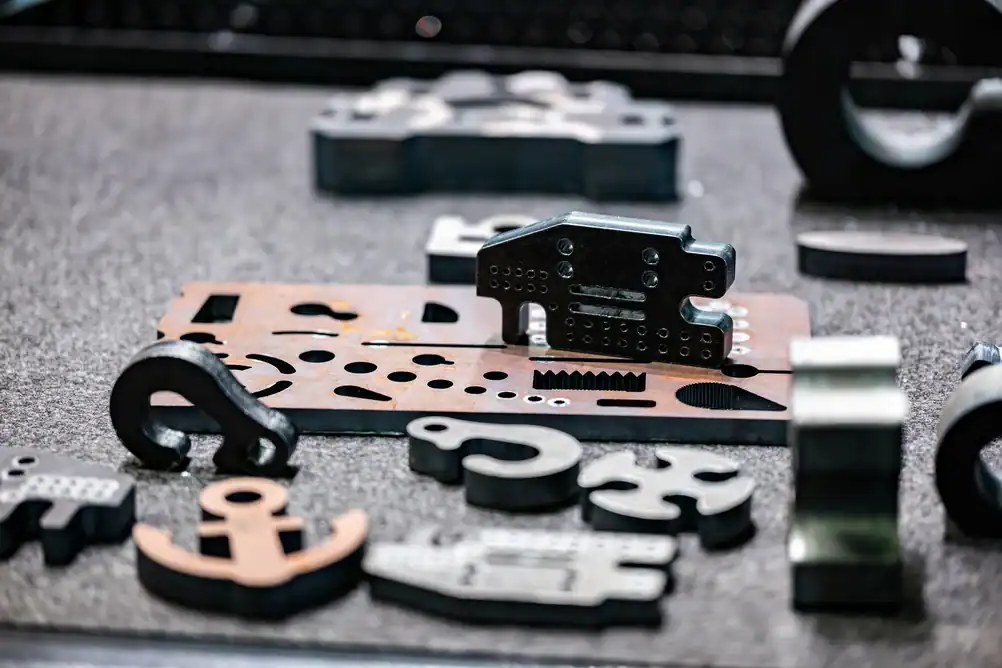
The process starts with your design file. You send us your CAD drawings with specifications, and we program the cutting path directly into our CNC system. That eliminates the tooling delays and setup costs you’d face with conventional machining.
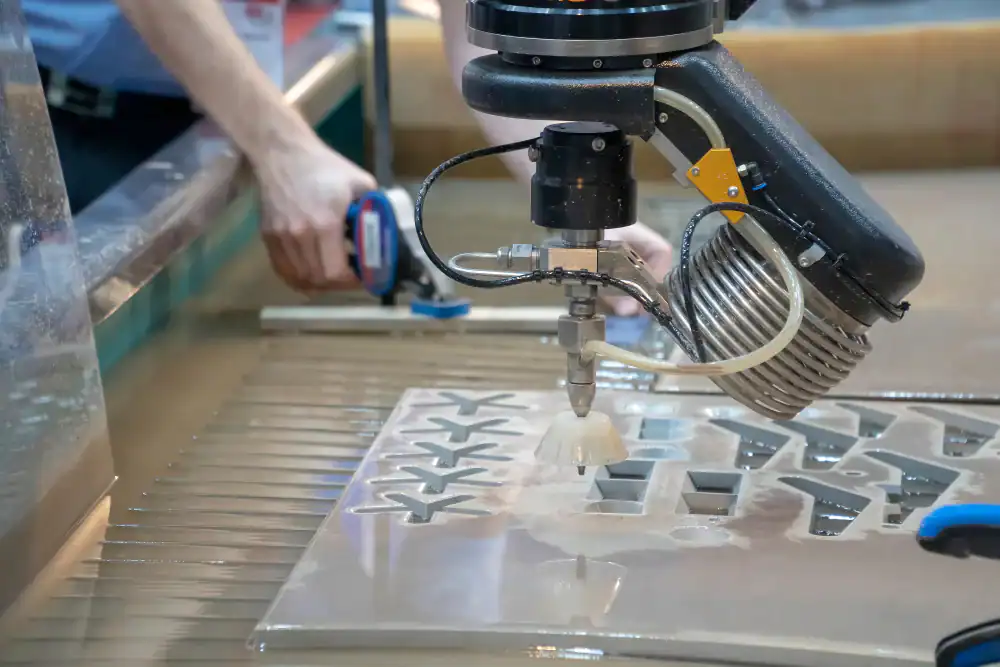
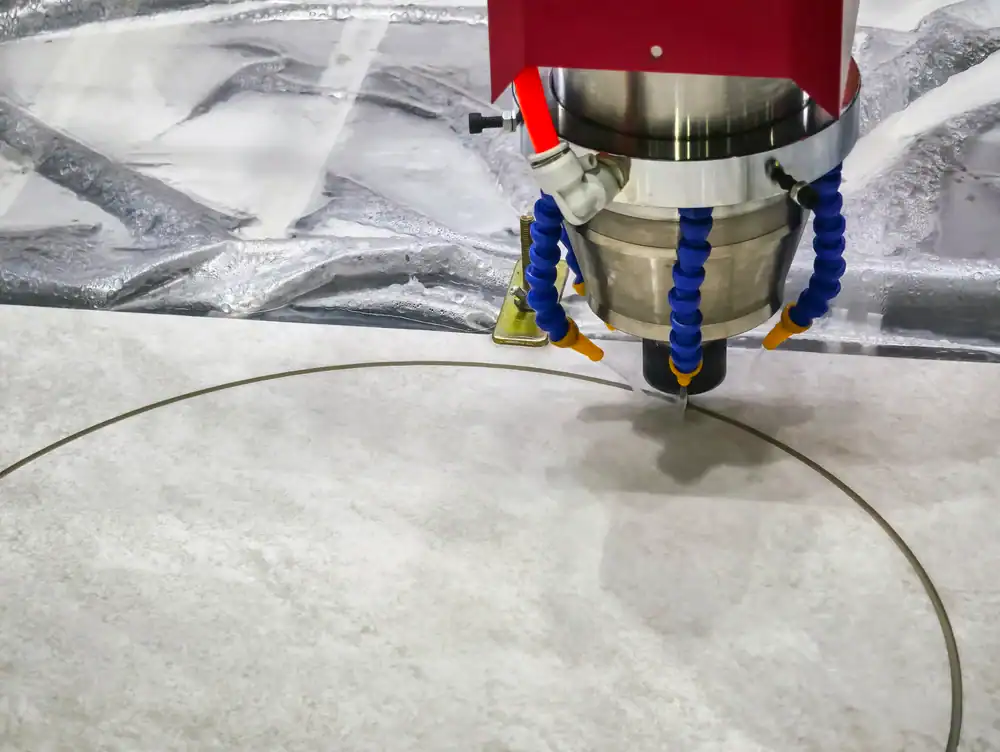
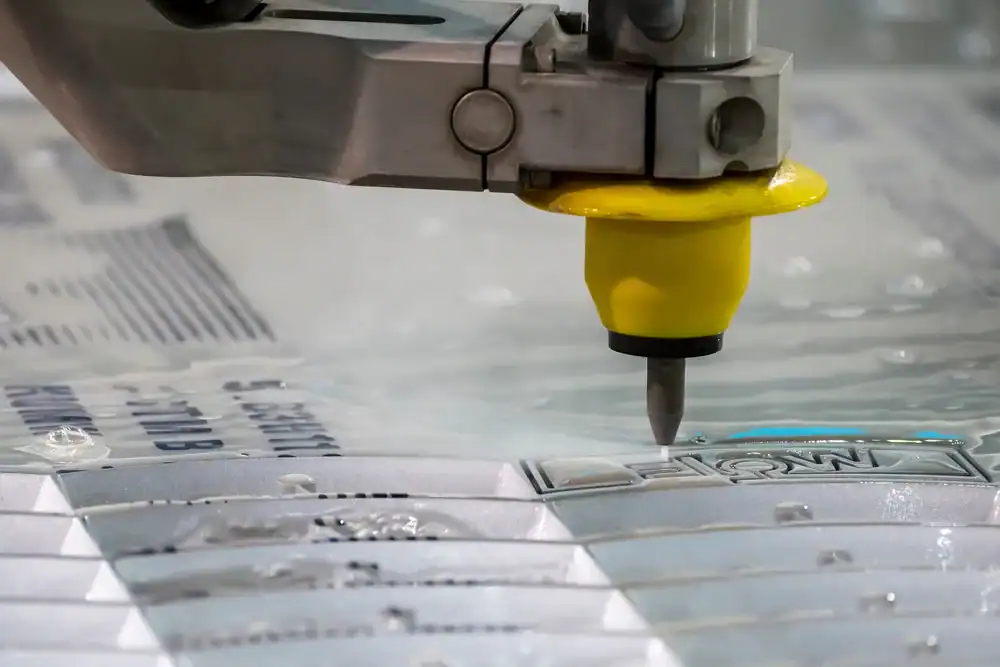
Once programming is complete, we secure your material on the cutting table. The waterjet system pressurizes water to 60,000 PSI and mixes it with fine abrasive garnet. This stream—narrower than a pencil lead—cuts through your material following the exact path programmed from your file. The CNC system maintains consistent speed and pressure throughout the cut, which is how we hold those tight tolerances even on complex geometries.
Because there’s no heat involved, materials don’t warp or develop stress points. Because the stream is so narrow (typically 0.030″ to 0.040″), material waste stays minimal. You’re not losing inches of material to wide kerf cuts.
After cutting, most parts need no additional finishing. The edges come off clean enough for immediate use in assembly or installation. If your application requires it, we can adjust cutting speed to achieve even smoother edge finishes, though that’s rarely necessary for structural or functional components.
Ready to get started?
You’re likely here because your project has specific demands that conventional cutting methods can’t meet reliably.
Maybe you’re fabricating aerospace components where heat-affected zones would compromise material certifications. Southampton’s proximity to Long Island’s established aerospace supply chain means you’re often working with exotic alloys and composites that can’t tolerate thermal stress. Precision waterjet cutting for tight tolerances in Southampton, NY handles these materials without altering their structural properties.
Or you’re cutting marine-grade stainless steel and need corrosion-resistant edges without the micro-fractures that thermal cutting can create. The saltwater environment around Southampton doesn’t forgive compromised edges. Waterjet cutting leaves the molecular structure intact.
Architectural projects present their own challenges. When you’re creating custom inlays, decorative panels, or structural elements from stone, glass, or metal, you need cuts that are both precise and clean enough to showcase the material. You can’t have chipped edges on a granite installation or burn marks on brushed stainless. The cold-cutting process delivers the aesthetic quality these applications demand.
The versatility matters too. Instead of coordinating with multiple fabricators for different materials, you’re working with one precision waterjet cutting shop in Southampton, NY that handles everything from 1/8″ acrylic to 6″ steel plate.
For most production applications, you can expect tolerances between ±0.002″ and ±0.001″ depending on material type and thickness. Thinner materials and harder substances like metal and glass typically hold tighter tolerances than softer materials like rubber or foam.
The tolerance also depends on what part of the cut you’re measuring. Straight cuts generally hold tighter than intricate curves, though modern CNC waterjet systems maintain consistency even through complex geometries. If your project requires tolerances tighter than ±0.001″, that’s worth discussing upfront so we can adjust cutting parameters accordingly.
What you won’t get is the dimensional drift that happens with thermal cutting methods. Because there’s no heat affecting the material, parts don’t warp as they cool. The dimensions you see on the table are the dimensions you get in your assembly.
Waterjet cutting never raises material temperature above ambient levels. The water stream actually cools the cutting area, which is the opposite of what happens with laser or plasma cutting.
This matters significantly for aerospace-grade titanium, where heat-affected zones can compromise the material’s strength-to-weight ratio and corrosion resistance. It’s equally important for carbon fiber composites, where thermal cutting causes delamination and frayed edges. The mechanical cutting action of the abrasive waterjet slices through these materials cleanly without altering their properties.
You also avoid the secondary problems that come with heat. No hardened edges that dull your tools during assembly. No oxidation or discoloration that requires additional finishing. No internal stresses that might cause cracking down the line. The material’s integrity stays exactly as it was before cutting.
Yes, and that’s one of the primary advantages over traditional cutting methods. The CNC system can follow any path you can draw in CAD, including sharp internal corners, intricate curves, and detailed patterns that would be difficult or impossible with saw cutting.
For architectural applications in Southampton, this means you can create custom stone medallions, decorative metal screens, glass panels with precise cutouts, or tile inlays with complex geometries. The narrow kerf width allows for fine details that maintain visual clarity even in intricate designs.
The process also allows you to nest multiple shapes efficiently on a single sheet of material, reducing waste on expensive architectural materials like marble, granite, or specialty metals. You’re not limited to straight cuts or standard shapes—if you can design it, we can cut it.
Turnaround depends primarily on material thickness, complexity of the cuts, and current shop schedule. Simple parts from thin material might be ready in a few days. Thicker materials or highly detailed cuts take longer because cutting speed has to decrease to maintain precision.
The advantage is that there’s no tooling to create or wait for. Once we have your CAD file and material specifications, we can program the cut and get started. That’s faster than processes that require custom dies, fixtures, or multiple setups.
For production runs, the first piece takes the longest because of programming and setup. After that, the CNC system reproduces identical parts with the same precision, which speeds up larger quantities considerably. If you’re working on a time-sensitive project, let us know upfront so we can schedule accordingly.
Most parts come off the waterjet table ready to use. The cutting process doesn’t create the burrs, slag, or rough edges you’d get from plasma cutting, laser cutting, or mechanical sawing.
The edge finish depends on cutting speed. Faster cuts leave a slightly striated texture on the bottom edge where the stream exits the material. For structural parts or components that will be welded, coated, or hidden in assembly, this finish is perfectly acceptable and requires no additional work.
If you need a smoother edge for aesthetic reasons or tight-fitting assemblies, we can slow the cutting speed to produce what’s called a “quality 5” finish—essentially a polished edge that looks and feels smooth. This adds time to the cutting process but eliminates secondary finishing operations. For most applications, though, the standard edge quality is clean enough that you’re moving directly to installation or assembly.
Abrasive waterjet cutting handles virtually any material except tempered glass and certain ceramics. Metals are straightforward—aluminum, stainless steel, titanium, brass, copper, tool steel, even hardened materials that would dull conventional cutting tools.
Stone and tile cut cleanly without chipping, which matters for architectural work where edge quality is visible. Granite, marble, slate, porcelain, and ceramic tile all respond well to waterjet cutting. Plastics from soft foam to hard acrylic cut precisely without melting or deformation.
Composites are where waterjet really shows its value. Carbon fiber, fiberglass, and laminated materials that delaminate under heat or vibration cut cleanly with waterjet. You can also cut dissimilar materials in a single pass—like metal bonded to plastic or stone inlaid with metal—without changing tools or processes. If you’re uncertain whether your specific material is suitable for waterjet cutting, that’s worth a quick conversation before you commit to the project.
Useful Links
Other Services we provide in Southampton