Hear from Our Customers
You’re not dealing with warped edges or heat-affected zones that compromise your material. High precision waterjet cutting in St. James, NY means your parts arrive with tolerances as tight as ±0.003 inches and edge quality that often skips secondary finishing.
That matters when you’re building aerospace components, custom automotive brackets, or architectural panels where dimensional accuracy isn’t negotiable. The cold cutting process keeps your material properties intact—no thermal stress, no melting, no hardening that throws off your specs.
You can cut virtually any material up to 3-1/4″ thick into complex geometries that other methods can’t touch. Tight radii, narrow corners, intricate patterns—all without starting holes or tool changes that slow down your timeline. When your production schedule is already tight, that speed difference adds up fast.
St. James sits in the heart of Long Island’s manufacturing corridor, where precision matters and deadlines don’t move. You’re working with a shop that understands what it takes to deliver parts that meet aerospace, medical, and industrial standards without excuses.
We know the difference between good enough and actually right. That means understanding your material, your tolerances, and your timeline before the first cut happens. It means having the equipment and experience to handle both your prototype run and your production order without a quality drop-off.
When local manufacturers need reliable precision water jet cutting services in St. James, NY, they’re looking for consistency. Same quality on part one and part one thousand.
You start by sending your specs—CAD files, drawings, material requirements, and tolerance needs. We review everything to confirm the waterjet process fits your application and timeline. If there’s a better approach or a potential issue with your design, you hear about it before any cutting starts.
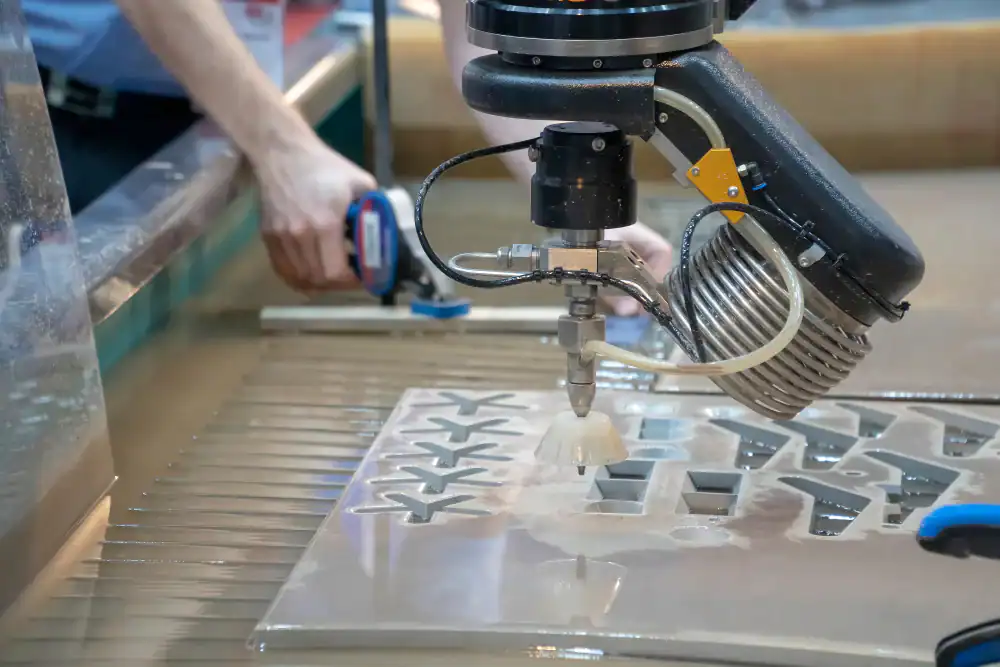
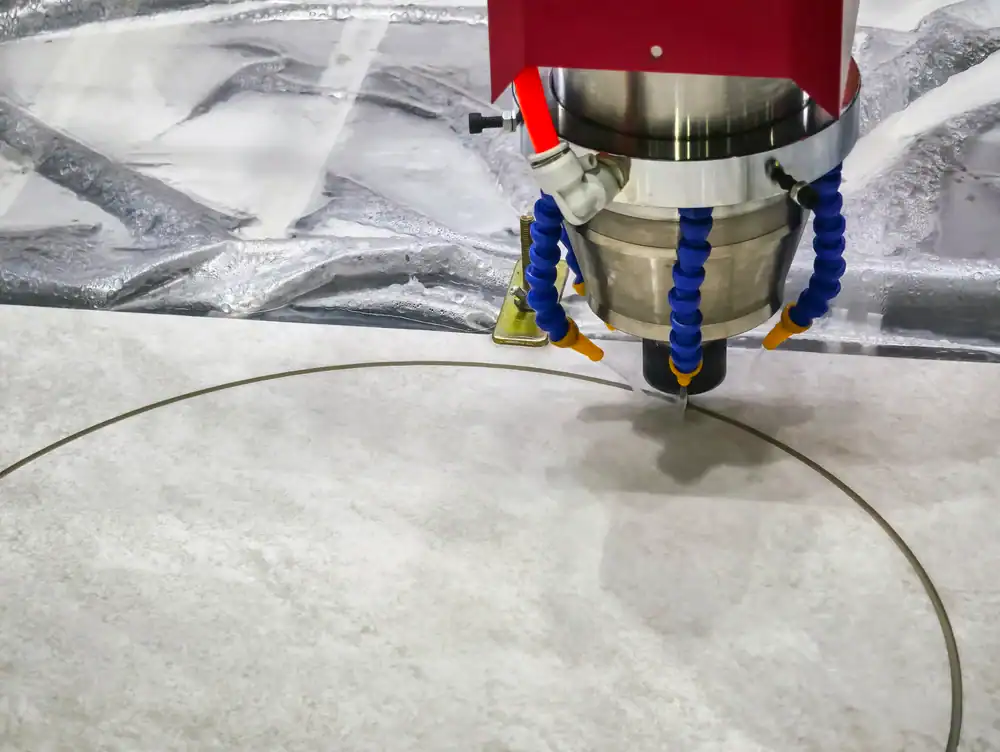
Once everything’s locked in, your material gets loaded onto the CNC table. Precision CNC waterjet cutting in St. James, NY uses a high-pressure stream mixed with abrasive garnet to cut through your material following the programmed path. The stream moves in any direction, handles complex shapes, and maintains consistent quality across the entire cut.
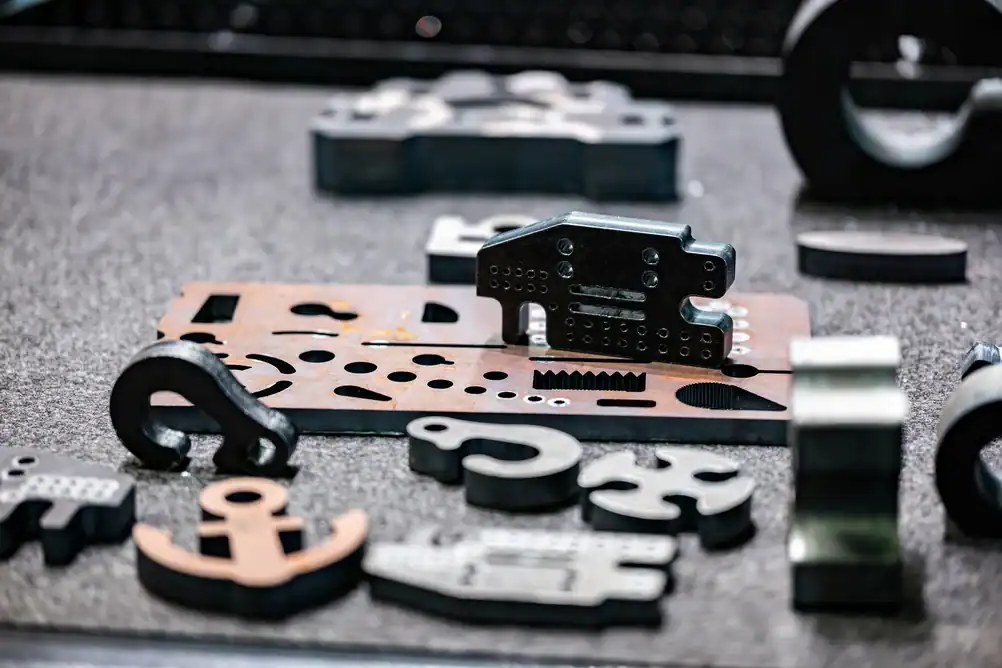
Because there’s no heat involved, your material doesn’t warp or develop a heat-affected zone. The edge comes out with a fine finish that often eliminates secondary operations. You get parts that match your specifications without the back-and-forth of rework or the cost of scrapped material.
After cutting, parts get inspected to verify dimensions and quality. Then they’re packaged and ready for pickup or delivery. The whole process is built around getting you accurate parts on schedule.
Ready to get started?
You’re working with a process that cuts metals, composites, stone, glass, ceramics, and plastics without changing tools or methods. That versatility matters when your project involves multiple materials or when you’re prototyping and haven’t finalized your material choice yet.
Precision waterjet cutting for tight tolerances in St. James, NY handles thicknesses other cutting methods struggle with—up to 3-1/4″ in most materials, and even thicker in some cases. The accuracy holds whether you’re cutting thin sheet metal or heavy plate. You get the same clean edge and dimensional precision across the thickness range.
For Long Island manufacturers, that capability means fewer limitations on design. You can specify the material that actually works best for your application instead of compromising based on what your cutting method can handle. Aerospace shops use it for composite layups and aluminum components. Automotive builders rely on it for custom brackets and prototype parts. Architectural firms specify it for decorative metalwork and structural elements.
The process also handles production runs efficiently. No tool wear means consistent quality from the first part to the last. No heat means no waiting for materials to cool between cuts. That keeps your per-part cost reasonable even on smaller production quantities.
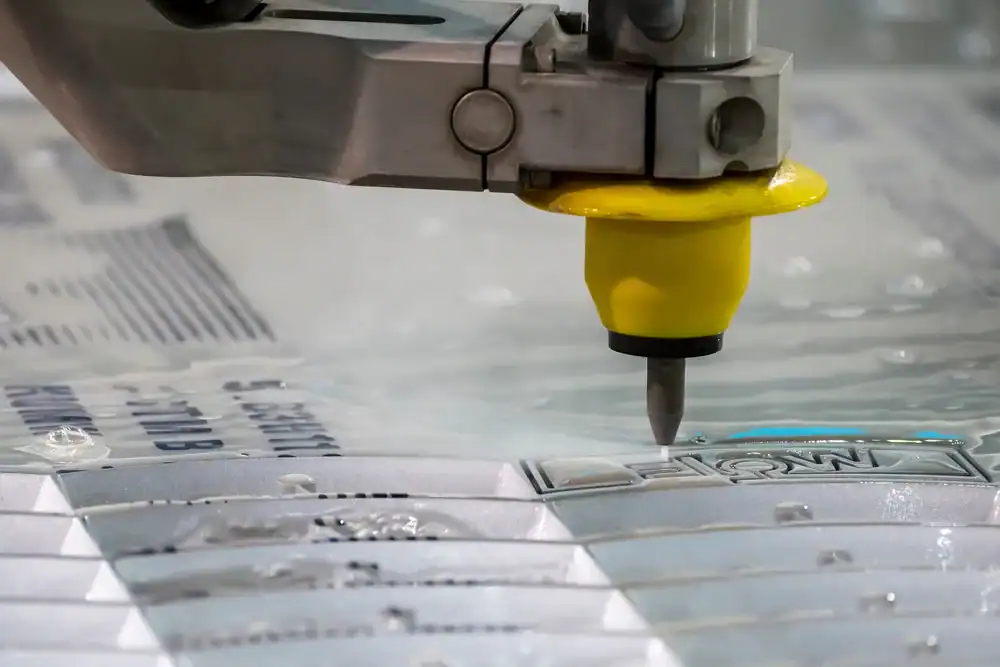
Waterjet cutting consistently holds tolerances within ±0.005 inches, and with proper setup and calibration, you can achieve ±0.003 inches on critical dimensions. That accuracy depends on several factors: material type, thickness, cutting speed, and nozzle condition.
Thinner materials generally hold tighter tolerances because the waterjet stream has less distance to travel through the material. As thickness increases, you may see slight taper on the cut edge—the top edge is slightly wider than the bottom edge. For most applications, this taper is negligible and well within acceptable limits.
If your project demands even tighter tolerances, secondary operations like machining can be performed on waterjet-cut parts. But for many precision applications, the as-cut edge quality eliminates that extra step entirely. The key is communicating your actual tolerance requirements upfront so we can optimize the cutting parameters for your specific needs.
Waterjet cutting uses a cold process—high-pressure water mixed with abrasive garnet—so there’s zero heat input into your material. That’s fundamentally different from laser or plasma cutting, which use thermal energy to melt or vaporize material.
When you cut with heat, you create a heat-affected zone where the material’s properties change. Metals can harden, warp, or develop internal stresses. Plastics can melt or discolor. Composites can delaminate. Those changes affect how your part performs and how it machines in secondary operations.
With waterjet, your material stays at ambient temperature throughout the cutting process. That means no warping, no hardened edges, no thermal stress, and no change to the material’s structural properties. For aerospace and medical applications where material integrity is critical, that cold cutting process is often the only acceptable method. You also avoid the secondary cleanup work—no slag, no dross, no heat discoloration to remove before the part is usable.
Waterjet cutting handles virtually any 2D shape you can draw. The stream is omnidirectional, meaning it cuts in any direction without repositioning the material or changing tools. Tight inside corners, small holes, intricate curves, sharp angles—all of those are standard capabilities.
The process doesn’t require starting holes for interior cuts like some methods do. The waterjet pierces directly through the material and begins cutting from that point. That speeds up setup and eliminates the extra operation of pre-drilling access holes.
For even more complex work, 5-axis waterjet systems can cut beveled edges and contoured surfaces at angles from 0 to 90 degrees. That’s useful for parts that need chamfered edges or angled cuts for assembly purposes. The CNC control maintains precision even on these complex geometries, so you’re not sacrificing accuracy for complexity. If you can model it in CAD, waterjet cutting can produce it.
Turnaround depends on material availability, cutting complexity, and current shop capacity, but waterjet cutting is generally faster than you’d expect. Simple parts in common materials can often be completed within a few days. More complex projects or specialty materials might take a week or two.
The speed advantage comes from minimal setup time. There’s no tooling to fabricate, no fixtures to build, and no tool changes between different cut geometries. The CNC program gets loaded, your material gets positioned, and cutting starts. That makes waterjet particularly efficient for prototype work or small production runs where traditional methods would require significant setup investment.
Rush service is often available when your timeline is critical. The key is communicating your deadline upfront so we can plan the schedule accordingly. For ongoing production work, lead times become even more predictable since the process and materials are already established. You’re not starting from scratch on each order.
Waterjet cutting typically costs more per hour than plasma but less than laser or EDM for most applications. However, the real cost comparison depends on your total project cost, not just cutting time.
Because waterjet often eliminates secondary finishing operations, your total cost can be lower even if the cutting rate is higher. You’re not paying for deburring, grinding, or cleanup work. The lack of heat-affected zones means you’re not scrapping parts due to warping or material property changes. And because there’s no tooling cost, low-volume runs are economical—you’re not amortizing expensive dies or fixtures across a small quantity.
Material waste is also minimal. Waterjet’s narrow kerf width and ability to nest parts efficiently means you get more parts per sheet. The scrap material that does result is clean and recyclable since there’s no contamination from heat or chemical processes. For projects where material cost is significant, that efficiency adds up. The best approach is to get a quote based on your specific parts and quantities rather than making assumptions based on hourly rates alone.
Waterjet cuts almost everything, but there are a few exceptions. Tempered glass shatters under the waterjet stream’s impact pressure. Certain very soft or brittle materials may not hold up to the abrasive stream. Some extremely hard ceramics can be cut but may require specialized parameters and longer cutting times.
For the vast majority of manufacturing materials, waterjet works without issue. Metals from aluminum to titanium, all grades of stainless steel, tool steels, composites like carbon fiber and fiberglass, plastics from acrylic to polycarbonate, stone, tile, rubber, foam—all of these cut cleanly and accurately.
The versatility means you can often use waterjet as your single cutting solution across multiple materials in the same project. You’re not managing different vendors or processes for different material types. That simplifies your supply chain and keeps quality control centralized. If you’re uncertain whether your specific material is a good fit for waterjet cutting, a quick conversation with us will give you a definitive answer based on our experience with similar materials.
Useful Links
Other Services we provide in St. James