Hear from Our Customers
You’re not looking for close enough. You need parts that fit, function, and pass inspection without a second pass or costly rework. That’s what high precision waterjet cutting in Uniondale, NY gets you—dimensional accuracy to ±0.001″, edges that don’t need deburring, and cuts that hold up under real-world conditions.
No heat means no warping, no hardening, and no burned edges that throw off your tolerances. Whether you’re working with hardened tool steel, titanium, or multi-layer composites, the cut stays cold and your material stays true.
You also avoid the bottleneck of tool changes. One setup handles intricate geometries, tight radii, and complex profiles without swapping bits or adjusting fixtures. That means faster turnaround and fewer chances for error between operations.
We operate out of West Islip and serve manufacturers, fabricators, and contractors across Uniondale, NY and the surrounding metro area. We work with aerospace suppliers, architectural metalworkers, and shops building parts for defense and industrial applications—industries where precision isn’t negotiable.
Uniondale sits in the heart of Nassau County’s manufacturing corridor, home to aerospace operations and precision machining shops that supply critical components. You’re working in an environment where quality standards are high and lead times are tight. We get that, because we operate in the same ecosystem.
Our precision waterjet cutting shop in Uniondale, NY handles everything from one-off prototypes to production runs, working directly from your CAD files, prints, or physical samples to deliver repeatable results you can count on.
You send us your specs—CAD file, technical drawing, or a sample part. We review your tolerances, material type, and any edge finish requirements to confirm what’s achievable and flag anything that might need adjustment before we start cutting.
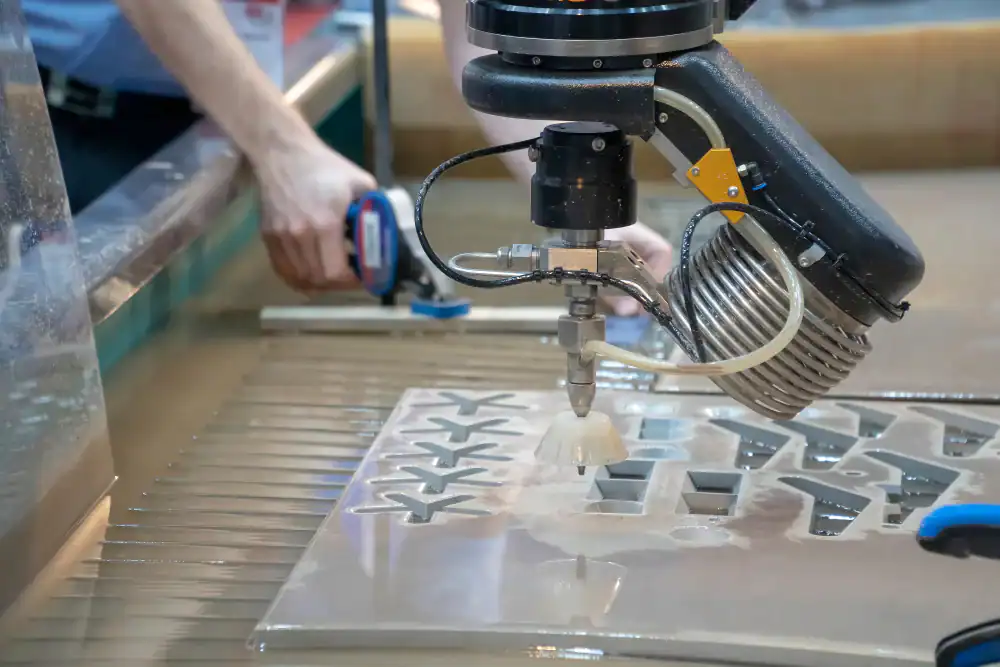
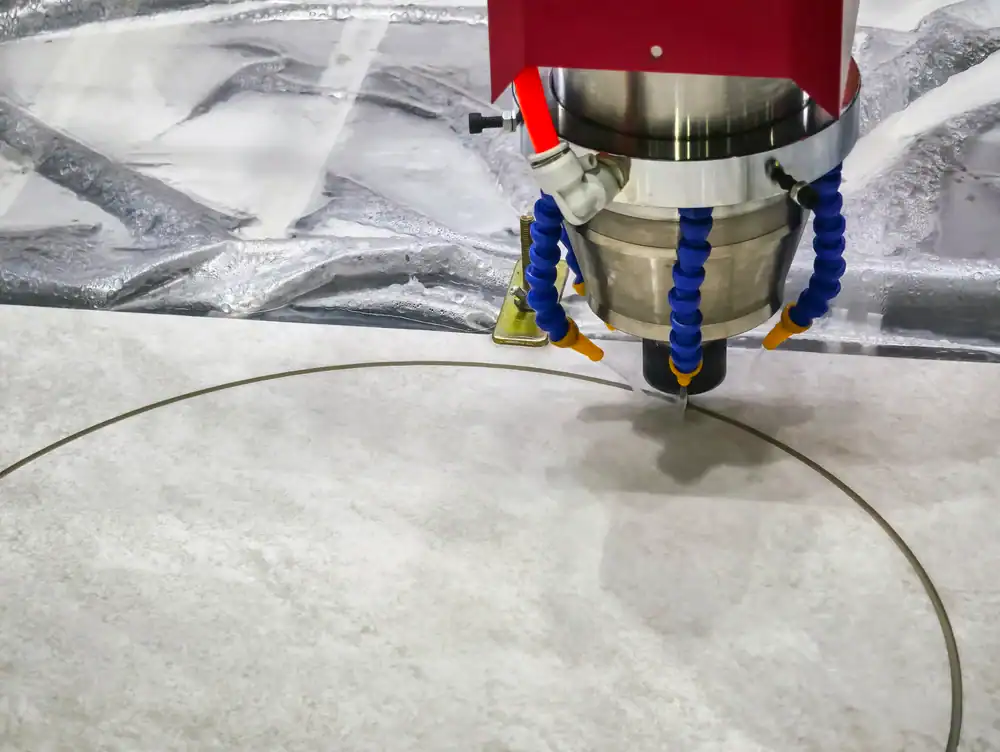
Once the file is programmed into our precision CNC waterjet cutting system in Uniondale, NY, the machine positions the cutting head and pierces the material with a high-pressure stream mixed with abrasive garnet. The stream cuts through your material without generating heat, which means no thermal stress and no change to your material properties.
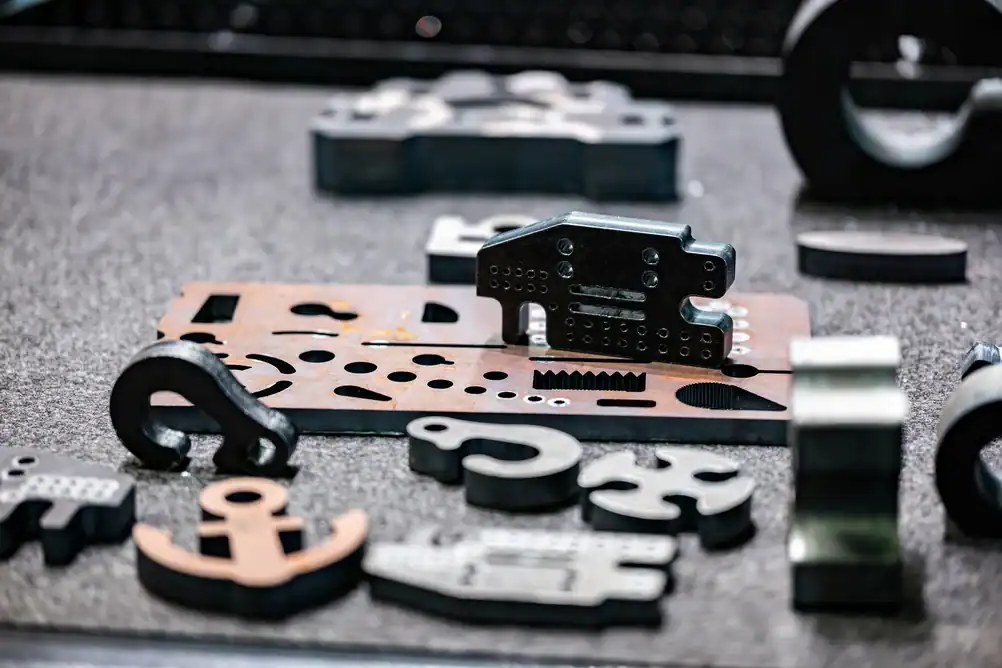
The CNC system follows your geometry exactly, handling tight corners, small holes, and complex curves in a single pass. Because we’re working from digital files, your parts come out consistent whether we’re cutting one or one hundred. After cutting, you get parts with a smooth, sandblasted-style finish that’s ready for assembly or requires minimal secondary work.
Ready to get started?
Our precision water jet cutting services in Uniondale, NY handle materials up to 8 inches thick, including metals like aluminum, stainless steel, titanium, Inconel, and hardened tool steels. We also cut composites, plastics, stone, and glass—basically anything that needs a clean cut without heat damage.
You get parts that hold tolerances as tight as ±0.001″ on thinner materials, with positioning accuracy controlled by our CNC software. Thicker materials see slightly relaxed tolerances, but we’ll walk you through what’s realistic for your application before you commit.
Long Island’s aerospace and defense manufacturers rely on precision waterjet cutting for tight tolerances in Uniondale, NY because it doesn’t introduce the stresses that come with torch cutting or machining. If you’re producing flight-critical components, submarine parts, or assemblies where material integrity matters, waterjet keeps your specs intact. We also support the area’s architectural metal fabricators who need intricate patterns cut into panels, railings, and decorative elements without visible tool marks or heat discoloration.
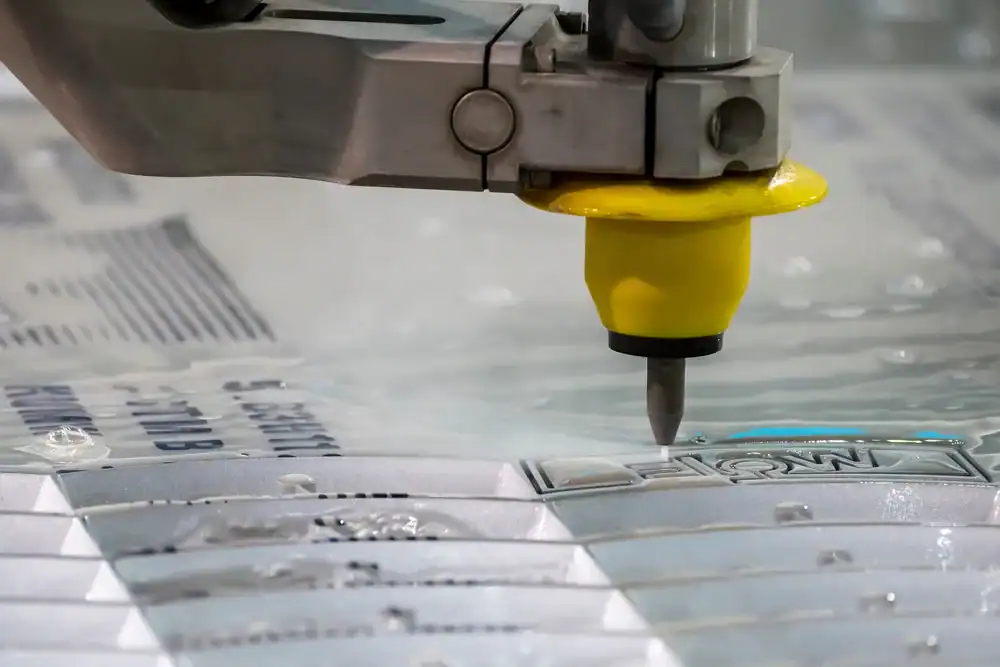
On materials up to about one inch thick, you’re looking at tolerances around ±0.001″ to ±0.005″, depending on material hardness and part complexity. That’s tight enough for most aerospace, medical device, and precision machining applications where fit and function are critical.
Once you get into thicker materials—say, over an inch—the stream widens slightly as it exits the bottom of the cut, which can open tolerances to around ±0.010″. It’s physics, not a limitation of the equipment. If you need tighter tolerances on thick stock, we can sometimes compensate by adjusting feed rates or making multiple passes, but that affects cost and turnaround.
The other factor is the pierce point, where the waterjet initially penetrates the material. That entry hole is slightly irregular, so we position it in waste areas or spots that won’t affect your final dimensions. Once the cut is moving, accuracy stays consistent across the rest of the part.
Waterjet handles a wider range of materials than laser or plasma, especially when you’re working with reflective metals, very thick stock, or anything that can’t tolerate heat. Laser struggles with copper, brass, and aluminum because they reflect the beam. Plasma generates a heat-affected zone that can warp thin materials or change hardness in tool steels.
Waterjet cuts all of those without issue. You can run hardened materials, exotic alloys like Inconel or titanium, and even stacked or laminated materials without delamination. There’s no oxidation, no dross, and no need for secondary cleanup on the edges in most cases.
The tradeoff is speed. Laser is faster on thin sheet metal, usually under a quarter inch. If you’re running high-volume production on thin gauge steel, laser might make more sense. But if you need thicker cuts, tighter tolerances, or you’re working with materials that don’t play nice with heat, waterjet is the better call.
Turnaround depends on material availability, part complexity, and how busy the shop is when your order comes in. For straightforward jobs with material in stock, you’re typically looking at a few days from file approval to finished parts. Rush jobs can sometimes be turned in 24 to 48 hours if the schedule allows.
Complex geometries or parts requiring multiple setups take longer, especially if we’re cutting thick material where feed rates slow down to maintain accuracy. If you’re ordering custom material that we don’t stock, add lead time for the supplier to deliver it.
We work with a lot of Uniondale-area manufacturers who need parts on short notice for prototyping or to keep production lines moving. If timing is tight, let us know up front so we can prioritize your job and give you a realistic delivery date. We’d rather tell you what’s possible than overpromise and leave you waiting.
CAD files are ideal because they go straight into our CNC system without interpretation, which eliminates the chance of errors. DXF and DWG formats work best, but we can also handle most other vector file types. If your file is clean and dimensioned, we can usually start cutting the same day.
If you don’t have a CAD file, we can work from a dimensioned print or technical drawing. We’ll recreate the geometry in our system and send you a proof to approve before cutting. That adds a little time to the process, but it’s not a dealbreaker.
Physical samples work too. We can measure an existing part and replicate it, though there’s always some tolerance stacking when you’re reverse-engineering from a physical piece. If the original part is critical and you need exact duplication, it’s worth having it scanned or measured on a CMM first to get a verified CAD model. Otherwise, we’ll get as close as the sample allows and confirm dimensions with you before running production.
Waterjet leaves a finish similar to fine sandblasting—smooth to the touch with a matte, slightly textured surface. It’s clean enough for most applications without secondary operations. You won’t see burn marks, slag, or the rippled edges that come from torch cutting.
The top edge of the cut is usually sharper and smoother than the bottom edge, where the stream exits. On thicker materials, you might see a slight taper or a bit more texture at the exit point. If your application requires a perfectly square edge or a polished finish, you can hit it with a file, grinder, or sander in a few seconds.
For parts going into assemblies, the as-cut finish is usually fine. For parts that need a specific surface roughness or cosmetic appearance—like architectural panels or decorative metalwork—you might want a post-process like bead blasting or polishing. We can point you toward local finishers in the Uniondale, NY area if you need that done, or you can handle it in-house if you’ve got the equipment.
Waterjet makes sense when you’re cutting profiles, shapes, or patterns that would take forever to machine—or when the geometry is too complex for standard milling setups. You’re not limited by tool access or the need to reposition the part multiple times. The stream cuts in any direction, so intricate curves, tight inside corners, and nested parts all happen in one operation.
Machining is still the go-to for parts that need threaded holes, precise depths, or 3D features like pockets and bosses. Waterjet is a 2D process, so it cuts through the material but doesn’t create depth variations unless you’re doing multiple passes or working with a tilt head, which most shops don’t offer.
The other advantage is setup time. Machining often requires custom fixtures, multiple tool changes, and careful work holding to avoid part movement. Waterjet just needs the material secured to the cutting bed. If you’re prototyping or running small batches where setup cost matters, waterjet keeps your per-part cost down. For high-volume production of simple parts, machining might be more economical once the setup is dialed in.
Useful Links
Other Services we provide in Uniondale