Hear from Our Customers
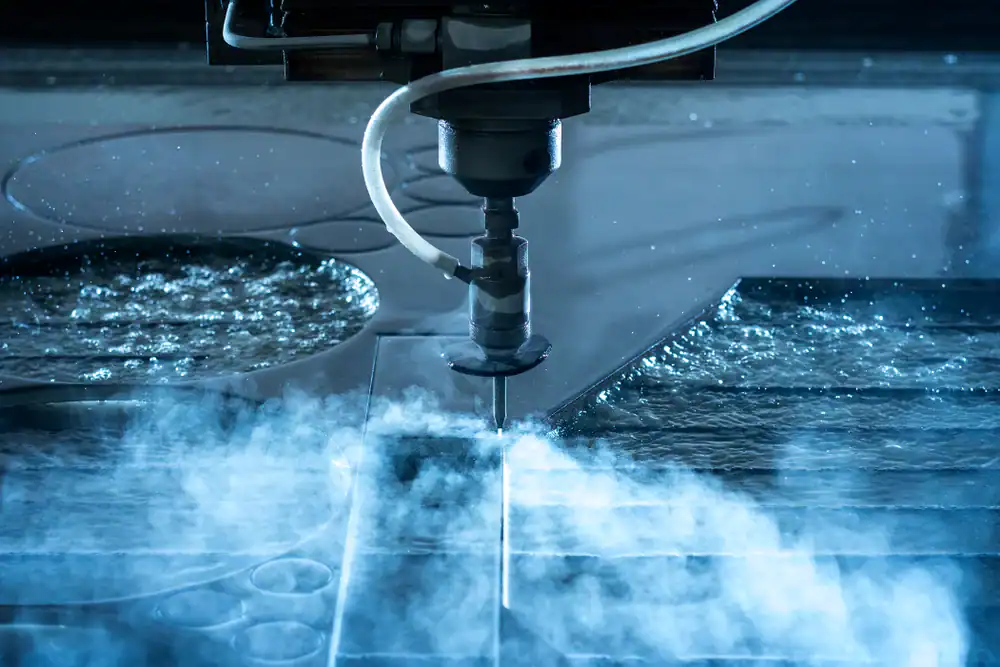
You’re working with glass because you need something specific. Maybe it’s an intricate architectural feature for a commercial build in Brookhaven. Maybe it’s custom components for an industrial application that can’t tolerate even minor imperfections. Either way, traditional cutting methods put your timeline and budget at risk.
Glass waterjet cutting removes heat from the equation entirely. No thermal stress means no micro-fractures forming along your cut lines. No chipping means no secondary grinding or polishing eating into your schedule. You get smooth, clean edges on the first pass, whether you’re cutting standard architectural glass or working with specialty materials like borosilicate or fused silica.
The process handles complexity that would break glass under conventional methods. Curves, tight radiuses, intricate patterns—the CNC-controlled cutting head follows your design down to 0.01mm precision. You’re not limited to straight cuts or simple shapes. If you can design it, waterjet cutting can execute it without compromising the structural integrity of your material.
For projects in Brookhaven’s growing commercial and industrial sectors, this means faster turnaround without sacrificing quality. You’re not waiting on multiple attempts or dealing with material waste from failed cuts.
We operate out of West Islip, NY, serving architects, designers, contractors, and manufacturers across Long Island. We’re close enough to understand Brookhaven’s market—the mix of commercial development, industrial facilities tied to institutions like Brookhaven National Laboratory, and the residential projects that demand both precision and aesthetic quality.
Our focus is straightforward: precision waterjet cutting, custom design consultation, and material guidance that helps your project succeed from concept through completion. We’re not trying to be everything to everyone. We cut glass and other materials with CNC waterjet technology because it’s the most effective method for delivering the tolerances and edge quality your work requires.
Brookhaven’s industrial parks and commercial growth create demand for fabrication services that can keep pace with tight deadlines and exacting specifications. That’s where our equipment and experience make the difference.
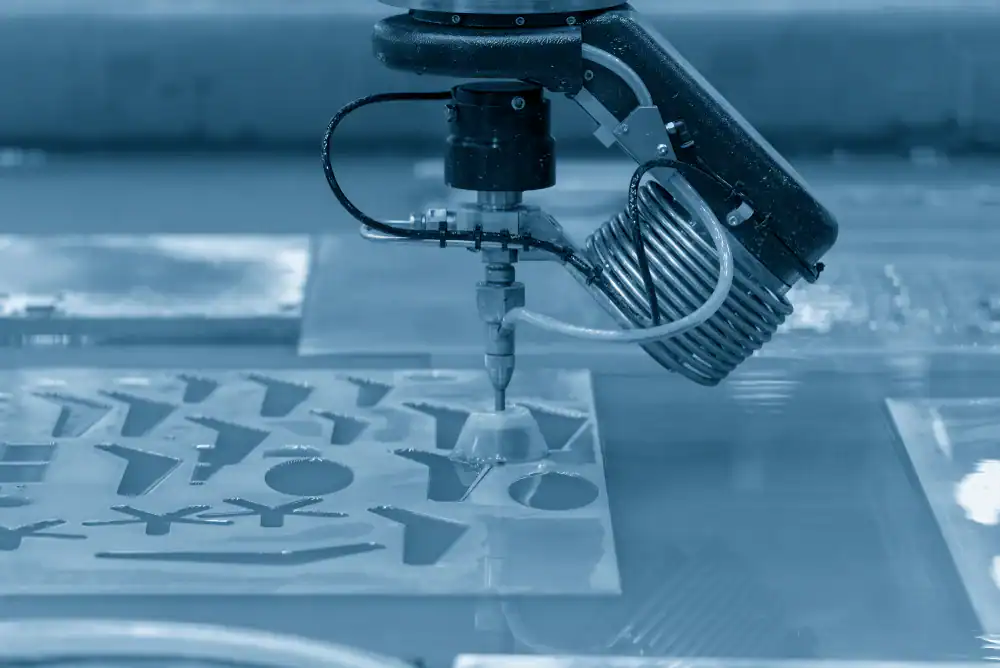
The process starts with your design. You provide CAD files or technical drawings, and we review them for feasibility. If there are potential issues—tolerances that might cause problems, design elements that could be optimized for cutting efficiency—we’ll flag them before any material gets loaded onto the cutting table.
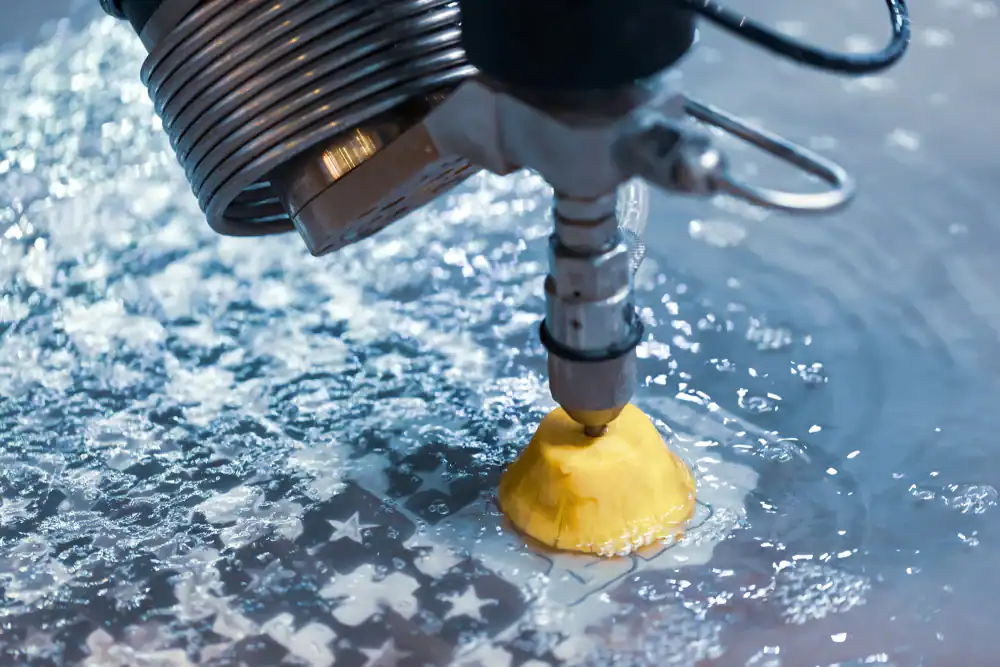
Once the design is confirmed, your glass gets positioned and secured. The CNC waterjet system uses a high-pressure stream of water mixed with fine abrasive particles to cut through the material. The cutting head moves along the programmed path with precision that manual methods can’t match. Because there’s no heat generated during cutting, your glass doesn’t experience thermal expansion or stress that leads to cracking.
The waterjet handles glass up to 6 inches thick, cutting complex geometries without tool changes or repositioning. Internal cutouts, sharp corners, gradual curves—the omnidirectional cutting stream executes them all in a single setup. You’re not dealing with multiple operations or transferring partially finished pieces between different machines.
After cutting, most pieces require minimal finishing. The edge quality from waterjet cutting typically eliminates the need for extensive grinding or polishing. You receive components ready for installation or assembly, not rough cuts that need additional processing.
Ready to get started?
Custom glass waterjet cutting in Brookhaven, NY means you’re working with a process designed for both precision and versatility. The service handles architectural glass for commercial buildings, custom residential installations, industrial components, and artistic applications. If your project involves optical glass, quartz, borosilicate, or other specialty materials, the waterjet process adapts without requiring different tooling or setup.
You get design consultation upfront. Before cutting begins, we review your specifications to identify potential improvements or issues. This isn’t about upselling—it’s about making sure your design translates effectively from file to finished product. Brookhaven’s diverse project landscape, from university research facilities to residential developments, means we’ve seen the range of applications and know where problems typically emerge.
Material waste stays minimal. The narrow cutting kerf and precise control mean you’re not losing significant material to the cutting process itself. For expensive specialty glass or projects with tight material budgets, this efficiency matters. You’re also not dealing with the secondary waste that comes from broken pieces or failed cuts common with traditional methods.
Turnaround times reflect the speed advantage of CNC glass waterjet cutting. The process moves faster than manual cutting or methods that require multiple tool changes and setups. For contractors managing project timelines in Brookhaven’s competitive construction market, faster fabrication without quality compromise keeps your schedule on track.
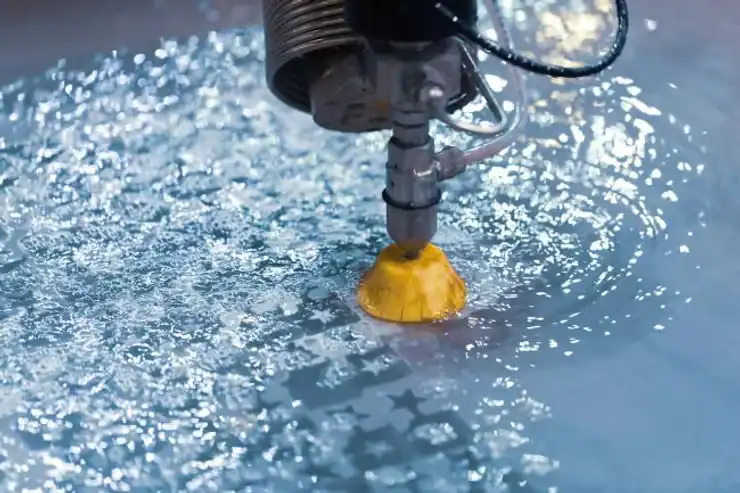
Waterjet cutting handles virtually every glass type you’d encounter in architectural, industrial, or residential applications. Standard architectural glass, tempered glass, laminated glass, optical glass, quartz, borosilicate, and fused silica all cut cleanly with this method.
The process works because it doesn’t rely on heat or mechanical force that causes different glass types to react unpredictably. Tempered glass, which shatters under traditional cutting methods due to internal stress, can be cut before tempering. Specialty glasses used in laboratory equipment or high-precision optical applications maintain their properties because there’s no thermal distortion.
Thickness isn’t a limiting factor the way it is with scoring or laser cutting. The waterjet cuts through glass up to 6 inches thick, maintaining edge quality and precision regardless of material depth. If you’re working with unusual glass compositions or thicknesses for a specific Brookhaven project, the waterjet process likely accommodates it without special tooling or setup changes.
Chipping and cracking happen when cutting methods introduce stress into the glass structure. Traditional scoring and breaking creates fracture lines that propagate unpredictably. Laser cutting generates intense localized heat that causes thermal expansion and stress fractures. Both methods fundamentally work against glass’s brittle nature.
Waterjet cutting uses a high-pressure stream of water and abrasive particles that erodes material rather than fracturing or melting it. There’s no heat buildup, so no thermal stress develops in the glass. There’s no mechanical force trying to snap the material along a score line. The cutting action is erosive and controlled, removing material particle by particle along the programmed path.
The result is clean edges without micro-fractures, chips, or stress points that could lead to failure later. For architectural installations in Brookhaven where glass panels need to maintain structural integrity and aesthetic quality, this edge condition matters. You’re not installing components with hidden stress fractures that might fail under load or temperature changes. The glass comes off the cutting table in stable condition, with edges that often require no additional finishing before installation.
Turnaround depends on project complexity, material availability, and current production schedule, but waterjet cutting itself is significantly faster than traditional methods. Simple cuts on standard architectural glass might be completed within days. More complex designs with intricate patterns or multiple pieces require more cutting time but still move faster than manual fabrication.
The speed advantage comes from CNC automation and single-setup cutting. Once your design is programmed and material is positioned, the cutting head executes the entire pattern without stopping for tool changes or repositioning. Complex shapes that would require multiple operations with traditional methods get cut in one continuous process.
For Brookhaven contractors managing construction timelines, this speed matters most when you’re on a tight schedule or dealing with last-minute design changes. The ability to go from approved design to finished glass components quickly means fewer delays waiting on fabrication. Rush projects can often be accommodated because the cutting process itself doesn’t have the bottlenecks built into traditional methods. Material procurement typically takes longer than actual cutting time, so having your glass specified and ordered early keeps projects moving.
CNC glass waterjet cutting excels at complex geometries that would be difficult or impossible with conventional methods. The cutting head moves in any direction with precision down to 0.01mm, following programmed paths that execute curves, angles, internal cutouts, and intricate patterns without manual intervention.
Tight tolerances are standard, not special requests. Architectural projects in Brookhaven often require glass components that fit precisely into metal frames or align with other building elements. Waterjet cutting maintains dimensional accuracy across the entire piece, so your glass arrives ready to install without field modifications or adjustments.
The process handles design complexity without increasing risk of breakage or defects. Delicate patterns, narrow sections, sharp internal corners—elements that would cause stress fractures with traditional cutting—execute cleanly because there’s no mechanical force or heat stress involved. If you’re working on a custom residential installation or a commercial project with distinctive architectural glass features, the design flexibility lets you specify what you actually want rather than compromising based on fabrication limitations.
Cost-effectiveness comes from multiple factors beyond the cutting rate itself. Waterjet cutting reduces material waste because cuts are precise and breakage is minimal. You’re not ordering extra glass to account for failed cuts or damaged pieces. For expensive specialty glass or large architectural panels, this waste reduction directly impacts project budgets.
Secondary processing costs drop significantly. Traditional cutting methods often produce rough edges that require grinding, polishing, or other finishing operations. Waterjet cutting delivers edge quality that’s typically installation-ready, eliminating those additional labor and equipment costs. You’re paying for one operation instead of cutting plus finishing.
The speed of CNC waterjet cutting also affects overall project costs. Faster fabrication means shorter lead times and less labor per piece. For contractors in Brookhaven managing multiple projects, faster turnaround on glass components keeps your crews productive instead of waiting on materials.
When you factor in reduced waste, eliminated secondary operations, and faster production, waterjet cutting often costs less overall than traditional methods—especially for complex designs or specialty glass materials. The per-hour cutting rate might be higher, but the total cost from design to finished component typically comes out lower.
Design consultation is part of the service because catching issues before cutting saves time and material. When you submit design files, we review them for elements that might cause problems during fabrication or installation. Sometimes it’s a tolerance that’s tighter than necessary and increases cutting time without improving function. Sometimes it’s a design feature that could be modified slightly to improve structural integrity.
This consultation isn’t about changing your vision—it’s about making sure the technical execution supports what you’re trying to achieve. For architects and designers working on Brookhaven projects, this means your glass components perform as intended without surprises during installation.
Material selection guidance is also available. Different glass types have different properties, costs, and cutting characteristics. If you’re uncertain whether standard architectural glass meets your needs or if a specialty material is worth the additional cost, we can walk through the options based on your specific application. The goal is helping you make informed decisions that balance performance, aesthetics, and budget for your particular project requirements.
Useful Links
Other Services we provide in Brookhaven