Hear from Our Customers
You’ve got a specific vision. Maybe it’s an architectural feature with curves traditional methods can’t handle, or thick glass that needs intricate interior cuts without fracturing. Whatever it is, you need it done right.
Waterjet cutting gives you that precision. We’re talking accuracy within 0.003 to 0.005 inches, which means your glass fits the first time. No guessing, no rework, no explaining to your client why the piece doesn’t match the spec.
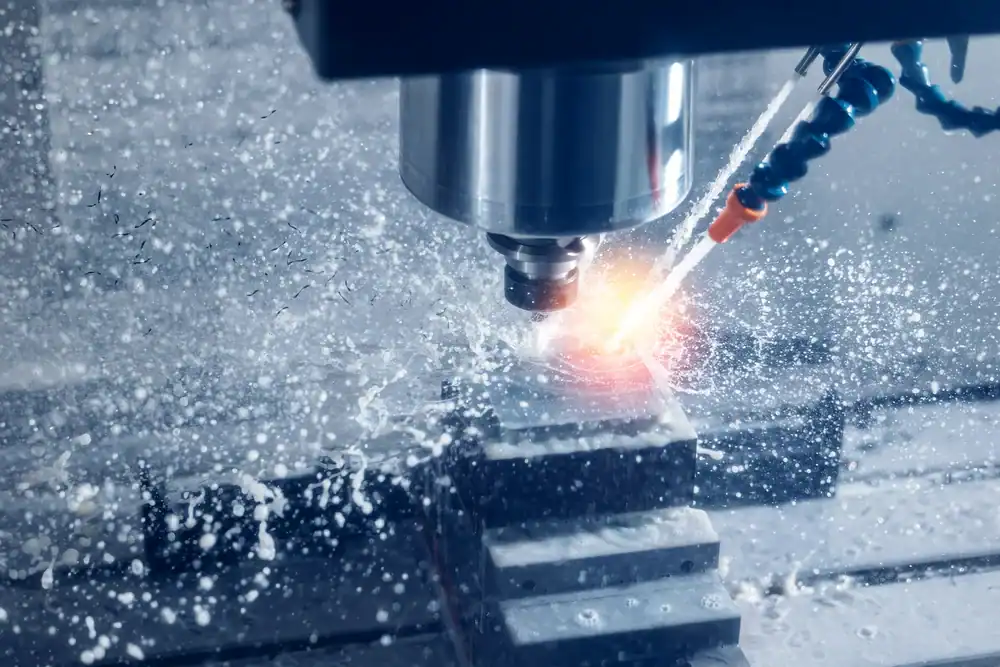
The process uses high-pressure water and fine abrasive to cut through glass without generating heat. That matters because heat creates stress, and stress creates cracks. You get clean edges, complex shapes, and zero thermal damage to the material. Your glass maintains its original strength from edge to edge.
Whether you’re working with standard glass or specialty materials, the cut quality stays consistent. Smooth edges that often don’t need additional finishing. Shapes that would be impossible or risky with traditional scoring methods. Thickness up to six inches handled without issue.
We operate out of Floral Park, NY with Flow Dynamic Waterjet systems built for precision work. These aren’t entry-level machines. They’re CNC-controlled platforms with dynamic taper compensation and vibration-dampened cutting tables designed specifically for materials like glass where micro-movement ruins the cut.
We’ve built our reputation on architectural, industrial, and custom residential projects across Long Island and the surrounding area. The kind of work where tolerance matters and second chances aren’t an option.
Floral Park’s mix of residential restoration, new construction, and commercial development means we see everything from custom shower enclosures to decorative glass panels for storefronts. Each project gets the same approach: understand what you need, cut it to spec, deliver it ready to install.
You start by sending us your design file or specifications. CAD files work best, but we can work with detailed drawings if that’s what you have. We’ll review it to confirm the design is optimized for waterjet cutting and flag any potential issues before we start.
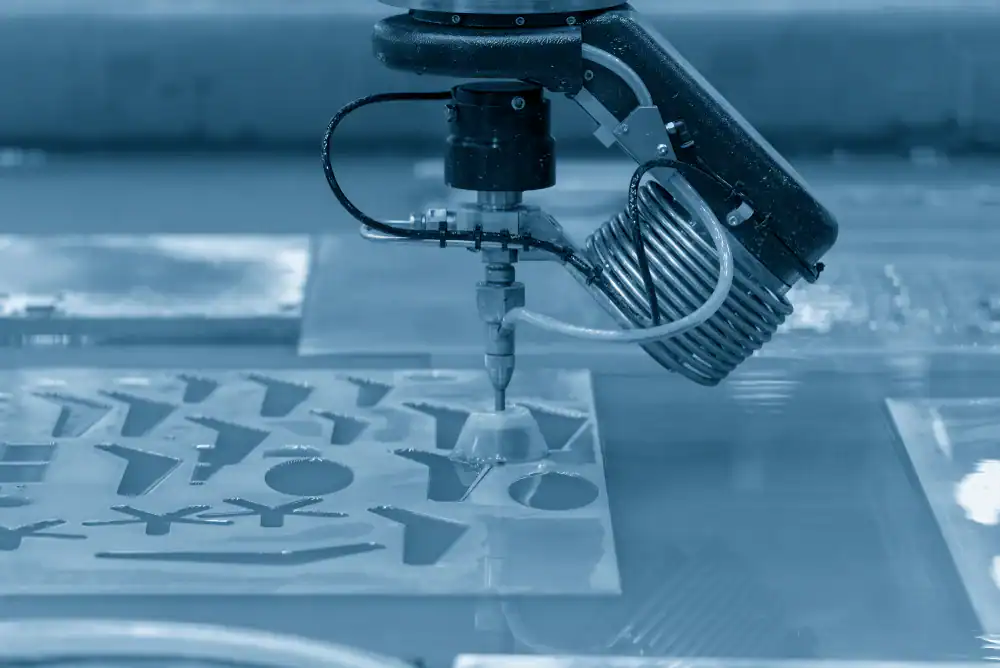
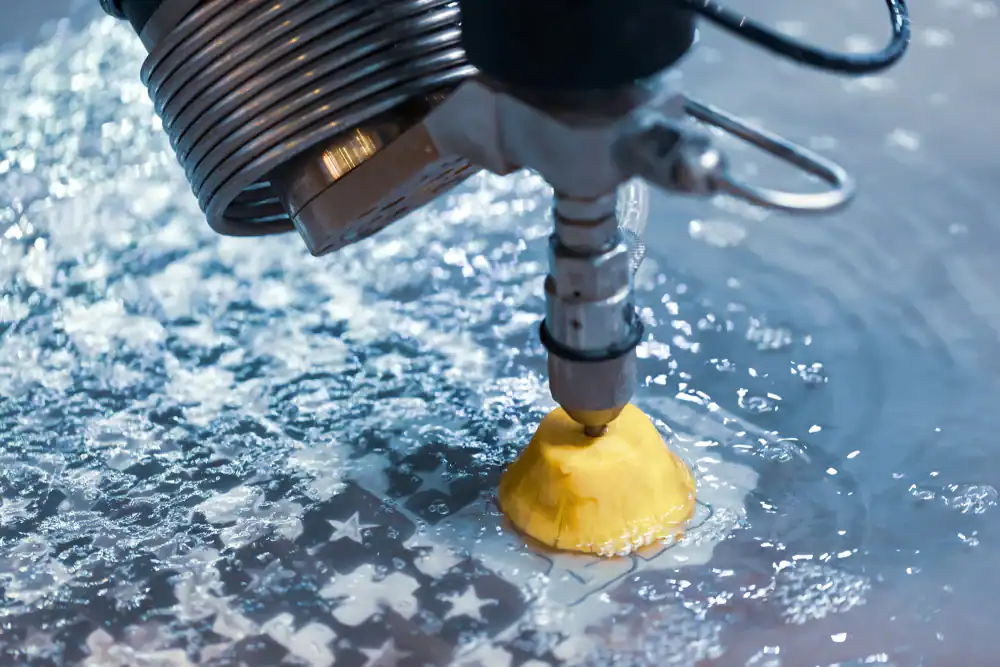
Once the file is dialed in, it goes into our CNC system. The cutting head positions itself with servo motor precision, then releases a stream of water mixed with fine garnet abrasive. That stream moves through your glass at controlled speeds—faster for straight cuts, slower when we need finer edges or tighter tolerances.
The machine follows your design exactly. Interior cuts, outside profiles, curves, angles—it handles all of it in one setup. No flipping the material, no multiple processes, no opportunities for alignment errors.
After cutting, we inspect the piece against your specs. You get glass that’s ready to use, with edges that are smooth and dimensions that match what you ordered. Most pieces need minimal or no additional edge work, which saves you time and keeps your project moving.
Ready to get started?
Every glass waterjet cutting project in Floral Park, NY gets cut on equipment that holds tolerances most traditional methods can’t touch. You’re looking at linear accuracy of ±0.003 to 0.005 inches across the entire cut path.
The process handles glass from 3mm up to 6 inches thick. Tempered glass, laminated glass, standard float glass—the waterjet doesn’t discriminate. It cuts through without creating heat-affected zones that compromise strength or introduce stress fractures.
For architectural glass waterjet cutting in Floral Park, NY, this means you can spec decorative panels with intricate patterns, custom facades with complex geometries, or interior features that need exact dimensions. Residential glass cutting services in Floral Park, NY cover everything from custom tabletops to shower enclosures with curved edges or cutouts for fixtures.
The abrasive stream width runs about 0.040 inches, so you’re not losing significant material to the kerf. That matters when you’re working with expensive glass or trying to maximize yield from a sheet. Less waste means better cost efficiency on your end.
Long Island’s design and construction market increasingly demands custom solutions. Standard sizes don’t cut it anymore—literally. Waterjet gives you the flexibility to say yes to complex projects without wondering if the fabrication side can actually deliver.
Tempered glass is tricky because it’s designed to shatter completely if you disturb the internal stress balance. Cutting tempered glass with any method—including waterjet—will cause it to break into small pieces. That’s just physics. If you need a specific shape, the glass has to be cut first, then tempered afterward.
Laminated glass is a different story. Waterjet handles it well because the process doesn’t create heat or vibration that would separate the layers. The abrasive stream cuts through both glass layers and the interlayer cleanly. You get a finished piece that maintains its laminated integrity.
If you’re not sure what type of glass you’re working with or what your project needs, bring that question up front. We can walk through options that’ll actually work for your application instead of discovering limitations after you’ve already ordered material.
Traditional glass cutting uses scoring and breaking, which works fine for straight lines and simple shapes. But when you need interior cutouts, tight curves, or intricate patterns, that’s where traditional methods hit their limits. Inside cuts create stress points, and separating scrap from the finished piece often causes fractures into the part you’re trying to keep.
Waterjet doesn’t rely on controlled breaking. The abrasive stream follows your design path exactly, cutting all the way through without creating stress in surrounding material. You can have multiple interior cutouts, sharp angles, radius corners under an inch—things that would be high-risk or impossible with score-and-break techniques.
The other advantage is consistency. Traditional cutting depends heavily on the skill of the person doing it. Waterjet is CNC-controlled, so the same file produces the same result every time. First piece matches the last piece, which matters when you’re doing multiples or need parts to be interchangeable.
The edge comes off the machine with a satin-smooth finish. It’s not polished-clear like you’d get from a dedicated edge polishing process, but it’s clean, uniform, and free of chips or micro-cracks. For many applications, especially architectural or industrial uses, that edge quality is perfectly acceptable as-is.
If you need a polished edge for aesthetic reasons—like on a glass tabletop or display case—that’s a secondary process we can discuss. But the waterjet edge gives you a solid starting point that’s already safer to handle and cleaner than what you’d get from scoring.
The cutting speed affects edge quality. Slower passes produce finer finishes. We adjust feed rates based on what you’re using the glass for and what kind of edge finish makes sense for your application. If you’re painting the edge or it’s going into a frame, we optimize for speed. If the edge is visible and needs to look good, we dial it back for a better finish.
Our equipment handles glass up to six inches thick, though most commercial and residential projects fall between a quarter inch and two inches. The process works across that entire range—it’s just a matter of adjusting cutting speed and abrasive flow to match the material thickness.
Thicker glass takes longer to cut because the abrasive stream needs more time to penetrate the full depth while maintaining edge quality. A quarter-inch piece cuts significantly faster than a two-inch piece with the same design. But the precision stays consistent regardless of thickness.
One thing to keep in mind: thicker glass is heavier and requires more careful handling during and after cutting. If you’re working with something in the four to six inch range, we’ll talk through logistics for transport and installation because that’s not something you’re moving around by hand.
CAD files work best—DXF and DWG formats translate directly into our CNC system with minimal conversion. If you’re working with a designer or architect, they can typically export in one of those formats. Vector files like AI or EPS can work too, though they sometimes need cleanup to remove elements that aren’t actual cut paths.
If you don’t have digital files, we can work from detailed drawings with dimensions. It takes a bit more time on our end to create the cut file, but it’s doable. The key is having accurate measurements and clear indication of what gets cut versus what’s just reference information.
Before we cut anything, you’ll see a proof of the toolpath. That’s your chance to catch any misinterpretation of the design or spot issues that might not have been obvious in the original drawing. Once you approve it, that’s exactly what gets cut. No surprises, no interpretation errors.
The waterjet process itself is what prevents most chipping and cracking issues. There’s no physical tool making contact with the glass, no vibration from a blade, and zero heat generation. The abrasive stream does all the work, and because it’s a cold process, you don’t get thermal stress that causes micro-cracks.
The cutting table plays a role too. Our Flow system uses a vibration-dampened surface that keeps the glass stable during cutting. Even small movements can cause problems with brittle materials, so that stability matters. The material sits supported across its entire surface, not just clamped at edges where stress can concentrate.
Feed rate control is the other piece. The CNC system adjusts how fast the cutting head moves based on the material and the complexity of the cut. Tight curves get slower speeds to maintain precision. Thicker sections get adjusted abrasive flow. It’s all programmed to optimize cut quality while minimizing any risk of edge damage or stress fractures in the finished piece.
Useful Links
Other Services we provide in Floral Park