Hear from Our Customers
You’re not just buying a cutting service. You’re avoiding the nightmare of panels that don’t fit, edges that chip during installation, and glass that cracks three months later because someone used a blade that generated too much heat.
When glass is cut with high-pressure water instead of traditional methods, there’s no thermal stress. That means no invisible fractures waiting to become visible problems. The edge comes out smooth enough that you’re not dealing with extra finishing work or safety hazards from rough cuts.
Complex shapes that would normally require multiple pieces or risky hand-cutting? Done in one pass with CNC precision. Intricate cutouts for hardware, curves for architectural features, or tight tolerances for industrial applications all happen without the guesswork. You get exactly what you specified, down to a tenth of a millimeter.
We’ve been serving the Glen Cove area and broader Long Island market for over twenty years. We’re ISO 9001:2015 certified, which means our quality standards aren’t just talk—they’re documented, measured, and consistent.
Our facility runs 2-axis and 3-axis CNC waterjet systems designed specifically for materials like glass that don’t respond well to heat or vibration. We’ve worked with everyone from local contractors renovating Gold Coast properties to manufacturers supplying components for medical and electronics applications.
Glen Cove’s mix of historic architecture and modern commercial development means we see everything from custom residential glass features to precision industrial components. We understand what’s needed here because we’ve been doing it here.
You send us your specifications—CAD files work best, but we can work from drawings or templates. Our team reviews the design to confirm it’s optimized for waterjet cutting and flags anything that might cause issues during installation or use.
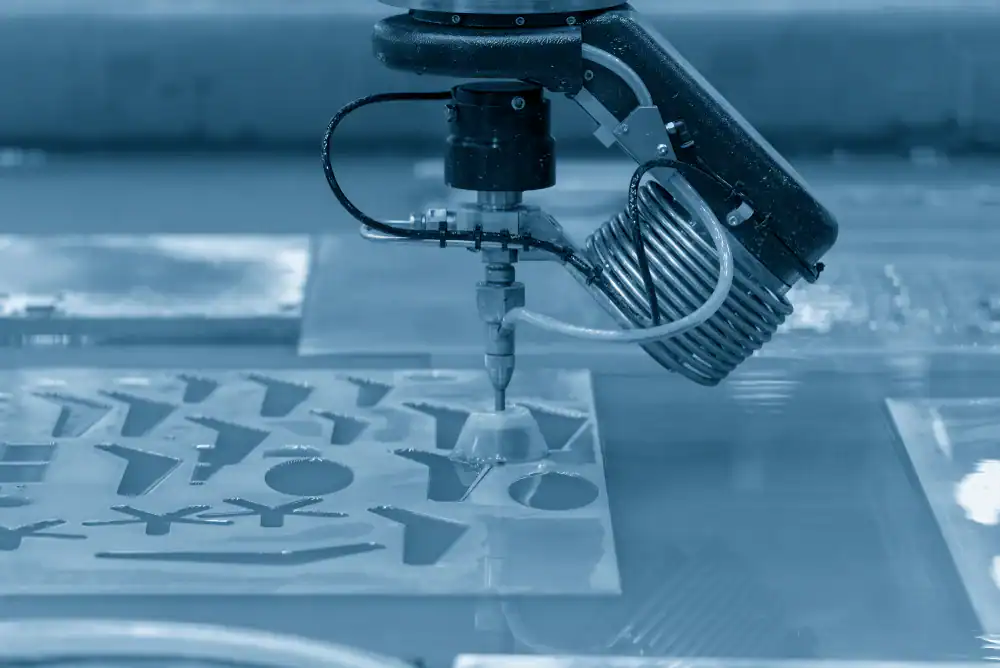
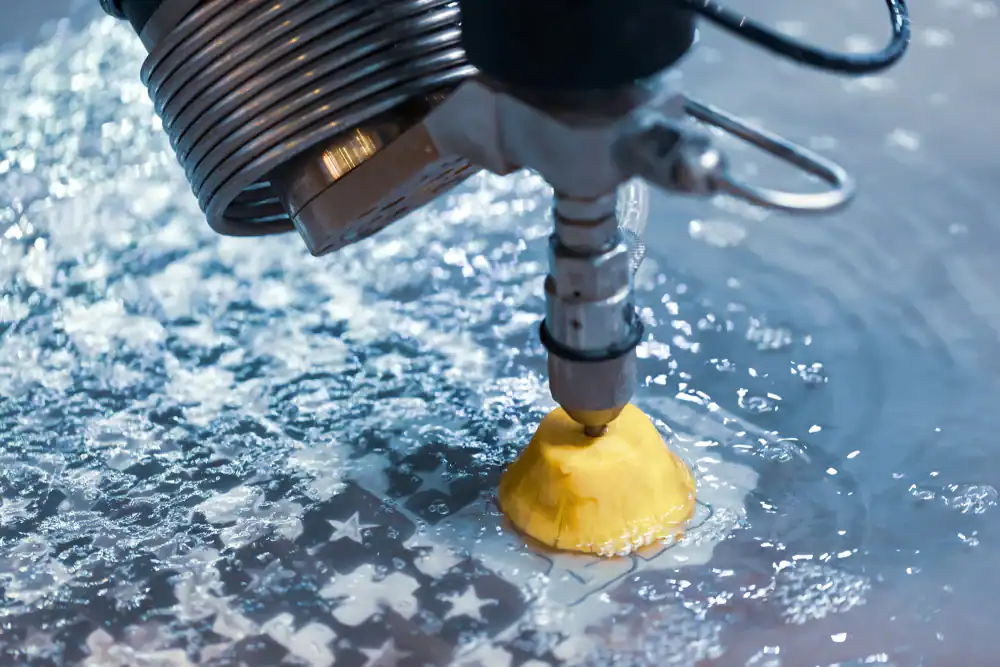
Once the design is locked in, we program the CNC system with your exact measurements. The glass gets secured on the cutting bed, and a high-pressure stream of water (with or without abrasive, depending on thickness and material) makes the cut. The stream is thinner than most saw blades, which means less material waste and tighter nesting of multiple pieces.
After cutting, we inspect dimensions and edge quality. If you need additional services like edge polishing or drilling, we handle that before delivery. Most projects turn around faster than traditional cutting methods because there’s no tool changing, no heat cooldown periods, and no secondary operations to remove burrs or stress points.
Ready to get started?
You get CNC-controlled cutting accurate to ±0.1mm, which matters when you’re fitting glass into existing frames or matching architectural specs. We cut standard glass types like tempered and laminated, plus specialty materials including optical glass, quartz, borosilicate, and fused silica. Thickness capacity runs up to 150mm, though most commercial and residential work falls between 3mm and 50mm.
Glen Cove’s architectural landscape—from waterfront properties to downtown commercial spaces—often requires custom glass work that standard fabricators can’t handle. Curved edges for Art Deco renovations. Precise cutouts for modern storefront installations. Complex shapes for custom furniture or fixtures. We handle all of it without the limitations of scoring-and-snapping or the heat damage risk of laser cutting.
We also work with local contractors and designers who need fast turnaround on projects where timing matters. Our production capacity scales from single custom pieces to runs of hundreds, depending on size and complexity. And because we’re local to the Glen Cove area, logistics are simpler and faster than working with out-of-state fabricators.
We cut virtually any glass type without the material restrictions you’d face with thermal cutting methods. That includes standard annealed glass, tempered glass, laminated safety glass, and low-iron ultra-clear glass common in architectural applications.
We also handle specialty materials that many shops won’t touch. Optical glass for precision instruments. Quartz for lab equipment and high-temperature applications. Borosilicate (like Pyrex) for scientific and industrial uses. Fused silica for electronics and semiconductor work. The process doesn’t care about hardness or thermal sensitivity because there’s no heat involved.
The main limitation is thickness. We can cut up to 150mm, but most projects fall well below that. If you’re working with glass that’s been chemically strengthened or has coatings, let us know upfront—some treatments affect how the material responds to cutting, and we’ll adjust the process accordingly.
Traditional cutting methods—whether it’s scoring and snapping, sawing, or laser—all create stress in the glass. Scoring creates a deliberate weak point. Sawing generates vibration. Lasers create extreme localized heat. All of these introduce micro-fractures that you can’t see but that compromise the glass’s structural integrity.
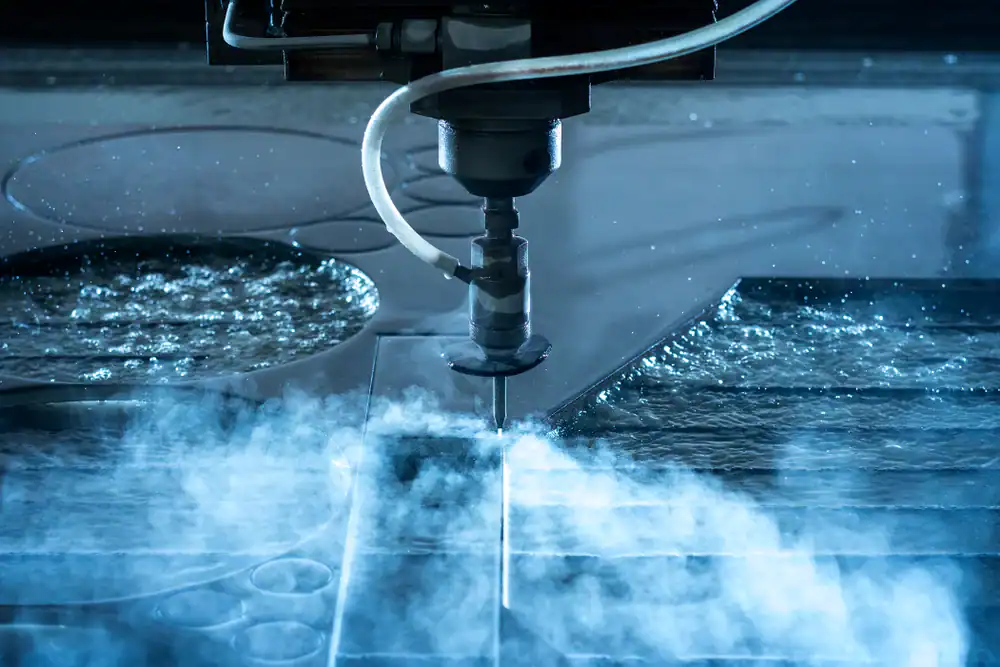
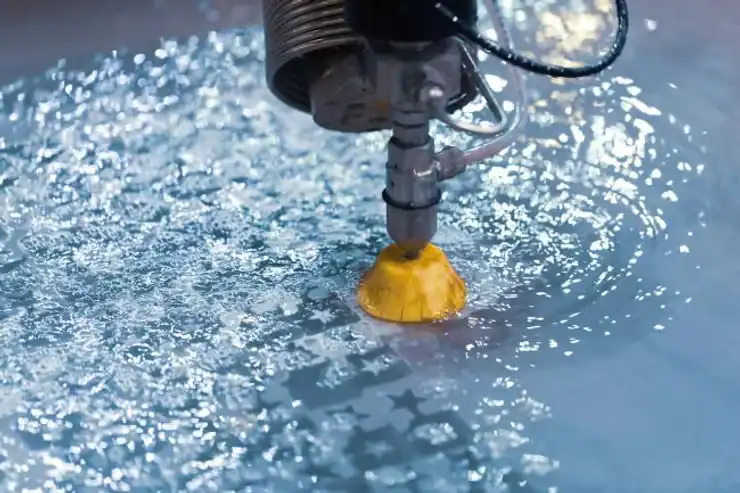
We use high-pressure water (sometimes with fine abrasive particles) to erode the material. There’s no mechanical force trying to break the glass, no vibration rattling through the sheet, and no thermal expansion and contraction. The water stream is doing the work through erosion, not stress.
This matters most in applications where glass is under load, exposed to temperature changes, or needs to last without failure. Architectural installations in Glen Cove’s variable climate. Automotive or marine applications. Anywhere that a hidden crack could turn into a catastrophic break. The cutting method directly affects how long your glass lasts and how safely it performs.
Yes, and that’s one of the biggest advantages over traditional methods. Our CNC waterjet systems follow programmed paths with precision that hand-cutting can’t match. Tight radius curves, intricate interior cutouts, asymmetrical shapes—all possible in a single setup without repositioning the glass or changing tools.
The cutting stream is extremely narrow, typically less than a millimeter. That means we can nest complex shapes close together to minimize waste, and we can create details that would be impossible with a scoring wheel or difficult with a saw. Think custom shower enclosures with curved edges, decorative architectural panels with detailed patterns, or industrial components with precise mounting holes and cutouts.
There are practical limits—extremely tight inside corners (sharper than the stream diameter) will have a small radius, and very thin sections might be fragile—but compared to other methods, waterjet opens up design possibilities that would otherwise require multiple pieces, hand-finishing, or compromises on the original vision.
Turnaround depends on project complexity, material availability, and our current queue, but waterjet is generally faster than traditional cutting methods. Simple cuts on standard glass can often be completed within a few days. More complex projects with intricate designs or specialty materials might take a week or two.
The speed advantage comes from the process itself. There’s no tooling to fabricate, no templates to create for complex shapes, and no secondary operations to remove heat-affected zones or rough edges. The CNC system cuts your design directly from the file, and the edge quality is usually good enough to use as-is or with minimal finishing.
For Glen Cove contractors and designers working on tight schedules, we can often accommodate rush projects if you need something faster. The key is getting us accurate specifications upfront—the more dialed-in your design is, the faster we can move from file to finished piece. CAD files are ideal, but we can work with detailed drawings or physical templates if that’s what you have.
Waterjet cutting typically costs more per linear foot than simple straight cuts with a scoring tool, but that’s not the whole picture. You’re comparing the cutting cost in isolation without factoring in waste, breakage, edge finishing, and the cost of pieces that don’t fit right the first time.
Waterjet minimizes material waste because the cutting stream is narrow and complex shapes can be nested efficiently. There’s no breakage from thermal stress or vibration. Edge quality is better, which means less labor for grinding, polishing, or safety-beveling. And the accuracy means fewer installation problems that eat up time and money on the job site.
For custom or complex work—anything beyond basic rectangles—waterjet often ends up more cost-effective when you account for the total project cost, not just the cutting invoice. You’re also getting capabilities that traditional methods simply can’t deliver. If your project needs curves, cutouts, or precision fits, waterjet isn’t more expensive than traditional cutting. It’s the only realistic option.
We handle both. Our ISO 9001:2015-certified facility is set up to produce anywhere from a single custom piece to production runs of hundreds or thousands, depending on the size and complexity of the parts.
For one-off custom work—a unique architectural feature, a replacement panel for a historic renovation, a prototype for product development—we can program and cut individual pieces economically. The CNC process doesn’t require expensive tooling or setup that only makes sense at high volume.
For larger runs, the same precision that makes custom work possible also ensures consistency across hundreds of identical pieces. Every part matches the CAD file, and every part matches every other part. That repeatability matters for projects like storefront installations, production components, or any application where parts need to be interchangeable. Whether you need one piece or a thousand, the process and quality standards stay the same.
Useful Links
Other Services we provide in Glen Cove